Origin and value
Amethyst Origin Guide: How Source Impacts Price (Uruguay, Brazil, Zambia)
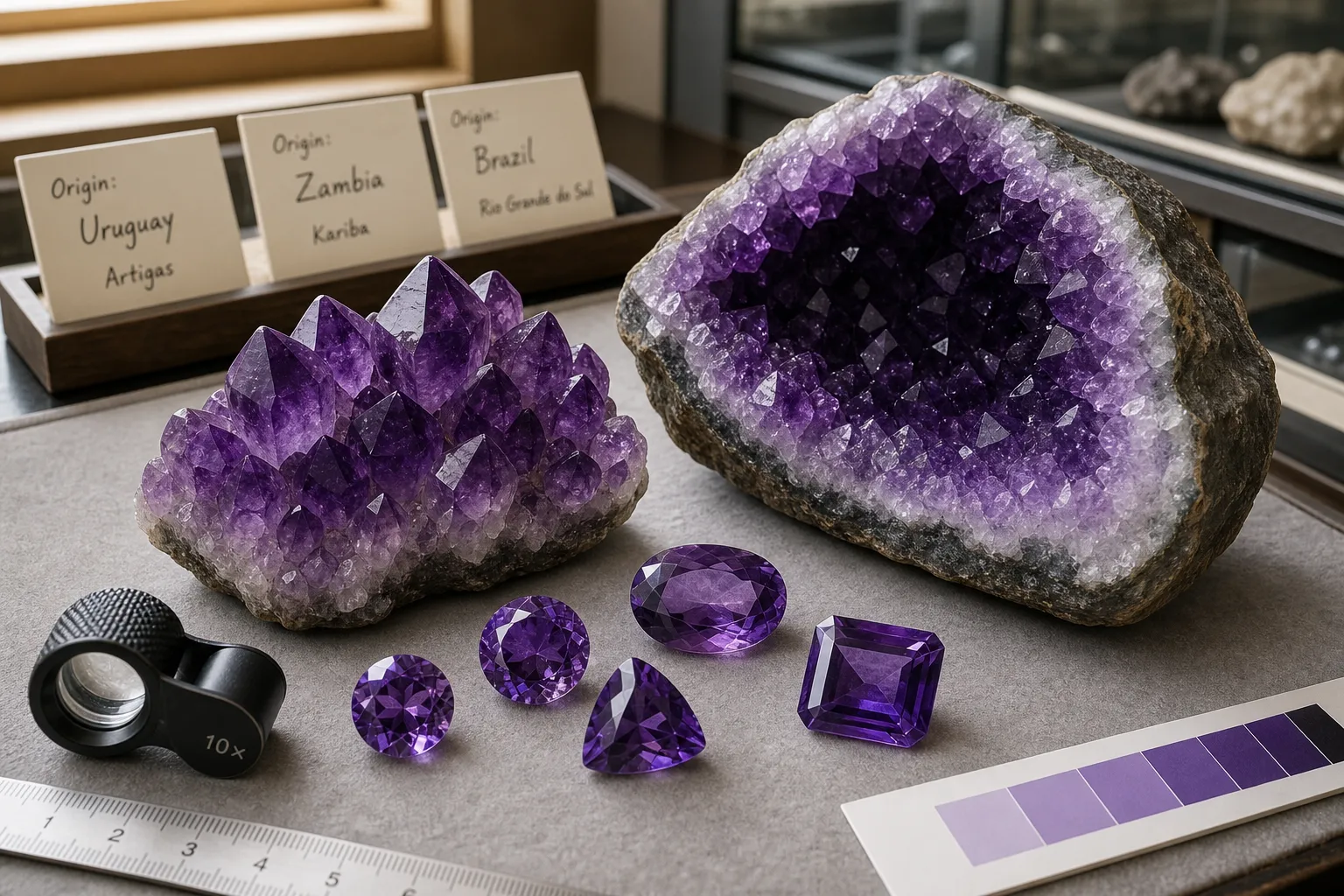
A seller’s origin label can sound decisive: Uruguayan, Brazilian, Zambian, Artigas, Kariba, sometimes even a named mine. The real question behind Amethyst Origin Value is simpler: does that label explain something you can see, verify, and compare?
Origin can matter. Certain sources are associated with recognizable color tendencies, geode forms, supply patterns, and market reputation. But origin does not override quality. A pale, chipped, poorly cut amethyst with a desirable country label may be less appealing than a vivid, clean, well-presented stone from a more common source.
The useful move is not to ignore origin. It is to make the origin claim earn its premium through visible quality, specimen form, documentation, and seller transparency.
broader context
Broader amethyst guide
This narrower page lands better after the broader amethyst context page.
Origin affects value indirectly, not automatically
Amethyst is the purple variety of quartz. In buyer-facing valuation, the strongest public gemological framework still begins with quality factors: color, clarity, cut, and size for gems; and color, form, condition, crystal quality, aesthetics, and practicality for specimens and geodes.
Origin sits around those traits. It does not replace them.
This is where listings become confusing. “Uruguay amethyst value” is often used as shorthand for deep color. “Brazilian geode value” may be framed around size and decorative impact. “Zambian amethyst quality” is often linked to saturated purple gem material. Those associations can help you know what to inspect, but they are not a substitute for inspection.
A quality-first buying judgment asks:
- Is the purple attractive, evenly distributed, and appropriately saturated?
- Is the tone lively, or so dark that the crystal face reads nearly black in normal light?
- Is the zoning pleasing, distracting, or hidden by the cut or setting?
- Is the material clean enough for its intended use?
- Are crystal points intact on a geode or cluster?
- Is the cut and polish competent on a faceted stone?
- Does the seller explain the origin claim clearly, or only use a vague country label?
- Is the price based on quality, or mostly on a dramatic locality story?
That sequence matters more than any country ranking.
Uruguay and Artigas: why the premium language exists, and where it overreaches
Uruguayan amethyst, especially material associated with the Artigas region and the Los Catalanes gemological district, has a strong market identity. Geological research supports northern Uruguay and nearby southern Brazilian districts as important amethyst-agate geode regions in basaltic lava settings. The Los Catalanes district is also scientifically notable for significant amethyst-agate geodes and a long mining history.
For buyers, that background usually turns into simpler retail language: darker purple, saturated color, compact geodes, and strong visual presence. A seller may describe Uruguayan Artigas amethyst as richer or more collectible than Brazilian material. Sometimes that is a fair market association. It becomes weak when it turns into an automatic rule.
The first issue is tone. Deep color is desirable only when it still has life. A very dark amethyst can look impressive under bright display lighting but heavy in an ordinary room. If the face reads black-purple except at the edges, the origin label should not override your eyes.
The second issue is zoning. Amethyst often shows color zoning, with purple concentrated in bands, tips, or growth areas. Zoning is not automatically a defect. In a crystal or geode, it can add depth and structure. In a faceted stone, uneven zoning may reduce appeal if it creates a patchy face-up look.
The third issue is condition. A compact Uruguayan geode with saturated crystals can still lose appeal if the points are chipped, the rim is poorly cut, the back is unstable, or the display face is awkward. For specimens, the whole object matters: crystal coverage, edge finishing, balance, durability, and whether the piece can be displayed without constant handling.
A sensible view of Uruguay amethyst value is:
- Give the origin label attention when it is paired with strong color and credible documentation.
- Do not pay extra for the label alone.
- Compare the piece under ordinary lighting, not only seller lighting.
- Be cautious with fixed percentage premium claims that are not tied to transparent pricing data.
- Ask whether “Artigas” is documented, inferred, or simply used as a retail phrase.
Uruguay can deserve a premium in a particular piece. It does not deserve a blank check.
Brazil: broad supply, broad quality, and a different way to judge geodes
Brazil is often treated as the “common” side of the Uruguay vs Brazil amethyst comparison. That is too simple. Brazil is a major source of amethyst, and the Ametista do Sul area in southern Brazil is widely discussed in geological literature for significant geode production in basaltic settings.
That geological importance does not translate neatly into one retail price rule. Brazilian material can range from pale lavender to deep violet, from small clusters to large geodes, from decorative pieces to attractive gem rough. Because the supply and forms are broad, Brazilian geode value should not be judged exactly like a faceted gemstone.
For a faceted amethyst, the buyer usually focuses on color, clarity, cut, and size. For a Brazilian geode, the value question expands.
“Brazilian amethyst is cheaper” is not a complete buying rule. Some Brazilian pieces are modest decorative material. Others are large, visually strong geodes with excellent interiors. A buyer comparing Uruguay vs Brazil amethyst should not ask only which country is better. The better question is: which individual object has stronger color, better condition, more pleasing form, and clearer documentation for the asking price?
Brazil also shows the difference between supply and quality. A source can produce a lot of material and still produce excellent pieces. Broad availability may affect market expectations, but it does not make every Brazilian amethyst low quality. It simply means buyers have to sort across a wider range.
Zambia: saturated color language, Kariba context, and the Mwakambiko caution
Zambian amethyst is often discussed in relation to saturated purple stones. Some buyer-facing descriptions associate Zambia, including Kariba-related material, with rich color. That reputation can be useful, but the available support is not strong enough to turn every Zambian label into a mine-level value claim.
This matters because search and retail language can become very specific: “Zambian Mwakambiko mine,” “Kariba amethyst,” “Zambian amethyst or synthetic,” or “blue flash” descriptions. Without strong documentation, those phrases should be treated as claims to check, not conclusions to accept.
A buyer considering Zambian amethyst should separate three questions.
1. Is it amethyst?
The material should be represented clearly as amethyst, the purple variety of quartz, rather than glass, dyed material, synthetic material represented unclearly, or another purple stone.
2. Is the quality strong?
Look at saturation, tone, zoning, clarity, cut, polish, and face-up appearance. Strong Zambian amethyst quality is still quality you can inspect.
3. Is the specific origin documented?
A country label is one thing. A named mine claim is another. If a seller says Mwakambiko, Kariba, or another specific locality, ask what supports that claim.
For faceted Zambian stones, color can be especially persuasive. But high saturation is not origin proof. Similar-looking purple material can come from different sources, and color alone cannot authenticate a locality. If the origin premium is meaningful, the seller should be able to explain the chain of information: parcel source, supplier documentation, a lab report where relevant, or at least a transparent statement of how the origin was assigned.
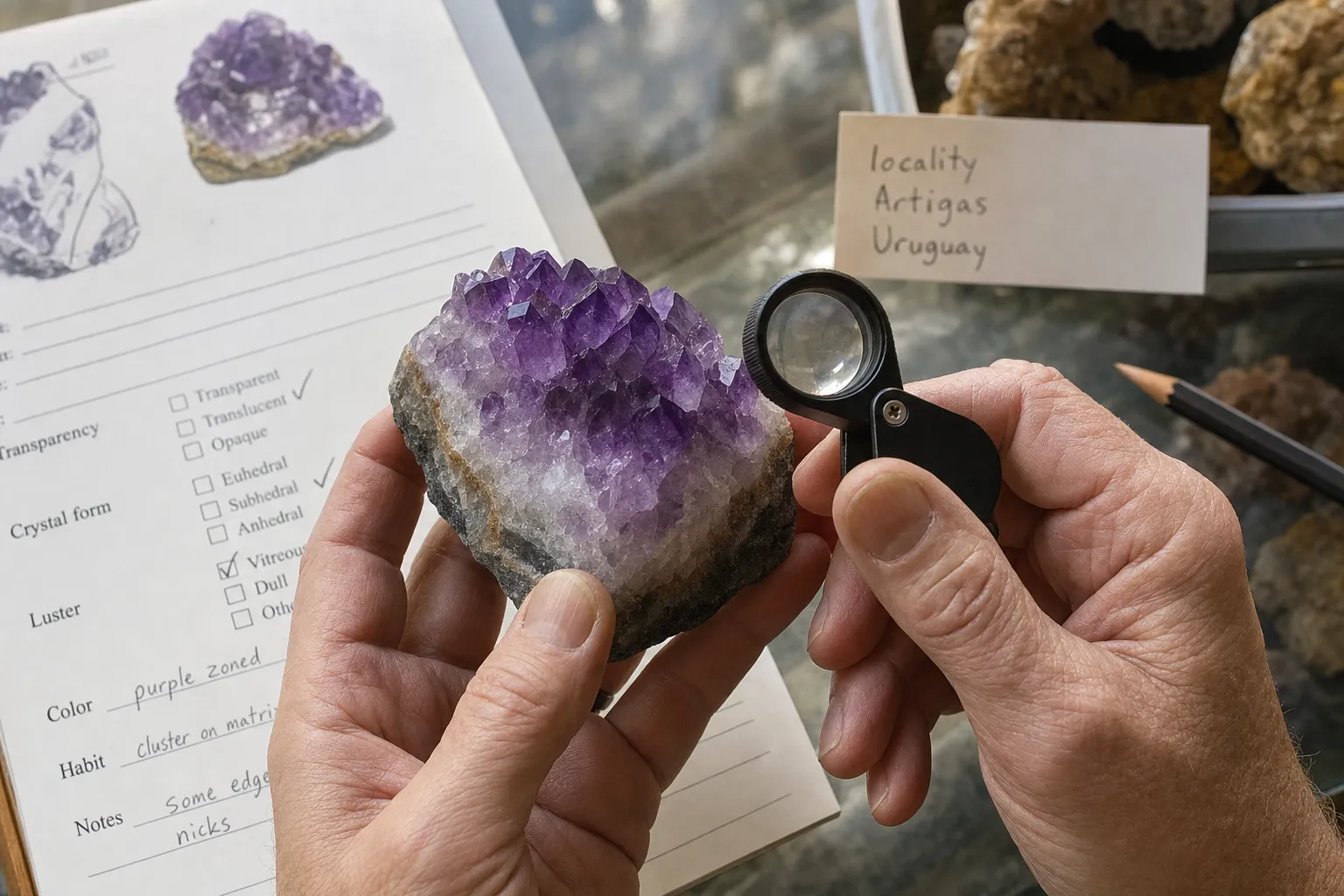
A loupe can help with basic buying inspection—chips, surface-reaching fractures, abrasions, polish quality, and inclusions—but it is not a magic origin tool. Instruments such as dichroscopes or spectroscopes may be part of gemological work, but a casual buyer should not be told that a quick tool check proves treatment status or locality. When treatment disclosure, synthetic origin, or mine-level attribution changes the price significantly, the evidence standard should rise.
How to inspect an origin premium before paying it
The cleanest way to handle an origin premium is to turn the label into a checklist before it shapes your budget.
Start with color, but judge saturation and tone together
Deep purple often commands attention, but saturation without light return can look flat. View the stone or geode in neutral light if possible. For a faceted stone, look face-up and from the side. For a geode, step back as well as inspect closely; some pieces are impressive close-up but visually heavy from across a room.
Ask:
- Is the color rich without becoming lifeless?
- Does the purple stay attractive outside bright display lighting?
- Are red or blue flashes visible naturally, or only under selective lighting?
- Is the color evenly pleasing, or does it collapse into dark patches and pale gaps?
Terms such as “Siberian grade” are often used in trade language for very fine deep purple with red or blue flashes, regardless of actual Siberian origin. Treat the phrase as a color-quality descriptor, not a locality guarantee.
Read zoning as appearance evidence, not a flaw label
Amethyst color zoning is common. In crystals and geodes, zoning may add interest. In faceted gems, it can be minimized by skillful cutting or made more obvious by poor orientation.
Ask:
- Does zoning improve the visual character?
- Is color concentrated only at the tips?
- Does the cut hide or exaggerate uneven color?
- Is the seller using zoning language to explain natural growth, or to excuse weak color?
Related quartz materials, such as ametrine, show how color zoning can become part of identity and value, but ametrine is a separate topic. For ordinary amethyst, zoning should be judged by how it affects the individual piece.
Match the evaluation to the form
A faceted amethyst, a crystal cluster, and a large geode should not be priced by the same mental formula.
For faceted stones, prioritize:
- Color
- Clarity
- Cut proportions
- Polish
- Size in relation to quality
- Treatment disclosure when relevant
For clusters and geodes, prioritize:
- Crystal coverage
- Point condition
- Color distribution
- Overall shape
- Rim and base preparation
- Stability
- Display impact
- Shipping and handling practicality
This is especially important with Brazil vs Zambia amethyst comparisons. A Zambian faceted stone and a Brazilian geode are not competing on the same value scale. One is mainly a gem-quality question; the other is a specimen and display-object question.
Ask for origin documentation in proportion to the premium
Not every modest amethyst needs a formal report. But the more the price depends on origin, the more documentation matters.
Useful seller transparency may include:
- A clear country and locality statement
- Whether the origin is documented, supplier-stated, or seller-inferred
- Any available parcel or mine-source paperwork
- Treatment disclosure
- Return policy and condition photos
- Unedited daylight images or video
- Measurements, weight, and notes on repairs or stabilization
Mindat and similar locality databases can help you check whether a locality exists and how it is described mineralogically, but they do not prove that a retail stone came from that locality. A locality database is a sanity check, not a certificate.
Discount vague hype
Be cautious when a listing leans harder on phrases than evidence: fixed premium percentages, guaranteed return language, dramatic mine claims without support, or origin language mixed with unrelated promises.
The seller is not automatically wrong. The claim simply has not done enough work yet. A trustworthy listing should make the object easier to understand, not harder to question.
Locality claims that deserve extra caution
Some locality phrases are genuinely useful. Others become marketing shorthand. Buyers do not need to become geologists, but they should know which claims are easy to overread.
“Uruguayan Artigas amethyst”
This phrase can be meaningful because Artigas and northern Uruguay are established in amethyst-geode geology and market language. Still, ask whether the claim is specific and documented. “Uruguayan style” is not the same as “from Artigas.”
“Brazilian geode”
This is a broad label. It may describe an inexpensive decorative geode, a large statement piece, or a finely crystallized specimen. The label should lead you to inspect size, color, condition, and display structure—not assume low or high value.
“Zambian Mwakambiko mine”
The current research base does not provide strong support for mine-level value claims about Mwakambiko. If the seller prices the piece around that mine name, ask for documentation. Do not conflate Mwakambiko with Kariba unless the seller provides a credible reason.
“Moroccan hourglass amethyst”
Moroccan hourglass amethyst is a separate specimen conversation and should not be used to rank Uruguay, Brazil, or Zambia. Hourglass zoning can be visually interesting, but it is not a shortcut for pricing ordinary origin-labeled amethyst.
“Siberian grade”
This is best treated as a color-quality phrase in modern trade language, not proof of Siberian origin. The stone still needs to show excellent color, clarity, and cutting or crystal condition.
Care and appearance preservation still matter to value
A short care note belongs in an origin-value guide because color and surface condition are part of perceived value. GIA care guidance treats amethyst as durable enough for many jewelry uses, but sensible handling still matters. Prolonged harsh light, heat exposure, knocks, abrasion, and poor storage can affect appearance or condition over time.
For specimens and geodes, the practical risks are often physical: chipped crystal points, dust buildup, unstable bases, and edge damage during moving. For jewelry, abrasion, impacts, and cleaning habits matter. Preserving a strong-looking amethyst is not about increasing its origin status. It is about protecting the visible traits that made it worth buying.
A practical decision frame for Uruguay, Brazil, and Zambia
Use origin as a hypothesis, not a verdict.
- Uruguay / Artigas may lead you to expect saturated, dark, compact geode or crystal appeal. Confirm that the color is lively, the condition is strong, and the locality claim is not merely decorative language.
- Brazil may lead you to expect broad variety and major geode production. Evaluate the actual form: size, crystal coverage, color distribution, intactness, rim quality, and display practicality.
- Zambia may lead you to expect saturated gem material. Keep Kariba and any named mine claims separate unless documented, and judge the individual stone through color, clarity, cut, and disclosure.
The best purchase is rarely the one with the loudest origin claim. It is the piece where the label, the visible quality, the form, and the seller’s explanation all point in the same direction.
Origin can add context, confidence, and market appeal. It can help explain why two purple quartz pieces are priced differently. But amethyst origin value is strongest when it supports what the stone already shows: beautiful color, sound condition, appropriate form, credible documentation, and a price that still makes sense after the locality story is stripped away.