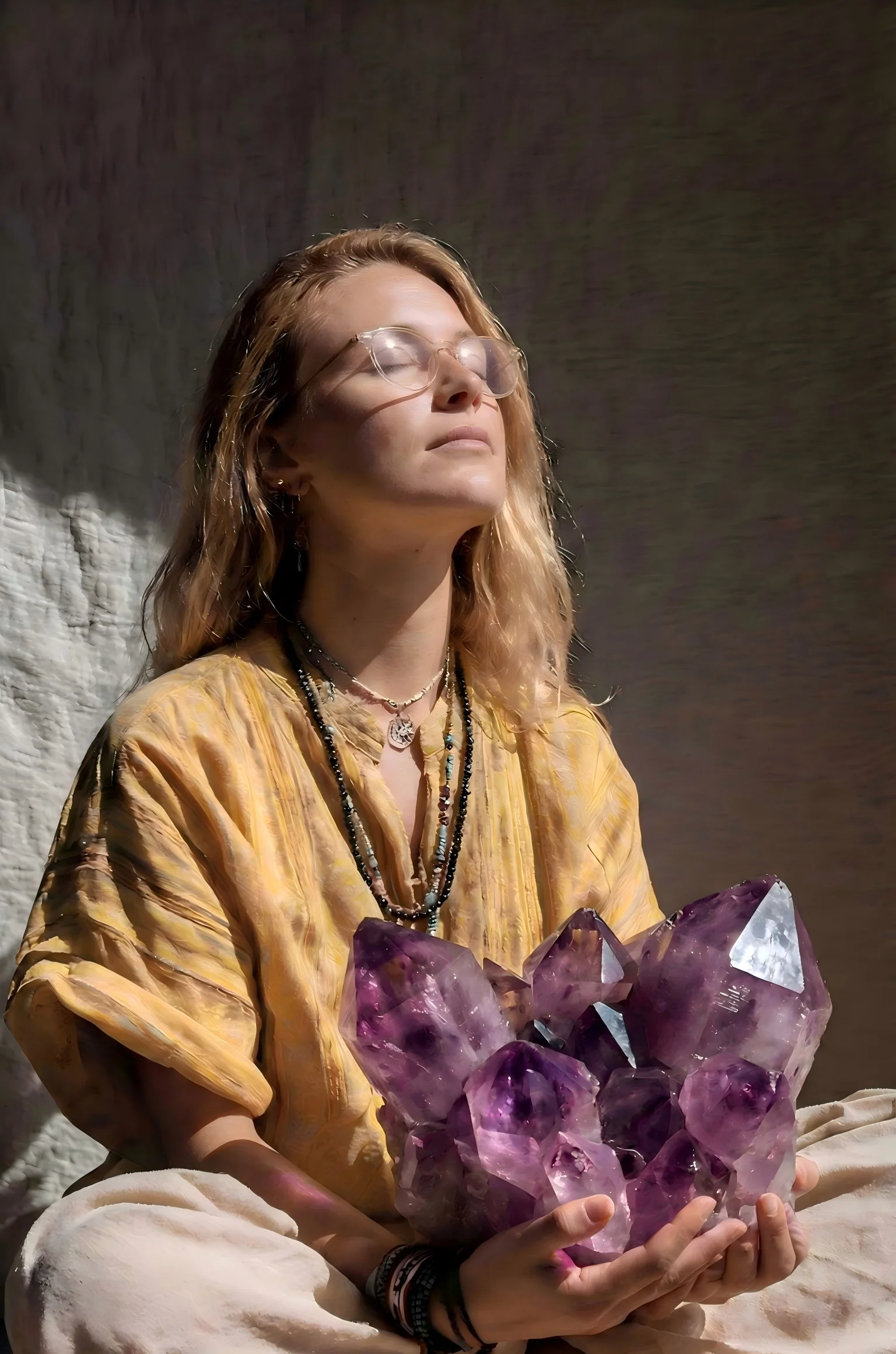
The Chemical Miracle: At its
core, Amethyst is Silicon Dioxide (SiO₂), identical to clear quartz.
The secret to its color lies in the disruption of its crystal lattice.
While pure quartz is transparent, Amethyst contains trace amounts of Iron (Fe³⁺).
However, the presence of iron alone produces a yellow or orange hue (seen in Citrine or Iron Quartz).
The transformation into purple requires a geological drama: Gamma Irradiation.
Over millions of years, radiation from host rocks (often containing radioactive isotopes like Potassium-40 or Thorium) bombards the quartz.
This radiation ejects an electron from the iron lattice, converting Fe³⁺ into Fe⁴⁺.
This specific oxidation state absorbs light in the yellow-green spectrum, reflecting back to our eyes the cool violet wavelengths we know as Amethyst.
Geodes vs. Veins
Most commercial Amethyst, particularly from Brazil and Uruguay, forms in Geodes.
These begin as gas bubbles trapped in cooling basaltic lava flows.
As the lava hardens into stone, these bubbles remain as hollow voids.
Over eons, silica-rich hydrothermal fluids (hot water) seep through the porous rock, filling these cavities.
As the water cools and evaporates, quartz crystals nucleate on the walls of the cavity, growing inward toward the center.
This inward growth means the tips (terminations) of the crystals are often the darkest purple, where the iron concentration and growth time were maximized, while the base near the rock wall remains clear or white quartz.
This zoning is a key identifier of natural amethyst.
"The deepest purples are often found in Uruguay, where the hydrothermal fluids contained higher iron concentrations, whereas Brazilian geodes are often larger but paler."
— Mineralogical Society of America Reports