Amethyst in Spatial Design: Period 9 Abundance Sectors & Home Atmosphere
Read the 2026 Context & Introduction▾
You step into a residential space in the year 2026. The air outside often feels thick with the fast-paced, digital exhaustion characteristic of this new era. I have walked into hundreds of client homes over the past decade, and the baseline frequency is invariably similar: visually cluttered, technologically overwhelming, and lacking distinct boundaries. However, as you cross a well-designed threshold, a deliberate stillness should wash over you. The subtle, deep violet resonance of a strategically placed geode creates an immediate psychological anchor. This is not about magic; this is the practical application of visual weight and environmental psychology. As we navigate the current landscape, finding appropriate spatial adjustments means designing rooms that foster mental resilience. Creating a focused Abundance Sector to maintain a clear career trajectory, introducing the heavy Earth Element to visually soften harsh architectural lines, mitigating the tension of shared spaces, and managing the overall flow of movement all begin with intentional, physical anchors.
✦ 10-Second Space Audit
What atmospheric challenge dominates your home?
✔
Observation: High Visual Tension
Your space requires the heavy, grounding presence of the Earth Element. When a room feels too "hot" or frantic, adding a substantial, dark Amethyst Geode in the central living area provides a visual sink. It pulls the eye downward, offering a psychological pause from the surrounding chaos. Stop relying on flimsy decor; you need physical mass.
Observation: Boundary Erosion
Focus on establishing a visual Digital Detox zone. Place a raw Amethyst Cluster near your primary workstation. The jagged, complex structure of a cluster creates a hard psychological boundary between "work mode" and "rest mode," helping to mitigate the exhaustion of constant screen glare.
Observation: Lack of Intentional Anchors
Re-evaluate your Abundance Sector. A space that lacks inspiration often lacks a focal point. Position a deep purple Amethyst in the Southeast sector (Xun). This does not generate sudden wealth; rather, it serves as a daily, unavoidable visual reminder to maintain a disciplined mindset toward your career objectives.
Mastering Spatial Adjustments for Modern Environments
We officially entered a new 20-year cycle in 2024, characterized in traditional systems by the Li Trigram—a symbol of rapid consumption, illumination, and technological hyper-connectivity. By 2026, the psychological impact of this constant visual and auditory stimulation requires a deliberate, heavy spatial response. Lightweight, minimalist decor often fails to anchor a room when the external environment is overwhelmingly fast.
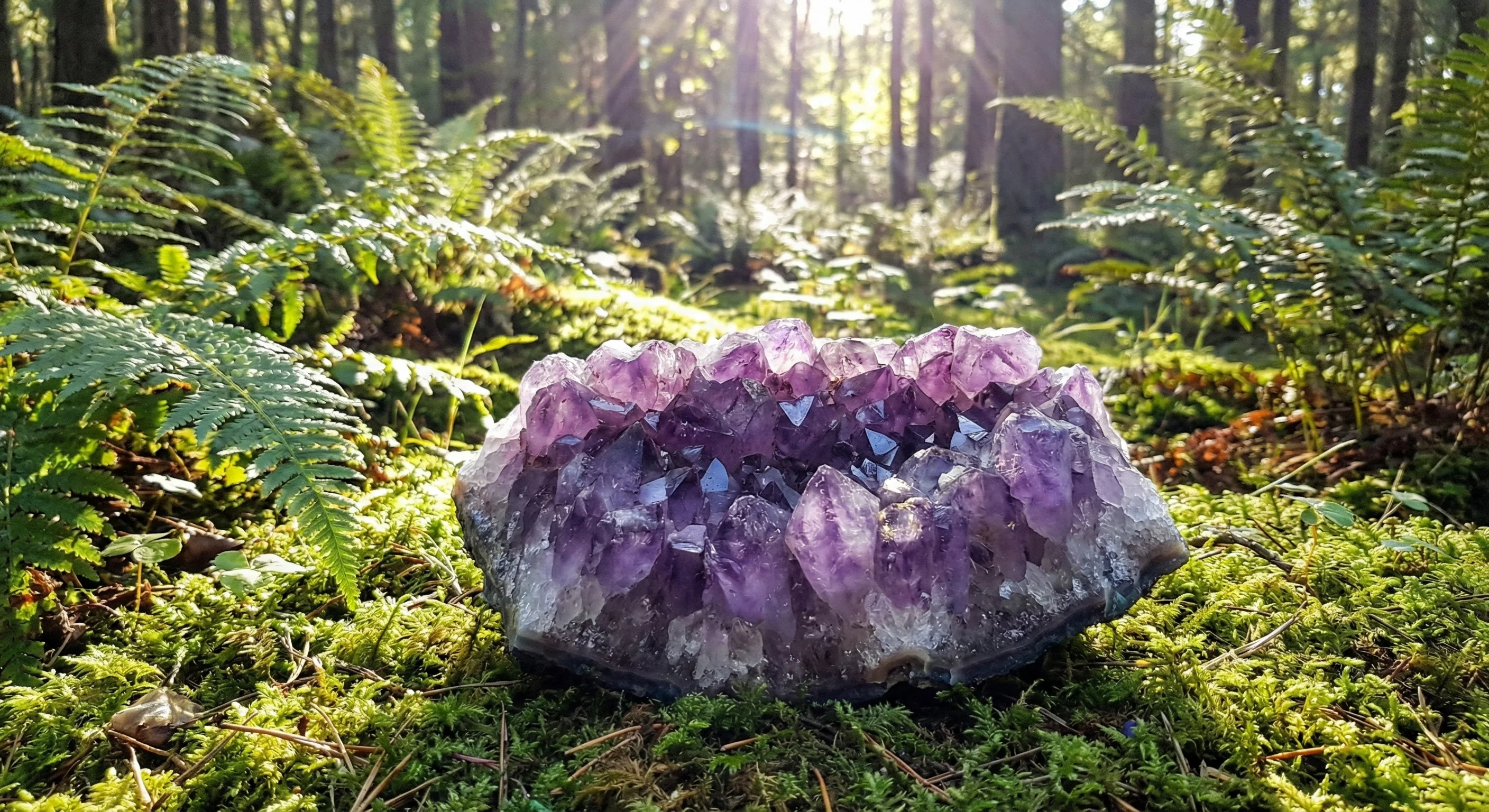
Why Amethyst? While clear quartz visually aligns with sharp, cutting energy, Amethyst's deep purple hue provides a cooling visual anchor. Its dense physical structure, especially in geode form, introduces a necessary heaviness. In environmental psychology, placing objects that represent substantial mass helps visually exhaust the overwhelming "noise" of modern life, creating a structured, calming atmosphere.
"From a design psychology perspective, the specific wavelength of deep violet promotes a sense of visual relaxation. Traditional systems recognized this atmospheric cooling effect long before modern color theory quantified it."
Fig 1: Visualizing the Shift in Spatial Harmony
The Reality Check: The True Cost of Mineral Aesthetics▾
Stop buying 50-pound cathedral geodes for your bedside table. It is a fundamental error in spatial planning that I encounter constantly. A massive, jagged geode in a resting space introduces intense visual complexity right where your eyes need the least amount of stimulation. I had a client who insisted on placing a waist-high Uruguayan geode directly opposite her bed; the harsh shadows cast by the crystals at night completely disrupted the room's calm atmosphere until we relocated it to the entryway.
Furthermore, we need to discuss maintenance. A raw amethyst cluster looks incredibly dramatic in architectural photography, but here is the ugly truth: they are uncompromising dust traps. If you place a rough cluster on an office desk, you are committing to weekly maintenance. Dust settles deep within the crystal points. You cannot simply wipe it with a cloth; you will need compressed air or a soft natural-bristle brush. If you fail to maintain it, the crystal shifts from being a beautiful visual anchor to a glaring reminder of household neglect, which completely defeats its psychological purpose.
There is also the trade-off of weight versus placement. When you lift a properly sourced, unheated amethyst sphere, the cold density of the quartz immediately registers. It is incredibly heavy for its size. You cannot place a 10-inch sphere on a cheap MDF floating shelf and expect it to hold. It requires a dedicated, structural plinth or a heavy wrought-iron stand. The aesthetic reward is high, but the infrastructural demand on your furniture is equally significant.
Spatial Design Case Study
Project Sanctuary: A Mindset Shift
The Friction
Sarah, a software director managing a remote team, felt her home office lacked definitive boundaries. The hum of servers and the persistent glare of three monitors dominated the East-facing room. The space felt inherently frustrating, lacking any visual pause.
Her designated focus area felt uninspiring. The environment was entirely dictated by utility cables and plastic casings, creating a baseline atmosphere that was wired, sterile, and unconducive to deep strategic thinking.
The Intervention
✓Visual Grounding: We introduced a polished, dark Amethyst sphere to the room. The smooth, uninterrupted surface provided a stark, necessary contrast to the sharp angles of her tech equipment, creating a visual 'pause'.
✓Mindset Anchor: A dense geode was placed within her line of sight. It wasn't intended to magically produce revenue, but rather to serve as a tactile, heavy reminder to maintain a disciplined, abundance-oriented mindset during difficult client calls.
The Reality
By intentionally introducing heavy, organic textures into a sterile digital space, the environment's baseline tension shifted. The physical presence of the minerals anchored the room visually, demanding attention away from the screens.
Sarah noted it became easier to transition out of work mode at the end of the day. The stones did not solve her software bugs, but they significantly altered how her workspace felt, supporting a more focused and less reactive daily routine.
The Unseen Mechanics: Navigating Workspace Integration▾
What the sleek portfolio photos of "Project Sanctuary" do not show are the logistical hurdles of integrating heavy geology with modern technology. I intentionally pushed back against Sarah's initial request to place a rough amethyst cluster directly under her main monitor. Why? Because the sharp points of a cluster reflect monitor glare in unpredictable, highly distracting ways, and they interfere with desktop ergonomics. When you are reaching for a mouse or a notebook, scraping your knuckle against raw quartz is a fast way to ruin your concentration.
Instead, we compromised on a polished sphere. A sphere diffuses light evenly rather than fracturing it. However, placing a 5-pound stone sphere on a glass-topped standing desk introduced a new problem: rolling hazard and weight distribution. We had to source a custom concave wooden base with a rubberized grip bottom to ensure the sphere remained absolutely static when the desk motors engaged to change heights.
This is the trade-off of professional spatial design. You cannot simply drop a beautiful object into a functional space without considering the physics of the environment. The sphere ultimately worked beautifully, providing a cool, smooth tactile surface for Sarah to touch during stressful conference calls—a physical grounding technique that interrupts the digital spiral. But achieving that seamless look required solving several mundane, highly practical engineering problems first.
Form & Function: The Dispersion Simulator
Different physical formations project completely different visual weights into a room. Select a geometric profile to analyze its architectural impact and psychological resonance.
Uninterrupted Symmetry
Visual Weight: Diffused & Ambient.
Architectural Impact: Creates a localized zone of visual softening. The eye finds no sharp edge to fixate on, forcing the gaze to slide off the object. This promotes parasympathetic relaxation, making it ideal for recovery zones.
The Maintenance Friction: Perfect symmetry requires perfect leveling. A 5-pound stone sphere becomes an immediate rolling hazard on modern sit-stand desks without a custom-milled concave plinth.
The Absorptive Cavity
Visual Weight: Heavy & Inward-Pulling.
Architectural Impact: Acts as a visual 'black hole' in bright, overstimulating rooms. The dark, recessed crystalline interior demands focus and physically anchors the eye, making it the ultimate tool for combating spatial drift in open-concept floor plans.
The Maintenance Friction: Geodes possess a fragile outer rind of agate or basalt. Placing them near HVAC vents causes micro-fractures due to thermal expansion. They require robust structural backing.
Fractured Complexity
Visual Weight: Aggressive & Scattered.
Architectural Impact: Highly stimulating. The multi-directional points fracture ambient light, creating micro-shadows that act as a visual scrub at entryways. It establishes a hard psychological boundary between distinct functional zones.
The Maintenance Friction: The ultimate dust trap. Clusters cannot be wiped with traditional cloths; the jagged points snag fibers instantly. Requires weekly maintenance via compressed air to maintain visual integrity.
Material Truths: Sourcing and Structural Integrity▾
Understanding the visual impact of a shape is only half the battle; knowing what you are actually buying is the other. The market is currently flooded with low-quality, artificially enhanced stones. I frequently consult for clients who have purchased vibrant, neon-purple "amethyst" spheres online, only to find out they are dyed quartz that will severely fade within six months if placed near a window. True high-grade amethyst, particularly from regions like Artigas, Uruguay, or Bahia, Brazil, possesses a deep, sometimes uneven saturation that shifts depending on the ambient lighting.
Let’s discuss the geode cave. A structurally sound geode is heavy and has a thick basalt or agate rind. If the rind is too thin, the geode is fragile and prone to cracking under its own weight, especially if subjected to temperature fluctuations near an HVAC vent. I have seen poorly reinforced geodes split down the middle on a client's display shelf. If you are investing in a piece larger than twelve inches, you must inquire about its structural stability and whether the back has been reinforced with concrete or epoxy—a common, acceptable practice, but one the buyer should be aware of to assess true weight.
Clusters present their own material realities. Because they lack a smooth outer rind, their base is often rough-cut matrix rock. Placing a raw cluster directly on a finished hardwood table is a guaranteed way to inflict deep, unrepairable scratches. You must always source custom-cut felt or cork pads for the exact footprint of the cluster. The romantic idea of simply placing a stone in a room ignores the physical friction between a Mohs hardness of 7 (quartz) and the delicate varnishes of modern furniture.
The Strategic Layout Blueprint
Test your spatial intuition. Drag and drop the optimal crystal shape into its ideal functional sector to unlock the detailed strategy.
1. Select a Form
🕳️Geode
🔮Sphere
🏔️Cluster
2. Designate Sector
Drop here for: Career Focus (Southeast)
Drop here for: Rest / Bedroom
Drop here for: Entryway / Boundary
✲
Interact with the layout puzzle on the left to reveal the detailed environmental strategies for each specific zone.
♞
The Southeast Focus Sector
To anchor a mindset of intention in a highly distractible era, the visual weight must be substantial. The deep, recessed cave of a Geode physically demonstrates depth and retention. It is not an abstract concept; it is a heavy object that demands you walk around it, forcing a physical acknowledgment of your designated career zone.
Practical Implementation:
Avoid Direct Sunlight: Amethyst is photosensitive. Placing a high-value piece directly on a Southeast-facing windowsill is a common error that will bleach the purple into a dull gray within a year. Position it deeper within the room.
The Visual Anchor: Use the geode as the absolute centerpiece of an intention table, keeping the surrounding surface entirely clear of paper clutter to maintain its psychological impact.
☽
The Rest & Recovery Zone
Bedrooms are often compromised by multi-purpose use—serving as gyms, offices, and sleeping quarters. A smooth Amethyst Sphere provides a gentle, uninterrupted visual presence that explicitly signals recovery. The lack of sharp edges is critical for creating a subconscious sense of safety.
Practical Implementation:
Scale Matters: I advise clients to keep bedside spheres between 2 to 4 inches in diameter. Anything larger begins to command too much visual authority, subtly competing with the primary function of the room: rest.
Symmetry: If utilizing nightstands on both sides of a bed, utilize two similarly sized spheres. Asymmetry in this highly personal zone can create a subtle, persistent sense of environmental imbalance.
✲
Entryways & Transition Boundaries
Transition zones dictate how external energy is carried into the private sanctum. A raw Cluster, with its multiple terminating points, is highly textured and stimulating. It acts as a visual 'scrubber' at an entryway, catching the eye and forcing a momentary mental reset before proceeding into the home.
Practical Implementation:
Height Positioning: Place entryway clusters at roughly chest-to-eye level on a console table. Placing them too low diminishes their impact as a boundary marker; they simply become floor obstacles.
Lighting Considerations: Clusters require directional overhead lighting (like a small gallery spot) to cast shadows within their points, highlighting their complexity. Flat, ambient lighting makes them look like indistinct dark rocks.
Authoritative References & Further Reading
For rigorous exploration of environmental psychology, mineralogy, and the impact of spatial design, consider these established sources.
▸
Journal of Environmental Psychology: Studies on the physiological and psychological responses to color wavelengths and organic textures in interior environments. Focuses on how visual complexity impacts cognitive load.
▸
Gemological Institute of America (GIA): The definitive authority on mineral identification, treatments, and sourcing ethics for Quartz (Amethyst). Essential for verifying the authenticity of high-value pieces.
▸
American Society of Interior Designers (ASID) - Evidence-Based Design: Frameworks for utilizing physical mass and natural materials to dictate traffic flow and emotional response in residential layouts.