Third Eye Chakra Placement
Frontal Lobe Cool-Down: Placing Amethyst on the Third Eye for Racing Thoughts
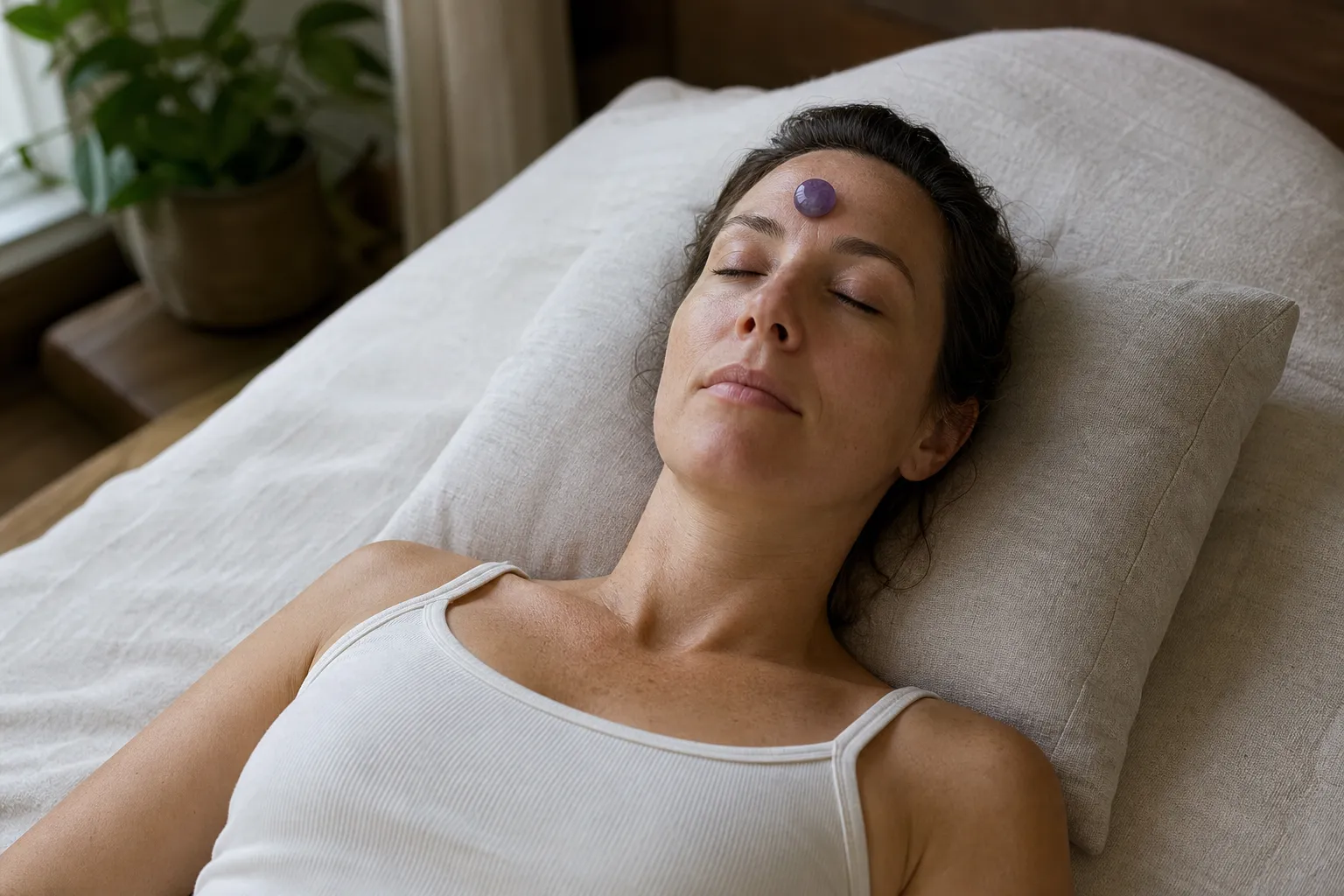
A smooth amethyst palm stone or small tumbled piece can rest lightly between the brows for a quiet third eye amethyst ritual. In Third Eye Chakra Placement, that brow point is usually treated as a symbolic center for attention, inward looking, and subjective mental clarity.
The careful answer is simple: you can use amethyst forehead placement as a calming forehead ritual for racing thoughts, but only as a symbolic pause cue. It is not medical care, not a headache answer, and not evidence that the prefrontal cortex is being cooled, regulated, or changed.
The stone is the focus object. The pause, posture, breath, and chosen meaning are the ritual. Keep it brief, gentle, and easy to stop; if discomfort, distress, or persistent symptoms are part of the moment, the crystal should not be asked to carry that concern.
broader context
Amethyst context note
This narrower page lands better after the broader amethyst context page.
How to Place Amethyst on the Third Eye Area
Choose a smooth piece of amethyst rather than a sharp point, rough cluster, or heavy display specimen. The forehead is not a shelf for dramatic crystal habit. For this placement, comfort matters more than color zoning, rarity, or visual impact.
Recline or lie down so the stone does not need to be pressed into place. Set it lightly between the eyebrows or just above them, where many readers mean the “third eye” area in spiritual placement language. If it slides, remove it instead of pushing harder.
A Simple Sequence
- 1.Set the stone beside you and choose a short time window.
- 2.Recline comfortably, with the neck supported.
- 3.Place the amethyst lightly at the brow point.
- 4.Let the eyes close or soften.
- 5.Use a phrase such as “I am pausing” or “I am gathering my attention.”
- 6.Remove the stone when the moment feels complete, or sooner if it distracts you.
The ritual does not need elaborate steps to feel intentional. Its value, if it has any for you, is personal and subjective: a single object, a cool surface, a visible symbol, and a reason to let the room become quieter for a few minutes.
What “Frontal Lobe Cool-Down” Can Mean
“Frontal lobe cool-down” works best as a metaphor. It can name the wish to quiet a crowded mind, especially when thoughts seem to arrive faster than you can sort them. It should not be read as a neurological claim.
The phrase “prefrontal cortex” belongs to brain and medical language. Without appropriate scientific support for this specific practice, an amethyst on the forehead should not be described as changing brain activity, improving cognition, or addressing a clinical condition. The stone’s position near the front of the head may make the image tempting, but location is not evidence.
Cleaner ritual language
“I use the stone as a symbol for settling my attention.” That belongs to personal ritual.
Unsupported claim language
“This changes my frontal lobe” would make a claim this page cannot support.
The same boundary applies to mental clarity. In a third eye reader context, mental clarity can mean a subjective sense of feeling less scattered, more reflective, or more able to name what is on your mind. It should not be presented as a measured cognitive result.
When This Ritual Fits—and When It Does Not
Amethyst forehead placement fits best as a low-intensity pause: a few minutes away from screens, a tactile object with personal meaning, and a quiet cue to stop chasing every thought. It belongs in a private, comfortable setting where the stone can be placed and removed without fuss.
The practice becomes less appropriate when the language around it grows too large. If it is being used to explain away ongoing distress, recurring headaches, sleep disruption, panic, neurological symptoms, or any worsening condition, the crystal has been given the wrong job. A stone can be part of a symbolic environment; it should not be the only response to a health concern.
Two Clear Limits
Headaches need caution. Some readers look for forehead crystal placement because coolness or light pressure seems connected to head discomfort. This page does not support claims that amethyst addresses headaches. If pressure on the forehead makes discomfort more noticeable, remove the stone. If head pain is persistent, severe, unusual, or concerning, that is outside the ritual question.
Racing thoughts need a boundary. Everyday mental noise, end-of-day overstimulation, or a desire for quiet reflection can fit a brief ritual. Thoughts that feel uncontrollable, frightening, prolonged, or connected to broader mental health concerns should not be reduced to a crystal placement issue.
Common Confusions Around Third Eye Chakra Placement
Spiritual language is not medical authority
Here, third eye chakra placement is spiritual and symbolic language: a way some readers name a brow-centered ritual for attention, intuition, or inner quiet.
A stronger-looking stone is not the goal
A large geode, pointed wand, or heavy collector specimen may be beautiful, but it is poorly matched to the forehead. A modest tumbled stone is more practical because it can rest without strain.
Market language is not outcome evidence
Product descriptions often speak confidently about calm, clarity, protection, or focus. Those phrases may reflect popular spiritual associations, but they are not enough to turn a personal ritual into a factual outcome claim. The narrower statement is more honest: amethyst can be chosen as a personal symbol in a calming ritual.
The ritual has not failed if thoughts continue
Racing thoughts rarely behave like a switch. A bounded spiritual self-care moment can give you a pause, a pattern, or a softer way to notice the mind. It does not need to erase every thought to have personal meaning.
A Short Ritual Script
Place the amethyst near you first, not on the forehead yet. Notice its color, shape, and surface. This returns the practice to an observable object before symbolic meaning enters.
“I am using this amethyst as a reminder to pause. I do not need to solve every thought right now. I can let one breath arrive, then another.”
Then set the stone lightly at the third eye area and use that restrained intention. Stay for a few breaths or a few minutes. If the stone feels cold, heavy, distracting, or emotionally unhelpful, remove it. There is no achievement in keeping a crystal on the forehead longer than feels comfortable.
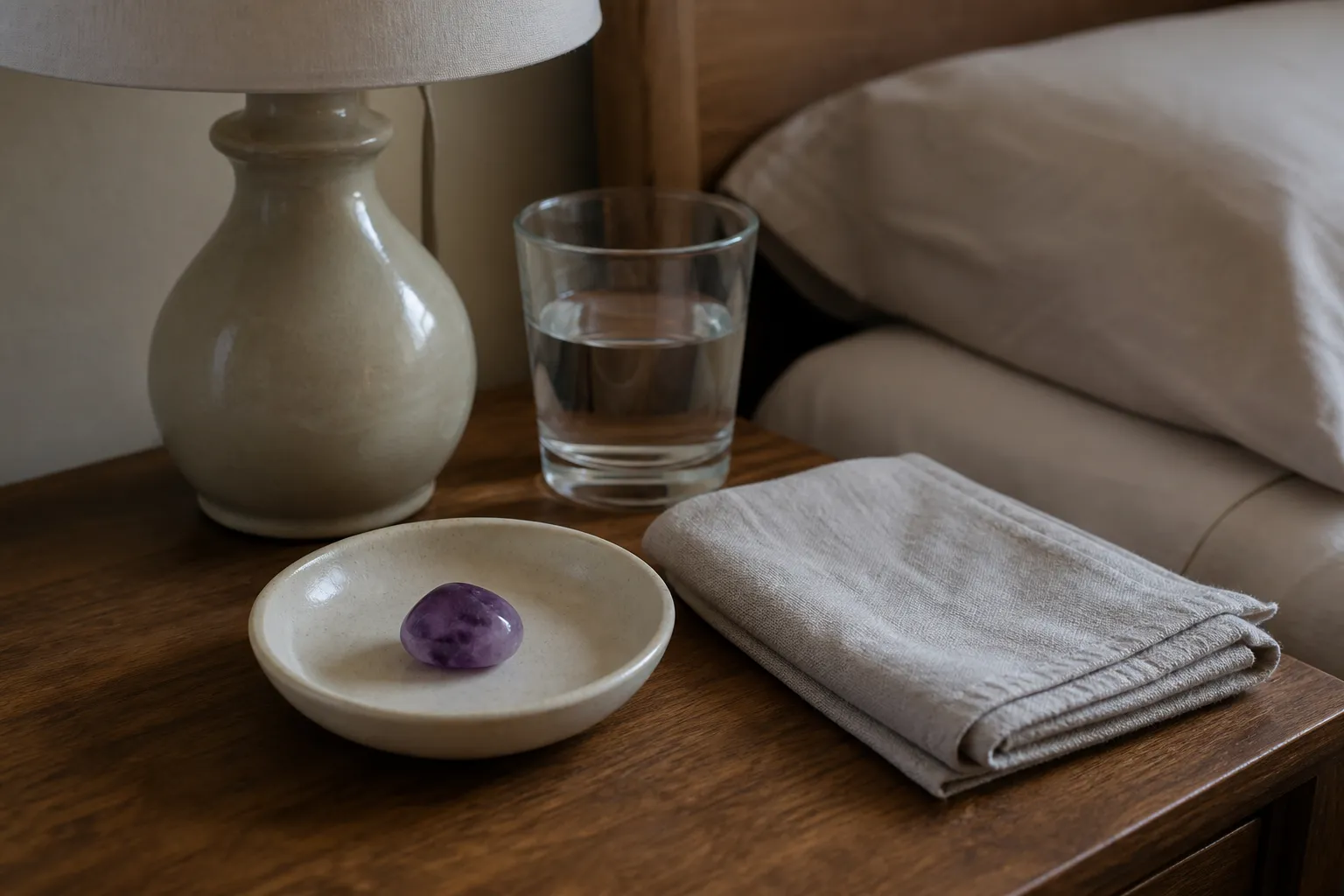
Afterward, place the amethyst somewhere ordinary: a bedside dish, a desk corner, or a small tray used for reflective objects. That keeps the stone in proportion. It can belong to atmosphere, care, and symbolism without becoming an answer to every unsettled feeling.
A Quick Boundary Check
Before using amethyst on the forehead, ask three questions.
- Am I treating this as a symbolic ritual rather than a health-outcome claim? If yes, the practice is in the right lane. If no, separate the crystal from the concern that needs more support.
- Is the stone physically comfortable? Smooth, light, and stable is the standard. Avoid pressure, sharp edges, and awkward balancing.
- Am I ignoring something more serious? Severe distress, neurological symptoms, concerning head pain, or persistent racing thoughts need more than symbolic third eye language. The ritual can sit beside responsible care habits, but it should not replace them.
The Practical Answer
You can place amethyst on the third eye area by reclining, setting a smooth small stone lightly between or just above the brows, and using it as a symbolic focus for pausing racing thoughts. Keep the practice brief, comfortable, and clearly non-medical. Do not treat the placement as evidence of mental clarity, chakra correction, headache improvement, or prefrontal cortex effects.
Amethyst remains a specimen first and a symbol by choice. On the forehead, its role is not to prove what is happening inside the brain; it is to mark a quiet moment where the reader chooses stillness, then returns the stone to the room without asking it to make claims it cannot carry.