Identifying the 'Raspberry Flash': A Technical Guide to Siberian Amethyst Valuation in 2026
Professional participation in the 2026 colored gemstone sector demands an uncompromising eye for detail. If you are currently evaluating rough or faceted material marketed as premium Russian origin but find yourself unable to detect the legendary secondary red hue, your specimen's market positioning is at risk. Industry feedback indicates that failure to verify the "Raspberry Flash" often causes a specimen's perceived value to align with standard commercial quartz rather than high-tier Siberian amethyst.
To accurately assess your material, you must move beyond casual observation and implement a rigorous diagnostic framework. If the flash remains elusive, the issue typically stems from one of three technical misalignments:
Crystallographic Axis Orientation
The secondary red component is pleochroic. It does not manifest uniformly. Light must propagate along the a-axis or b-axis to trigger the flash; viewing the stone directly down the c-axis (the optic axis) will frequently result in a dead, monochromatic purple.
Structural Integrity and Twinning
The modern market is saturated with hydrothermal synthetics. Natural Siberian amethyst crystals typically exhibit "Brazil law twinning," visible as "tiger-stripe" patterns under polarized light. If the internal structure appears too homogenous, the specimen may be a laboratory-grown proxy.
Light Scattering and Thermal History
Specimens that have undergone rapid temperature fluctuations may contain micro-fissures. These internal disruptions scatter light before the specific red wavelengths can reach the observer's eye.
Discard guesswork in favor of the following lapidary and analytical protocols designed to isolate, verify, and document the optical properties of your stone.

Core Prerequisites & Technical Setup
Before initiating any physical testing, calibrate your workspace to forensic standards. To justify a premium valuation, your environment must minimize optical interference.
- Darkfield Loupe (10x-20x): Required for mapping internal color zoning and identifying diagnostic inclusions.
- Calcite Dichroscope: This tool is mandatory for separating the primary purple from the secondary magenta-red components.
- 3200K Incandescent Fiber-Optic Illuminator: Avoid LED sources, which often lack the necessary red spectral output to excite the flash.
- Immersion Cell with Refractive Index (RI) Fluid: This setup eliminates surface reflections, allowing for a clear view of the internal crystal lattice.
Operational Substitutions:
- • Alternative 1: If a professional immersion cell is unavailable, utilize a clean glass vessel filled with mineral oil. The RI of mineral oil is sufficiently close to quartz (1.54) to suppress surface glare and reveal internal color banding.
- • Alternative 2: In the absence of a dichroscope, utilize two polarized filters. Rotate them at a 90-degree angle relative to each other over a light source to construct a functional polariscope for identifying twinning.
Step-by-Step Execution: Isolating and Verifying the Flash
Step 1: Optical Isolation and Axis Mapping
You cannot effectively grade material that has not been optically neutralized. The goal is to eliminate surface diffraction and pinpoint the red color centers.
Submerge the rough or faceted stone into the immersion fluid. Position the fiber-optic light at a 45-degree oblique angle relative to the base of the cell. Slowly rotate the specimen using gem-grade tweezers. Look for concentrated, angular zones of magenta-red. In authentic Siberian material, this color is rarely uniform; it typically manifests in chevron-shaped or rhombohedral zones. Once the flash is identified, mark the orientation on the rough using a waterproof fine-point marker.
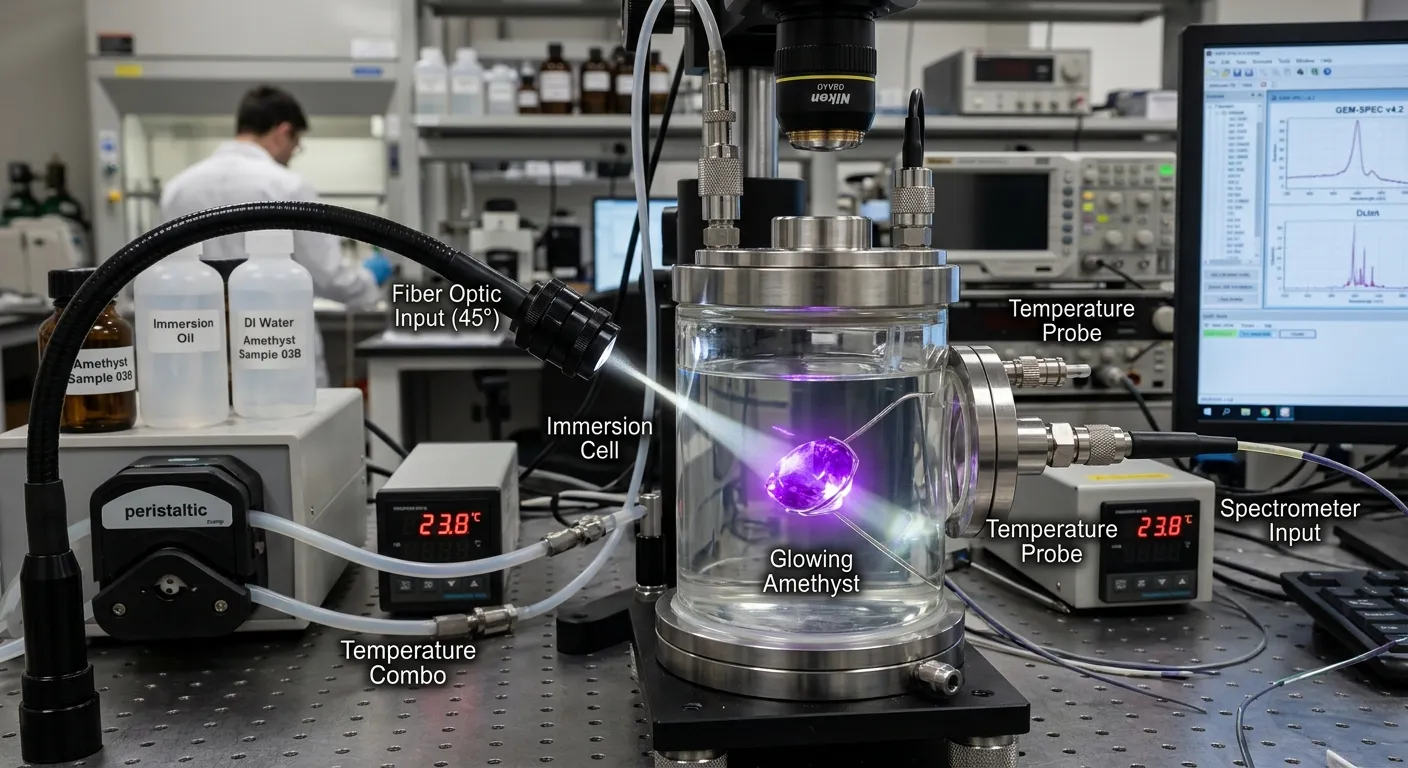
Pro Tip: Perform this Step-by-Step in total darkness. Ambient fluorescent lighting provides excessive blue/green wavelengths that neutralize the red return.
Troubleshooting: If the stone appears opaque or excessively dark in the fluid, increase light intensity or use a red pinpoint laser (650nm) directed through the sharpest edge of the crystal to force light transmission.
Step 2: Advanced Spectrochemical Verification
The 2026 market relies on empirical data rather than visual claims. To confirm the geological origin and justify a premium, the material must be looked at by an independent lab.
Request that the sample be analyzed with EMPA (Electron Microprobe Analysis). Ensure the laboratory is using a wavelength-dispersive technique to achieve a precise parts-per-million (PPM) count of trace iron (Fe) isotopes. The resulting data should be calculated from ideal end-member formula baselines. This confirms the stone developed within a natural pegmatite environment rather than a synthetic hydrothermal chamber.
EMPA Trace Element Analysis (Fe Isotopes)
Pro Tip: Specifically request an "Origin and Trace Element Report." A generic identification report may only state "Natural Amethyst," which is insufficient for high-tier market positioning.
Troubleshooting: If the analysis detects Cobalt (Co) rather than specific Iron (Fe) isotopes, halt all processing. This chemical signature is indicative of synthetic doping.
Step 3: Lapidary Execution and Fashioning
Once the material is verified, it is fashioned into gemstones. The orientation chosen by the cutter determines the final optical output.
Orient the gemstone's table facet perfectly parallel to the red color zones identified during immersion. Calibrate the lapidary mast to a 42-degree pavilion angle. Cutting too shallow causes "windowing," where the red flash leaks through the bottom of the stone. Conversely, cutting too deep leads to "extinction," turning the stone black. The crown should be cut at 34 degrees to optimize light return.
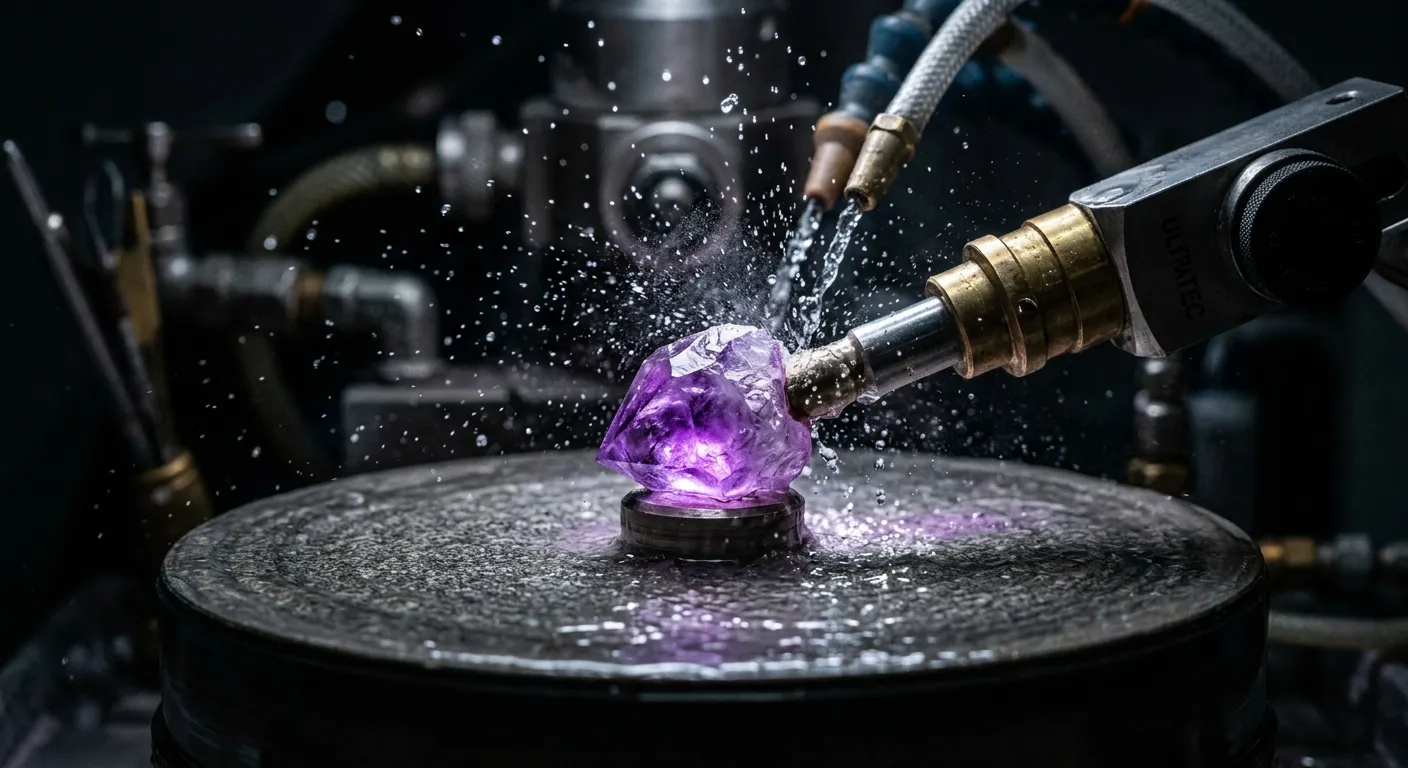
Pro Tip: Utilize a 1200-grit sintered diamond lap for the pre-polish phase. Amethyst is prone to sub-surface damage; a sintered lap ensures clean cuts without introducing micro-fractures into the color zones.
Troubleshooting: If the specimen appears cloudy during the grinding process, it indicates excessive heat friction. Immediately increase the water flow and allow the stone to cool naturally. Never quench the stone in cold water.
Step 4: Market Positioning and Digital Liquidation
After the stone is cut, it must be presented accurately in the digital space to attract qualified buyers.
When listing the specimen, you must add a new photo that specifically highlights the red flash using a macro lens and warm backlighting. Because buyers frequently search by color using platform filters, your metadata must be precise. To maintain professional standards, restrict this thread to selling/swapping only and avoid unproductive debates regarding origin. Protect the transaction by swapping only with established users with a documented history.
Pro Tip: Avoid wire transfers with unverified international parties. Utilize payment using PayPal's goods & services to ensure a layer of protection against fraudulent claims.
Troubleshooting: If a prospective buyer requests shipment to an unverified third-party appraiser, decline the transaction. Only ship to verified addresses and insist on using top-tier laboratories (e.g., GIA) for post-sale inspections.
Fatal Mistakes to Avoid
Mistake 1: Storage-Induced Structural Failure
Amethyst that has re-crystallised during decompression throughout its geological history is susceptible to thermal shock. You must store properly to avoid cracking.
- ↳ Observation: Rapid temperature drops can cause internal structural planes to separate, leading to cleavage cracks.
- ↳ The Fix: Maintain Siberian gems in high-density foam within a climate-controlled environment kept between 68°F and 72°F (20°C-22°C).
Mistake 2: Prioritizing Mass Over Saturation
Inexperienced participants often focus on large geodes, assuming volume equates to value.
- ↳ Observation: Massive geodes typically consist of commercial-grade quartz with low liquidity. The "Siberian" effect is most concentrated in smaller, high-saturation single crystals.
- ↳ The Fix: Direct resources toward facet-grade rough under 50 grams that demonstrates high color concentration.
Mistake 3: Inaccurate Pricing Benchmarks
Valuations based on outdated metrics fail to account for the 2026 demand for verified Siberian material.
- ↳ Observation: Genuine, lab-verified Siberian stones frequently command a 400% to 600% premium over standard South American material.
- ↳ The Fix: Regularly benchmark against actual auction results from the preceding 90 days.
90-Day Auction Premium Analysis
Technical FAQ
Q: Why is the red flash visible under incandescent light but not in sunlight?
A: Incandescent sources are rich in red/yellow wavelengths (approx. 2700K), which excite the specific iron color centers. Sunlight (approx. 5500K) contains more blue/UV light, which can overwhelm the subtle red return of the amethyst.
Q: Can heat treatment enhance the "Raspberry Flash"?
A: No. Heating natural amethyst beyond 400°C destabilizes the iron color centers, typically resulting in a transition to citrine or clear quartz. The Siberian flash is a result of natural irradiation, not thermal intervention.
Q: How is Siberian color zoning distinguished from other sources?
A: While some material shows parallel bands, genuine Siberian specimens exhibit rhombohedral zoning. The color is concentrated in sharp, angular geometric patterns following the crystal's natural faces. Use immersion fluid to map these patterns.
Q: Why would a stone with inclusions be identified as synthetic?
A: Modern hydrothermal techniques can intentionally introduce "nailhead spicules" or fluid inclusions to mimic natural stones. This is why you must rely on advanced spectroscopic analysis rather than visual inclusion checking alone.
References & Academic Literature
Peer-reviewed sources and gemological data supporting the technical frameworks discussed.
- [1]
-
[2]
Morphological and chemical evolution of corundum (ruby and sapphire): Crystal ontogeny reconstructed by EMPA, LA-ICP-MS, and Cr 3+ Raman mapping
De Gruyter Brill (2016) · American Mineralogist
View Document -
[3]
Forensic gemmological investigation based on optical and crystal-chemical changes in topaz from Ouro Preto and Caraí, Brazil, induced by heat treatment
Nature Scientific Reports (2025) · Scientific Reports
View Document -
[4]
Vanadium and Chromium-Bearing Pink Pyrope Garnet: Characterization and Quantitative Colorimetric Analysis
Gemological Institute of America (GIA) (2015) · Gems & Gemology
View Document - [5]