Science of amethyst
The Science Behind Amethyst: Color Centers and the Placebo Effect
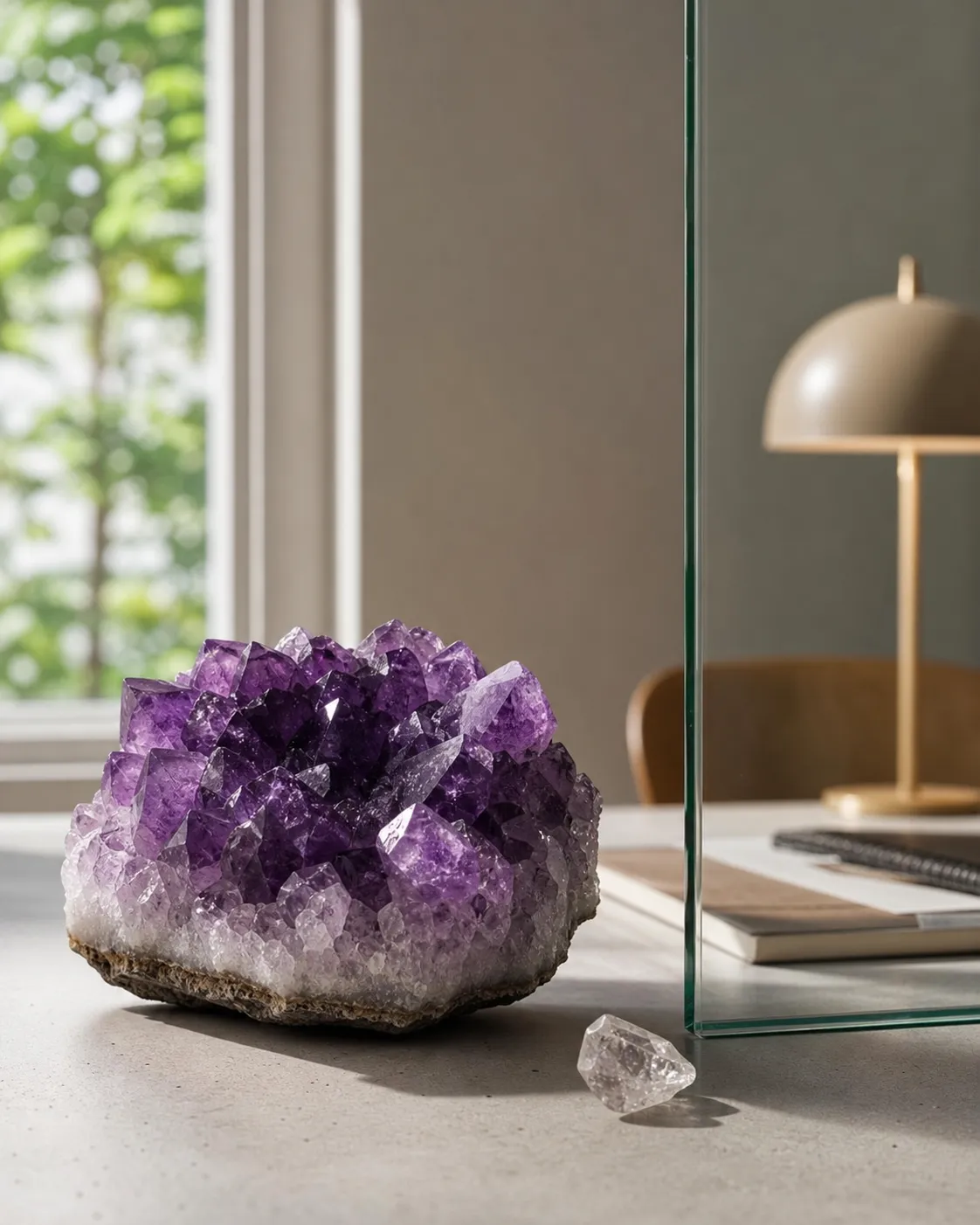
The science of amethyst starts with a plain mineral fact: amethyst is quartz. More specifically, it is a purple variety of quartz, a mineral made of silicon dioxide, written as SiO2. Its color belongs to mineralogy and gemology. The calm, focus, comfort, or meaning people sometimes associate with it belong to a different kind of explanation: perception, expectation, ritual, and personal context.
That split is the useful answer. Science can describe amethyst as a mineral, discuss its purple color with cautious color-center language, and explain why a person may perceive benefits around a meaningful object. It does not turn personal experience into evidence that amethyst has a crystal-specific health effect.
broader context
Begin with the main amethyst page
This narrower page lands better after the broader amethyst context page.
Amethyst as quartz: the material starting point
Amethyst is not a separate magical substance. It is part of the quartz family. Quartz has the chemical formula SiO2, meaning its crystal structure is built from silicon and oxygen.
In gem and mineral descriptions, amethyst is usually discussed through visible and physical features: purple color, transparency, crystal form, locality, cluster or geode growth, faceted gems, polished stones, and specimen quality. Those details are useful because they describe the stone itself.
They do not, by themselves, establish effects on a person.
A clean way to sort the language is this:
- “Amethyst is quartz” is a mineral classification.
- “Amethyst is SiO2” is chemical formula context.
- “Amethyst is valued for purple color” is gemological framing.
- “I feel calmer around amethyst” is a subjective experience.
- “Amethyst causes a specific health result” is a different kind of claim and needs a different kind of evidence.
That distinction does not make personal meaning foolish. It simply keeps mineral facts and human experience in the right categories.
What color centers can explain
Color centers are often mentioned when people ask why amethyst is purple. In general mineral-science language, a color center is a defect or irregularity in a crystal structure that can affect how light is absorbed, changing the color we see.
That idea is relevant to quartz color. It helps explain why a crystal can have color even when its main chemical formula remains quartz. Amethyst’s purple is not just a label added by sellers; it is a real optical feature of the mineral.
But this is also where the answer should stay narrow. The public references used here support amethyst’s identity as purple quartz and support a cautious discussion of color in mineral terms. They are not enough to make detailed claims about the exact defect chemistry, irradiation history, iron-related mechanisms, heat behavior, or every condition that produces purple coloration in amethyst.
Amethyst’s purple color belongs to the physical science of quartz and light interaction. Color-center language is part of the scientific vocabulary used for crystal color, but it should not be stretched into a complete technical explanation unless stronger mineral-physics sources are being used.
Most importantly, a color mechanism explains color. It does not show that the same stone has a special action on the body or mind.
The physical science of amethyst explains the stone. It does not automatically explain every experience attached to the stone.
Why perceived benefits can feel real
Placebo research is useful here because it gives a respectful way to discuss perceived benefits without mocking them and without overstating the crystal.
In placebo-related responses, expectation, belief, attention, prior experience, and setting can shape what a person notices and feels. A person may sincerely report comfort from an object or ritual even when that experience is not evidence of a specific active property in the object itself.
That fits many amethyst stories. Someone may place amethyst on a desk, bedside table, shelf, or meditation cushion and feel more settled when seeing it. The experience may be shaped by the color, the quiet moment around it, the act of arranging the space, the intention attached to the stone, or the expectation that it represents calm.

Calling that placebo-related does not mean “fake.” It means the experience may be shaped by meaning and context rather than by a demonstrated amethyst-specific mechanism.
This is the balanced reading: the stone can be part of a meaningful setting, and the person’s response can be sincere. That still does not make amethyst a scientifically established tool for producing health outcomes.
Where amethyst claims often get blurred
The confusion usually starts when geological language is placed next to wellness language as if one proves the other.
“Amethyst is SiO2 quartz” is a mineral fact.
“Amethyst has purple color tied to quartz color science” is a gemological statement.
“Amethyst therefore creates a measurable inner result” is a category jump.
A few common mix-ups are worth keeping separate.
Color is not efficacy.
Amethyst’s purple color is part of its identity as a gemstone and quartz variety. A physical explanation for color does not mean the color has a demonstrated biological or emotional effect.
Mineral classification is not a health claim.
SiO2 tells you what quartz is made of. It does not tell you what the stone does for a person.
A meaningful ritual is not the same as clinical evidence.
A person may use amethyst as a reminder to pause, tidy a room, mark a quiet corner, or begin a reflective practice. That can have personal value. It should not be presented as proof that the mineral itself produces a specific result.
The placebo effect is not a shortcut.
Placebo research helps explain how expectation and context can influence subjective experience. It does not make every crystal claim scientifically established.
For collectors and casual owners, this separation is useful. It lets amethyst be interesting on its own terms: a purple quartz mineral, a decorative or collectible object, and sometimes a personal symbol.
What science can say in plain terms
Science can say that amethyst is a variety of quartz, that quartz is SiO2, and that amethyst’s gem identity is tied to purple color. It can place amethyst within mineral classification and gemological description. It can also use color-center language carefully when discussing how color can arise in crystals.
Science can also say that people’s experiences with objects are shaped by more than chemical formula. Expectation, setting, attention, belief, and repeated ritual can influence perception.
What science should not do is use the words “quartz,” “SiO2,” or “color centers” as a bridge to unsupported health-outcome claims.
A short version
Amethyst is scientifically interesting because it is purple quartz. Its color belongs to mineral and gemological explanation. Its perceived calming or meaningful effects are better discussed through expectation, ritual, attention, and personal association. Those explanations can sit beside each other, but they should not be merged into one claim.
A practical way to read amethyst descriptions
When you read a description of amethyst, look for the moment where the writer changes evidence lanes.
A careful description may say that amethyst is quartz, that its formula is SiO2, that it is valued for purple color, and that crystal color can involve structural or defect-related explanations. It may also say that people use amethyst in symbolic or reflective settings and may perceive comfort through association, attention, or expectation.
A weaker description jumps from “amethyst has a scientific color mechanism” to “therefore it produces a specific inner result.” The first part may be mineral science. The second part is not established by the first.
If you are choosing amethyst as a mineral or decorative object, pay attention to visible quality, color, form, transparency, damage, treatment disclosures when available, and whether the seller separates observation from claims. If you use amethyst symbolically, it is still reasonable to enjoy its appearance and meaning. Just keep personal significance separate from scientific proof.
The bottom line
The science behind amethyst has two layers.
The mineral layer explains amethyst as SiO2 quartz with a purple gemological identity and a color story that can be discussed cautiously through color-center concepts.
The perception layer explains why a person may feel comfort, focus, or meaning around amethyst through expectation, ritual, attention, and belief.
Those layers may meet in lived experience, but they are not the same kind of evidence. Amethyst can be appreciated as a real mineral, a collector object, a decorative stone, and a personal symbol. The careful answer keeps the boundary visible: the purple quartz is physically real, the subjective response may be sincere, and mineral facts should not be used to support claims they do not prove.