Protective Storage Systems
The Sanctuary: Anti-Tarnish Storage & Travel Architecture
Jewelry owners usually start looking for Protective Storage Systems after two frustrations begin to blur together: metal that looks duller after storage, and pieces that come out of a pouch scratched, tangled, bent, or rubbed. A box, roll, tray, pouch, or jewelry travel case may be sold as if it solves all of those problems at once. In practice, storage is not one promise. It is a set of choices about separation, air and moisture exposure, packing structure, and how much weight to give anti-tarnish language that may or may not be documented.
For amethyst jewelry, the answer is rarely about the stone alone. The setting metal, chain, clasp, plating, lining, adhesive, and travel environment can all change what “protective” should mean.
broader context
Begin with the main amethyst page
This narrower page lands better after the broader amethyst context page.
Protective Storage Systems Have Three Separate Jobs
A useful storage system starts by separating three ideas that are often marketed together.
Physical Protection
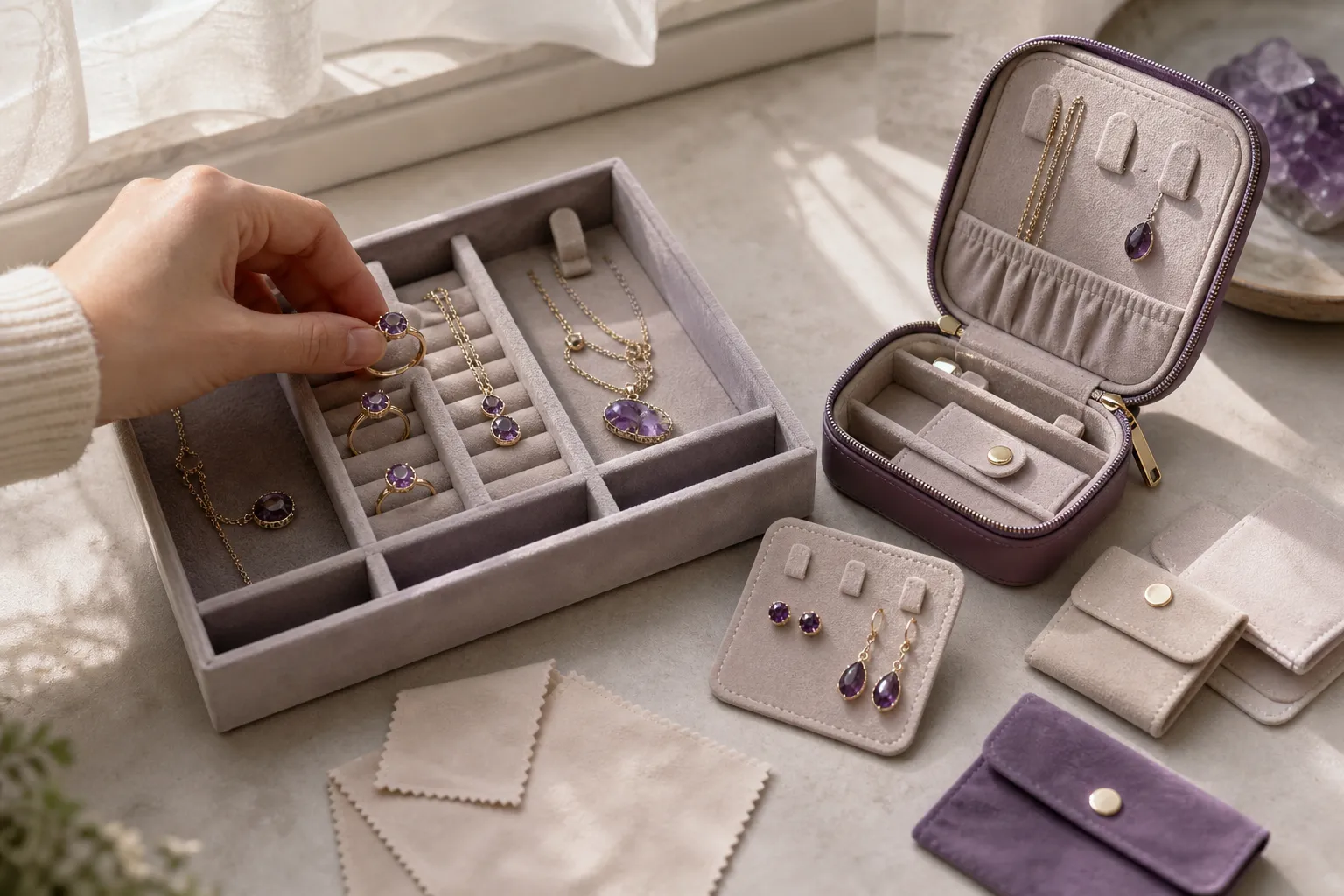
Compartments, ring rows, necklace tabs, earring panels, padded walls, zip closures, and firm shells can reduce piece-to-piece contact. They may help limit abrasion, tangling, pressure, and chain-on-chain friction. They do not prove that every scratch, bend, or travel accident has been avoided.
Anti-Tarnish Intent
Anti-tarnish storage usually means the product is presented as reducing conditions associated with metal darkening or surface change. Without product documentation or conservation-grade support, that should be treated as an intention, not a guaranteed result.
Environmental Awareness
Jewelry stored in a bathroom drawer, a coastal suitcase, a gym bag, a sunlit vanity, or a dry closet is not facing the same conditions. Avoid enclosing damp pieces, reduce unnecessary moisture contact, and follow qualified guidance for valuable, antique, plated, porous, treated, fragile, or sentimental jewelry.
A lining, pouch, strip, tab, or insert may be useful, but this article does not have evidence verifying how well any specific product works, how long it works, or which jewelry materials it suits. A strong storage plan respects all three jobs without pretending they are the same feature.
Home Storage Starts With Separation
At home, the best-looking solution is often the least dramatic: give each piece a stable place, keep incompatible forms apart, and make the system easy enough to use every day.
- Rings: slots or small compartments that keep settings upright.
- Necklaces: hooks, channels, cards, or individual sleeves so chains do not knot.
- Earrings: pairing without letting posts, hoops, or sculptural shapes press into softer pieces.
- Bracelets and bangles: enough room that harder edges are not sitting under weight or friction.
This is where organized jewelry storage matters more than an impressive product label. A plain drawer insert with clear separation may do more practical work than a beautiful box where pieces slide into one another. A pouch may be fine for one sturdy item and poor for a mixed cluster of chains, posts, and stone-set pieces. A deep compartment may look generous but encourage stacking, which defeats the reason for separating jewelry in the first place.
For mixed jewelry, begin with the most vulnerable interaction. A chain can tangle with another chain. A raised setting can catch fabric or rub against a neighboring surface. An earring post can press into a gemstone, bead, enamel detail, plated finish, or softer material. A heavy cuff can crush a fine chain. These are ordinary physical risks; they do not need inflated technical language.
Amethyst jewelry adds another reason to avoid casual piling. Even when the stone feels sturdy in ordinary wear, the piece may include prongs, adhesives, plating, fracture-filled material, or delicate metalwork. Storage for mixed jewelry should be planned around the whole object, not only the gemstone name or metal stamp.
A home sanctuary can be simple: separate by form, avoid damp storage, keep high-friction items apart, and do not assume one velvet-lined compartment suits everything.
Read Anti-Tarnish Claims Narrowly
The phrase anti-tarnish storage is useful because it names a real owner concern: metal should not look neglected between wears. As a claim, though, it needs careful reading.
Retail language may apply “anti-tarnish” to a pouch, cloth, lining, strip, tab, container, or sealed case. Some products also invoke terms such as Intercept technology or reactive polymer tabs. Those terms may have meaning in specific product systems, but this article does not include authoritative documentation verifying their mechanism, lifespan, suitable materials, or performance across jewelry types. They should not be treated here as proven solutions.
The point is not to dismiss these categories. Some may be useful when supported by clear product documentation, reputable materials information, or jeweler guidance. The point is to avoid turning market language into certainty. “Designed to reduce tarnish exposure” is more responsible than “prevents tarnish.” “May help when used correctly” is more accurate than “permanently neutralizes tarnish.”
This matters for silver, gold-tone, plated, mixed-metal, and heirloom pieces. Surface change can be influenced by metal composition, environment, prior wear, skin oils, cleaning residue, storage materials, and time. A storage product can be part of care, but it should not be the whole care plan.
Moisture Matters, but Precision Can Mislead
Humidity control is one of the easiest storage topics to overstate. Numbers sound reassuring, and product pages often imply that a packet, strip, or sealed case creates a controlled micro-environment. The available material for this page does not support a specific humidity percentage, replacement calendar, or universal comparison between silica gel, calcium chloride, and other drying materials for jewelry boxes.
That does not make moisture irrelevant. It means the advice should stay practical.
Before enclosing jewelry, ask whether it is dry and free of obvious residue. Pieces worn in summer heat, coastal air, after handwashing, near perfume, around sunscreen, or in a humid room should not be sealed away while visibly damp or coated. A post-wear routine can be as simple as letting the piece air out safely and using only cleaning methods appropriate to that jewelry. For amethyst settings, ultrasonic cleaning, harsh polishing, and aggressive liquids should not be assumed suitable unless the jeweler or manufacturer says so for that piece.
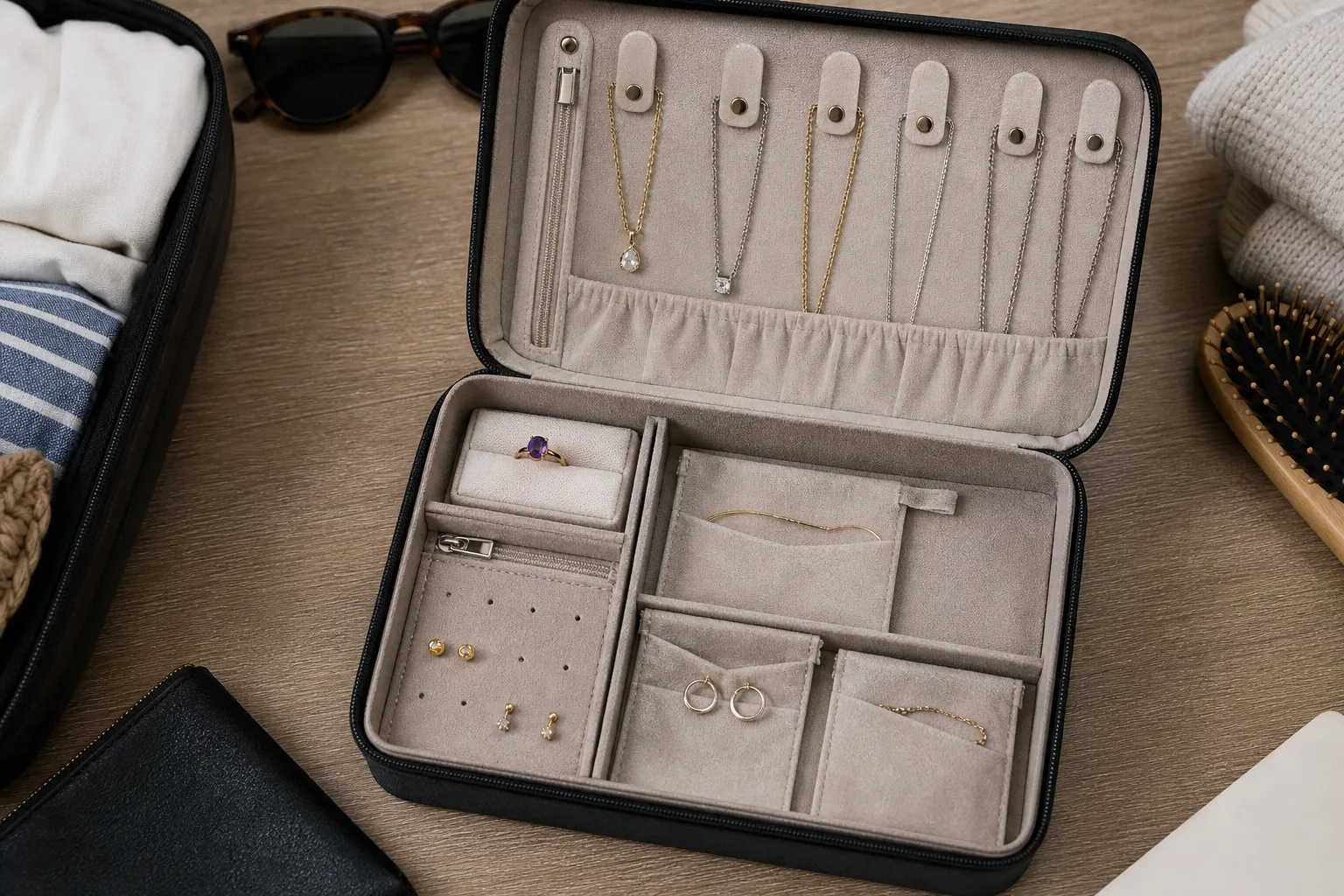
Travel adds another moisture variable. A jewelry travel case may move from a dry home to a bathroom counter, beach bag, hotel safe, airplane cabin, or humid resort room. A compact case can keep pieces organized while also enclosing whatever moisture or residue entered with them. Protective travel storage should therefore be understood as a packing structure, not a controlled environment.
If a product includes a drying packet or anti-tarnish component, the useful questions are specific: Is there guidance on replacement? Which materials is it intended for? Should it touch the jewelry? If those answers are missing, treat the feature as a possible helper, not the foundation of care.
Travel Protection Is About Movement, Not Capacity
A jewelry travel case is often judged by how many rings, necklaces, earrings, and bracelets it can hold. Capacity is only one variable. Travel creates motion, compression, rushed packing, and unpredictable surfaces. A case that looks organized on a dresser may behave differently inside a suitcase.
Check Internal Movement
A necklace channel that leaves chains loose may still allow tangling. A ring roll that compresses tall settings may put pressure on prongs or stones. An earring panel may keep pairs together while letting longer earrings swing into other pieces. A bracelet compartment may be too shallow for sculptural forms.
Separate by Form
“Necklaces here, earrings there” is not always enough. A fine chain, pointed pendant, rigid collar, and strand of beads do not need the same treatment. Modular travel architecture is useful when it lets the owner adapt with small bags, removable panels, adjustable dividers, or a dedicated sleeve.
Consider the Case Exterior
A soft roll may be light and easy to pack but weak against compression. A rigid case may reduce crushing risk but take more room and still need internal separation. A zip pouch may suit one sturdy bangle but not several chains.
A stronger travel system is usually layered
- Pack pieces dry and reasonably clean.
- Separate chains, posts, raised settings, and delicate surfaces.
- Use structure for pieces that should not bend or crush.
- Avoid overfilling compartments until they create pressure points.
- Give fragile, high-value, or sentimental pieces handling that matches their importance.
This does not guarantee that travel damage will not happen. It reduces avoidable friction, tangling, and compression.
Mixed Metals and Mixed Materials Change the Storage Plan
Many owners store by occasion: everyday pieces, formal pieces, vacation pieces, symbolic pieces, heirlooms. That feels natural, but it can hide material conflicts.
A single tray may hold sterling silver, gold, gold-plated pieces, costume jewelry, amethyst rings, beaded bracelets, pearl-like elements, enamel, plated chains, and unknown alloys. A system that works for one material may not suit another. This article cannot claim that storing silver and gold together creates a specific rate of tarnish, or that a particular anti-tarnish system solves mixed-metal concerns. The better habit is simpler: when materials differ, separate first and generalize second.
This is especially important for jewelry with unknown construction. A vintage pendant, plated chain, repaired ring, glued setting, or inherited piece may have care needs that are not visible. For jewelry that is valuable, old, treated, porous, plated, sentimental, or structurally uncertain, direct guidance from a jeweler, maker, or conservator is stronger than a universal storage rule.
Amethyst pieces sit between mineral appreciation and wearable design. The stone may be the emotional center, but storage must also account for the setting, finish, adhesive, chain, clasp, and nearby materials. A raised amethyst ring needs different space than a flat pendant. A beaded amethyst bracelet needs different packing than a prong-set cocktail ring. A pendant worn for symbolic reasons still needs ordinary physical care.
The more mixed the collection, the more useful sequential compartmentalization becomes: group by vulnerability, then by form, then by frequency of use. Daily pieces should be easy to return to their places. Rarely worn pieces can be given more deliberate protection. Travel pieces should be selected before the case is packed, not forced into whatever slot remains.
Unsupported Storage Claims Have a Recognizable Sound
Storage marketing often uses confident language because confidence sells. A cautious jewelry owner can learn to separate practical features from unsupported performance promises.
Practical Features
A practical feature is visible or verifiable from the product itself: individual compartments, padded dividers, a firm shell, necklace hooks, snap tabs, removable pouches, ring rows, earring panels, a closure that stays shut, or dimensions that match the jewelry. These features can be judged against the owner’s actual pieces.
Performance Promises
A performance promise reaches further: preventing tarnish, stopping corrosion, controlling humidity to a precise range, protecting every gemstone, neutralizing environmental agents, or making travel damage unlikely in broad conditions. Those claims require stronger evidence than this page has.
This is where layered storage architecture is useful. It shifts attention away from a miracle material and toward reduced exposures:
- Separation limits piece-to-piece contact.
- Structure reduces bending, crushing, and uncontrolled motion.
- Clean, dry storage avoids enclosing obvious residue and moisture.
- Clear layout reduces hurried handling.
- Selective travel packing reduces how many vulnerable pieces are in motion.
A layered system does not need to be expensive. It needs to match the jewelry. A small collection may need only a divided tray, individual soft sleeves, and one structured travel case. A larger collection may need a home drawer, anti-tarnish-intended inserts for certain metals, hanging space for chains, and separate travel modules. An heirloom collection may need professional advice before any storage upgrade.
The boundary is straightforward: trust features you can inspect, treat performance language as conditional, and ask for documentation when a product claims a technical effect.
A Decision Frame for Home and Travel
When comparing protective jewelry storage systems, start with the collection rather than the container.
- First, identify the recurring problem. Do necklaces tangle? Do earrings lose their partners? Do rings rub against each other? Do plated pieces dull quickly? Do travel pouches come back chaotic? Do amethyst settings sit high enough to catch on fabric? The answer determines the storage priority.
- Second, separate home needs from travel needs. Home storage can be spacious and visible. Travel storage must control movement in a smaller footprint. A beautiful home box may be too bulky for travel; a compact travel roll may be too compressed for daily storage.
- Third, decide which pieces deserve extra caution. Valuable, antique, sentimental, plated, fragile, treated, repaired, or structurally unusual jewelry should not be forced into generic advice. For those pieces, follow guidance from the jeweler, maker, manufacturer, or a qualified preservation professional.
- Fourth, read technical claims narrowly. If a product mentions Intercept technology, anti-tarnish lining, humidity control, or reactive materials, look for what the material is, what it is intended to do, which jewelry it suits, how long it lasts, and whether replacement is needed.
- Finally, test the organization in ordinary terms. Ask whether anything can rub, bend, knot, scratch, press, close under pressure, or require disturbing five items just to remove one.
Those questions are more useful than a broad promise printed on a tag.
The Quiet Standard: Less Contact, Less Confusion, Fewer Rushed Choices
The strongest Protective Storage Systems do not make jewelry invulnerable. They make poor handling less likely.
For home, that means every piece has enough room and can be returned without friction or guesswork. For travel, it means the case resists internal chaos: chains restrained, earrings paired, rings protected from pressure, rigid pieces kept away from delicate ones, and damp or residue-covered jewelry not sealed away casually. For anti-tarnish intent, it means choosing products with clear documentation when technical claims matter and staying skeptical when the language is broad but the support is invisible.
That is the architecture of a jewelry sanctuary: not a single box, not a miracle lining, and not a universal humidity rule. It is a practical system that reduces avoidable exposure, limits abrasion and tangling, respects material differences, and leaves room for specialized guidance when the piece deserves more than general advice.