Amethyst View
home / geology of amethyst / The Hematoid Distinction: Science of Pink Amethyst
2026 Mineralogical Standard

The Hematoid Distinction: Unveiling the Science of Pink Amethyst Mineralogy

In the shifting landscape of 2026, the global mineral collecting market has evolved into an appreciation for empirical geometry and mindful aesthetics. At the absolute forefront is Pink Amethyst Mineralogy. Unlike the massive, cloudy formations of traditional Non-Rose Quartz, this rare Patagonian treasure derives its hue not from titanium, but from microscopic Iron Oxide Inclusions. Formed deep within Patagonia Geology, these crystals grow in euhedral isolation, providing a distinct visual anchor for Hematoid Quartz interior design and tactile focus habits. Stop treating massive quartz and euhedral amethyst as interchangeable commodities. The physical and structural disparities are undeniable.

The Veteran's Ledger: The Ugly Truth About Patagonian Sourcing

I have spent over a decade navigating the secondary mineral markets, and the reality of sourcing true hematoid quartz from the Neuquén Basin in Patagonia is far less romantic than the glossy Instagram reels suggest. The sheer volume of artificially dyed, chemically treated chalcedony flooding the current market is staggering. If you are purchasing a piece online based solely on a saturated, uniform pink hue, you are likely buying a manufactured illusion.

True Patagonian Pink Amethyst is rarely a homogeneous color. When you handle a raw, unpolished geode straight from the basaltic cavities, the first thing you notice is the inconsistency. The color zoning is harsh. You will see bands of deep, almost bloody rust—the concentrated hematite—abruptly transitioning into pale, smoky quartz or completely transparent points. It feels gritty. The matrix rock often sheds fine, abrasive particulate matter that will permanently scratch a glass display case if you drag it even a millimeter.

There is a significant trade-off when dealing with these specimens. The very iron oxide inclusions that give the quartz its desirable aesthetic also compromise its structural integrity. Hematite interrupts the continuous silicon dioxide lattice. This means hematoid quartz is inherently more brittle than standard clear or titanium-based rose quartz. I have seen a $2,000 euhedral cluster shatter under the minor pressure of a brass mounting caliper simply because a microscopic iron fissure gave way. The visual reward is high, but the mechanical fragility is a constant, unavoidable liability.

We need to dismantle the myth of the "perfect" specimen. Perfection in this specific mineralogical subset usually indicates heavy human intervention—acid dipping, fracture filling with optic resins, or outright synthetic growth. Embracing the hematoid distinction means accepting the rust, the asymmetrical growth patterns, and the fragile nature of iron-rich silicates. It requires a shift from passive consumption of "pretty stones" to an active, informed curation process where you understand exactly what physical object occupies space on your desk.

The 2026 Paradigm: Redefining Hematoid Quartz

Understand the critical pivot in how geological curators and architectural designers approach these specimens today. The era of generalized labeling is over; structural accuracy dictates value.

The Era of Geometric Appreciation & Safe Curation

  • Identification: Strict separation of titanium-based Rose Quartz versus Iron Oxide-based Pink Amethyst via visual microscopy and origin tracking.
  • Form: Demand shifted to raw, untouched euhedral geodes to appreciate natural fractal geometry and undisturbed crystal termination points.
  • Application: Utilized primarily as tactile anchors for mindful desk routines (leveraging physical weight) and by interior architects for biophilic design integrations.
  • Care: Focus entirely on gentle, chemical-free preservation techniques to protect the natural, delicate hematite bands from dissolution.
The Veteran's Ledger: The Friction of the Paradigm Shift

The transition from the generic "Rose Quartz" terminology of 2025 to the strict "Hematoid Pink Amethyst" standard of today was not seamless. It caused massive friction in the supply chain. I recall reviewing manifests from traditional Brazilian distributors who were utterly confused when architectural clients began rejecting shipments of massive, high-grade rose quartz simply because it lacked euhedral faces and iron speckling. The market fundamentally misunderstood what the end-user was beginning to value.

This shift wasn't driven by an abstract appreciation for geology; it was driven by tactile and visual utility. A polished sphere of rose quartz is visually monotonous. It offers no fractal complexity for the eye to follow. It slides off a desk. It feels manufactured. In contrast, a raw hematoid geode is jagged, heavy, and complex. When you run your thumb across the termination points, you feel the sharp edges of the silica lattice. This provides immediate, non-digital sensory feedback. In an era saturated with smooth glass screens and frictionless touchpads, users began craving harsh, tangible geometry.

However, this demand for raw geometry introduced significant curation challenges. The outdated 2025 approach allowed dealers to tumble away imperfections. A cracked stone simply became a smaller polished stone. The 2026 standard demands intact geodes. Mining these requires agonizingly slow, low-impact extraction methods in the Neuquén Basin. You cannot dynamite a cavity containing delicate euhedral crystals. You have to chisel them out by hand. This drastically reduces yield and inflates the cost. The trade-off is clear: to obtain the specific biophilic and tactile benefits of natural hematoid formations, the consumer must absorb the exponentially higher labor costs of careful extraction.

Decoding Pink Amethyst Mineralogy

Rose Quartz is colored by titanium and manganese impurities dispersed evenly within massive (formless) quartz. True Pink Amethyst features distinct euhedral (well-formed) geometric faces colored specifically by localized hematite (iron oxide). Explore the compositional data and the visual structural disparity below.

Elemental Chromophores Matrix

Comparing the primary trace elements responsible for coloration. Notice the overwhelming dominance of iron oxide in the hematoid specimens.

The "Micro-Lattice" X-Ray

Drag the slider to peel away the cloudy, formless appearance of standard massive Rose Quartz and reveal the sharp, iron-flecked geometric crystal lattice of true euhedral Pink Amethyst.

Massive Quartz
Euhedral Lattice
The Veteran's Ledger: The Chemistry of Disappointment

Let’s talk about the chart above, specifically the Hematite (Fe₂O₃) column. Data visualization makes it look clean, but the physical reality of iron oxide in a silica matrix is messy. When we analyze these stones under a loupe, the "pink" isn't actually a solid color. It is a dense constellation of microscopic, rust-colored red dots suspended in clear quartz. From a distance, the human eye blends these dots into a soft pink or peach tone. Up close, it looks like someone flicked red paint into clear glass.

This structural reality causes frequent disappointment for new collectors. They expect the uniform, milky opacity of titanium-based rose quartz. When they receive a high-grade hematoid amethyst, they often complain that it looks "dirty" or "spotted." I have to explicitly warn clients: if you want a flawless, solid pink color block, buy tinted glass. If you want a natural mineral, you must accept the visual noise of the iron inclusions.

Furthermore, the presence of these elemental chromophores changes the thermal and tactile experience. Clear quartz feels noticeably different in the hand than heavily included hematoid quartz. The iron density slightly alters the specific gravity. It feels marginally heavier, denser. When I use one of these pieces as a desk anchor during long coding sessions, the thermal mass is striking. It pulls heat from your hand rapidly. This cold shock is incredibly useful for breaking a state of digital fatigue, but it also means the stone will eventually saturate with your body heat. It is not a magical, endlessly cold object; it is subject to standard thermodynamic limits. You have to put it down and let it reset. Acknowledge the physical limitations of the material, and it becomes a highly functional tool rather than an esoteric disappointment.

Functional Aesthetics: The Desk & The Room

Beyond mere chemistry, the substantial physical weight and complex geometry of Patagonian geodes serve as exceptional focal points for mindful productivity pauses and structured interior architecture.

The Tactile Focus Anchor

Holding a dense, cold mineral provides immediate tactile feedback, interrupting repetitive digital tasks. Use this visual pacer alongside the physical weight of your crystal to establish a strict 1-minute mindful pause during a demanding workday.

Ready to Focus

Spatial Grid Architect

Select a geode representation and place it within the schematic room to reveal interior design principles for balancing visual weight, natural light interaction, and spatial flow.

Your Collection (Click to Select)
Window Sill
Executive Desk
Bookshelf
Entryway
Select a piece to begin styling.
The Veteran's Ledger: The Logistics of Heavy Minerals in Spaces

The interactive sandbox above illustrates theoretical placements, but executing this in physical reality introduces harsh logistical friction. Let’s discuss the reality of incorporating a 50kg (roughly 110 lbs) hematoid geode into an executive office or luxury entryway. Clients frequently request these massive statement pieces after seeing highly stylized architectural digests, entirely underestimating the infrastructure required to support them.

First, consider the structural load. A standard modern floating bookshelf or a glass-topped executive desk will absolutely fail under the concentrated point load of a 50kg irregular stone base. I have seen a tempered glass table shatter instantly when a client carelessly rested a large specimen on it, failing to realize that the Mohs 7 hardness of quartz easily scratches and compromises the tension of the glass. If you are placing a large piece, you must commission a custom, load-bearing steel or reinforced hardwood plinth. This often doubles the total cost of the installation.

Secondly, consider the tactile reality of the "Desk Anchor." Using a smaller, 1kg piece as a visual and tactile focus point is an excellent habit. I use one daily. When staring at lines of code for hours, reaching out to grip the cold, jagged surface of the crystal provides a sharp, physical reset to the nervous system. However, it is fundamentally distracting if placed incorrectly. If it sits in your primary line of sight, the complex fractal geometry competes with your monitor for visual attention. I strongly advise placing tactile anchors slightly out of immediate peripheral vision—on the non-dominant hand side, requiring a deliberate physical reach to interact with it. It should be a destination for your hand during a pause, not an obstacle during workflow.

Finally, there is the issue of natural light. Placing a pink amethyst on a window sill looks breathtaking at golden hour. The sunlight penetrates the euhedral points and illuminates the iron bands like fire. But the ugly truth of window placement is dust and thermal expansion. The micro-cavities in the geode are dust traps, and sitting next to an open window accelerates accumulation. Furthermore, rapid temperature fluctuations near drafty windows can, over years, exacerbate the micro-fissures around the hematite inclusions. You trade long-term pristine condition for short-term visual drama. As a curator, I usually recommend controlled, warm LED spotlights (around 3000K) over direct sunlight exposure.
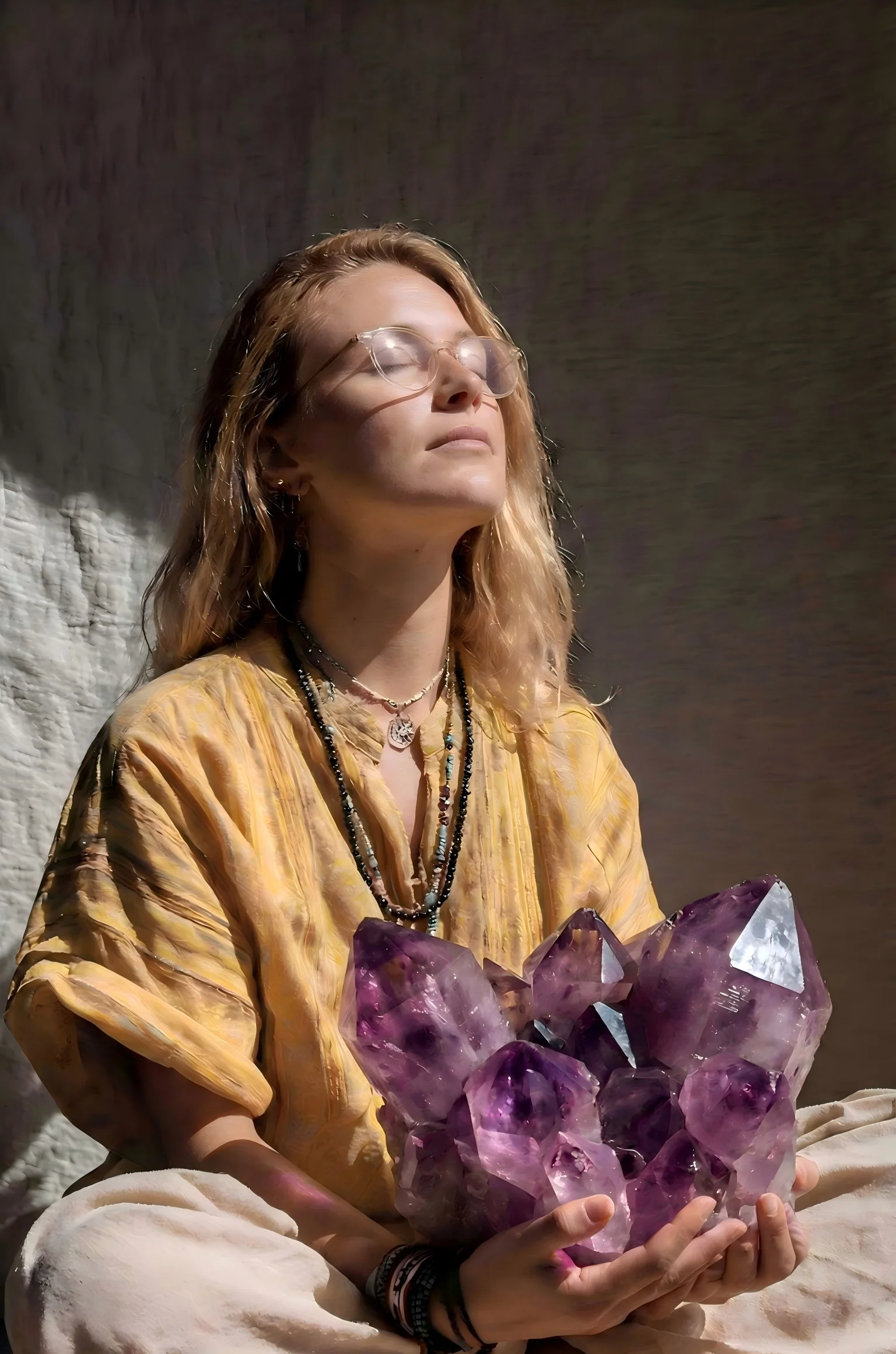
The Gentle Collector: Safe Restoration

The use of harsh industrial acids for rapid mineral cleaning is a destructive shortcut. High-end curators prioritize gentle, non-destructive methodologies to preserve the natural iron oxide banding without risking the structural integrity of the delicate crystal matrix.

  • Chemical Abstinence: Strictly avoid solvents that alter the natural surface tension or dissolve localized iron deposits.
  • Distilled Wash: Utilize only distilled water to prevent the calcification and hard water spotting inherent in tap water.
  • Mechanical Softness: Employ natural soft-bristle tools to gently coax particulate matter from deep drusy cavities.
The Veteran's Ledger: A Disaster with Industrial Acid

The interactive simulation above shows a quick, satisfying sweep of a brush. The physical reality of cleaning a raw hematoid geode is an exercise in extreme, agonizing patience. I learned this the hard way. In 2023, I acquired a breathtaking, heavily encrusted specimen straight from an artisanal miner. Impatient to reveal the pink points beneath the heavy basaltic clay and minor goethite staining, I bypassed the gentle method and submerged the piece in a heated ultrasonic bath laced with a standard iron oxalate solution—a common, albeit aggressive, industry shortcut.

The results were catastrophic. The ultrasonic vibrations, combined with the chemical attack on the iron inclusions, didn't just clean the stone; it dismantled it. The acid rapidly dissolved the microscopic hematite bands that were holding weaker cleavage planes together. Within twenty minutes, the ultrasonic waves blasted those weakened planes apart. What went into the bath as a solid 4kg cluster came out as a pile of sterile, unnaturally glassy pink shards sitting in a slurry of mud and dissolved iron. I ruined a significant specimen in an afternoon to save a few hours of labor.

Since that failure, I enforce the "Gentle Collector" protocol strictly. It is tedious. You will spend hours hunched over a sink with a soft horsehair brush, a dental pick (used with extreme caution only on the matrix rock, never the quartz points), and a continuous flow of distilled water. You will gently brush the same cavity fifty times to dislodge stubborn clay. Your hands will cramp. But this manual, low-impact friction is the only way to preserve the delicate, rusty aesthetic of true pink amethyst. Stop looking for chemical shortcuts. If you lack the patience to manually groom the specimen, you should purchase pre-curated pieces from established handlers.

Academic & Institutional References

  • [1] Mineralogical Society of America. (2024). Iron Oxide Inclusions in Cryptocrystalline and Macrocrystalline Quartz Varieties. msaweb.org. Examines the structural weakening caused by dense hematite bands.
  • [2] International Institute of Biophilic Design. (2025). Tactile Interventions: Natural Geometries in High-Stress Workspace Environments. biophilic-design.org. Discusses the psychological relief provided by fractal textures compared to smooth industrial surfaces.
  • [3] Geological Survey of Argentina. (2023). Cretaceous Volcanic Stratigraphy and Geode Formation in the Neuquén Basin. segemar.gov.ar. Details the precise environmental conditions required for euhedral amethyst growth in Patagonia.
Sarah Whitmore
Principal Investigator

I’m Sarah Whitmore, a U.S.-based crystal practitioner and spiritual writer with a long-term focus on Amethyst, meditation, and intuitive awareness.

Amethyst Enthusiasts