The Mechanics of Amethyst Degradation: Mitigating Tetravalent Iron Collapse
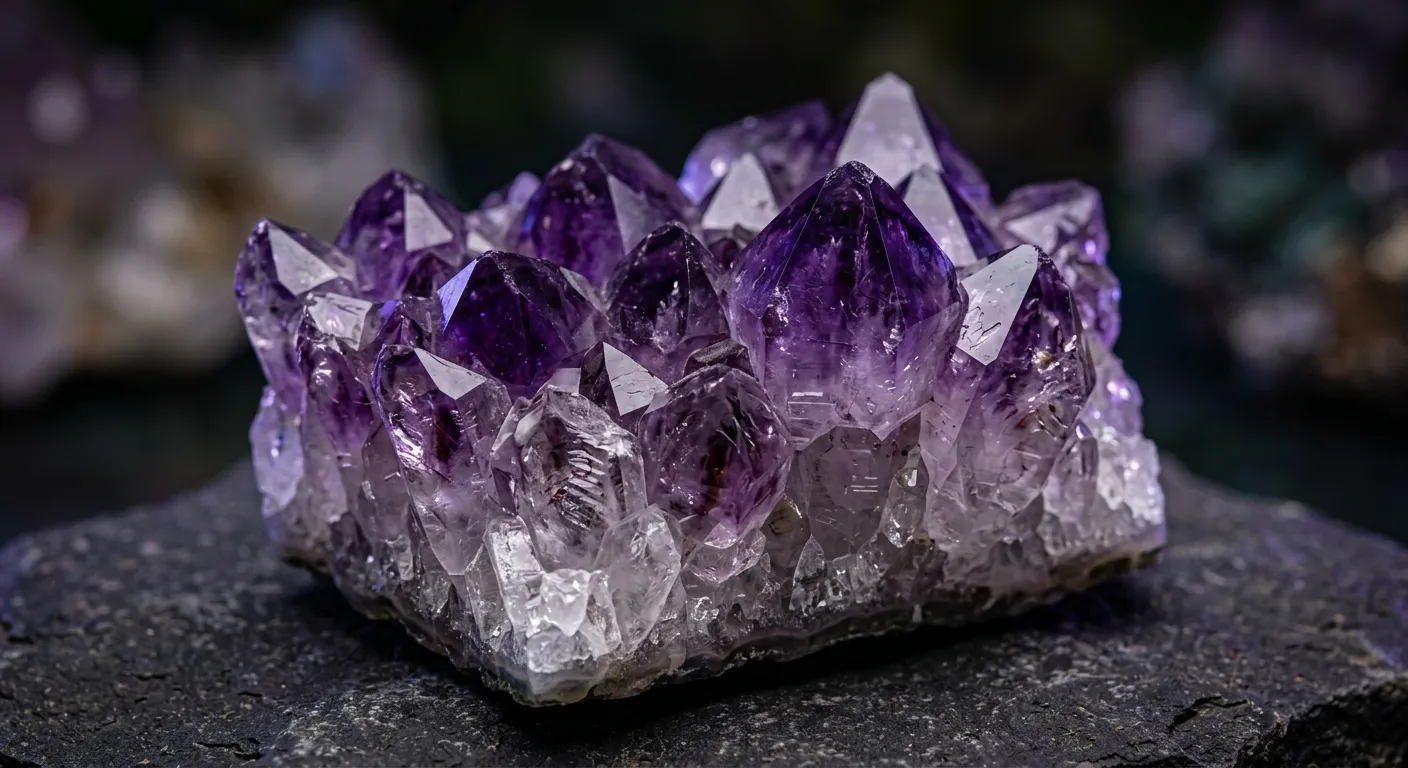
Pay attention to your collection. You are likely observing a once-deep purple amethyst that currently resembles pale, washed-out glass. Working in the lapidary and mineral-preservation sector for over twenty years, professionals witness this specific degradation constantly. You did not purchase a counterfeit specimen; industry observers note this is a documented physical mechanism known as tetravalent iron collapse.
The purple saturation within your quartz matrix does not rely on a standard pigment. Industry specialists recognize it as a highly unstable structural color center generated by trace iron impurities interacting with background environmental radiation over geological time. Introduce incorrect ambient variables, and practitioners report those iron atoms drop their charge, causing the visual saturation to disappear entirely.
Immediate Diagnostic Protocol
Initiate the diagnostic process immediately. Pinpoint the exact vector responsible for your specimen's degradation and execute rapid triage protocols to arrest further saturation loss.
The Photonic Vector
Inspect the display location. Has the specimen rested on a windowsill? Industry consensus indicates that prolonged exposure to sunlight acts as the primary catalyst for this mineral's visual degradation. UV photons systematically dismantle the fragile iron electron configuration.
The Thermal Vector
Check the proximity to radiators, high-output halogen bulbs, or assess if you applied thermal extraction techniques to vintage jewelry. If the quartz matrix is heated to more than 300-400°C, lapidary experts observe it does not merely lose saturation—it undergoes a structural phase shift toward the yellow-orange spectrum associated with citrine.
The Chemical Vector
Review your handling procedures during routine cleaning. You must strictly keep away from alcohol and sanitizers, alongside aggressive household solvents. Professionals report these chemicals degrade the host matrix and strip the surface polish, resulting in a visually flat and lifeless presentation.
🛠️ Required Hardware & Secondary Options
Before running the extraction and preservation sequence, organize the tools required on your workbench. Precision is mandatory for specimen recovery.
The Primary Apparatus
- ● LED Display Modules: Install strictly 3000K-4000K diodes emitting zero UV radiation.
- ● Digital Hygrometer/Thermometer: Mount this inside your display housing. Maintain the ambient temperature strictly below 25°C (77°F).
- ● 100% Pure Acetone: Procure lapidary-grade solvent for jewelry and resin separation.
- ● Distilled Water & Mild Surfactant: Mix these for abrasive-free particulate removal.
- ● Soft Bristle Brush: Obtain a jeweler-grade tool with natural fibers.
Budget-Conscious Workarounds
Workaround 1 (Illumination): If museum-grade UV-filtered glass enclosures exceed your budget, acquire a roll of automotive ceramic UV-blocking film (50% or 70% VLT). Apply this material directly to the glass panels of your standard retail display cases.
Workaround 2 (Particulate Removal): Bypass high-frequency ultrasonic gem cleaners. Industry technicians note these machines frequently fracture heavily included quartz. Instead, deploy standard baby shampoo heavily diluted in room-temperature, double-filtered water.
⚙️ Core Operational Sequence
Step 1: Baseline Triage and Environmental Isolation
Arrest the active degradation immediately. Extract the mineral from its current setting and establish a visual baseline to verify if the saturation drop has stabilized.
Transport the specimen into a controlled environment utilizing strictly artificial, non-UV illumination. Position the piece against a neutral grey or white matte backdrop and capture high-resolution macro documentation. Record the current saturation metrics. Moving forward, handle this specimen with extreme caution. Direct irradiation with UV light remains strictly prohibited. When processing a massive inventory, always separate natural from lab grown materials. Handlers report that synthetic amethyst frequently exhibits distinct color-center stability thresholds, occasionally degrading at an accelerated rate under intense commercial gallery lighting.
Lock your camera's white balance to 5000K during baseline documentation. Automatic white balance algorithms will artificially compensate for the saturation loss, generating inaccurate data regarding the specimen's actual state over time.
If the specimen exhibits a muddy yellow or brown tint rather than simple paling, do not initiate rapid cooling procedures. Technicians note this indicates severe thermal shock. Maintain the piece at room temperature; observers state the transition toward the citrine spectrum is permanent.
Step 2: Safe Extraction from Damaged Settings
Clients frequently present faded amethyst trapped within degraded memorial resin or substandard epoxy mounts, requesting immediate extraction for remounting.
Novice handlers frequently obliterate their specimens by melting out resin with blowtorch. Never execute this technique! Extreme thermal shock instantly fractures the quartz matrix and neutralizes any remaining structural color. Instead, deploy a protracted chemical dissolution tactic. Submerge the entire assembly by soaking it in acetone inside a hermetically sealed glass container for 24 to 48 hours. The solvent expands and degrades the polymer bonds without generating thermal energy, permitting you to extract the stone manually using a wooden dowel.
Suspend the metalwork within the acetone utilizing a copper wire hook. This prevents the specimen from resting in the dissolved polymer sludge at the base of the container.
If the polymer converts into a viscous gel that refuses to release the mineral, do not apply mechanical leverage with steel tools. Transfer the assembly into a fresh acetone bath for an additional 24-hour cycle until the resin achieves total liquefaction.
Step 3: Mechanical Cleaning and Surface Prep
Following isolation and extraction, strip the matrix of organic lipids, epidermal cells, and atmospheric particulates. These contaminants scatter light and artificially amplify the visual degradation.
Combine eight ounces of distilled water with two drops of a gentle surfactant. Submerge the mineral and agitate the exterior using the soft-bristle brush. Focus mechanical action on the pavilion facets where debris accumulates. If you operate lapidary equipment to resurface scratched facets, heed this operational mandate: do not grind dry. Airborne silica particulates present severe mechanical hazards to workshop ventilation systems and operators. Industry safety guidelines mandate that you run a continuous coolant drip over your diamond wheels to suppress particulate generation and regulate surface friction temperatures.
When transporting specialized cleaning agents to trade events, always use small TSA approved bottle enclosures. Aviation cargo pressure differentials routinely rupture oversized, partially empty solvent containers, flooding adjacent equipment.
If microscopic white scaling appears within surface fissures post-wash, you are observing mineral deposits from hard water. Submerge the specimen in a 10% acetic acid (white vinegar) solution for exactly 15 minutes, followed by an immediate distilled water flush.
Step 4: Metaphysical and Traditional Handling Integration
Many practitioners incorporate amethyst into holistic frameworks. If you operate within this demographic, specific traditional handling routines frequently trigger the degradation.
Never position these minerals on windowsills to absorb solar energy. If traditional protocols require environmental exposure, execute them nocturnally under lunar illumination, or utilize dry earthen materials. You may sprinkle a mixture of salt and desiccated botanicals inside a basin, resting the specimen upon a protective textile barrier above the mixture (never permit coarse salt to abrade the polished facets). If the protocol dictates you must carve a protective symbol, engrave it directly into the wooden base of the display stand, never into the crystalline matrix. Should your routine necessitate liquid elements, anoint with a few drops directly onto the external display housing. Never apply oils to the mineral itself; practitioners observe that lipids penetrate micro-fissures and permanently alter the internal refractive index.
If utilizing combustible botanicals (like sage or palo santo) in the vicinity of your collection, maximize room ventilation. Heavy resinous smoke coats the crystalline exterior over time, severely depressing the optical return.
If essential oils breach a surface fracture, immediately submerge the specimen in a heated surfactant bath. The detergent action extracts the lipids prior to polymerization.
🛑 Operational Failures to Avoid
Veteran catalogers occasionally destroy premium specimens. Memorize these three critical operational errors to ensure you absolutely avoid replicating them:
1. The Ultrasonic Bath Trap
- The Error: Submerging heavily included or internally fractured amethyst into a high-frequency commercial ultrasonic tank.
- The Consequence: The acoustic cavitation targets the weakest structural junctions within the quartz, initiating catastrophic internal fracturing.
- The Correction: Execute manual washing protocols exclusively. Deploy a soft brush and tepid water. Reserve ultrasonic equipment strictly for corundum and diamond matrices.
2. The Dashboard Display
- The Error: Positioning an amethyst geode or faceted pendant on a vehicle dashboard.
- The Consequence: Sealed automotive interiors routinely exceed 70°C (160°F) during peak solar hours. Coupled with magnified photon bombardment through the safety glass, this environment guarantees rapid degradation. Observers note the tetravalent iron configuration collapses almost immediately.
- The Correction: Transport all specimens inside opaque, thermally insulated, padded enclosures. Never position them in direct alignment with automotive windows.
3. The "Re-Baking" Myth
- The Error: Operating under the assumption that processing the specimen in a residential kitchen oven will regenerate the purple saturation.
- The Consequence: You will permanently compromise the matrix. Thermal energy remains the primary antagonist of the structural color center.
- The Correction: Recognize that saturation loss operates as a unidirectional process outside of specialized laboratory environments. Proactive environmental control represents your sole defensive mechanism.
🧠 Advanced Diagnostic FAQ
Q1: Is there a mechanical procedure to reverse the degradation and restore the purple saturation?
Technician Response: Within a residential workspace? No. The visual purple relies on a specific [FeO4]0 structural center. Photon bombardment reduces the iron into a highly stable Fe3+ configuration. Reversing this requires stripping an electron. In heavily shielded, strictly regulated radiation facilities utilizing Cobalt-60 emitters, technicians note the color center can be regenerated. Lacking access to industrial gamma irradiation, the saturation loss remains permanent.
Q2: I subjected my specimen to solar exposure, but it transitioned to yellow instead of turning transparent. Explain the mechanism.
Technician Response: Solar radiation transmits both UV photons and infrared thermal energy. If the mineral rested at a magnified focal point (such as behind structural glass), the localized thermal buildup likely surpassed the critical threshold for atomic alteration. You did not simply neutralize the color center; you thermally forced the iron oxidation state to shift. Industry observers classify the resulting material as a low-grade citrine equivalent.
Q3: Can I safely run a mechanical polish over a degraded amethyst to improve its optical return?
Technician Response: Affirmative. Mechanical abrasion strictly alters external surface geometry; it does not interact with internal atomic color centers. You can mount the specimen on a lapidary arbor to regenerate a high-gloss finish. Strictly adhere to the primary lapidary directive: flood the wheel with coolant and do not grind dry.
Q4: How do I differentiate between photon-induced degradation and a specimen that naturally formed with low saturation?
Technician Response: Analyze the geometric distribution of the color zoning. Natural saturation rarely presents uniformly; it typically aggregates beneath the rhombohedral terminations (the apex points). If the apex points appear stark white while the lower matrix retains a faint purple phantom, technicians attribute this to photon damage, as the exposed terminations absorbed the primary radiation load. Conversely, if the matrix exhibits uniform, milky translucence throughout, lapidary experts classify it as a naturally low-grade hydrothermal formation.
Q5: Will standard LED illumination modules inside my display housing trigger saturation loss?
Technician Response: Standard warm-white diodes (calibrated under 4000K) project negligible UV radiation and generate minimal thermal output, rendering them the optimal hardware for specimen illumination. However, bypass "daylight" or "cool white" diodes (6000K+), and strictly eliminate halogen fixtures from your workspace, as they project massive amounts of destructive infrared energy.