Collector observation
The Dual Light Test: How to Spot the Difference Between $50 and $100 Per Carat
The Amethyst Dual Light Test compares the same amethyst under incandescent light and fluorescent light to see how well its purple color holds up. If the stone stays rich, balanced, and lively in both settings, that can support a stronger collector impression. It does not, by itself, prove that an amethyst belongs at $100 per carat instead of $50.
The real question is narrower: does the purple remain attractive when the light changes, or does it turn gray, brownish, patchy, washed out, or too dark?
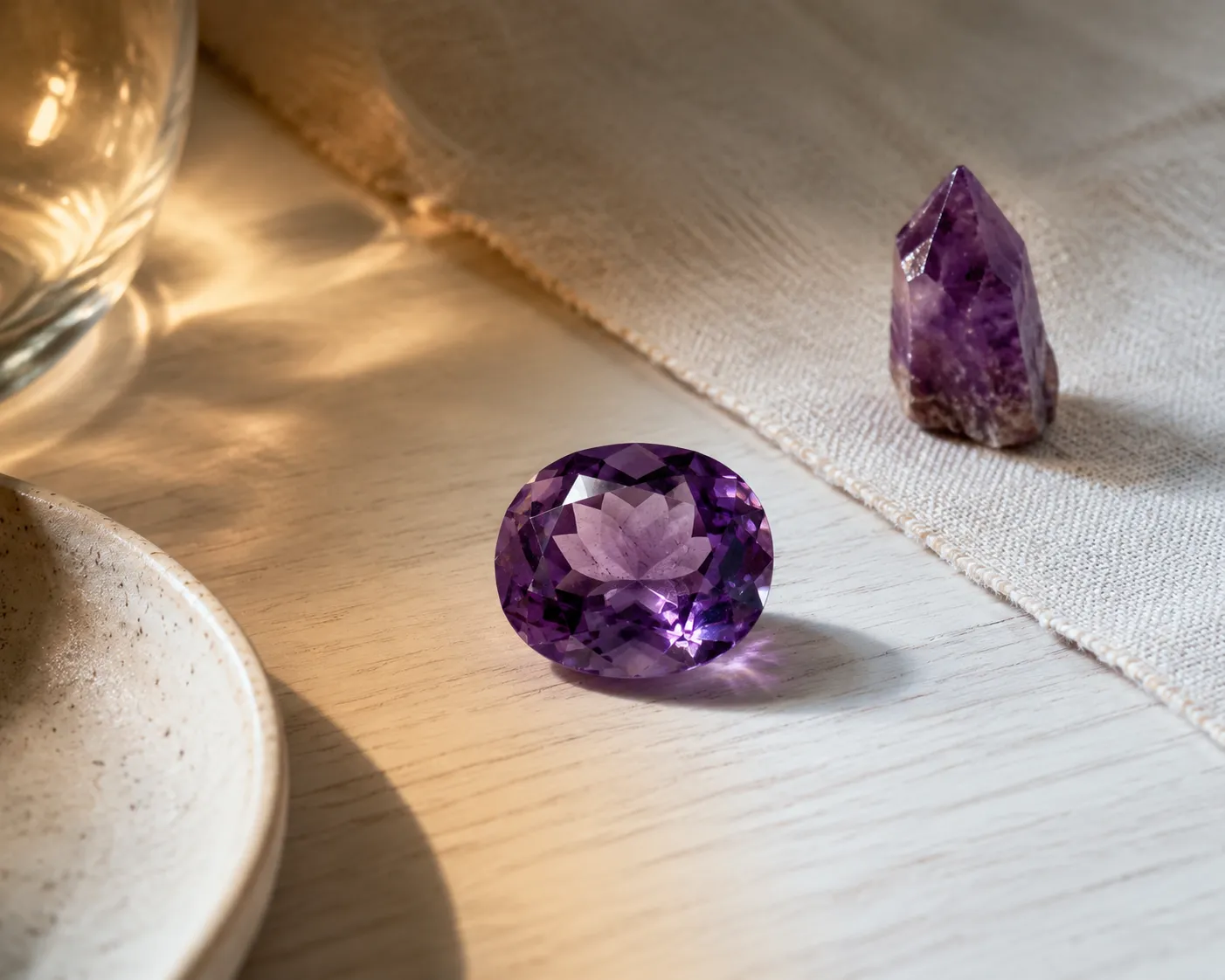
What the Amethyst Dual Light Test shows
Amethyst is the purple variety of quartz, and color is one of its most important visible quality factors. In collector and gem evaluation language, that color is usually judged through hue, tone, saturation, evenness, and visible color zoning.
The dual light test makes those traits easier to notice.
- Incandescent light or warm household light may make purple look warmer, redder, or deeper.
- Fluorescent light or cooler indoor light may make the same stone look bluer, flatter, sharper, or more gray.
- Comparing both helps show whether the color is broadly stable or dependent on one flattering light source.
This is not the same as calling amethyst a formal “color-change gemstone.” For this test, the useful issue is color stability: does the stone still read as pleasing purple quartz under ordinary warm and cool lighting?
A stone that looks lush under warm light but dull or uneven under fluorescent light may still be genuine amethyst. It may still be attractive. The test simply suggests that its strongest appearance depends more on lighting. A stone that keeps saturated purple in both conditions has a better visual case, but that case still needs to be weighed with clarity, cut, size, disclosure, and seller context.
How to run the test without reading too much into it
Keep the comparison simple. Use the same stone, the same viewing distance, and a neutral background if possible. The point is not to create a laboratory setting. It is to avoid judging one stone under flattering display light and another in a dull room.
A practical version looks like this:
- Place the amethyst on a white or neutral surface.
- View it under warm incandescent-style light.
- View it again under fluorescent or cool white light.
- Rotate the stone slowly, especially if it is faceted.
- Notice what changes and what stays consistent.
The best observations are specific rather than dramatic. Look for whether the amethyst remains a rich purple instead of sliding toward gray. Notice whether the saturation stays strong or becomes watery. Watch for brownish or bronze tints that weaken the purple. Check whether the color remains even, or whether bands and patches become obvious.
Color zoning matters because many amethysts have lighter and darker purple areas. In loose faceted stones, zoning may be easier to see against a white background, especially from different angles. Face-up, the cut can hide some unevenness, but it does not remove it.
Tone also matters. A very dark amethyst can look impressive in bright light, then lose life in weaker indoor light. If it turns inky or nearly black, its depth may be less useful than it first seemed. A pale amethyst may look consistent in both lights but still lack the saturation associated with finer material.
Useful notes might sound like this:
- “Medium-dark purple, still saturated under cool light.”
- “Warm light brings out red flashes, but fluorescent light makes it look gray.”
- “Attractive face-up, but zoning is clear against white.”
- “Deep tone, with brightness dropping in dimmer light.”
That language is more useful than relying only on labels such as “AAA” or “premium.” Seller grade labels can be convenient shorthand, but they are not a universal grading system that automatically converts into a fixed price per carat.
Why it cannot separate $50 from $100 per carat by itself
The $50 and $100 per carat comparison reflects a common buyer question: can a lighting test show which stone belongs in a higher bracket? The cautious answer is no. The Amethyst Dual Light Test can support a value judgment, but it cannot settle one.
Two stones may perform similarly under warm and cool light while differing in other important ways. One may be eye-clean while the other has visible inclusions. One may have better cutting, symmetry, or brightness. One may show distracting zoning from the side. One may come with clearer disclosure about treatment or origin claims.
Color itself is also more than darkness. A higher-looking amethyst usually needs a pleasing balance of hue, tone, and saturation. Deep purple can be beautiful, but if it becomes muddy or blackish, the depth works against the stone. A vivid medium-dark purple may look more alive than a darker stone with poor brightness.
The same caution applies to red or blue flashes. Seller descriptions often make flashes sound like a price code. They can point to an attractive appearance, but a flash seen at one angle under one light source is not the same as stable, desirable body color.
Cut can change the result as well. A well-cut amethyst returns light in a way that helps the color look lively. A poorly cut stone may show windows, dead areas, or uneven brightness that confuse the lighting comparison. In that case, the issue is not only color response; it is how the stone handles light.
Carat weight is not a shortcut either. Amethyst is available in many sizes, and larger stones do not always create the steep price jumps seen in some rarer gems. A large stone with dull color is not automatically stronger than a smaller stone with finer color and better cutting.
So the dual light test belongs near the beginning of evaluation, not at the end. It helps you decide whether the color deserves closer attention. It does not replace the rest of the judgment.
What can change the result
The same amethyst can look different depending on the light, background, setting, and cut. That is why this test is comparative, not absolute.
The light source matters
“Incandescent” and “fluorescent” are practical terms, not perfectly fixed conditions. Warm bulbs, cool office lighting, daylight-balanced lamps, and mixed room lighting can all shift appearance.
For a fairer comparison, avoid several light sources at once. Testing beside a sunny window while warm lamps and overhead fluorescent lights are also on may tell you more about the room than the stone.
The background and setting matter
A white background can reveal body color and zoning more clearly in a loose stone. A dark background can make color look richer. Metal settings can also influence perception: yellow metal may warm the purple, while white metal may make it appear cooler or crisper.
If the stone is already mounted, the test still has value, but it is less isolated. You are observing the amethyst as worn or displayed, not as a loose gem.
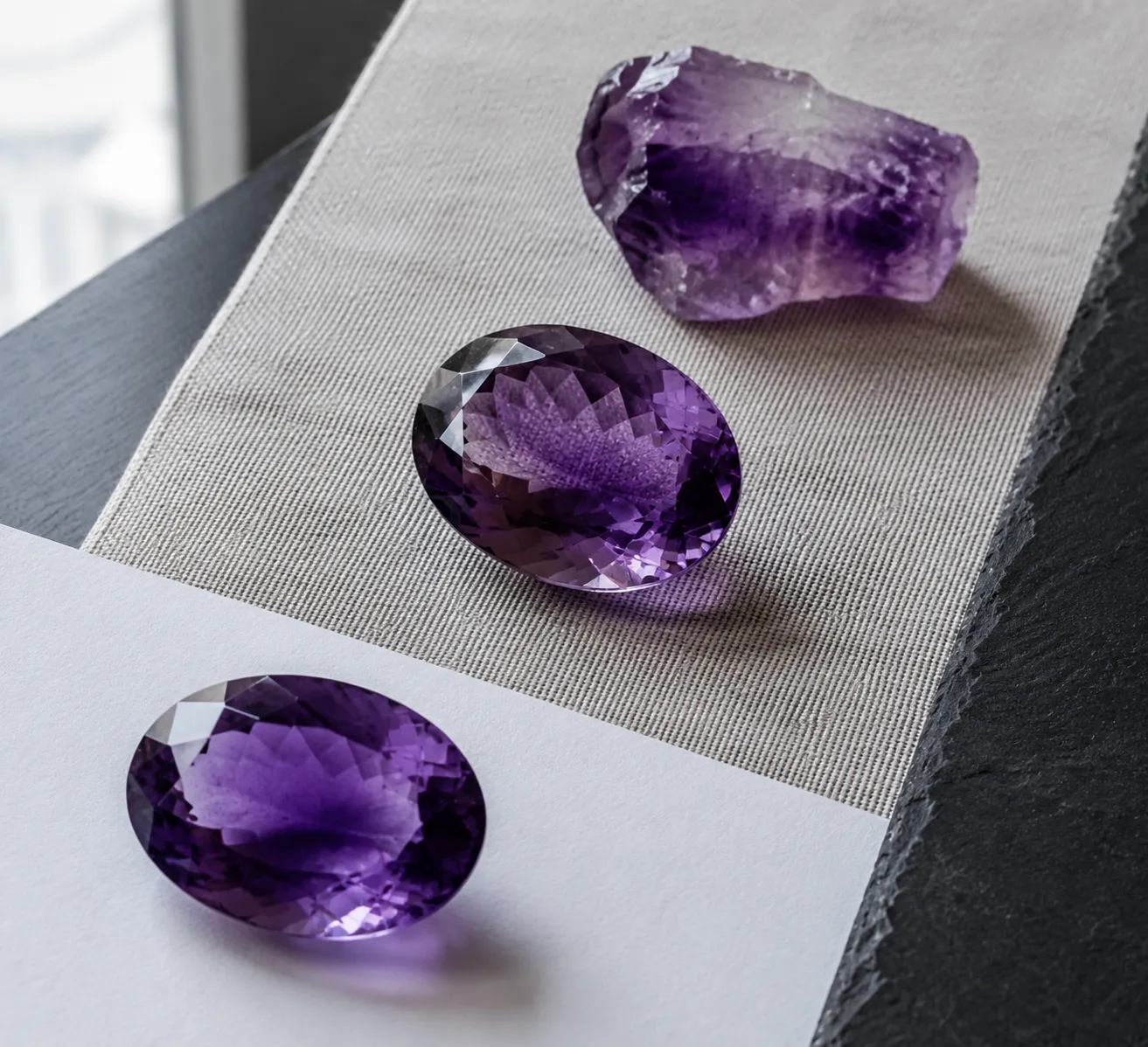
The cut and viewing angle matter
Faceted amethyst changes as it moves. Some angles show brightness; others show extinction, windowing, or uneven color. Rotate the stone slowly rather than judging from a single face-up view.
If a color issue appears only at one awkward angle, it may matter less. If the stone repeatedly looks gray, patchy, or blackish as it moves, the concern is stronger.
Treatment and origin claims need more than light
A home lighting comparison cannot confirm untreated status, natural origin, synthetic versus natural identity, or locality. It can only show how the visible purple behaves in two lighting conditions.
For higher-value purchases, disclosure, documentation, or a qualified gemological opinion carries more weight than a desk-lamp comparison.
Common confusion around “color change” and price tiers
One misunderstanding is that any visible shift under warm and cool light means higher quality. That is too simple. Many colored stones shift somewhat as lighting changes. The better question is whether the amethyst remains attractive, saturated, and reasonably even across ordinary conditions.
Another confusion comes from compact seller descriptions. A listing may combine “deep purple,” “eye-clean,” “excellent cut,” “red flashes,” an origin name, and a per-carat price. That can make value look like a checklist. In practice, each term needs context. “Deep” may mean rich, or it may mean too dark. “Eye-clean” is helpful, but it does not rescue weak color. An origin name may be interesting, but it does not override the visible quality of the individual stone.
The $50 versus $100 per carat idea should be read as a market-shaped comparison, not a universal dividing line. A stone that holds strong color in both incandescent and fluorescent light may be more plausible as higher-quality material than one that only looks good under a warm bulb. The final price still depends on the whole gem and the selling situation.
A short checklist for the Amethyst Dual Light Test
Use this checklist when comparing amethyst under incandescent light and fluorescent light:
- Does the purple remain rich in both lights?
- Does the stone become gray, brownish, dull, or washed out?
- Is the tone deep but still bright, or does it become too dark?
- Is the color even, or does zoning become obvious?
- Do flashes support the body color, or distract from weak saturation?
- Are inclusions visible enough to affect the overall impression?
- Does the cut keep the stone lively as it moves?
- Are treatment, origin, and seller claims documented rather than assumed?
If most answers point toward stable, saturated, even purple, the stone has a stronger visual profile. If several answers point toward dullness, patchiness, or overdependence on one light source, a lower-value interpretation becomes more reasonable. Still, the checklist is a guide to observation, not a price certificate.
FAQ
Is the Amethyst Dual Light Test an authenticity test?
No. It can help you observe color stability, but it cannot confirm that an amethyst is natural, synthetic, treated, untreated, or from a particular locality.
Should expensive amethyst look exactly the same under both lights?
Not exactly. Some shift is normal when lighting changes. The stronger sign is that the stone remains attractive, saturated, and reasonably even under both warm and cool light.
Can one bad lighting result lower the value?
It can raise a useful question, especially if the stone becomes gray, brownish, patchy, or overly dark in ordinary lighting. Value still depends on the full gem evaluation, not one viewing condition.
The dual light test is best used as a disciplined pause. It asks whether an amethyst’s purple beauty survives a change of light. If it does, that supports a higher-quality impression. If it does not, the stone may still be appealing, but the case for a higher per-carat value becomes weaker. Either way, the result remains one clue among several—not the final word on whether an amethyst belongs at $50 or $100 per carat.