Desk Feng Shui for focus
The "Focus Grid": Feng Shui Your Desk for Deep Work in 2026
The simplest way to use Desk Feng Shui for focus is to turn your desk into a five-zone “Focus Grid”: support behind you, open space in front of you, active tools on the left, quieter objects on the right, and a clear center for the task you are doing now.
In feng shui language, this borrows from the Black Tortoise, Vermilion Bird, Green Dragon, White Tiger, and the open bright hall, or ming tang. In everyday desk terms, it means fewer visual interruptions, less searching for tools, and one obvious place for your attention to land. Amethyst can be included as a small symbolic cue, but it should not crowd the work zone or be treated as a productivity guarantee.
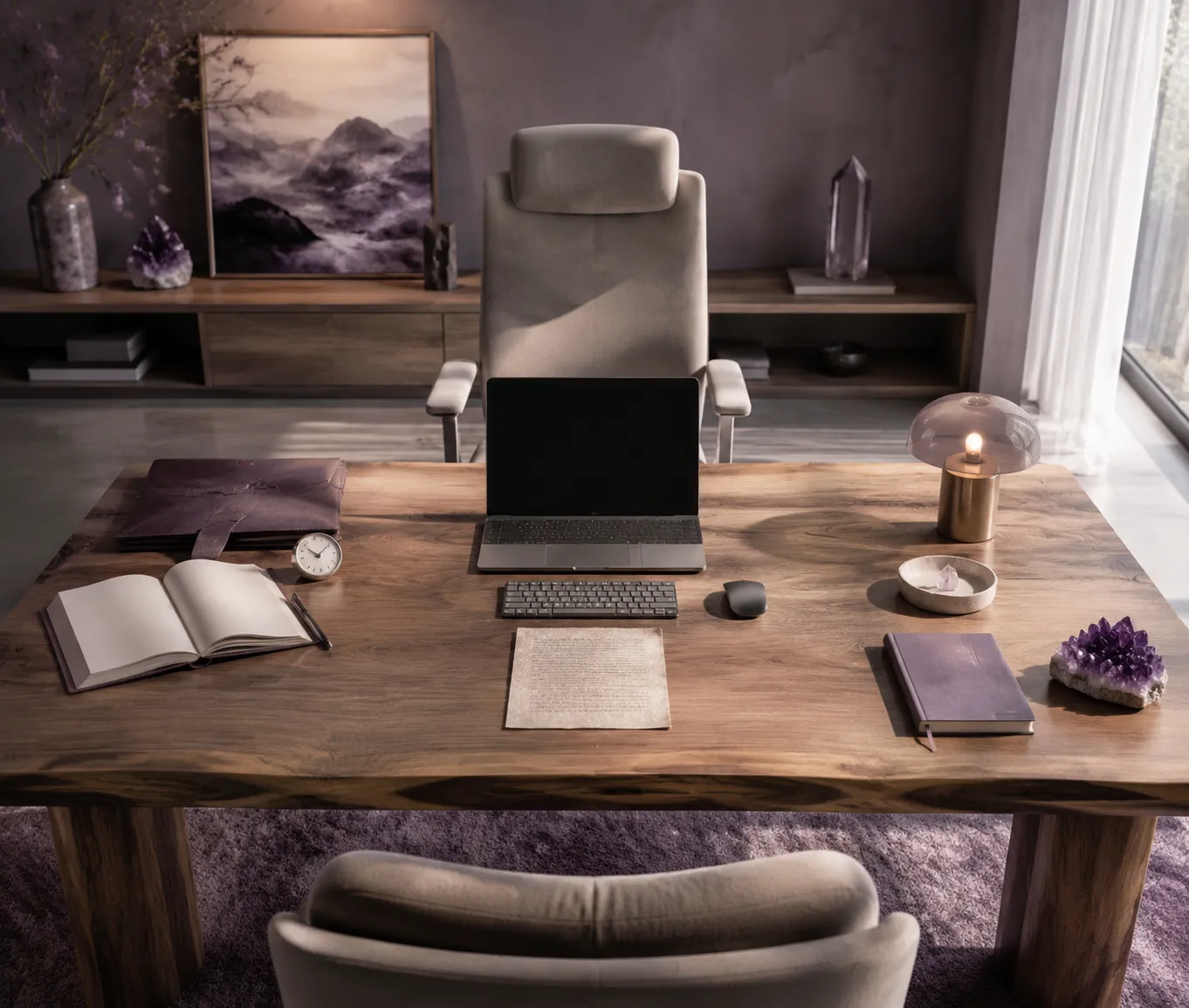
The Focus Grid in one desk layout
A Focus Grid is not a separate school of feng shui. It is a practical desk arrangement inspired by common feng shui placement language and adapted for a modern work surface.
Think of your desk from the seated position:
Back: Black Tortoise support
This is the space behind your chair. In feng shui language, it suggests backing, protection, and a “mountain at your back.” In a real workspace, it means you ideally do not feel exposed to constant movement behind you.
Front: bright hall / ming tang
This is the open visual field in front of you. On a desk, it becomes the area where your eyes can rest without immediately meeting clutter, glare, tangled cables, or piles of unfinished work.
Left: Green Dragon side
The left side is often associated with activity and movement. In the Focus Grid, this is where active tools can live: a notebook in use, pen cup, planner, task card, timer, or the documents you are currently handling.
Right: White Tiger side
The right side is treated as calmer, lower, and more contained. It can hold quieter objects: a closed notebook, a small tray, a reference book, a low lamp, or an optional amethyst cluster or point.
Center: current-task zone
This is the most important part of the modern desk. It should hold only what belongs to the current work session: screen, keyboard, mouse or trackpad, one notebook, one document, and perhaps one drink placed safely away from electronics.
The point is not to decorate every inch. The point is to make the desk answer one question before you sit down: where does my attention go first?
Place the desk before arranging the objects
The Focus Grid starts with the chair and desk position, not with the objects on top. A beautiful desktop can still feel unsettled if your back faces a hallway, a door, or a window that keeps pulling your attention.
Many feng shui desk placement discussions prefer some version of the command position: you can see the entrance, but you are not directly in line with the door. The practical version is simple. If possible, sit where you can glance toward the door without being in the main path of movement.
If your desk faces a wall, you may still be able to soften the setup by adding a small side mirror, shifting the chair angle, or turning the desk slightly. If you cannot see the entrance, do not turn that into a rule-based problem. Ask the more useful question: does this position make the desk feel distracted, compressed, or constantly interrupted?
For the Black Tortoise zone behind you, a solid wall is the clearest form of support. If that is not available, other objects can create a stronger sense of enclosure:
- a high-backed chair
- a shelf or cabinet behind the chair
- a curtain over a bright window
- a folding screen
- a tall plant
- a room divider
- a visually weighty piece of art behind you
These are not magic fixes. They are ways to make a remote work setup feel less exposed, especially in a bedroom, dining area, or shared room.
The front zone matters just as much. A clear ming tang does not require a large room. It may simply mean that the wall or space in front of you is not overloaded with sticky notes, open boxes, tangled cords, or harsh reflections. If you face a window, manage glare. If you face a wall, give the eye one calm focal point rather than a dozen reminders of unfinished tasks.
Build the desktop from the center outward
Once the desk position is workable, arrange the desktop in the order your attention uses it.
Start with the center task area. Clear everything from the main work zone and put back only the essentials for the next deep-work block. For most people, that means a laptop or monitor, keyboard, mouse or trackpad, one notebook, one pen, and the exact document or tab set needed for the task.
This center-first approach is what keeps the Focus Grid useful. It prevents the common problem of placing meaningful objects everywhere while leaving no clean area for actual work.
Next, build the Green Dragon side on the left
Use it for tools that move with the work:
- an open notebook or planner
- an active project folder
- pens or markers you reach for often
- a small timer
- a task card with the next action
- a frequently used charging cable, kept tidy
The left side can be slightly more active or visually taller than the right if that feels natural. A pen cup or upright planner on the left, paired with a lower tray on the right, creates a simple sense of movement balanced by stillness.
Then set the White Tiger side on the right
Keep this side lower, quieter, and more contained. It can hold objects that support work without competing for attention:
- a closed reference notebook
- a small inbox tray
- a low-profile lamp
- a coaster
- one decorative object
- a small amethyst cluster, point, or polished piece
This side loses its calming role if it becomes a museum of crystals, cables, receipts, gadgets, and half-finished notes.
Finally, check the front bright hall. If the front edge of the desk or the area beyond the screen is crowded, remove one layer. A clear front field can make the desk easier to approach before reading, writing, design, planning, or focused administrative work.
Where amethyst fits in the Focus Grid
Amethyst belongs here because many readers use it as part of a symbolic desk practice. The cleaner boundary is this: amethyst is better treated as a visual focus anchor or intention cue, not as an object that guarantees clearer work or better outcomes.
In this setting, the stone marks the kind of work atmosphere you want to return to: calm, deliberate, uncluttered, and single-tasked.
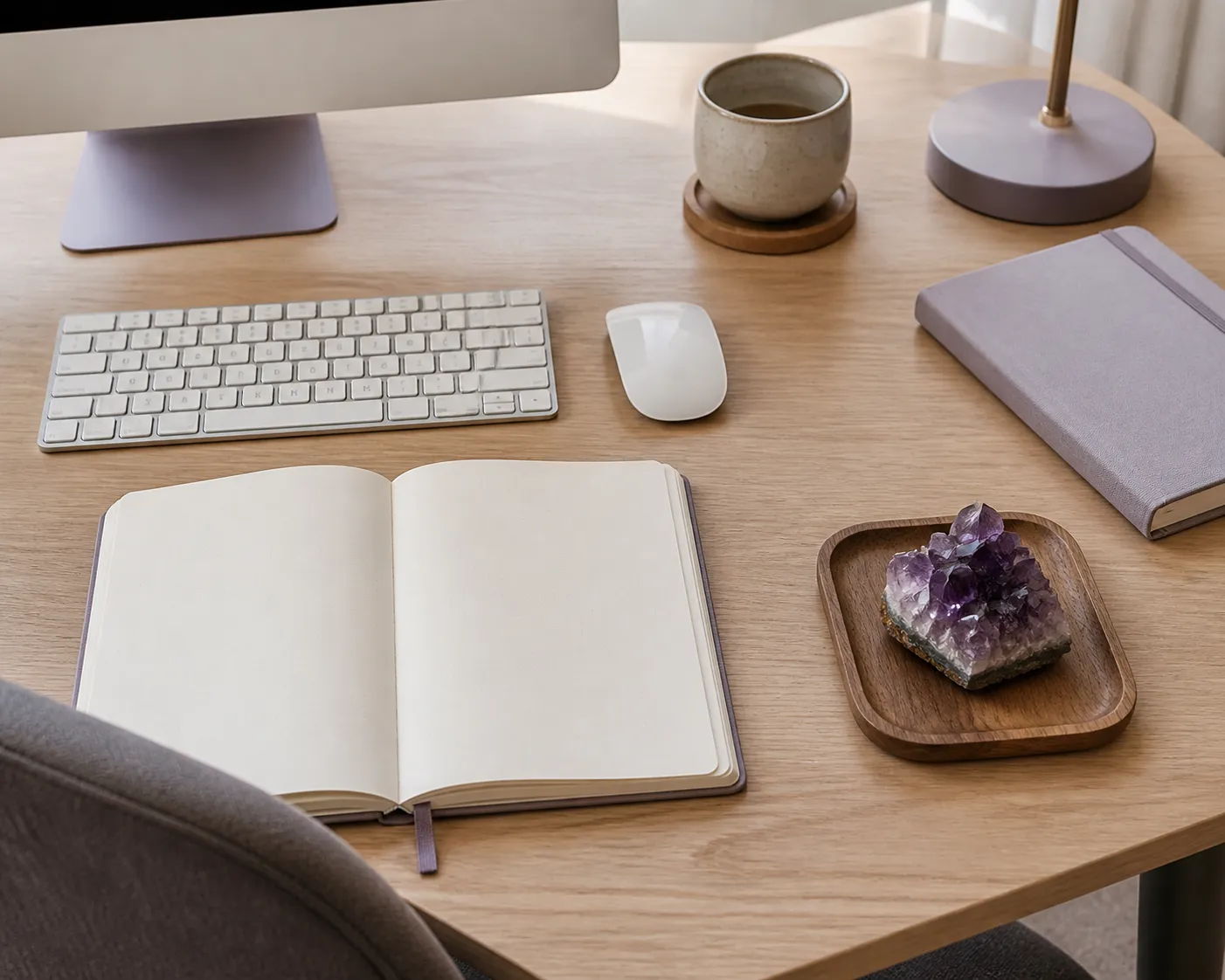
For amethyst geode placement, avoid making the geode the center of the desk unless it is very small and not visually distracting. A large geode can be reflective, visually strong, and space-consuming. It may work better on a shelf within view, on the quiet right side, or in a chosen intention corner near the desk.
A small amethyst point or cluster can sit in one of three places:
- Right-side White Tiger zone: Use this placement if you want the stone to feel quiet, stable, and low-profile.
- A shelf behind or beside the desk: Use this if the desk surface is small or already visually busy.
- A symbolic wealth corner: Use this only as an intention spot for order, values, and stewardship—not as a promise of money, promotion, or career success.
The “wealth corner” is often described in feng shui content as a meaningful area for abundance-related intention. In the Focus Grid, keep that meaning symbolic. It might hold a small amethyst, a written value, a closed financial notebook, or a simple plant. The point is care and attention, not a guaranteed result.
Scale matters. A desk crystal should not block hand movement, crowd the keyboard, create glare, or become another object to work around. If the piece is beautiful but distracting, place it slightly farther away.
What changes for remote work and small rooms
Desk feng shui changes when the room is doing too many jobs. A separate home office is one thing; a bedroom-office, dining-table office, or shared apartment corner is another.
If your desk is in a bedroom, the main issue is not finding a perfect compass direction. It is separating work and rest clearly enough that the desk does not visually take over the room. Use a screen, curtain, shelf, rug, lamp change, or end-of-day reset to mark the boundary. Even closing the laptop, clearing the center zone, and placing the notebook in a tray can help the desk feel less unfinished after hours.
If the only possible desk position puts your back to a door or walkway, strengthen the back zone instead of chasing an impossible ideal. A high-backed chair, curtain, shelf, or plant can give the space more structure. If people move behind you often, angle the monitor or desk slightly so your attention is not constantly pulled backward.
If you sit near a window, treat light as both a benefit and a variable. Natural light can make a desk feel more open, but glare on a screen works against the purpose of the layout. Use curtains, blinds, a shifted monitor angle, or a different desk orientation if direct light keeps interrupting your work.
If you work from a very small desk, shrink the grid. The center remains the task zone. The left may be only one pen and one notebook. The right may be only a small tray or stone. The back may be the chair itself. The front bright hall may be a clear wall space the width of your monitor. A small grid still works if every zone has a job.
Common confusion about desk feng shui for success
The phrase “feng shui desk for success” often pulls in claims about wealth, promotion, luck, or protection from office conflict. This page uses a narrower meaning. A Focus Grid can make a desk feel more orderly, intentional, and easier to return to. It does not guarantee professional results.
Another common confusion is thinking that desk direction matters more than desk experience. Traditional and popular feng shui systems may discuss direction, doors, windows, qi openings, beams, and symbolic placement. For a modern remote-work desk, those ideas are most useful when they help you notice practical friction: glare, clutter, exposed seating, cramped movement, too many objects, or a center zone with no clear priority.
There is also a difference between a symbolic ritual and a productivity hack. A ritual object, such as an amethyst point or a written intention card, may help some people mark the start of a work session because it gives the routine a visible cue. That is different from saying the object itself creates deeper concentration.
The cleanest rule is this: if an item supports the next work session, it may stay. If it mainly represents an aspiration but interrupts the work, move it to the edge, a shelf, or a reset tray.
Quick Focus Grid reset for 2026
Use this checklist when your desk starts to feel noisy:
- Back: Is there enough support behind the chair, or do I feel exposed to movement?
- Front: Is the bright hall open, or is my first view cluttered?
- Left: Are my active tools easy to reach?
- Right: Is the quiet side low, stable, and contained?
- Center: Is only the current task in the main work zone?
- Light: Is glare reduced enough for comfortable screen work?
- Amethyst: If present, is it a small cue rather than a centerpiece?
- Bedroom office: Can I close, cover, or reset the work area at the end of the day?
The Focus Grid is most useful when it stays modest: support behind, openness in front, movement on the left, calm on the right, and one clear task in the center. That is enough. The desk does not need to promise transformation; it only needs to make focused work easier to begin.