Reflective Pisces Practice
Emotional Alchemy: Turning Pisces Sensitivity Into a Superpower
Emotional alchemy, in this article, means a reflective way of working with strong feelings: notice them, name them honestly, and turn them into clearer self-trust instead of instant reaction. For readers who identify with Pisces sensitivity, the “superpower” is not absorbing every mood in the room or treating every emotion as a cosmic instruction. It is learning to let sensitivity become discernment.
In symbolic Pisces language, that shift moves you from porous empathy to intuitive authority: the ability to sense what feels meaningful while still asking, “Is this mine, is this true, and what action is actually needed?”
The limits matter. Astrology, crystals, and spiritual language can be meaningful personal frameworks, but they should not be presented as personality science, professional guidance, or evidence-based emotional support. The useful frame here is symbolic and reflective: sensitivity becomes powerful when it is contained, questioned, and translated into wise boundaries.

broader context
Broader amethyst guide
This narrower page lands better after the broader amethyst context page.
What Pisces Sensitivity Means Here
Pisces sensitivity is used here as a symbolic phrase, not a verified psychological category. Many spiritually oriented readers use Pisces as shorthand for emotional permeability, compassion, imagination, dreaminess, and a quick awareness of atmosphere.
That language can be useful when it helps you name a pattern. It becomes less useful when it turns into a fixed identity: “I am sensitive, so I cannot choose,” or “I feel this strongly, so it must be spiritually true.”
A grounded reading is simpler. Pisces-style sensitivity can describe a felt relationship with emotion: moods arrive quickly, beauty lands deeply, conflict lingers, and other people’s pain may be hard to ignore. That does not prove an astrological mechanism. It can still offer a mirror.
The better question is not “What does this prove about me?” but “What do I do with what I notice?”
Reflective emotional alchemy begins there. It does not ask you to harden yourself or dismiss emotion as irrational. It asks you to slow the feeling down long enough to separate three things:
- The feeling itself: sadness, tenderness, longing, unease, compassion, grief, desire, hope.
- The story attached to it: “They are upset with me,” “I should rescue this,” “This is a sign,” “I cannot handle this.”
- The next honest action: rest, ask a question, set a boundary, write it down, wait, apologize, step back, or choose not to absorb it.
The shift is not that a difficult feeling magically becomes pleasant. It is that the feeling becomes information you can handle with more care. Sensitivity as reflection is different from sensitivity as surrender.
The Emotional Alchemy Framework
A useful emotional alchemy framework can stay modest: notice, name, filter, choose. These are reflection prompts, not clinical steps.
Notice
First, notice the emotional weather before you interpret it. “I feel heavy” is not the same as “something bad is happening.” “I feel drawn to this person” is not the same as “this connection should override my judgment.” Observation comes before meaning.
Name
Second, name the feeling in plain language. Spiritual vocabulary can be beautiful, but it can also become foggy. Before calling something a download, soul lesson, or energetic sign, try ordinary words: I feel disappointed. I feel protective. I feel overstimulated. I feel hopeful but unsure. Clear naming gives sensitivity a container.
Filter
Third, filter what belongs to you. If you easily attune to rooms, texts, facial expressions, or silence, you may mistake emotional reception for responsibility. A useful question is: “What part of this feeling is mine to understand, and what part may simply be near me?” The answer does not need to be perfect. The pause itself helps move sensitivity from absorption toward discernment.
Choose
Fourth, choose one grounded response. Intuitive authority is not the loudest feeling winning the room. It is the ability to respect inner signals while still checking timing, context, and consequences. Sometimes the wise response is a conversation. Sometimes it is a boundary. Sometimes it is doing nothing until the emotional charge settles.
That is the heart of emotional alchemy for Pisces-style sensitivity: the feeling is honored, but it is not automatically obeyed.
Intuitive Authority Is Not Emotional Certainty
Intuitive authority can sound grand, so it needs a plain meaning. Here, it means earned self-trust: listening inwardly without abandoning proportion, reality, or other people’s agency.
Emotional certainty often arrives fast. It says, “I know because I feel it.” Intuitive authority is quieter. It says, “I feel something, and I am willing to examine it before I act.”
That difference matters. A feeling can be sincere and still incomplete. A symbolic impression can be meaningful and still need ordinary verification.
For a spiritually oriented reader, this does not require rejecting intuition. It gives intuition a better role. Instead of treating it as a final verdict, treat it as an opening question:
- What is this feeling asking me to notice?
- What evidence do I actually have?
- Am I responding to the present, or to an old emotional pattern?
- What would respect for myself and the other person both require?
- Can this wait until I am less flooded?
These questions do not flatten mystery. They protect it from becoming impulsive. Intuitive authority becomes stronger when it can coexist with patience.
This is also where emotional alchemy becomes a boundary practice. A Pisces-sensitive person may imagine compassion as endless availability. But compassion without limits can become confusion, resentment, or self-erasure. A more mature symbolic reading would say: water needs a vessel. Sensitivity needs form.
The superpower is not being boundaryless. It is being receptive without losing your own outline.
Where Rhodonite and Rose Quartz Fit
Rhodonite and rose quartz belong here only as symbolic objects or ritual cues. They should not be presented as producing verified emotional or health outcomes. Within crystal-spirituality language, some readers use stones as touchpoints for reflection: something to hold while journaling, place on a desk, or associate with an intention.
Rhodonite
Rhodonite symbolism is often used by spiritual readers as a cue for steadiness, compassionate honesty, or working through emotional friction. In this bounded frame, rhodonite can represent the moment when sensitivity stops collapsing into self-blame and starts asking for a cleaner response. A simple prompt might be: “What am I responsible for, and what am I not responsible for?”
Rose Quartz
Rose quartz symbolism is commonly associated in spiritual spaces with tenderness, softness, and the heart. Here, it can stand for the gentler side of emotional alchemy: not forcing yourself to become less sensitive, but learning to hold sensitivity with kindness. A rose quartz prompt might be: “Can I be kind to this feeling without letting it run the whole decision?”
The important distinction is that the stone is not doing the emotional work for you. The object marks an intention. The reflection, naming, boundary-setting, and action remain yours.
Common Confusion
Treating sensitivity as proof
One common confusion is treating sensitivity as proof. A strong emotional response may feel persuasive, especially for someone who identifies with Pisces symbolism. But strong feeling alone does not prove another person’s motive, the future of a relationship, or the spiritual meaning of an event. It may be a signal worth listening to; it is not automatically a conclusion.
Treating softness as weakness
Another confusion is treating softness as weakness. Many readers arrive at this topic because they are tired of feeling too permeable, too moved, or too affected. The goal is not to become cold. Emotional alchemy asks for a different kind of strength: staying open while choosing what gets access to your energy, time, and attention.
Using spiritual language to avoid ordinary decisions
A third confusion is using spiritual language to avoid ordinary decisions. A person might call something “meant to be” when they need a conversation. They might call a boundary “low vibration” when it is simply uncomfortable. They might call exhaustion “empathic overload” when they need rest, practical support, or distance from a draining situation. Symbolic Pisces language can illuminate these moments, but it should not replace clear choices.
Believing intuitive authority means never doubting yourself
A final confusion is believing intuitive authority means never doubting yourself. In practice, self-trust often includes doubt. A reflective person can say, “I sense something here, but I do not have enough clarity yet.” That sentence may be one of the most mature forms of intuition because it refuses to turn uncertainty into performance.
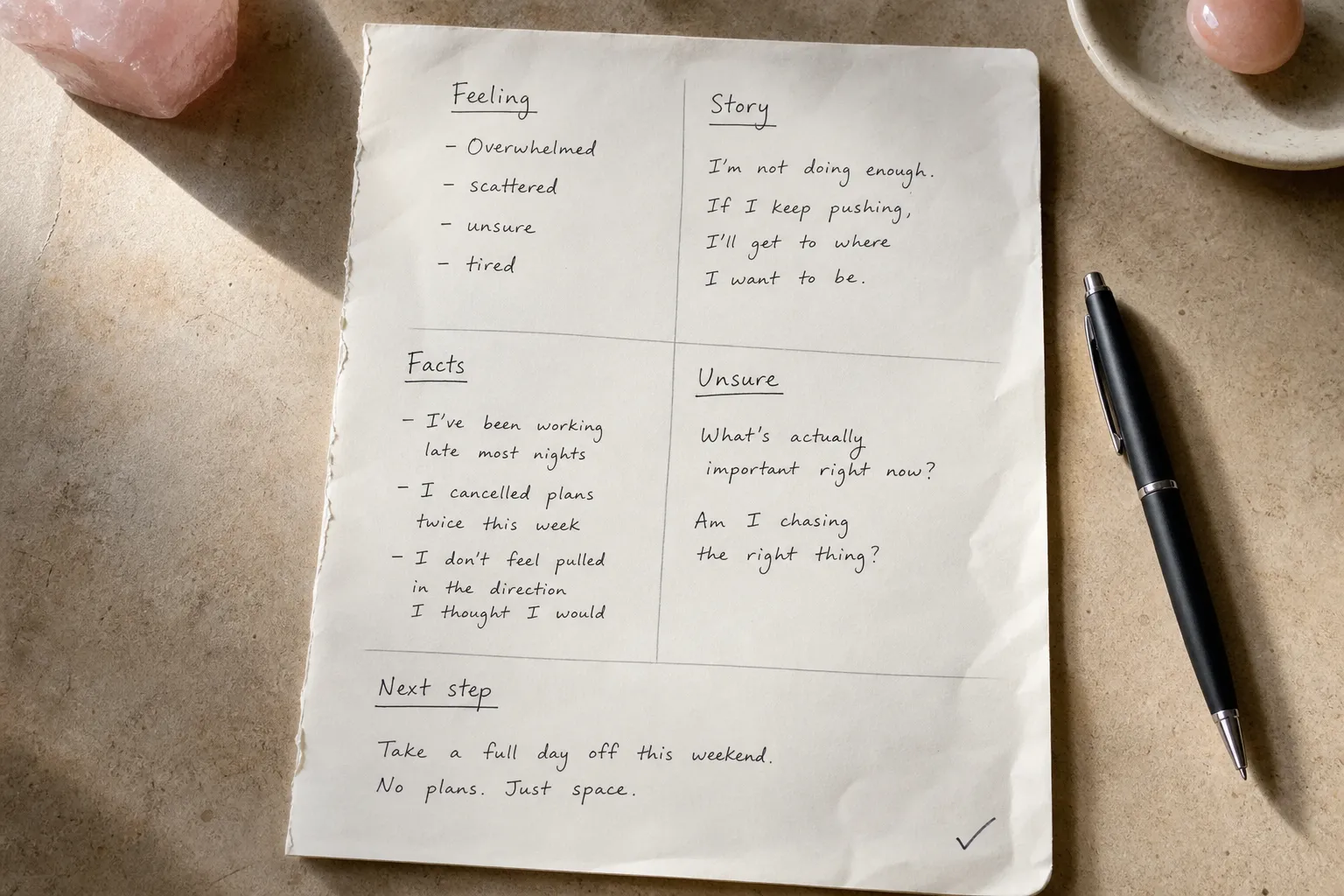
A Small Practice for Turning Feeling Into Discernment
If you want to apply this idea, keep it small. The point is not to build a complete spiritual system. The point is to give sensitivity a reliable path before it becomes overwhelm or over-interpretation.
Try this journaling sequence when a feeling is strong:
- The feeling I notice is…
- The story I am adding to it is…
- What I know for sure is…
- What I do not know yet is…
- The kindest boundary or next step available to me is…
That sequence keeps emotional alchemy grounded. It lets you honor the symbolic and intuitive layer without pretending that symbolism is evidence. It also helps separate emotional depth from emotional urgency.
Not every feeling requires a same-day answer. Not every intuitive impression requires dramatic action. Sometimes the transformation is simply moving from “I am flooded” to “I can stay with this without handing it the steering wheel.”
For Pisces-style sensitivity, that is the meaningful shift. Instead of asking, “How do I stop feeling so much?” the better question becomes, “How do I let feeling become wisdom without letting it erase my boundaries?”
The Scope Limit
Because no authoritative public references or usable firsthand evidence were available for this page, the claims stay intentionally limited. Emotional alchemy is treated as reflective language, not a clinically defined method. Pisces is treated as symbolic astrology language, not established personality science. Rhodonite and rose quartz are treated as crystal symbolism, not verified tools for changing health or emotional outcomes.
That boundary does not make the topic meaningless. It places it where it belongs: personal reflection, spiritual interpretation, journaling, ritual symbolism, and self-inquiry. If emotions feel overwhelming, unsafe, or persistently hard to manage, this kind of symbolic article is not enough on its own; consider support from someone qualified to help in that area.
The grounded answer is both gentle and firm: Pisces sensitivity becomes a superpower when it stops being treated as fate and starts being practiced as discernment. Emotional alchemy is the pause that turns a wave into a message, a message into a question, and a question into a wiser choice.
FAQ
Is emotional alchemy a real method?
Here it is used as a reflective and symbolic framework, not a formal clinical method. Its value is in helping you slow down, name feelings, and choose more carefully.
Does Pisces sensitivity prove someone is more intuitive?
No. In this article, Pisces sensitivity is symbolic language. It may help some readers describe their experience, but it should not be treated as proof of personality traits or special perception.
Can rhodonite or rose quartz change emotions?
This page does not present crystals as verified tools for emotional or health outcomes. Rhodonite and rose quartz can be used as symbolic reminders, journaling cues, or ritual objects if that feels meaningful to you.
What is the simplest takeaway?
Feel deeply, but do not let intensity make every decision. Emotional alchemy turns sensitivity into discernment by asking what the feeling is, what story you are adding, and what response is actually wise.