Reflective journaling
Journaling Prompts to Overcome Emotional Arrested Development
Emotional arrested development journaling can be useful when certain moments make you feel younger, reactive, ashamed, frozen, or overly eager to please. The point is not to force a dramatic breakthrough. A safer use is to slow the reaction down: name the feeling, notice the trigger, separate present-day facts from older responses, and choose one small repair or support step.
Journaling may help some people organize thoughts, track emotions, and manage stress. It should be treated as a self-reflection tool, not therapy, trauma work, crisis care, or a substitute for professional support.
Use the prompts gently. Skip any that feel too intense.

broader context
Amethyst context note
This narrower page lands better after the broader amethyst context page.
A safer way to understand “emotional arrested development”
Many people use the phrase “emotional arrested development” when they notice a painful mismatch: they may be capable and responsible in daily life, yet in conflict or rejection they suddenly feel childlike, panicked, defiant, ashamed, or unable to calm themselves.
For this page, the phrase is best understood as self-help language, not a diagnosis. A more careful way to describe the pattern is:
- reacting from old coping patterns;
- having difficulty self-soothing under stress;
- becoming highly reactive to emotional triggers;
- shutting down or avoiding charged situations;
- people-pleasing before checking what you actually feel;
- spiraling into shame after a mistake;
- feeling younger than your present age during conflict, criticism, or rejection.
Journaling can help because it gives the reaction a place to slow down. Instead of arguing with yourself, you can observe what happened, what you felt, what your body wanted to do, and what a steadier next step might be.
A useful rule: write to notice, not to force yourself open.
Paced journaling prompts for emotional triggers
Start with one recent moment, not your whole history. Choose a situation that felt emotionally bigger than the event itself: a delayed text, a sharp comment, a correction at work, a boundary someone set, or a moment when you felt ignored.
Set a modest limit: five to ten minutes, or one page. If writing starts to feel overwhelming, stop and orient yourself to the room around you.
1. Name the feeling before explaining it
Reactive patterns often intensify when the mind jumps straight into a story: “They do not care,” “I ruined everything,” “I have to fix this now,” or “I am being abandoned.” Before the explanation, try naming the feeling.
Prompts:
- What is the main feeling here: anger, fear, shame, sadness, envy, loneliness, disgust, helplessness, or something else?
- If I had to choose only three words for this feeling, what would they be?
- Where do I feel it in my body?
- What did I want to do immediately: attack, explain, disappear, apologize, control, freeze, leave, or please?
- What feeling am I trying not to feel by focusing on blame, analysis, or urgency?
This is not about finding the perfect label. It is about giving the emotional charge a clearer shape before you act from it.
2. Track the trigger without judging yourself
A trigger is not proof that you are broken. It may be a sign that something in the present has touched an older sensitivity, fear, habit, or protective response. The point of trigger reactivity journaling is to see the sequence more clearly.
Prompts:
- What happened, in plain observable terms?
- What did I assume it meant?
- What felt most threatening: rejection, criticism, loss of control, being misunderstood, being trapped, being exposed, or being abandoned?
- Did my reaction feel larger than the present event? If so, how?
- What did I do next, or what did I strongly want to do?
- What helped even slightly?
- What made the reaction stronger?
Keep the language plain. “They took six hours to reply” is more useful than “They proved I am unlovable.” You can write the painful interpretation too, but mark it as an interpretation, not a fact.
3. Separate present-day facts from old responses
This prompt is useful when you feel pulled into a younger version of yourself. The aim is not to diagnose where the reaction came from. The aim is to distinguish what is happening now from what your system may be bracing for.
Make two columns.
Present-day facts
- What do I know for sure happened?
- What is my current age, location, and actual level of safety?
- What choices do I have now that I may not have had before?
- What information is missing?
Old response or learned pattern
- What does this situation remind me of emotionally?
- How old do I feel in this reaction, even if I know I am not that age?
- What rule seems to be running me right now? For example: “Do not upset anyone,” “Never need too much,” “Win before they hurt you,” or “Disappear before you are rejected.”
- Is this response trying to protect me from something?
- Is that protection still helping, or is it now costing me connection, clarity, or rest?
A gentle phrase can help: “This may be an old response meeting a present-day situation.” That wording leaves room for curiosity without turning the journal into a courtroom.
4. Write through shame spirals without feeding them
Shame often sounds final: “I am too much,” “I am immature,” “I always do this,” or “No one should have to deal with me.” Journaling can either deepen that spiral or interrupt it. The difference is whether the writing moves toward observation and repair rather than self-attack.
Prompts:
- What did I do, specifically, without turning it into a statement about my whole character?
- What am I afraid this says about me?
- Is that fear a fact, a memory, a belief, or a prediction?
- What would accountability sound like without humiliation?
- If someone I cared about wrote this about themselves, what would I want them to understand?
- What is one repair step that fits what actually happened?
A repair step may be simple: apologize without overexplaining, clarify a boundary, take a pause before replying, clean up one practical consequence, or ask for a calmer conversation later. The goal is not to erase discomfort. It is to keep discomfort from becoming your identity.
5. Explore shutdown and avoidance
Not every emotionally stuck pattern looks dramatic. Sometimes it looks like going blank, delaying a message, sleeping too much, becoming “fine,” or avoiding the person or task entirely.
Prompts:
- What am I avoiding right now?
- What emotion appears when I imagine facing it?
- What is the feared outcome?
- Am I avoiding danger, discomfort, conflict, shame, responsibility, or grief?
- What is the smallest safe next step?
- Do I need rest, support, information, a boundary, or a timed pause?
- If I do not act today, what would help me return to this without abandoning it completely?
For shutdown, shorter writing is often better. A few lines may be more useful than trying to produce a deep entry while you already feel overloaded.
6. Notice people-pleasing before it becomes a promise
People-pleasing can look like maturity because it keeps the peace. But if it bypasses your own limits, resentment often follows. Journaling gives you a private place to hear both the “yes” and the “no” before you answer someone else.
Prompts:
- What do I want to say automatically?
- What am I afraid will happen if I disappoint this person?
- What do I actually have capacity for?
- What part of my answer is care, and what part is fear?
- What would a truthful, respectful response sound like?
- Can I ask for time before answering?
- What boundary would protect both my honesty and the relationship?
A steady adult response is not always a hard no. Sometimes it is: “I need to check my capacity,” “I can do part of that,” or “I care, but I cannot take this on.”
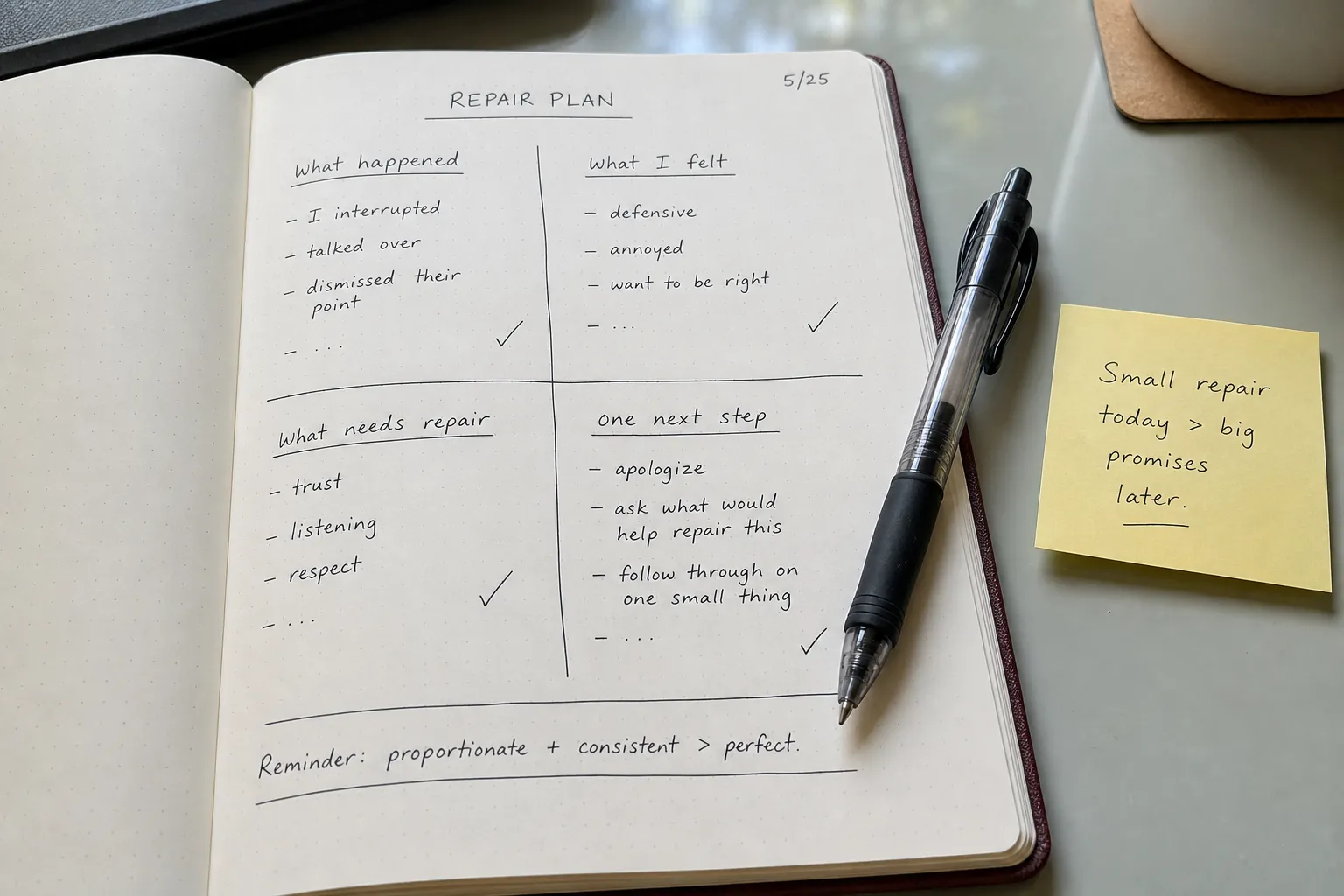
A simple repair-plan page after an overreaction
When you have already reacted in a way you regret, journaling can help you move from panic into responsibility. Keep this page practical.
Write these headings:
- What happened: Describe the event in neutral language.
- What I felt: Name the feelings without defending them yet.
- What I did: State the behavior plainly.
- What I wish I had done: Choose one alternative.
- What needs repair: Identify whether repair is needed with another person, with yourself, or with a responsibility you dropped.
- What I can do within 24–48 hours: Choose one small step.
- What I need next time: Name a pause, phrase, boundary, reminder, or support.
Example repair language:
“I raised my voice earlier. I was overwhelmed, but I do not want to speak to you that way. Next time I am going to pause before continuing the conversation.”
The journal is not the repair itself. It is preparation for repair.
When journaling is not enough
Journaling is a self-reflection practice. It can support noticing thoughts and feelings, organizing emotional material, and managing stress. It is not designed to provide crisis care, psychiatric support, or full professional care.
Pause or stop the exercise if writing brings up overwhelming distress, panic, dissociation, traumatic memories that feel hard to step away from, self-harm thoughts, unsafe impulses, severe depression, relationship violence concerns, or an inability to function. In those situations, seek qualified professional support or urgent crisis help in your area.
Also be cautious if journaling repeatedly becomes rumination. If every entry ends with the same self-attack, the same unresolved fear, or the same escalating body state, the method may need outside support, a different structure, or a much gentler pace.
A useful stopping point is: “I have learned enough for today.” You do not have to finish the whole emotional story to benefit from one clear observation.
A short routine you can repeat
If you want one repeatable format, keep it small:
- One trigger: What happened?
- One feeling: What am I feeling before I explain it?
- One old response: What familiar pattern showed up?
- One present-day fact: What is true now?
- One need: What support, boundary, rest, or information do I need?
- One repair or next step: What can I do that is honest and proportionate?
This is the heart of emotional arrested development journaling: not a dramatic excavation of the past, but a steady practice of noticing where old responses appear in present life. Used with pacing and clear limits, journaling may help you become more aware of emotional triggers, soften shame spirals, and choose more grounded responses. When the material feels too intense to hold alone, the next wise step is not more forceful writing. It is support.