Amethyst color restoration
Can You Restore Faded Amethyst? Myths vs. Industrial Reality
In most real-world cases, no. A faded amethyst usually cannot be restored to its original purple with moonlight, sunlight, cleaning rituals, household heat, or any other home method. In a much narrower technical sense, quartz color can sometimes be altered through controlled irradiation and heat treatment, but that is not the same as reliably restoring a specific faded stone.
If your amethyst looks lighter than it used to, the practical goal is usually to confirm whether the change is real, stop further fading, and avoid treatments that could make the color worse.
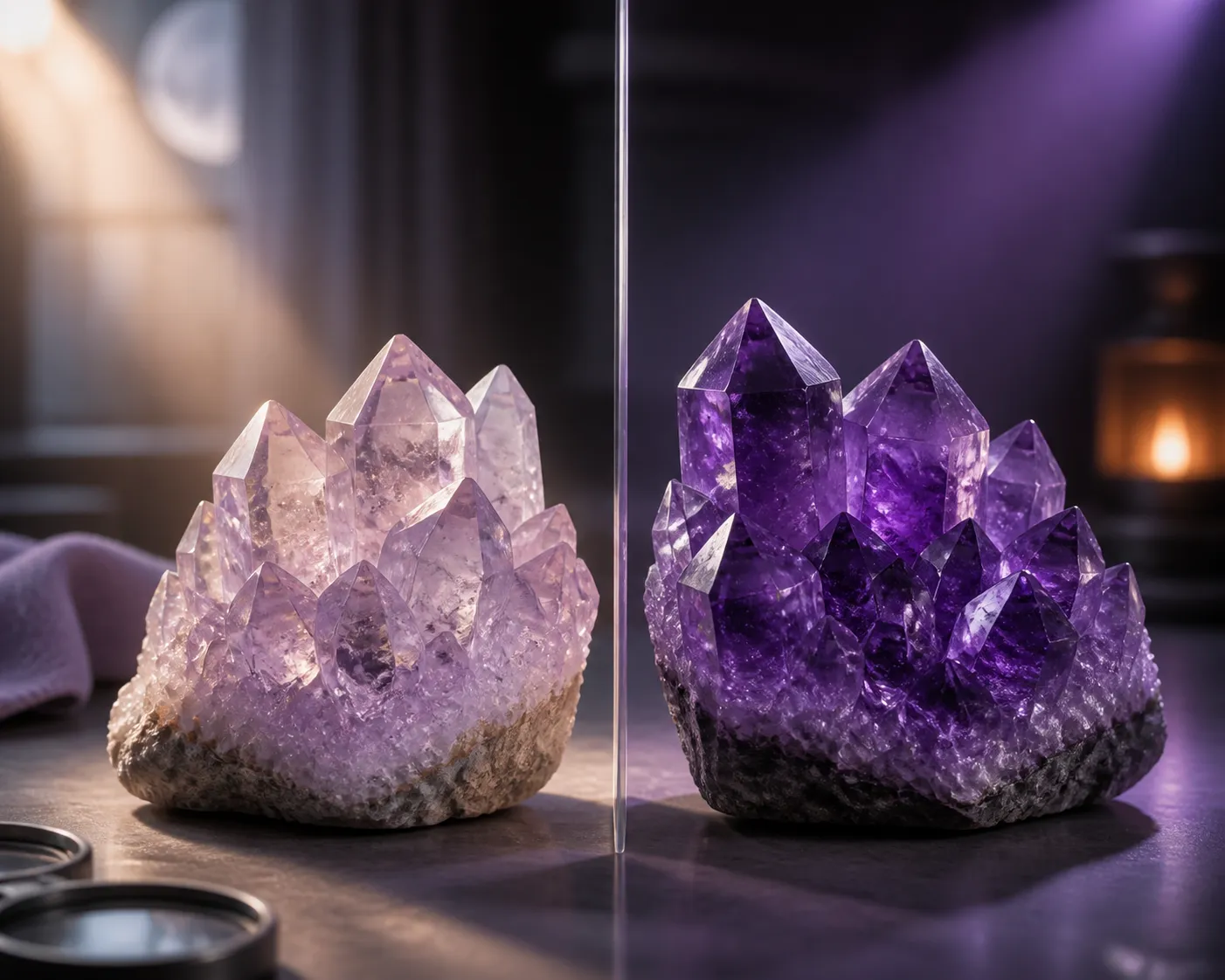
The direct answer
Amethyst is purple quartz, and its color comes from internal color centers linked to iron and radiation-related processes in the crystal structure. That matters because the purple is not a surface layer you can polish back, rinse back, or “charge” back.
So when people search for amethyst color restoration, two different ideas often get mixed together:
Appearance improvement
Cleaning, better lighting, repolishing, or removing buildup from a setting
True color restoration
Bringing back lost internal purple color
Those are not the same thing. A stone can look brighter after cleaning and still remain chemically unchanged.
Why faded amethyst usually does not “come back”
Amethyst can look different under different lighting, and that is one reason the subject gets confusing. A warm lamp may make a stone look richer. Cool daylight may make the same stone look grayer or paler. That shift is real, but it is an optical difference, not proof that the color has returned.
Actual fading is a different issue. Prolonged sunlight, ultraviolet exposure, and heat are all associated with color change or color loss in amethyst. Once those color-producing conditions have been altered, ordinary care does not rebuild them.
Research on amethyst and quartz color helps draw the boundary here:
- the purple color is tied to defect chemistry inside the quartz
- heat can weaken violet color or shift it toward other colors
- some color changes are described as irreversible
For a stone owner, the takeaway is simple: heat and strong light can change amethyst color, but they are not dependable ways to restore it.
Industrial reality: treatment exists, but it is not a consumer fix
This is where the myths usually start. It is true that quartz color can be changed under controlled treatment conditions. Gemological and scientific sources describe gamma irradiation and heat treatment as real parts of the quartz treatment landscape, sometimes involving Cobalt-60 in industrial settings.
But that does not mean a faded ring stone, pendant, cluster, or geode can be safely and predictably restored.
Three distinctions matter:
- Color alteration is not the same as restoration.
A treated stone may change color, but that does not mean it has regained its original natural purple. - Response depends on the material.
Two amethysts can behave differently because of differences in iron content, growth history, zoning, and prior exposure. - This is not a home process.
Irradiation and controlled heat treatment belong to regulated industrial or laboratory contexts, not household experiments.
That is why “restore faded amethyst” is usually the wrong expectation. The science supports the idea that quartz color can be modified under controlled conditions. It does not support a reliable DIY path for returning a faded amethyst to its former shade.
Why the moonlight story persists
The moonlight charging myth survives because people often blend together color, mood, symbolism, shine, and ritual care.
If someone places amethyst in moonlight as a personal practice, that sits in the realm of belief or symbolism. But for the physical question on this page, the boundary is much narrower: moonlight is not shown to rebuild amethyst color centers or restore lost purple.
Sunlight gets misunderstood in the opposite direction. Because light affects how the stone looks, some people assume stronger light might also bring the color back. In practice, sunlight is more often discussed as a fading risk than a remedy.
So the common mix-up looks like this:
| What you notice | What it likely means |
|---|---|
| The stone looks deeper purple under warm indoor light | Lighting is changing how the color appears |
| The stone looks paler after years near a window | Real fading or color alteration is possible |
| The stone looks brighter after cleaning | Surface appearance improved, but not necessarily the internal color |
| Someone says it can be “recharged” overnight | That is not evidence of physical color restoration |
What to do if your amethyst has faded
If the color really has faded, conservative care is the useful next step.
- Keep the stone out of prolonged direct sunlight.
- Avoid heat from windowsills, lamps, radiators, hot water, ovens, torches, or steam.
- Clean it gently in a way that suits both the quartz and its setting.
- Store it in a shaded place when not in use.
- If the piece is valuable or sentimental, ask a qualified gemologist or jeweler to assess it before any treatment is considered.
For display pieces such as clusters and geodes, prevention matters just as much. Long daily light exposure can fade exposed areas unevenly, especially if the piece sits in a bright window for years.
For jewelry, also consider simpler explanations before assuming the stone itself changed. Dirt under the setting, worn metal, scratches, or dull mounting can all make the color seem weaker. Cleaning or repolishing may improve appearance, but that is still different from true faded amethyst restoration.
When “irreversible” is the practical answer
“Irreversible damage” sounds dramatic, but here it usually means the lost color is not practically recoverable by ordinary means.
That is the most useful answer for most readers: if the color loss came from sunlight, UV exposure, or heat, there is no reliable home method to restore the original purple. Controlled industrial treatment may alter quartz color in some cases, but it is not a safe, predictable consumer restoration method for a specific faded amethyst.
So if you are wondering whether you can restore faded amethyst, the honest answer is restrained but clear: usually no. What you can do is confirm whether the color change is real, avoid myths that promise too much, and protect the color that remains.
FAQ
Can moonlight restore faded amethyst color?
No evidence shows moonlight restores the internal color centers that produce amethyst’s purple color.
Can sunlight bring the purple back?
Usually no. Sunlight is more often associated with fading risk than recovery.
Can heat restore faded amethyst?
Not in any reliable home-care sense. Heat can alter amethyst color, but it can also push the stone farther from its original appearance and may damage the jewelry setting.
Is gamma irradiation a real treatment for quartz?
Yes, controlled irradiation is a real industrial or laboratory treatment context for some quartz color changes. That does not make it a safe or predictable restoration method for a consumer-owned faded amethyst.
Should I try any home experiment?
No. Avoid improvised heat, strong UV exposure, irradiation ideas, or other DIY attempts. If the stone matters financially or personally, get it evaluated first.