Sustainable Amethyst Mining
Closed-Loop Mining: The New Standard for Eco-Friendly Amethyst
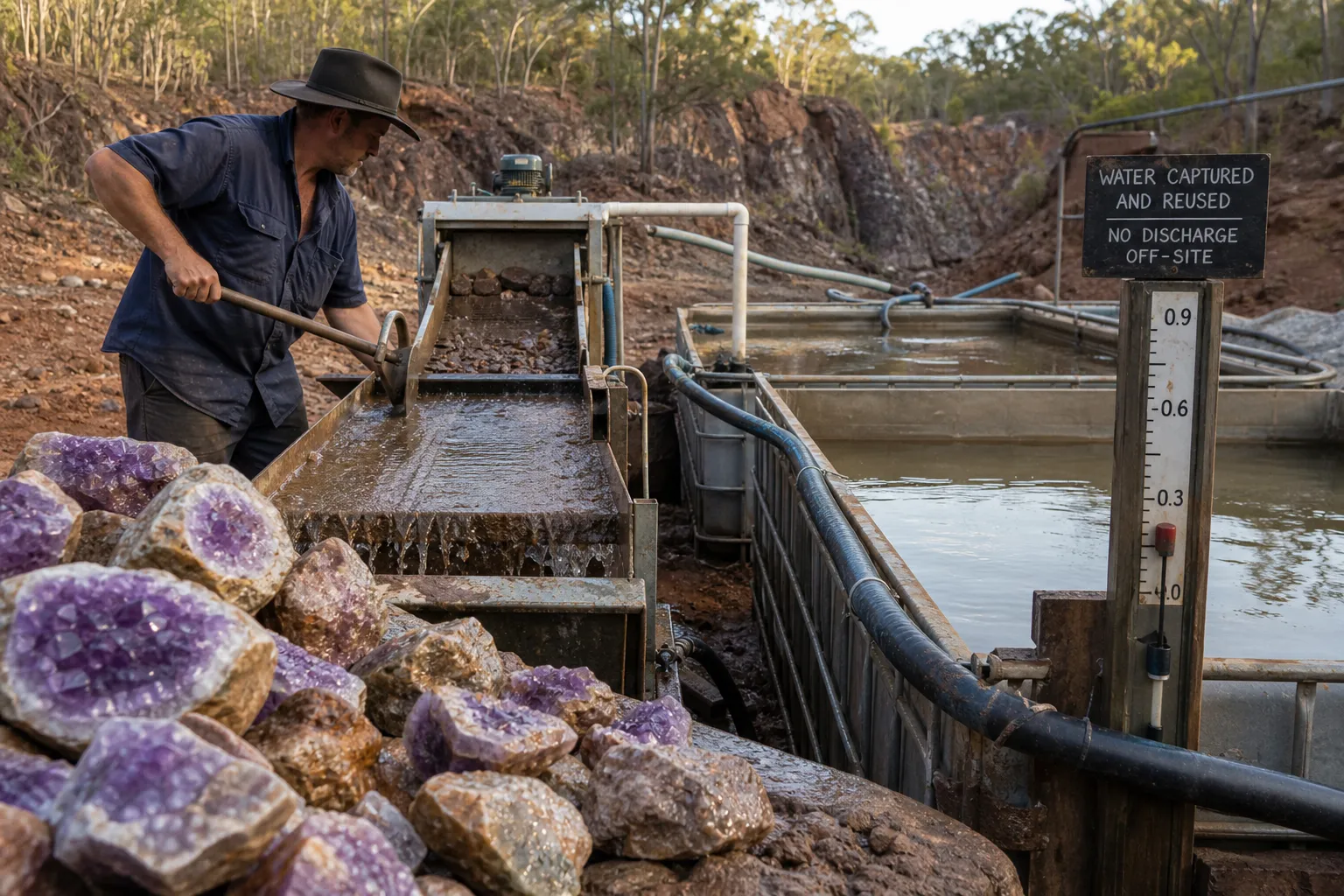
Closed-loop mining is a useful benchmark for Sustainable Amethyst Mining, but it is not proof by itself. For amethyst buyers, the practical answer is simple: a closed-loop claim matters only when a mine or supplier can show how water is captured, reused, monitored, and kept from uncontrolled discharge.
The claim becomes more credible when it is tied to land rehabilitation and traceable sourcing records. Without those details, phrases such as “closed-loop,” “green,” or “eco-friendly” are still marketing language, not verified evidence.
broader context
Broader amethyst guide
This narrower page lands better after the broader amethyst context page.
What Closed-Loop Mining Means for Amethyst
In plain terms, a closed-loop water system keeps process water circulating inside the mining, washing, or handling operation instead of using it once and releasing it without control. For amethyst, that may involve water used for washing quartz material, sorting, dust control, or nearby site handling.
The environmental goal is reasonable: use less fresh water, reduce dirty water movement, and limit the chance that sediment or site material leaves the working area.
The limit is just as important. The available material for this page does not support a claim that closed-loop water handling is now standard across amethyst mining, or that there is a verified 2026 amethyst mining standard requiring it across the trade.
A useful distinction
“Water should be contained and reused”
A sustainability principle.
“This mine has a documented closed-loop system”
A site-specific evidence claim.
“Most amethyst is mined this way”
A broad industry claim that needs strong support.
Closed-loop mining also does not mean “no impact.” Any mining changes land, moves rock, uses energy, and requires oversight. It is better understood as one possible part of environmental management, not a seal of purity.
The Three Practices That Make the Claim Stronger
Sustainable amethyst language is more useful when it names connected practices instead of leaning on one green phrase. Closed-loop water handling, land rehabilitation, and ethical sourcing each answer a different part of the question.
Water Recycling
Water recycling is the most direct part of a closed-loop claim. A serious description should explain where water is used, how it is collected, how sediment or residue is handled, whether water is reused in the same process, and what happens when water cannot be reused.
A vague claim says the mine “uses water responsibly.” A better claim explains whether water is recirculated, stored in controlled areas, settled before reuse, or monitored before any release.
The stronger question is not “Is it closed-loop?” It is: “What part of the water system is closed, and how is that checked?”
Land Rehabilitation
Land rehabilitation in mining refers to what happens to disturbed ground during or after extraction. In an amethyst setting, this may include reshaping disturbed areas, stabilizing exposed ground, managing waste rock, replacing soil where appropriate, and supporting vegetation recovery where local conditions allow.
This cannot be judged from a polished crystal photo or a short product description. Rehabilitation depends on mine size, geology, climate, local land use, legal requirements, and the condition of the site before mining began.
A credible claim should avoid simple promises such as “fully restored” unless there is evidence. Better wording points to a rehabilitation plan, staged closure work, dated site records, or independent review where available.
Ethical Sourcing
Ethical amethyst sourcing is related to sustainability, but it is not the same thing as water or land management. It asks who extracted, handled, cut, traded, and sold the stone, and under what conditions.
For readers who choose amethyst for both beauty and meaning, opaque sourcing can feel like a mismatch. That does not mean every small seller can provide mine-level documentation. It does mean the seller should be clear about what is known, what is documented, and where the chain becomes uncertain.
Ethical sourcing improves when uncertainty is reduced. It is not created by attractive wording alone.
What Better Evidence Looks Like in 2026
Because there are no usable public references here for amethyst-specific closed-loop standards, it would be misleading to say that 2026 standards formally require closed-loop systems, land rehabilitation, or traceability across the amethyst sector.
A better framing is: what would stronger evidence look like now?
Useful evidence may include
- Mine-level water management descriptions
- Records showing how water is captured, reused, or discharged
- Rehabilitation plans and dated site photographs
- Legal extraction or origin documentation
- Supplier traceability records
- Independent review where available
- Clear notes about what remains unknown
None of these proves a perfect stone or a perfect mine. They are simply stronger than broad eco-friendly language.
Claim strength and evidence gaps
“Eco-friendly amethyst”
It tells you a marketing position. The specific practice being claimed is still missing.
“Water is recycled”
It tells you a possible practice. How much, where, and how it is monitored are still missing.
“Closed-loop water handling is used”
It tells you a stronger process claim. System design, exceptions, and discharge records are still missing.
“Land is rehabilitated after mining”
It tells you a closure intention. Site plan, timeline, and visible progress are still missing.
“Ethically sourced”
It tells you a values-based claim. Traceability, labor safeguards, and documentation are still missing.
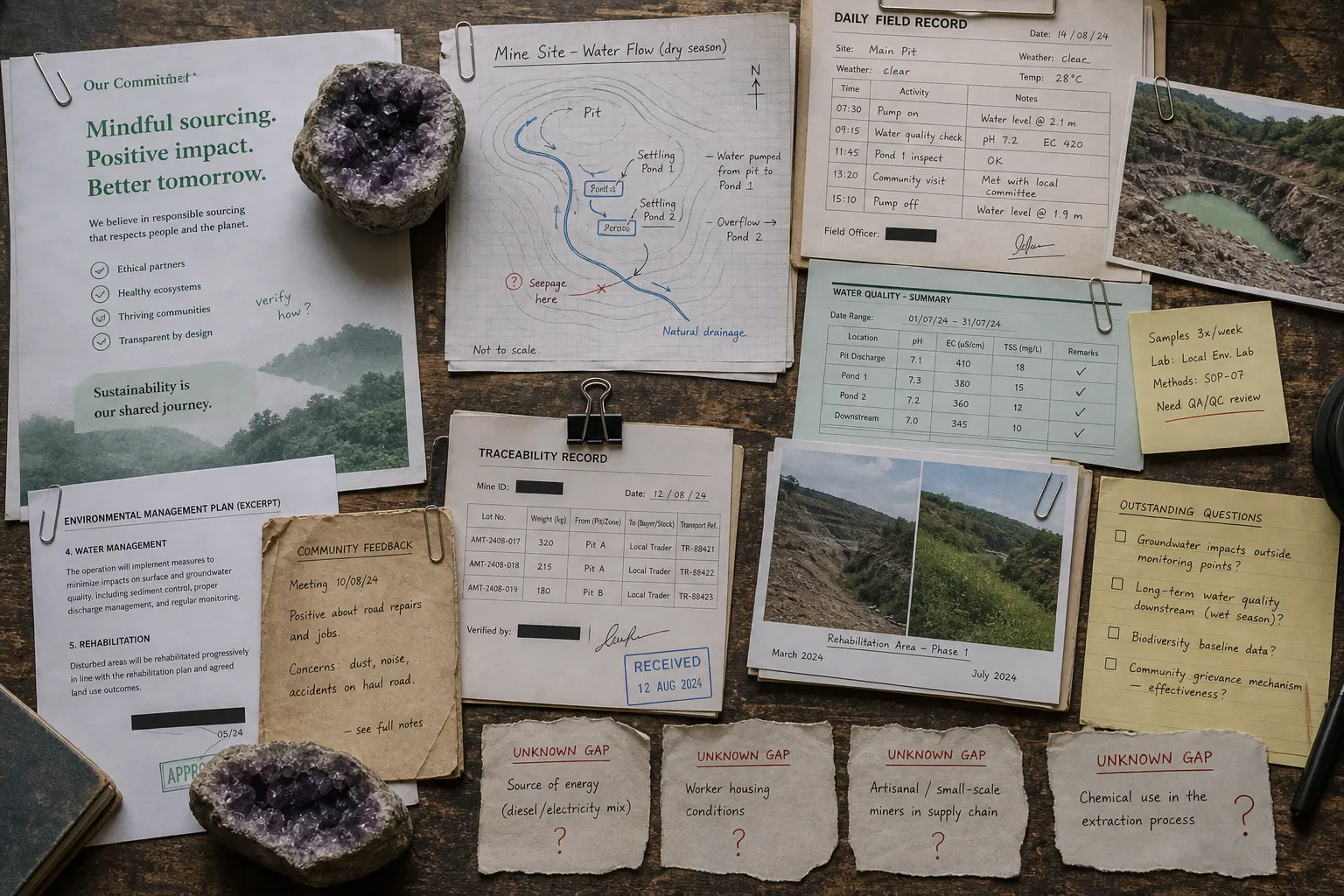
This evidence ladder keeps the question practical. A buyer does not need to become a mining engineer. They only need to separate responsible-sounding language from records that make a claim easier to evaluate.
Where Eco-Friendly Amethyst Claims Become Overstated
The common mistake is treating a sustainability principle as proof of performance. Closed-loop water handling may reduce uncontrolled water movement when it is properly designed, maintained, and monitored. That does not mean every mine using the phrase has a complete system.
Another mistake is treating one good practice as proof of the whole stone. A mine could reuse water but provide little evidence of land rehabilitation. A supplier could offer partial traceability but know little about water handling. A seller could use careful packaging while having no mine-level information.
Certification language can also be loose in crystal and gemstone retail. A document may confirm a shipment, a country of origin, a business relationship, or a seller policy without verifying environmental performance at the mine. That does not make every document useless, but it does mean readers should ask what the document actually verifies.
The clearest reading is modest: eco-friendly amethyst mining claims are stronger when they are specific, documented, and limited to what can be shown. They are weaker when they are emotional, absolute, or detached from mine-level information.
Questions to Ask Before Trusting the Claim
When a seller uses strong sustainability language, it is fair to ask for stronger detail:
- What mine, region, or supplier does this amethyst come from?
- Is the water recycling claim mine-specific, supplier-specific, or general?
- What does “closed-loop” mean in this case?
- Are there records for water handling, discharge control, or site monitoring?
- Is there a rehabilitation plan for disturbed land?
- Are there dated photos or updates showing rehabilitation work?
- What labor or sourcing safeguards are documented?
- Does any certificate verify mining practice, or only origin, shipment, or seller policy?
- What part of the supply chain is unknown?
The last question often matters most. A seller who names uncertainty may be more reliable than one who gives a perfect-sounding answer with no detail.
The Real Limit of “Closed-Loop” as a Standard
Closed-loop mining points in a responsible direction, but it is not enough on its own to define Sustainable Amethyst Mining. A serious standard would need more than water recycling. It would need documented environmental management, land rehabilitation, legal extraction, traceable sourcing, and honest limits on what each participant can verify.
Based on the evidence available for this article, it is too strong to say that closed-loop mining is already the universal new standard for amethyst. It is more accurate to say that closed-loop water handling is one practice readers can look for when assessing eco-friendly amethyst mining claims.
If a seller can document closed-loop water use, rehabilitation planning, and ethical sourcing controls, the claim deserves more attention. If the claim appears only as a polished phrase beside a purple crystal, it should be read as marketing until better evidence is provided.
For now, the most reliable reader standard is not a slogan. It is specificity: what was done, where it was done, who can document it, and what remains unknown.
FAQ
Is closed-loop mining automatically sustainable?
No. Closed-loop water handling can be part of a more responsible mining approach, but sustainability also depends on land disturbance, waste handling, energy use, legal extraction, labor conditions, and supply-chain transparency.
Does “ethically sourced amethyst” prove the mine used water recycling?
No. Ethical sourcing and water recycling are different claims. A supplier may have some traceability records without knowing whether the mine used a closed-loop water system.
Are there verified 2026 amethyst mining standards?
Not from the material available for this page. Stronger public sources would be needed before claiming that closed-loop water use, rehabilitation, or traceability is required across the amethyst sector.
What is the best quick test for an eco-friendly amethyst claim?
Ask what specific practice is being claimed, where it happened, what document supports it, and what remains unknown.