Buyer inspection guide
The Concrete Trap: How to Spot Reconstituted “Cathedral” Geodes
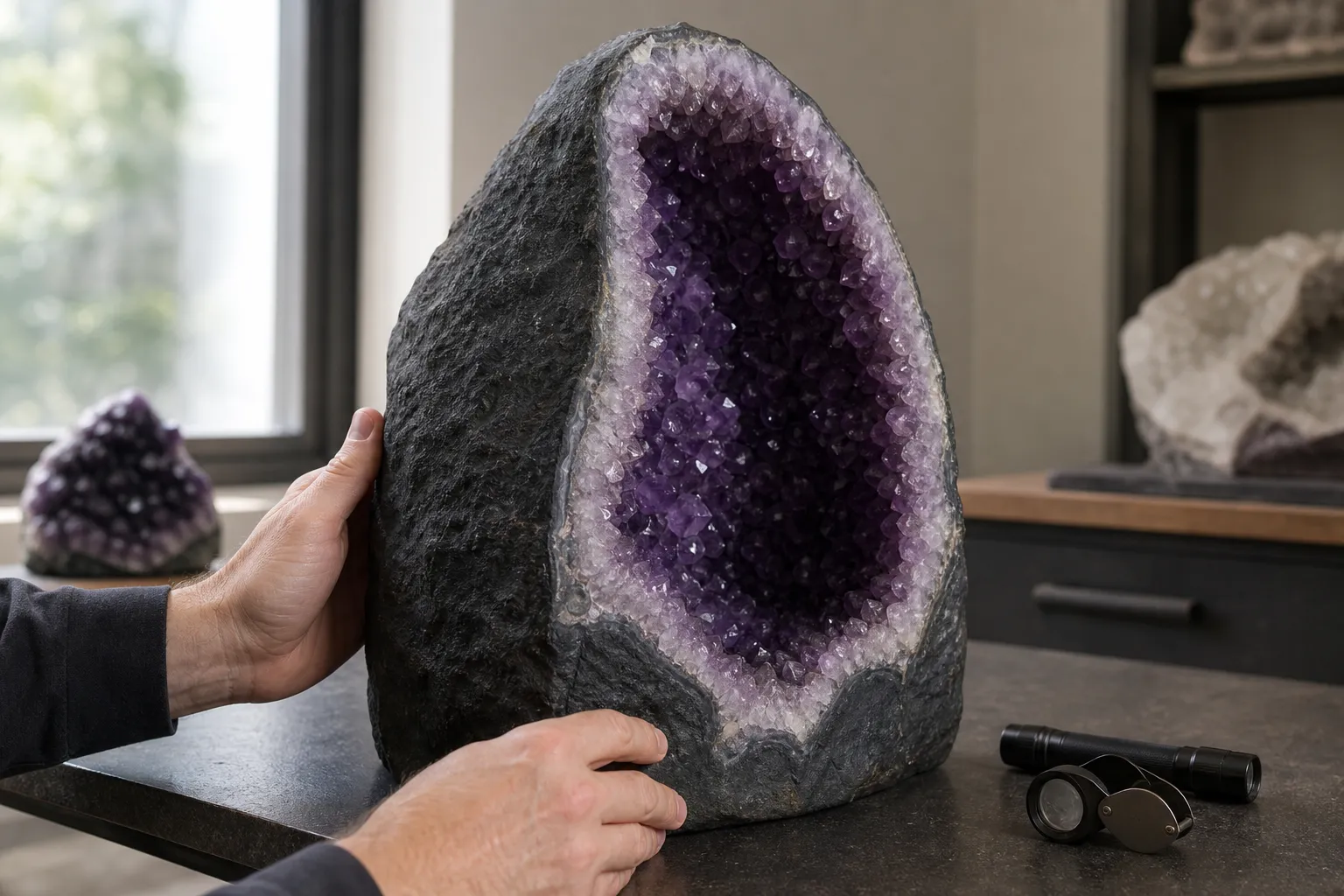
A large amethyst cathedral is not suspicious just because it has a flat base, a rough back, or a stabilized edge. Many big display pieces are cut, shaped, or supported so they can stand upright.
The warning sign is a cluster of things that do not quite belong together: cement-like backing, unusually smooth filled areas, mismatched textures, repaired-looking crystal points, resin-like patches, fresh paint, color where it should not be, or a seller who cannot explain what was repaired, reinforced, or added.
For buyers researching Amethyst Geode Repairs, the practical answer is: you usually cannot confirm a reconstituted, cement-filled, or reinforced cathedral from photos alone. What you can do is spot enough red flags to pause, ask better questions, and decide whether the piece needs in-person review by an experienced mineral dealer, appraiser, lapidary, or restoration professional.
broader context
Amethyst context note
This narrower page lands better after the broader amethyst context page.
What “Reconstituted” Can Mean in a Geode Listing
In listings and buyer conversations, “reconstituted cathedral geode” is often used loosely. It may point to several different concerns:
- A broken shell that has been repaired
- A hollow or unstable area filled with a cement-like material
- A reinforced back added for display support
- Crystal points reattached after damage
- Resin, coating, paint, or color alteration on the surface
Those are not the same issue.
A reinforced backing may be a practical display choice. A cement filled geode, if that is what it truly is, raises different questions about disclosure, weight, originality, handling, and value. Resin in amethyst geodes may be part of a repair, a coating, or another surface treatment. Dyed geode surfaces are a separate concern from physical reconstruction.
So the first step is not to call the piece fake or assume intent. The first step is to separate what you can see from what you can verify.
A cathedral geode is usually bought as both a mineral specimen and a display object. That matters. A collector may care deeply about natural surfaces and repair history. A decor buyer may care more about appearance, stability, and honest pricing. Either way, the buyer deserves to know whether the crystal interior, rim, back, and base are original, repaired, reinforced, filled, or altered.
Visual Warning Signs Worth Slowing Down For
Visual inspection is not proof. It is a way to decide when the purchase needs more evidence.
Back and base
Start with the back and base. Concrete backed geodes, cement-like fills, and reinforced geode backings may show a surface that looks different from the surrounding rock: flatter, smoother, more uniform, less mineral-like, or oddly shaped for display. A prepared base is not automatically a problem. An unexplained base that looks poured, coated, patched, or painted is worth questioning.
Rim and crystal pocket
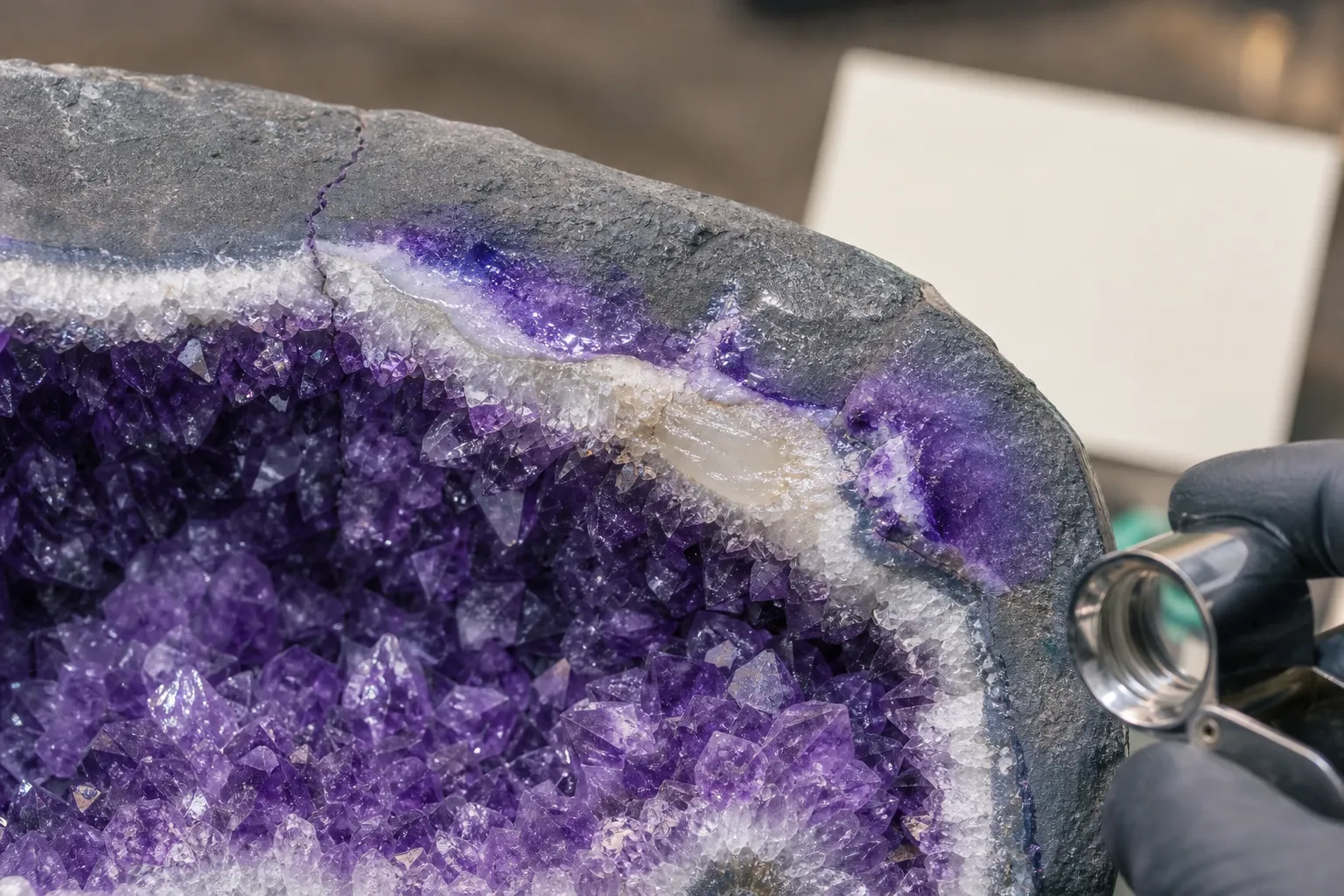
Then check the transition between the purple crystal pocket and the outer shell. Natural edges are often irregular. A suspicious rim may look abruptly sealed, over-smoothed, heavily painted, or visually disconnected from the crystal interior. If the back, rim, and base all look like separate materials joined together, ask for close-up photos before treating the piece as intact.
Crystal field
Look across the crystal field. Repaired crystal points may show glossy adhesive-like areas, isolated clusters that seem to sit above nearby crystals, or breaks that do not match the surrounding pocket. None of that confirms a repair by itself. Lighting can exaggerate shine, crystals can break naturally, and photos can flatten depth. But several odd patches together make the geode integrity question fair.
Color and seller story
Color is another clue, but not a verdict. Over-saturated purple, color on non-crystal matrix, painted-looking rims, or sharp color changes around a seam can suggest surface alteration. At the same time, camera settings, wet polish, and showroom lighting can mislead. Treat color as a reason to ask, not as a final answer.
Finally, compare the seller’s story to the object. “Natural, no repairs” paired with a thick artificial-looking base, hidden back, filled-looking rim, and no close-ups is a mismatch. A seller who openly says the cathedral has a reinforced back and shows the work clearly is offering a different kind of buying situation.
Questions to Ask Before Buying
Good geode inspection guidance is often less about having a perfect eye and more about asking precise questions. “Is it real?” is too broad. Ask about specific areas and materials.
Ask whether the geode has any repaired breaks, reattached crystal points, filled voids, added backing, resin, cement, concrete, paint, dye, or stabilizing material. Ask separately about the crystal interior, rim, back, and base. A seller may not know every detail, especially if the piece changed hands before, but they should be able to tell you what they know and what they cannot verify.
Ask for photos in ordinary light. Request the back, bottom, side profile, rim, and close-ups of suspicious seams or patches. For a heavy cathedral, a short video of the piece being slowly turned can reveal relationships between surfaces better than one front-facing image.
Ask about weight and scale. Weight does not prove authenticity, but large filled or reinforced areas can affect handling, display, and shipping expectations.
Ask whether the item was repaired after shipping damage. Shipping damage on large crystal specimens is plausible, but the phrase should not become a vague explanation for major reconstruction. If there was damage, ask what broke, what was repaired, who repaired it, and whether the repair is visible.
Ask about return terms before payment. A return policy does not authenticate the geode, but it gives you room to inspect it after arrival. For a high-value piece, consider making the sale conditional on review by a qualified person. If the seller will not answer repair questions, show the back, or allow a reasonable inspection window, that may be enough reason to walk away.
What Photos Cannot Tell You
A photograph cannot reliably identify every repair material. A cement-like surface may be cement, plaster, mortar, resin mixed with aggregate, paint over natural matrix, or another stabilizing material. A heavy base may be natural rock or added support. A smooth back may be cut, coated, reinforced, or simply prepared for display.
That is why the wording matters. It is fair to say, “This area may indicate filling,” or “This backing should be verified before purchase.” It is much harder to say, from photos alone, “This is fake,” “This will fail,” or “This destroys the value.”
Geode integrity also has more than one meaning. A reinforced cathedral may still be attractive and displayable. A repaired specimen may still be desirable if the repair is disclosed and the price reflects it. A heavily reworked piece may be less appealing to a collector who wants minimal intervention. The issue is not only whether a repair exists. It is whether the repair is disclosed, understood, stable enough for the buyer’s intended use, and accounted for in the purchase decision.
There is one common exception worth keeping in mind: some large amethyst cathedrals are prepared for standing display. A flat base, cut back, or support surface does not automatically make the geode reconstituted. The warning sign is not preparation. The warning sign is unclear preparation presented as untouched natural integrity.
A Practical Inspection Checklist
Use this as a pause-and-question tool, not a pass-or-fail test.
- Back surface: Does it look like natural matrix, or does it appear poured, coated, patched, painted, or unusually uniform?
- Base: Is the bottom cut or stabilized for display, and has that been disclosed?
- Rim: Are there abrupt seams, filled gaps, mismatched textures, or areas where the shell seems disconnected from the crystal pocket?
- Crystal points: Do any clusters look reattached, overly glossy at the base, or inconsistent with nearby crystals?
- Color: Is purple color limited to the crystals, or does it appear on matrix, filler, backing, or repaired areas?
- Photos: Are there clear images of the front, back, bottom, sides, rim, and close-up problem spots?
- Disclosure: Has the seller answered directly about repairs, cement filling, resin, reinforced backing, dye, and shipping damage?
- Verification: Is the piece valuable enough to justify review by an experienced mineral dealer, appraiser, lapidary, or restoration professional?
If several answers remain unclear, do not argue with the listing. Slow the transaction down. Ask for more evidence, negotiate based on uncertainty, request inspection rights, or keep looking.
When to Walk Away
Walk away when a piece is priced as an intact natural cathedral but the seller avoids basic repair questions. Walk away when the listing only shows the glittering interior and hides the back and base. Walk away when “no repairs” is stated while visible seams, patches, or filled-looking areas remain unexplained. Walk away when you are pressured to decide before you can verify geode repairs before purchase.
It is also reasonable to pass if the geode is too large, costly, or logistically difficult for your confidence level. Big amethyst cathedrals are not casual objects. Their weight, fragile edges, display needs, and shipping risk make uncertainty more expensive.
The best outcome is not always finding a perfect untouched cathedral. It is knowing what you are buying. A disclosed reinforced backing, visible repair, or stabilized base may be acceptable to one buyer and unacceptable to another. The concrete trap is buying a reworked-looking cathedral as if it were unquestionably intact, with no photos, no disclosure, and no path to verification.
FAQ
Does a concrete-looking back mean the geode is reconstituted?
Not by itself. It may be added support, a display preparation, a coating, or another material. It becomes more concerning when the seller cannot explain it, the surface looks heavily filled, and other parts of the geode show mismatched seams or repair signs.
Are repaired amethyst cathedral geodes always bad?
No. A repaired or reinforced piece can still be attractive and usable if the work is disclosed and the price makes sense for the buyer. The problem is undisclosed repair, unclear materials, or a listing that presents a heavily altered piece as untouched.
Can I verify cement filling from photos?
Usually not with confidence. Photos can suggest filled areas, reinforced backings, painted surfaces, or repaired crystal points, but material identification often needs closer inspection. For expensive pieces, ask for detailed images, video, written disclosure, and professional review if needed.
What is the safest buying tip for a repaired-looking geode?
Ask specific questions before purchase: what was repaired, what was filled, what was reinforced, what materials were used, and whether the back, base, rim, and crystal interior are original or altered. If the answers stay vague, treat that uncertainty as part of the price and risk.