Gemstone viewing note
Dead Black vs. Deep Purple: Understanding “Extinction” in Gemstone Cutting
A deeply colored amethyst should still read as purple when the light is reasonable. If parts of the stone turn into flat, dead-looking black areas that do not give back much color or brightness as you move it, you may be seeing Amethyst Extinction rather than rich saturation.
In plain gem-viewing terms, extinction means dark areas where little useful light appears to return to the viewer. Saturation is different: it describes the strength of the purple color itself. The hard part is that both can happen in the same stone. An amethyst can have a naturally strong, dark purple body color and still show blacked-out areas from the way light is behaving in the cut.
The quick difference: purple depth versus black silence
When people ask whether an amethyst is “deep purple” or “going black,” they are usually reacting to the same visual problem: the stone looks impressive at first, but some areas are too dark to read.
A useful question is: does the darkness still contain color?
In a richly saturated amethyst, the dark areas still feel purple. You may see plum, violet, grape, reddish purple, or blue-purple flashes as the gem moves. Even when the tone is dark, the face of the stone has some color presence.
In an extinct-looking area, the darkness feels more like absence. The patch may look black, gray-black, or inked in. It does not look like a deeper purple zone; it looks like that part of the stone has stopped returning light.
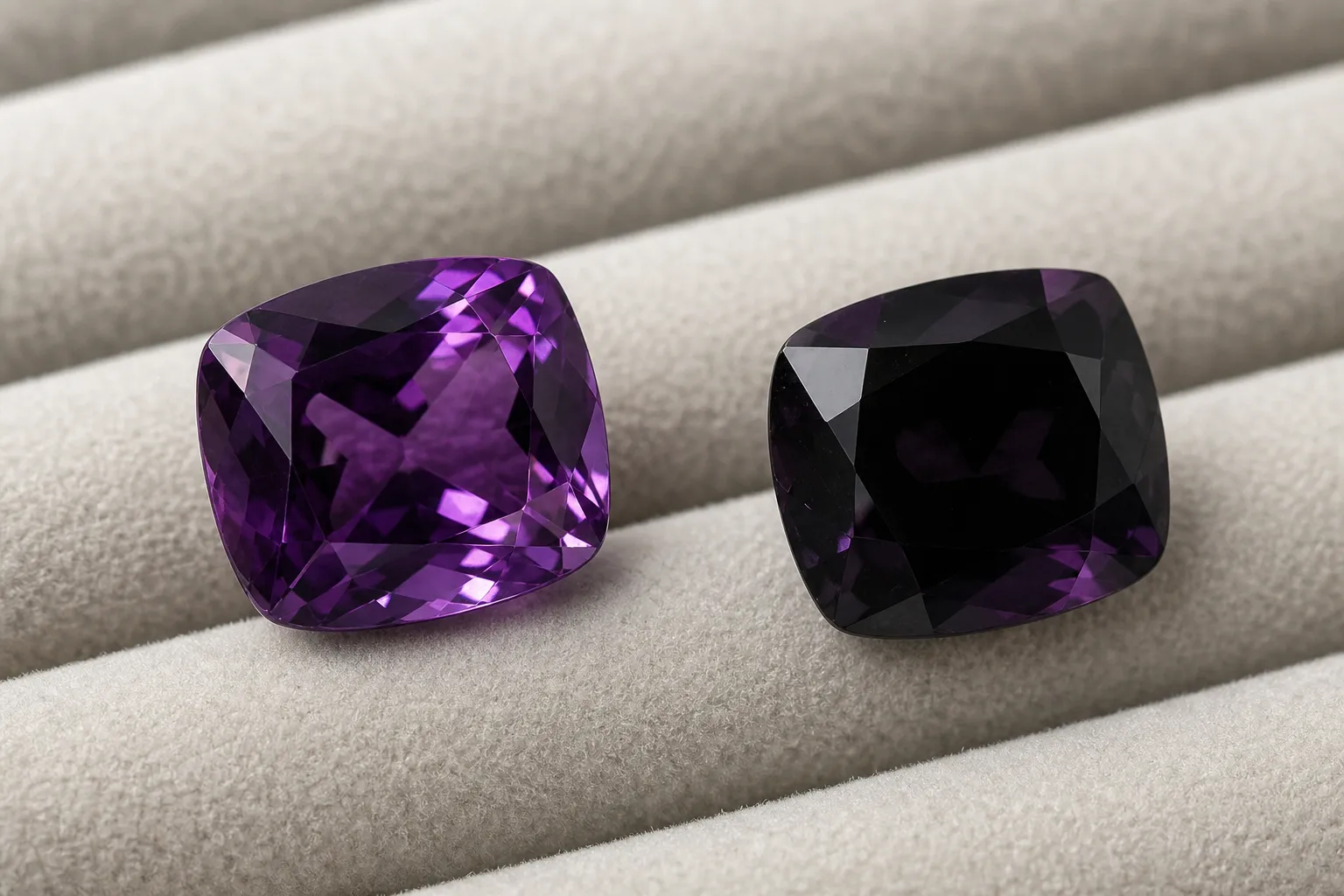
Three separate ideas
- Tone is how light or dark the color appears.
- Saturation is how strong or vivid the purple appears.
- Extinction is the visual shutdown of areas that return little light to the eye.
For a buyer or collector, the better question is not “Is dark bad?” It is: does this dark amethyst still show purple life, or does it collapse into black?
What to check when an amethyst looks black
You do not need lab equipment to make a first visual judgment, but you do need more than one glance. A faceted amethyst can look very different under jewelry-counter lights, soft daylight, phone-camera exposure, and dim indoor light.
Use these as viewing habits, not as a formal grading system.
Rotate the stone slowly
Hold the amethyst face-up and turn it a little at a time.
A deep purple amethyst may shift between brighter and darker areas, but the color should not disappear across large sections at normal viewing angles. If a dark area breaks up, moves, or turns purple as the stone rotates, it may be angle-dependent light behavior.
If the same area stays flat and black through small movements, that is a stronger visual cue that the stone is not returning much visible light from that part of the face.
This does not prove a specific cutting fault. It simply tells you that the face-up appearance includes zones with weak visible return under those conditions.
Compare straight-on and tilted views
Look at the stone straight on, then tilt it gently.
If the amethyst looks black only at a steep angle, that may be ordinary viewing behavior. Many faceted stones show dark reflections or shadows from some directions. If it looks dead black in the main face-up view, especially across broad areas, the stone may appear less lively than its color description suggests.
The distinction matters because “deep purple” is still a color impression. “Dead black” is closer to a loss of readable color.
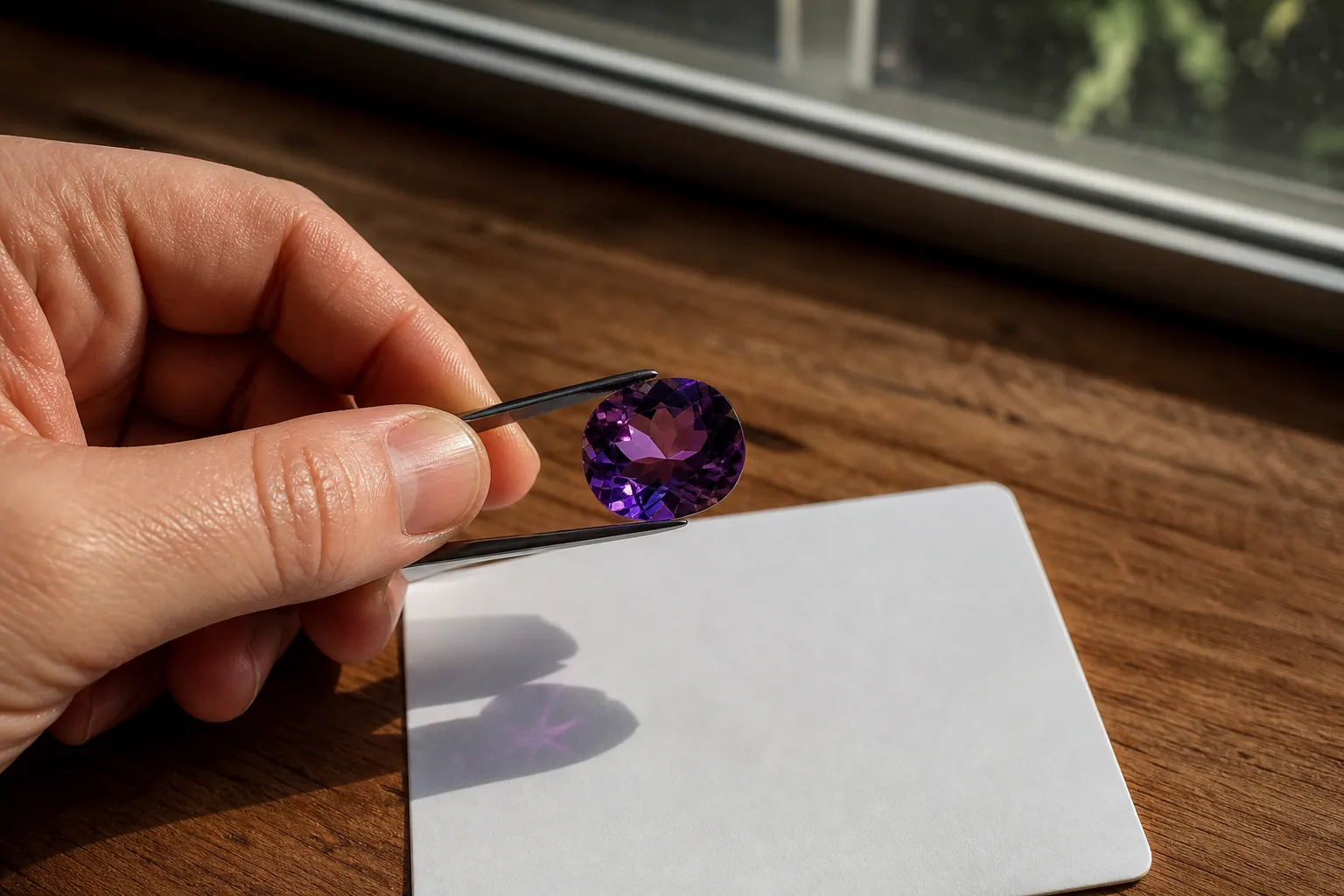
Change the light, but keep it realistic
A dark purple amethyst can look nearly black in weak light. That alone is not enough to call it extinction.
Move the stone from dim room light to soft daylight near a window, or use a neutral, diffuse light. Avoid judging only under intense spotlights, because strong direct lighting can create flashes that hide everyday darkness. Also avoid relying on one listing photo, since camera exposure and contrast can make a dark amethyst look either richer or flatter than it appears in hand.
The practical question is simple: under fair light, does the stone return purple, or does it stay visually closed?
Look for color inside the darkness
This is often the easiest cue. A deep purple amethyst can be moody, concentrated, and dark, but you should still be able to find color inside that darkness.
If the stone looks like a black mirror with only a few purple edges, pause. Seller words such as “extra deep,” “inky,” or “near black” may describe an aesthetic style, but they do not by themselves show good light return or strong saturation.
Why tone, saturation, and light return get mixed up
The confusion around amethyst saturation versus extinction comes from the fact that all three can make a stone look darker.
A pale lavender amethyst has a light tone. A dark royal-purple amethyst has a dark tone. But tone alone does not tell you whether the gem is lively.
Saturation is about the strength of the color impression. A strongly saturated amethyst looks clearly purple rather than weak, grayish, or washed out. It can be medium-dark or dark and still be saturated.
Light return is the visual impression of light coming back from the facets. When that return is weak in some areas, those areas may look black or lifeless.
In the eye, these categories overlap. A dark, saturated amethyst can look dramatic. A poorly returning dark area can also look “deep” for a moment. Movement usually helps separate them: true color depth tends to keep showing purple as the gem moves, while extinction-like areas tend to read as dead zones.
There is also a material side to amethyst color. Amethyst is purple quartz, and research on its color often discusses iron-related color centers, irradiation history, lightness, and chroma. That background helps explain why “darker” and “more colorful” are not identical. For this page, though, the main point stays practical: the stone’s body color and the cut’s light behavior are different things, even when your eye receives them together.
When a dark amethyst is not necessarily a problem
A dark amethyst is not automatically a poor-looking stone. Some people prefer a serious, saturated purple over pale lavender. In jewelry, a darker stone can feel formal, calm, or atmospheric.
The caution is that darkness should not be treated as quality by itself. An amethyst can look dark because:
- Its purple color is strong.
- Its tone is naturally low in lightness.
- The light is weak.
- The cut returns little light in the face-up view.
- The setting or photograph makes the stone read darker.
A convincing deep purple amethyst keeps its identity as purple across ordinary viewing conditions. It does not need to be bright like a pale gem, and it does not need to sparkle from every angle. But it should give the eye enough color information to read as amethyst, not as an anonymous black stone.
Style preference is separate. If someone likes near-black amethyst for mood or contrast, that is an aesthetic choice. It should not be stretched into claims about higher value, better cutting, natural origin, treatment status, or rarity without stronger evidence.
A practical “extinction or saturation?” check
Use this short check when an amethyst looks black in a listing, at a counter, or in your hand.
- Does the darkness still show purple? If yes, you may be seeing deep tone and saturation. If no, the area may be extinction-like or simply underlit.
- Does the stone wake up in soft daylight? A saturated amethyst should usually become easier to read under suitable light. If it stays black in fair light, be cautious.
- Do the black areas change as you rotate it? Small changing shadows are normal. Large, persistent dead zones are more concerning visually.
- Is the whole stone dark, or only certain patches? Overall dark tone is different from black patches that interrupt the face-up pattern.
- Are you judging from one photo? Do not make a strong call from a single image. Exposure can exaggerate both richness and blackness.
- Are color words being used as proof? Terms such as “deep,” “royal,” and “inky” are descriptions, not evidence of light return.
This check cannot replace professional grading or lab work. It also cannot tell you whether an amethyst is natural, synthetic, treated, rare, or valuable. It is only a clearer way to look at the visual issue in front of you.
What this visual judgment cannot tell you
Amethyst extinction is useful as a viewing concept, but it has limits. A black-looking area does not identify the stone’s origin. It does not establish treatment history. It does not prove an exact value grade. It also does not identify a precise cutting angle or show that recutting would improve the stone.
Other factors can make amethyst appear uneven or darker in places, including color zoning, inclusions, lighting, setting style, viewing angle, and photographic contrast. Some belong to the material. Some belong to the viewing conditions. Some may relate to the cut.
The strongest responsible conclusion is visual: if an amethyst looks dead black in important viewing positions and does not return much purple under reasonable light, it is not giving the same face-up impression as a deep purple amethyst that remains visibly alive. If it stays purple even when dark, with color returning as the stone moves, the darkness is more likely part of its rich tone and saturation rather than a shut-down appearance.
You are not trying to solve the entire history of the crystal. You are deciding whether the stone in front of you has deep purple presence — or whether the darkness has taken the purple away.