The Sauna Embargo: Why Heat is the Silent Killer of Quartz
Yes. Sauna heat can increase the damage risk for amethyst and other quartz gemstones, especially when heat is combined with steam, sweat, metal settings, and fast cooling afterward. The practical rule is simple: remove amethyst jewelry before entering a sauna, steam room, hot tub, or any situation with abrupt temperature change.
That does not mean every amethyst will crack the moment it gets warm. It means thermal shock in gemstones is an avoidable stress event, and a finished amethyst jewel is not built to be repeatedly heated, humidified, and cooled like sauna equipment.
Quartz is hard enough for normal jewelry use. But hardness is scratch resistance, not heat immunity. A gemstone can resist everyday abrasion and still be vulnerable to internal stress, existing fractures, liquid inclusions, setting pressure, or color instability under heat.
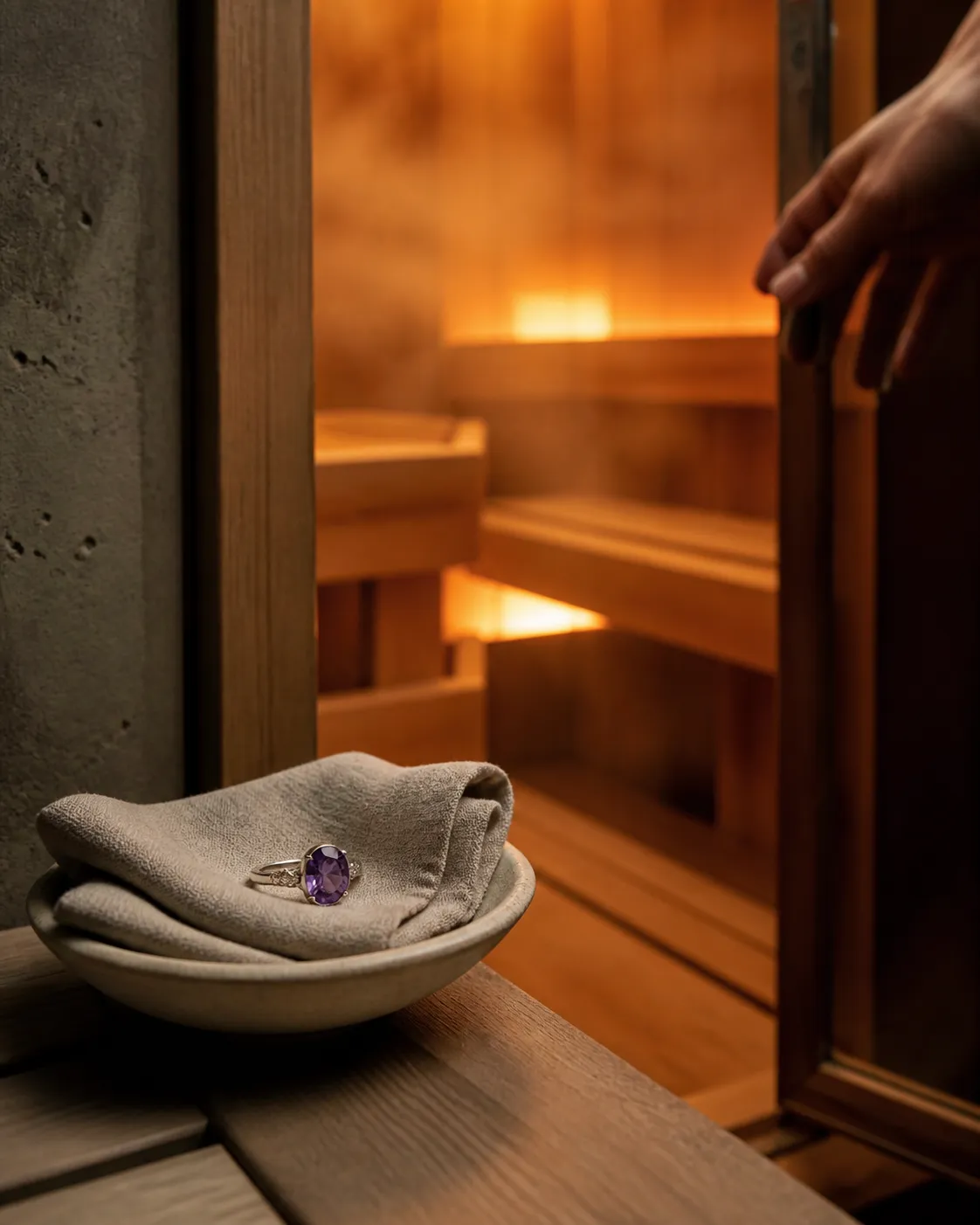
Why quartz hardness does not make amethyst sauna-proof
Amethyst is the purple variety of quartz, which is part of the confusion. Quartz is familiar, relatively durable, and common in jewelry, specimens, and decorative objects. On the Mohs scale, it stands up better than many softer gems.
But a sauna challenges a jewel in a different way. A ring, pendant, or bracelet may be exposed to:
- sustained heat;
- humid air or steam;
- sweat and salts;
- hot metal in close contact with the stone;
- uneven heating between exposed and covered areas;
- quick cooling when the wearer steps into colder air, rinses off, touches cold surfaces, or enters a pool.
The concern is not simply “hot air.” It is temperature difference and temperature change. Quartz warms and expands. Metal warms and expands too, but not necessarily at the same rate. If the stone already contains inclusions, tiny fractures, chips, or repaired areas, those weak points can matter more under stress.
That is why normal wear and sauna exposure should be treated as different care situations.
What thermal shock means for amethyst jewelry
Thermal shock happens when temperature change creates stress faster than a material can comfortably accommodate. In gemstones, the issue is usually rapid heating, rapid cooling, or uneven heating across one stone.
A hot exterior and cooler interior can create internal strain. So can a stone that has been heated and then quickly chilled. Different parts of the gem expand or contract differently; if that stress concentrates around a weak point, a fracture may open or extend.
This is where the coefficient of thermal expansion matters. The term describes how much a material expands when heated. Quartz has its own thermal behavior. Gold, silver, platinum, solder, adhesives, and inclusions inside a gem can behave differently. A finished jewel is not just “a quartz stone.” It is a small structure of stone, metal, pressure points, contact surfaces, and sometimes past repairs.
For an owner, the useful takeaway is not a specific number. It is the principle: mixed materials and internal features can respond differently to heat. That makes a sauna a poor durability test.
Pieces that deserve extra caution
Some amethyst jewelry is more vulnerable than a clean, sturdy, unset quartz specimen. Be especially careful with:
- stones with visible veils, feathers, chips, or cracks;
- heavily included amethyst;
- stones with known liquid inclusions or fluid-filled internal features;
- antique or heirloom jewelry;
- repaired jewelry;
- glued, foiled, or closed-back settings;
- stones with damaged facet edges, points, or girdles;
- pieces that are valuable, sentimental, or difficult to replace.
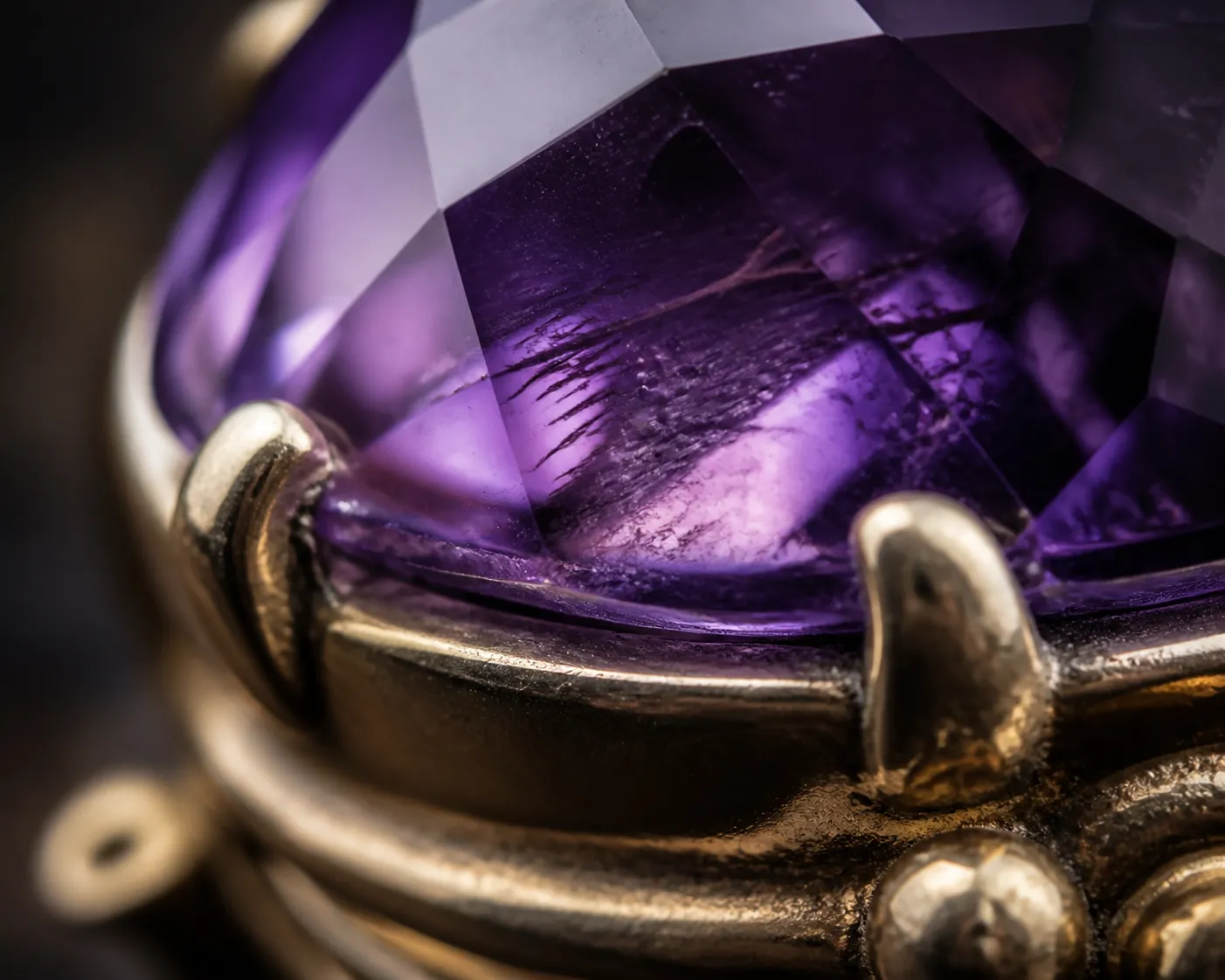
Liquid inclusions are worth naming because they complicate the heat story. A fluid-filled inclusion is not the same material as the surrounding quartz. Under heating and cooling, it may respond differently and contribute to localized stress. That does not mean every included amethyst will fail in warmth, but it does make “it’s just quartz” an oversimplification.
Heat can affect color, cracks, and settings in different ways
Color change is one issue
Controlled heat treatment of amethyst is a known gemological subject. Research on heated amethyst describes color changes at high treatment temperatures, often far above ordinary sauna conditions.
So, a sauna is not the same as a professional heat-treatment process, and it should not be described as likely to turn an amethyst ring into citrine. But the existence of heat treatment also does not prove that finished amethyst jewelry is sauna-safe. It only shows that amethyst color centers can be heat-sensitive under certain conditions.
Cracking is another issue
Heat-related cracking is usually not about a stone melting or visibly burning. It is more often about stress, expansion, and pre-existing weak points. Crystal fractures may appear as new cracks, extensions of old feathers, or damage along a chipped edge.
A clean quartz specimen, an included amethyst cabochon, and an old prong-set ring should not be treated as the same object.
Setting damage is a third issue
Jewelry is more than the gemstone. Heat and moisture can also affect the mounting:
- metal expands under heat;
- prongs and bezels may shift pressure on the stone;
- sweat and humidity can collect in crevices;
- adhesives may soften or age poorly;
- older repairs may be less stable than they look.
A stone may survive while the setting becomes less secure. Or the setting may place pressure on a stone already under thermal stress. In a sauna, gem and mounting share the risk.
Why heated amethyst products do not answer the jewelry question
Some confusion comes from wellness businesses that use amethyst in heated rooms, mats, panels, or decorative equipment. That can make the advice feel contradictory: if amethyst appears in heated products, why remove an amethyst ring before a sauna?
The answer is context. Decorative or engineered uses of amethyst are not the same as a faceted gem held in a ring against a sweating hand. A product may use slabs, small stones, crushed material, enclosed panels, or designs unlike wearable jewelry. Any health-outcome marketing attached to those products is outside the gemstone-care question.
For care purposes, the comparison should stay narrow: your jewelry was selected and set for appearance, wearability, and adornment, not for repeated thermal cycling in a hot, humid room.
What to do before and after sauna exposure
Remove amethyst jewelry before:
- dry saunas;
- steam rooms;
- hot tubs;
- very hot baths;
- plunge-pool routines after heat;
- direct heat from lamps, heaters, or flames;
- home steam cleaning, unless the piece has been checked for suitability.
Store the piece somewhere dry and stable. At a spa or gym, a padded pouch or small jewelry case is better than leaving a ring on a hot bench, a cold tile ledge, or loose in a bag with keys.
If your amethyst has already been in a sauna, do not try to “fix” it with cold water. Let it return gradually to room temperature. Avoid ice, cold rinsing, or placing it on a chilled surface. Afterward, inspect it in good light. Look for new cracks, looseness, rattling in the setting, trapped moisture, or a change in how the stone sits.
For routine cleaning after normal wear, mild soap, lukewarm water, and a soft cloth are usually the safer direction. Steam cleaners and ultrasonic cleaners are not automatic choices for amethyst jewelry, especially if the stone is included, fractured, repaired, glued, antique, or valuable.
If the piece matters financially or sentimentally, have a jeweler or gemologist inspect the setting and visible condition rather than testing it at home.
What the evidence can and cannot say
The evidence supports a cautious care recommendation, but it is not the same as a dedicated study of faceted amethyst rings worn through real sauna routines.
Gemological references distinguish hardness from broader durability and discuss heat, sudden temperature change, inclusions, and cleaning risks in gemstone care. Mineral and materials sources support the underlying ideas of thermal expansion, temperature-related stress, and fracture behavior in quartz. Amethyst heat-treatment studies show that heat can affect color under controlled conditions.
What is less available is jewelry-specific testing that predicts exactly how one amethyst ring will behave after repeated sauna sessions. That gap should not be filled with retailer reassurance or spa marketing. It simply means the owner’s decision should be risk-based: the benefit of wearing amethyst in a sauna is small, while the possible damage is avoidable.
Quick decision checklist
Remove the jewelry before heat exposure if any of these apply:
- the amethyst is worn against skin in a sauna;
- the stone has visible inclusions, veils, chips, or fractures;
- the setting is antique, repaired, glued, closed-back, or unfamiliar;
- the piece is valuable, sentimental, or difficult to replace;
- the routine includes moving from heat to cold air, a shower, a pool, or a plunge bath;
- you are unsure whether the stone has been treated or repaired.
Even if none of those apply, removal is still the cleaner choice. Amethyst is durable enough for ordinary jewelry use, but that durability should not be stretched into a heat-resistance claim.
Enjoy amethyst as jewelry, but give it an embargo from the sauna. Hardness helps it face daily wear. It does not make it immune to heat, steam, rapid cooling, or the hidden stress points inside a real gemstone.