Crystal structure note
Brazil Law Twinning: The Hidden Architecture of Natural Crystals
Brazil Law Twinning is a crystallographic feature in quartz where right-handed and left-handed quartz structures occur together within one crystal. In amethyst, which is violet quartz, it can matter because this internal structure affects optical behavior used in gemological observation. It does not mean the crystal came from Brazil. It is not the same as purple color zoning. And on its own, it does not prove that an amethyst is natural, valuable, or from any specific locality.
The simplest reading is this: “Brazil law” names a twin law in quartz. It describes how parts of the crystal lattice are oriented, not where the specimen was mined.

broader context
Begin with the main amethyst page
This narrower page lands better after the broader amethyst context page.
What Brazil Law Twinning means in quartz
Crystal twinning happens when two or more parts of a crystal grow together in an ordered relationship. The parts are not random fragments. They share a defined crystallographic orientation, as if one domain has been related to another by a specific structural rule.
Brazil Law Twinning is one of the known twin laws in quartz. Quartz can occur in right-handed and left-handed structural forms. In Brazil law twinning, those unlike handed structures are intergrown. That is why the feature is often discussed as an optical or chiral twinning pattern: the hidden structure can affect how the material behaves under polarized light.
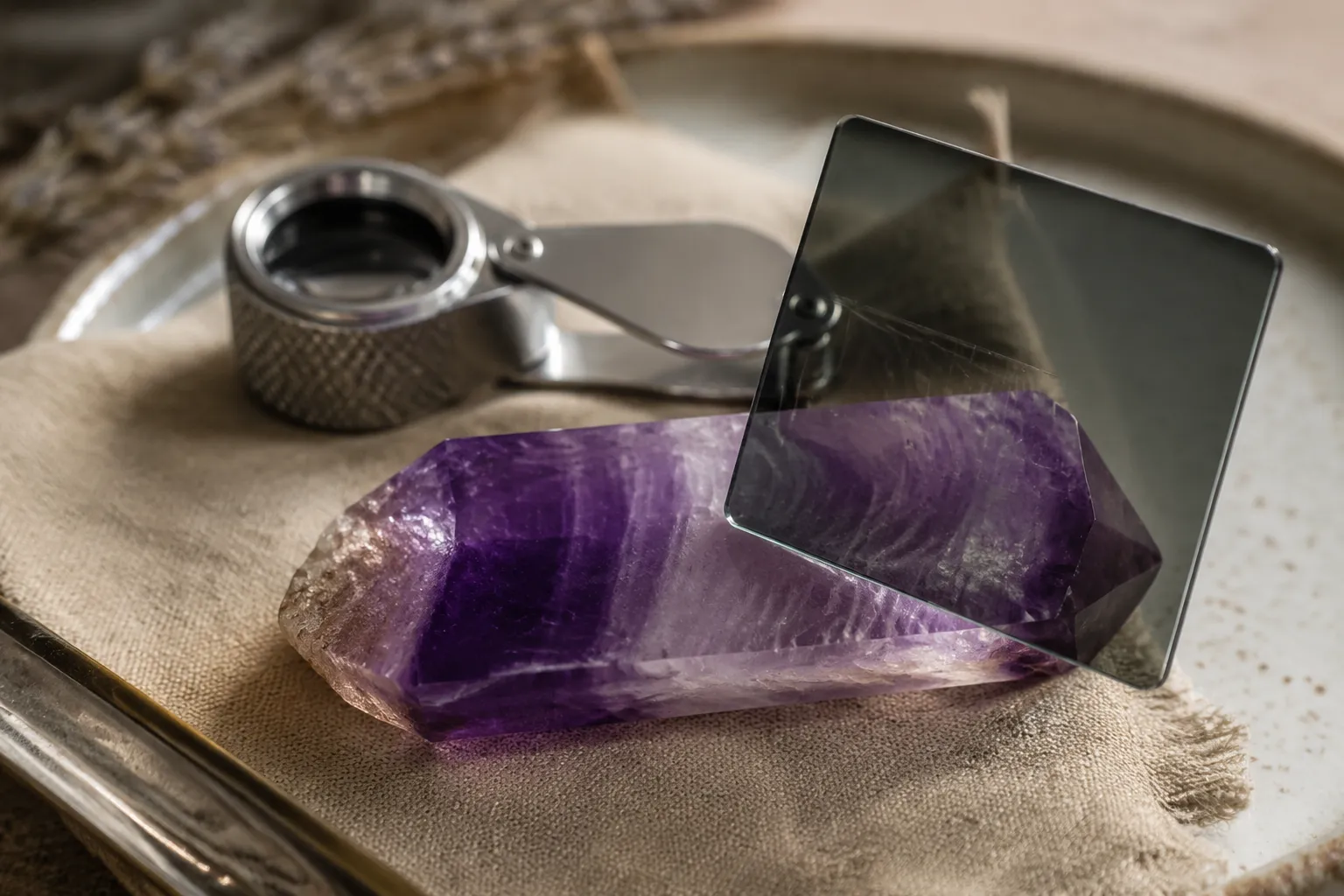
This does not usually appear as a neat surface mark that a collector can spot at a glance. The important action is inside the crystal lattice. In amethyst, Brazil law twinning may be expressed through lamellae, domains, or polysynthetic twinning, where repeated thin twin regions occur in a structured way. These features are usually interpreted with optical methods, polarizing instruments, microscopy, or other gemological techniques.
A useful distinction
- Crystal lattice: the ordered internal arrangement of atoms in quartz.
- Twin law: the rule describing how one crystal domain is oriented relative to another.
- Brazil Law Twinning: a quartz twin relationship involving right-handed and left-handed structures.
- Polysynthetic twinning: repeated thin twin lamellae arranged through the crystal.
- Optical structure: the way internal arrangement affects light behavior, especially under polarized-light observation.
The word “law” can sound legal, but in mineralogy it means a crystallographic rule. It has nothing to do with Brazilian regulations. A crystal can show Brazil law twinning without being Brazilian, and a Brazilian amethyst is not identified by this feature alone.
How it differs from amethyst color zoning
Amethyst is violet quartz, not a separate mineral species. Its material identity is quartz: silicon dioxide arranged in a crystalline framework. The violet color is usually discussed in relation to trace elements, lattice effects, and irradiation history. Brazil Law Twinning belongs to a different layer of the same material: the orientation of quartz structures inside the crystal.
That distinction matters because amethyst can show more than one kind of internal pattern. Some patterns are color patterns. Some are structural patterns. They can occur in the same crystal, but they are not the same thing.
Color zoning refers to uneven distribution of violet color. It may appear as bands, triangular zones, deeper purple areas, or paler regions, depending on how the crystal grew. Natural amethyst often shows zoning, and collectors commonly notice strong color near crystal terminations or within particular growth sectors.
Brazil Law Twinning, by contrast, is about the orientation of right-handed and left-handed quartz domains. Mineralogical and gemological descriptions often discuss amethyst as showing Brazil law twinning in repeated lamellae. These lamellae can be very fine and may not be visible to the unaided eye.
A purple band is not automatically a twin boundary. A pale zone is not proof of synthetic growth. A fine internal line is not enough to identify Brazil Law Twinning without context. The geometry and optical behavior matter.
Why Brazil Law Twinning matters in natural vs synthetic amethyst
Brazil Law Twinning is often mentioned because it can help gemologists separate many natural amethysts from many synthetic amethysts. The careful phrase is “can help,” not “settles the question.”
Natural amethyst is commonly described as showing Brazil law twinning. Hydrothermal synthetic amethyst can share the chemical and physical identity of quartz and may look convincing in ordinary viewing. Because of that, internal growth features, inclusions, color zoning, and twinning patterns can all become useful clues.
The responsible collector-level answer is: Brazil Law Twinning can be one clue in gemological identification, but it is not a standalone verdict.
Several conditions affect the interpretation
- Natural amethyst can be twinned, but the feature may not be easy to observe.
- Many synthetic amethysts may differ in twinning behavior, but twinned synthetic examples are discussed in the literature.
- The character of the twinning pattern matters, not just the presence of a line or band.
- Gemological identification usually weighs multiple observations together.
Older simplified statements sometimes treat Brazil law twinning as proof of natural amethyst. That is too broad. Identification can depend on the pattern of twinning, inclusions, color zoning, growth features, and the instrument used.
For ordinary buying decisions, a listing that says “Brazil Law Twinning” should not be treated as a full certificate of natural origin. It may be a meaningful technical note if supported by proper observation, but it is not the same as laboratory documentation.
For higher-value material, especially faceted amethyst sold as natural, documentation or professional gemological review carries more weight than a visual claim made from photographs. Photos can show color, cut, clarity, and sometimes growth zoning. They rarely settle subtle crystallographic questions on their own.
What Brazil Law Twinning does not prove
Brazil Law Twinning sits between mineral structure and gemological interpretation. Its limits are part of the answer.
It does not prove Brazilian origin
The name is not geographic evidence. “Brazil law” is a crystallographic term. Amethyst deposits occur in many regions, and the presence or absence of this twinning feature should not be used as a country-of-origin label.
A specimen described as “Brazil law twinned” is being described by internal structure, not by mine location. If origin matters, it needs separate provenance support.
It is not the same as color zoning
Color zoning concerns how violet color is distributed through the crystal. Brazil Law Twinning concerns how quartz domains are oriented in the crystal lattice.
The two may be discussed together because both can appear in amethyst and both can affect gemological observation. But a band of color is not automatically a twin lamella, and a twin lamella is not simply a darker purple zone.
It does not guarantee value
Brazil Law Twinning can be scientifically interesting, but value is not determined by the term alone. Collector and market judgment usually depend on a wider set of factors: color quality, clarity, cut, crystal form, specimen condition, size, locality documentation, rarity, aesthetics, and current demand.
In a faceted stone, twinning may be relevant to identification. In a mineral specimen, it may interest a collector who values crystallographic features. But it should not be treated as a price guarantee.
It does not replace gemological testing
Some internal features require instruments and training to interpret. Polarized light, microscopy, and other testing methods can reveal information that ordinary viewing cannot. Even then, twinning is usually considered alongside other evidence.
If the question is low-stakes curiosity, a general explanation may be enough. If the question affects purchase value, resale, appraisal, or origin claims, Brazil Law Twinning should be treated as one possible data point rather than the final answer.
It is not a spiritual measurement
Amethyst has long carried symbolic associations, from ancient cultural meanings to modern decorative and contemplative use. Those meanings belong to a symbolic layer. Brazil Law Twinning belongs to the material layer of quartz crystallography.
A person may appreciate amethyst for beauty, atmosphere, or personal symbolism. That does not make twinning a measurable sign of spiritual strength or personal outcome. The structural fact and the symbolic reading should stay separate.
How to read the term on a listing or label
When a seller, article, or collector note mentions Brazil Law Twinning, read it first as a technical description.
Ask three questions:
- Is the claim about structure, origin, or value?
The term properly refers to structure. If it is being used to imply country of origin or a guaranteed premium, more evidence is needed. - How was the twinning observed?
A credible discussion should have an optical or gemological basis, not just point to a visible purple pattern. - Is the claim being used alone?
Natural vs synthetic amethyst identification should consider more than one feature. Twinning may help, but it should sit beside inclusions, zoning, growth features, documentation, and appropriate testing.
For amethyst care, Brazil Law Twinning does not change the basic caution around the stone. Amethyst color can be sensitive to excessive light exposure, and heat can alter color. That care note is about color stability, not the twin law itself.
The main collector skill is separation. Structure is structure. Color is color. Origin is documentation. Value is market judgment. Symbolism is interpretation.
FAQ
Is Brazil Law Twinning only found in amethyst?
No. Brazil Law Twinning is a quartz crystallographic feature, so the broader topic belongs to quartz. It is often discussed in amethyst because amethyst commonly shows twinning patterns that can be useful in optical and gemological study.
Can Brazil Law Twinning identify synthetic amethyst?
It can help in some cases, but it should not be used as the only test. Natural amethyst commonly shows Brazil law twinning, while many synthetic amethysts may differ in twinning behavior. However, twinned synthetic material is known, so careful identification requires multiple observations.
Does Brazil Law Twinning make amethyst rare?
Not automatically. The presence of twinning is a structural feature, not a rarity label by itself. Rarity and value depend on the full specimen or gemstone context, including quality, documentation, appearance, and market interest.
Brazil Law Twinning is best understood as hidden architecture: an ordered intergrowth of right-handed and left-handed quartz structures inside a crystal. In amethyst, it can help explain optical behavior and may contribute to gemological identification. Its main limit is just as important: it does not prove Brazilian origin, does not equal color zoning, and does not settle natural-versus-synthetic questions without supporting evidence.