Geochemical comparison
Brazilian vs. Uruguayan Amethyst: A Geochemical Comparison Guide
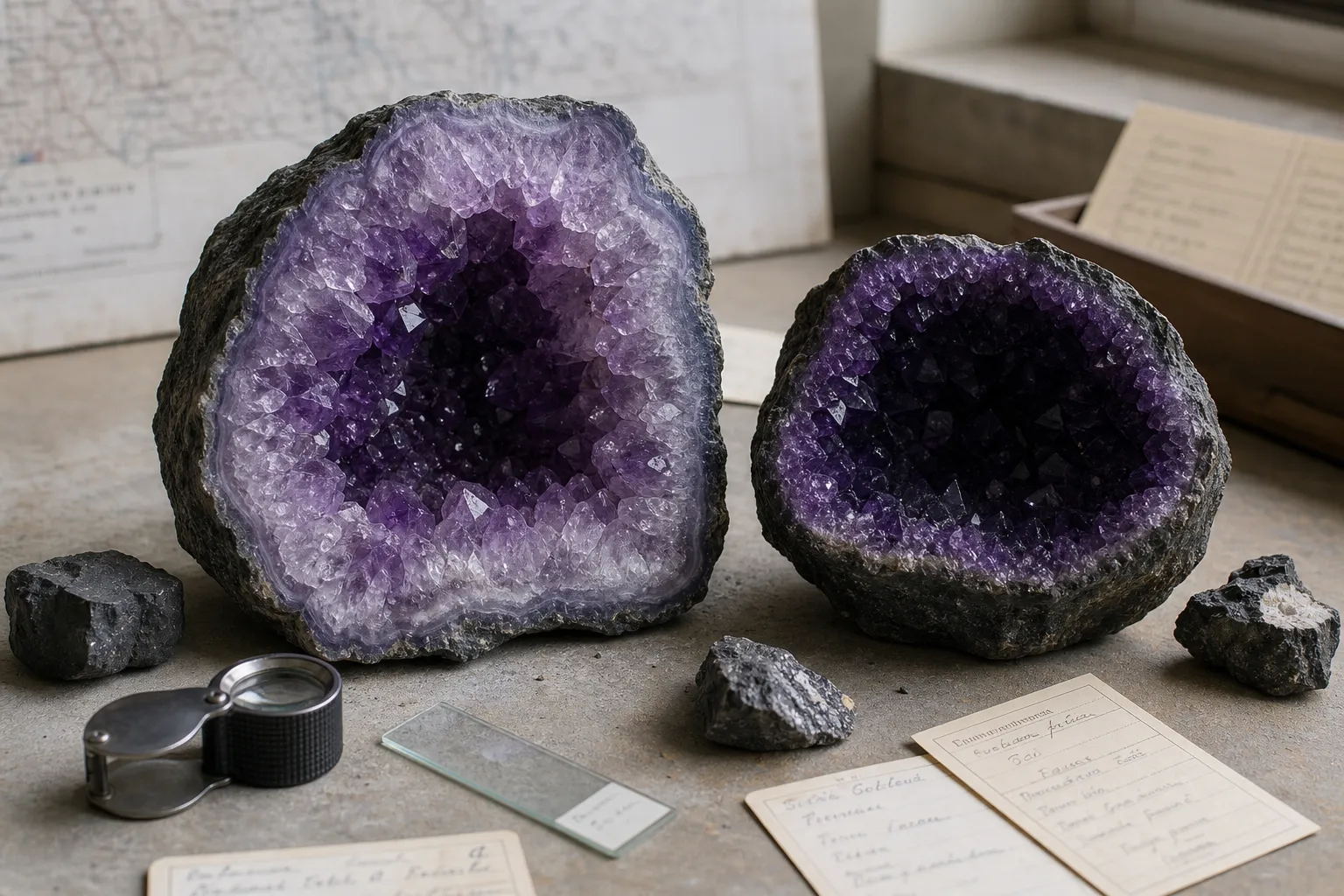
Brazilian vs Uruguayan Amethyst is better read as a comparison of related volcanic districts than as a simple “Brazil is lighter, Uruguay is darker” rule. Both famous sources are tied to basaltic lava flows of the Paraná Volcanic Province, where cavities in volcanic rocks were later filled by silica-rich fluids to form amethyst-agate geodes.
The useful distinction is not that one country produces “better” amethyst. It is that studied Brazilian and Uruguayan districts sit in different lava-flow settings, show different host-rock geochemical patterns, and preserve evidence of fluid-driven geode formation. Color, size, clarity, and price may follow market habits, but none of them proves origin by itself.
broader context
Broader amethyst guide
This narrower page lands better after the broader amethyst context page.
The short geological answer
Retail comparisons often say Uruguayan amethyst is darker, scarcer, and more premium, while Brazilian amethyst is larger, more available, and more varied. That wording is common, but it flattens the geology.
In plain terms: Brazil and Uruguay are not two unrelated amethyst worlds. They are neighboring expressions of a large volcanic system, shaped by basalt flows, cavity formation, later fluid movement, silica deposition, and crystal-growth conditions.
Why the Paraná Volcanic Province matters
The shared backbone is the Paraná Volcanic Province, one of the major volcanic provinces of southeastern South America. Its basaltic lava flows host some of the best-known amethyst geodes from southern Brazil and northern Uruguay.
Locality still matters. The host lava, alteration style, cavity type, fracture network, fluid movement, and timing of silica precipitation all affect the environment in which quartz grows. If “terroir” is used here, it should be used carefully: not as a romantic label, but as shorthand for the geological conditions of a particular district.
In Brazil, Ametista do Sul is a major reference point in the literature. Work on the Veia Alta flow shows that geodes are not distributed randomly across a country. They are tied to flow architecture, including lava-rise structures, tumuli, pits, altered basalt, and feeder fractures beneath geode-bearing zones.
In Uruguay, Los Catalanes / Artigas is the key comparison district. Studies describe giant amethyst-agate geodes in altered basaltic lavas and examine how cavities and mineral fillings formed. Recent fluid-inclusion and stable-isotope work is especially useful because it shifts the explanation away from a simple “gas bubble in lava” story and toward later fluid processes.
A geologist’s question is therefore narrower than “Brazil or Uruguay?” It is: which district, which lava flow, which cavity system, which alteration history, and which stage of crystal growth?
Geode formation is more than trapped bubbles
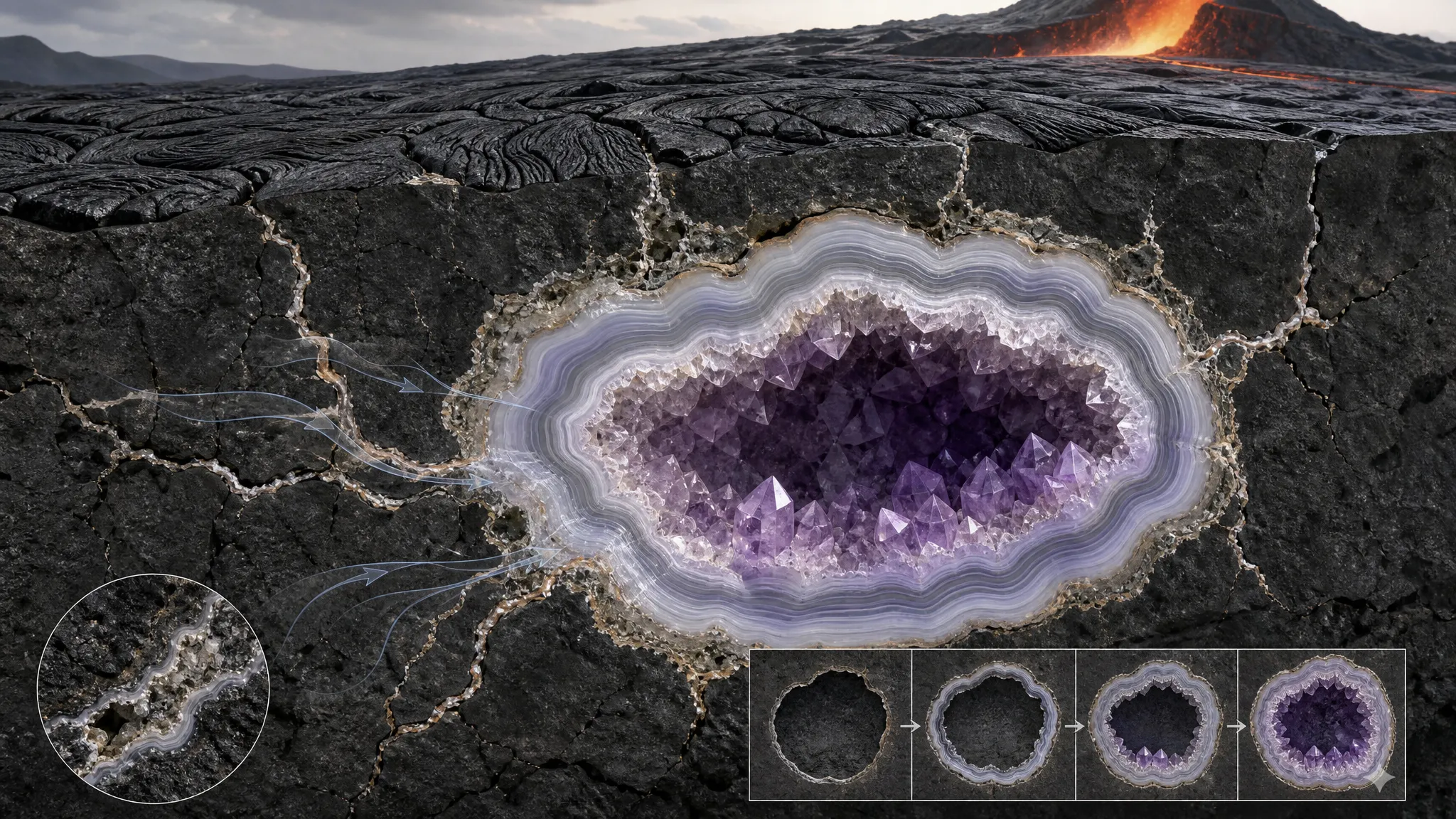
A simple explanation says amethyst geodes formed when gas bubbles in lava later filled with crystals. That can help introduce volcanic cavities, but it is too thin for the giant amethyst-agate geodes known from Brazil and Uruguay.
In the Los Catalanes district, field evidence has been used to connect giant geode cavities with relatively low-temperature hydrothermal processes. The model includes brittle fracturing, overpressured aqueous fluids, alteration of basalt to clay minerals, dissolution, and later silica deposition.
In southern Brazil, research on Ametista do Sul also emphasizes alteration and structural controls. The Veia Alta flow is described as an important geode-producing flow, and studies discuss feeder fractures and local volcanic structures as guides to geode occurrence. That helps explain why one part of a flow can be rich in geodes while another nearby part is not.
The evidence does not support a neat split where Brazilian geodes form one way and Uruguayan geodes form another. The better reading is family resemblance: basaltic lava flows provide the setting, while later fluids, alteration, cavity modification, and silica precipitation help build the geodes collectors recognize.
This also complicates the familiar size claim. Brazil is widely associated in the market with large cathedral geodes, but geological work also documents giant geodes in Uruguay. Size is a district and specimen feature before it is a national rule.
What the geochemistry actually compares
An amethyst geochemical comparison can refer to several different layers. They should not be treated as one thing.
Host-lava chemistry
Paraná lavas vary in composition. Some studied Brazilian amethyst-bearing settings are associated with high-Ti basaltic rocks, while recent Los Catalanes work describes Uruguayan deposits in low-Ti lavas. That distinction matters in the studied contexts, but it does not mean a loose crystal can be identified by eye as Brazilian or Uruguayan.
Alteration chemistry
In both countries, basalt near geode systems can be strongly altered. Clay minerals, zeolites, calcite, agate, quartz, and amethyst may appear in staged cavity fillings. Fresh basalt chemistry and altered geode-zone chemistry are related questions, but they are not identical.
Mineralizing-fluid chemistry
Fluid inclusions and stable isotopes preserve clues about the water from which quartz and associated minerals formed. Los Catalanes studies report low-salinity fluids, in some cases close to pure water, with compositions compatible with meteoric-water influence. Brazilian studies also discuss low-salinity fluids and changes between mineralization stages.
Crystal color mechanisms
Amethyst is violet quartz. Its color is linked to defects and iron-related color centers, with radiation history and crystal structure involved. Heat can also change amethyst color under controlled conditions, which is one reason color alone should not be used as an origin test.
That is why “amethyst origin and color” is a tricky search question. The host rock tells one story, the fluid another, and the final color center another. They are connected, but not interchangeable.
Color, quality, and price: where retail shorthand breaks down
The market contrast exists for a reason. Many buyers encounter Uruguayan pieces that are intensely purple, densely crystallized, and sold at higher prices. Many also see Brazilian material in a wider range of sizes, tones, and decorative formats. As retail language, that pattern is understandable.
As geology, it needs limits.
Deep purple does not automatically prove Uruguayan origin. Brazilian amethyst can be deep. Uruguayan amethyst can vary. Color is affected by crystal chemistry, defects, radiation history, growth zoning, thickness, lighting, polishing, camera saturation, iron staining, and possible treatment.
Quality is not a country label either. It depends on what is being compared: faceting rough, a cabinet specimen, a geode display, a documented locality piece, crystal points, or a decorative object. A pale but well-documented locality specimen may matter more to one collector than a darker piece with weak provenance. A saturated geode can be visually dramatic and still have repairs, unstable edges, dye suspicion, or unclear labeling.
Price and rarity are even easier to overstate. Some commercial pages frame Uruguayan amethyst as rarer and Brazilian amethyst as more abundant. That may describe common retail positioning, but it does not establish a universal country-wide ranking. Price can reflect mining output, export channels, color sorting, labor, size, display preparation, shipping weight, documentation, and current demand.
Use origin as context, not as a verdict.
What you can and cannot infer from a specimen
A visual inspection can suggest possibilities, but it cannot reliably settle Brazil vs Uruguay amethyst origin.
You may be able to observe
- color saturation and zoning
- crystal size and habit
- geode wall thickness and matrix appearance
- associated agate, calcite, zeolites, or quartz layers
- sawing, polishing, cementing, or repair signs
- whether the label gives a district, not just a country
You cannot reliably infer from appearance alone
- exact country of origin
- specific district or mine
- host-lava titanium signature
- fluid salinity or isotope composition
- whether color intensity is natural, enhanced, or lighting-driven
- whether the specimen is “better” because it is Brazilian or Uruguayan
For a serious locality comparison, documentation matters. “Brazil” or “Uruguay” is useful, but “Ametista do Sul, Rio Grande do Sul, Brazil” or “Los Catalanes, Artigas, Uruguay” is more meaningful. Even then, the label is part of the evidence, not a substitute for it.
A careful comparison method
If you want a geochemical comparison rather than a shopping slogan, compare at four levels.
- Volcanic setting. Both sources belong to the Paraná volcanic world, but studied districts can occupy different lava-flow positions and host-rock chemical groups.
- Geode system. Ask whether the specimen is linked to a district known for geode-bearing basalt flows, alteration zones, feeder fractures, or specific cavity types.
- Fluid history. Fluid inclusions and stable isotopes are not visible to the naked eye, but they are central to modern explanations of how these geodes formed.
- Individual specimen. Color, clarity, crystal coverage, size, damage, repairs, and locality documentation are specimen-level traits. They may line up with market expectations, but they do not become universal national facts.
This gives both origins their due. Brazil’s southern amethyst districts are not merely “large affordable geodes.” Uruguay’s Artigas material is not merely “dark premium purple.” Both are part of a shared volcanic and fluid-driven mineral story, with local differences that deserve more precision than retail shorthand usually gives them.
FAQ
Is Uruguayan amethyst always darker than Brazilian amethyst?
No. Uruguayan material is often marketed as deeply saturated, and many specimens are dark purple, but Brazilian amethyst can also be intense. Color is specimen-dependent and not a reliable country test.
Is Brazilian amethyst lower quality?
No. “Brazilian” is an origin label, not a grade. Brazilian amethyst ranges from pale commercial material to strong collector pieces and large geodes. Quality depends on the specimen, purpose, condition, and documentation.
Can geochemistry prove whether an amethyst is from Brazil or Uruguay?
In research settings, host-rock chemistry, alteration studies, fluid inclusions, stable isotopes, and locality context can support comparisons between districts. That is different from identifying a loose retail crystal by color or appearance alone.
Are Brazilian and Uruguayan amethyst formed in completely different ways?
Not completely. Both are tied to basaltic lava flows and later mineralizing fluids in the Paraná volcanic region. The differences are more about local flow architecture, host-rock chemistry, alteration, and fluid history than a clean country-by-country split.
Bottom line
Brazilian and Uruguayan amethyst are closely related in regional geology, especially through the Paraná Volcanic Province and its amethyst-bearing lava flows. The most meaningful differences come from district-level lava chemistry, flow architecture, alteration, cavity formation, and mineralizing-fluid history.
Retail claims about Uruguayan darkness or Brazilian size may describe common market impressions, but they are not dependable geochemical tests. The better question is not “Which country is better?” It is: what locality is documented, what geological setting is known, what does the individual specimen show, and where does the evidence stop?