The Tessin Habit: Decoding the Unique Shape of Vera Cruz Amethyst
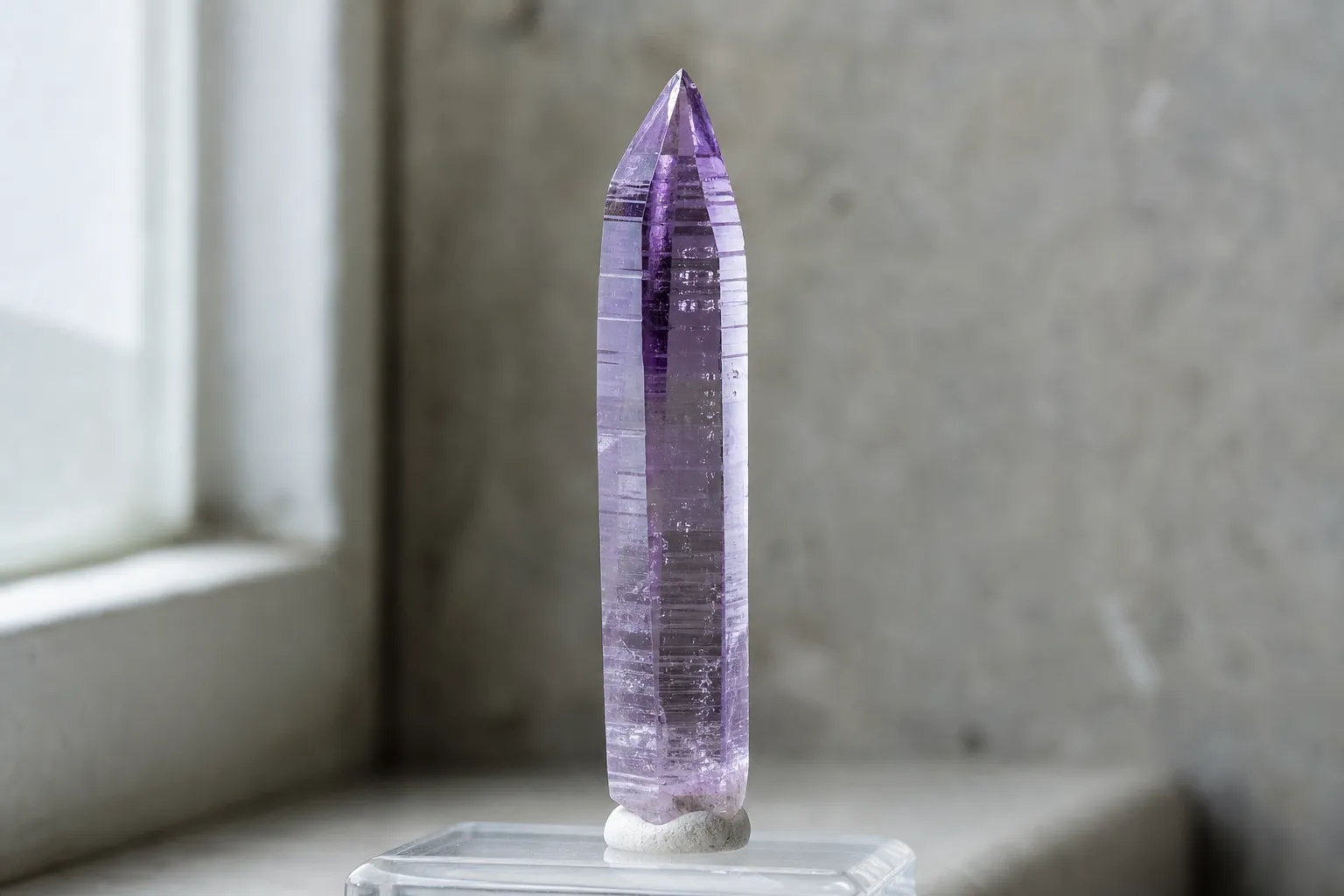
Vera Cruz Amethyst is often recognized by a slender, elongated prismatic shape that narrows toward the tip. That is the look many collectors casually call “laser wand”-like. The more mineralogical idea behind it is often described as a Tessin crystal habit: a quartz form that appears long, tapered, and strongly directed along its length.
That shape helps explain why many Mexican amethyst points look delicate and distinctive. It does not, by itself, prove Veracruz origin, rarity, authenticity, price, or any claimed effect.
broader context
Amethyst context note
This narrower page lands better after the broader amethyst context page.
What “Tessin habit” means for amethyst
A crystal habit is the external form a mineral commonly shows. In quartz, that usually means a visible balance of prism faces, termination faces, and overall proportions along the crystal’s long axis. Amethyst is the purple variety of quartz, so its shape is still described with quartz habit language.
In plain visual terms, Tessin habit refers to a quartz crystal that looks stretched, narrow, and tapering rather than stout or evenly column-like. The sides may appear to pull inward toward the termination, giving the point a spear-like or wand-like silhouette. That is why descriptions such as “elongated prismatic,” “long prismatic points,” and “tapered amethyst crystals” often appear around Vera Cruz Amethyst.
Key distinction
- Vera Cruz Amethyst is a locality-linked collector name, commonly associated with Veracruz, Mexico, especially the Las Vigas area in mineral records and market descriptions.
- Tessin crystal habit describes shape.
- A tapered quartz crystal does not automatically come from Veracruz.
- A Veracruz specimen does not have to match the perfect “laser” shape.
Why Vera Cruz Amethyst can look so wand-like
“Laser wand” is not a formal crystallographic term. It is retail and collector shorthand for a narrow crystal with a long body, a focused-looking point, and a strong base-to-tip direction.
Several visible features can create that impression:
A long prismatic body
The crystal looks extended along one main axis rather than broad.
Tapering toward the termination
The sides narrow enough to make the point feel drawn out.
High transparency
Clear violet amethyst can look lighter and more delicate than included or opaque material.
Pale lavender to light violet color
Many pieces described as Vera Cruz material are known for softer color rather than deep saturated purple.
Glassy luster
Clean quartz faces can sharpen the visual impression of the form.
Fine horizontal striations
Surface lines on prism faces may catch light and add definition.
Color zoning or clear sections
Uneven violet areas or transparent zones can make the crystal look airy instead of dense.
These traits are useful for description, not for proof. They form the familiar Vera Cruz-style look, but none is exclusive to Vera Cruz Amethyst.
Matrix pieces need the same caution. Some specimens are shown as long amethyst points rising from pale matrix, and some labels mention associated green minerals such as epidote. Matrix can support a specimen’s story when the collection history is reliable, but matrix alone does not authenticate locality.
Tessin habit vs. “laser wand”
The common mistake is treating “Tessin habit” and “laser wand” as if they carry the same weight. They do not.
“Tessin habit” sits closer to mineral-habit language. It describes the external shape: elongated prism development, tapering, termination style, and the way the crystal’s proportions change from base to tip.
“Laser wand” is popular market language. It tells you how the crystal appears to the eye. It does not tell you where the specimen formed, how scarce it is, whether the label is correct, or whether a seller’s effect-based claims are reliable.
Tessin crystal habit
Best way to read it: Mineral-habit description.
What it can help with: Understanding a tapered, elongated quartz form.
Elongated prismatic amethyst
Best way to read it: Visual/mineral description.
What it can help with: Describing long prism faces and proportions.
Vera Cruz laser wand
Best way to read it: Collector or retail nickname.
What it can help with: Recognizing the popular look buyers search for.
High-vibration Vera Cruz Amethyst
Best way to read it: Belief-based or marketing language.
What it can help with: Understanding the sales vocabulary, not mineral evidence.
The nickname can still be useful. If someone searches for a “Vera Cruz laser wand,” they are usually trying to understand a long, narrow, transparent or semi-transparent amethyst point. The phrase works as a bridge from shop language to mineral observation, but it is not a diagnostic term.
What the shape can suggest—and what it cannot prove
The shape can suggest that a specimen matches the familiar market image of Vera Cruz Amethyst: slender, tapered, pale, transparent, and prismatic. It can also help you describe a piece more accurately. Instead of saying only “it looks like a wand,” you might say it has an elongated prismatic form with tapering toward the termination.
That is useful language. It is not enough evidence for a conclusion.
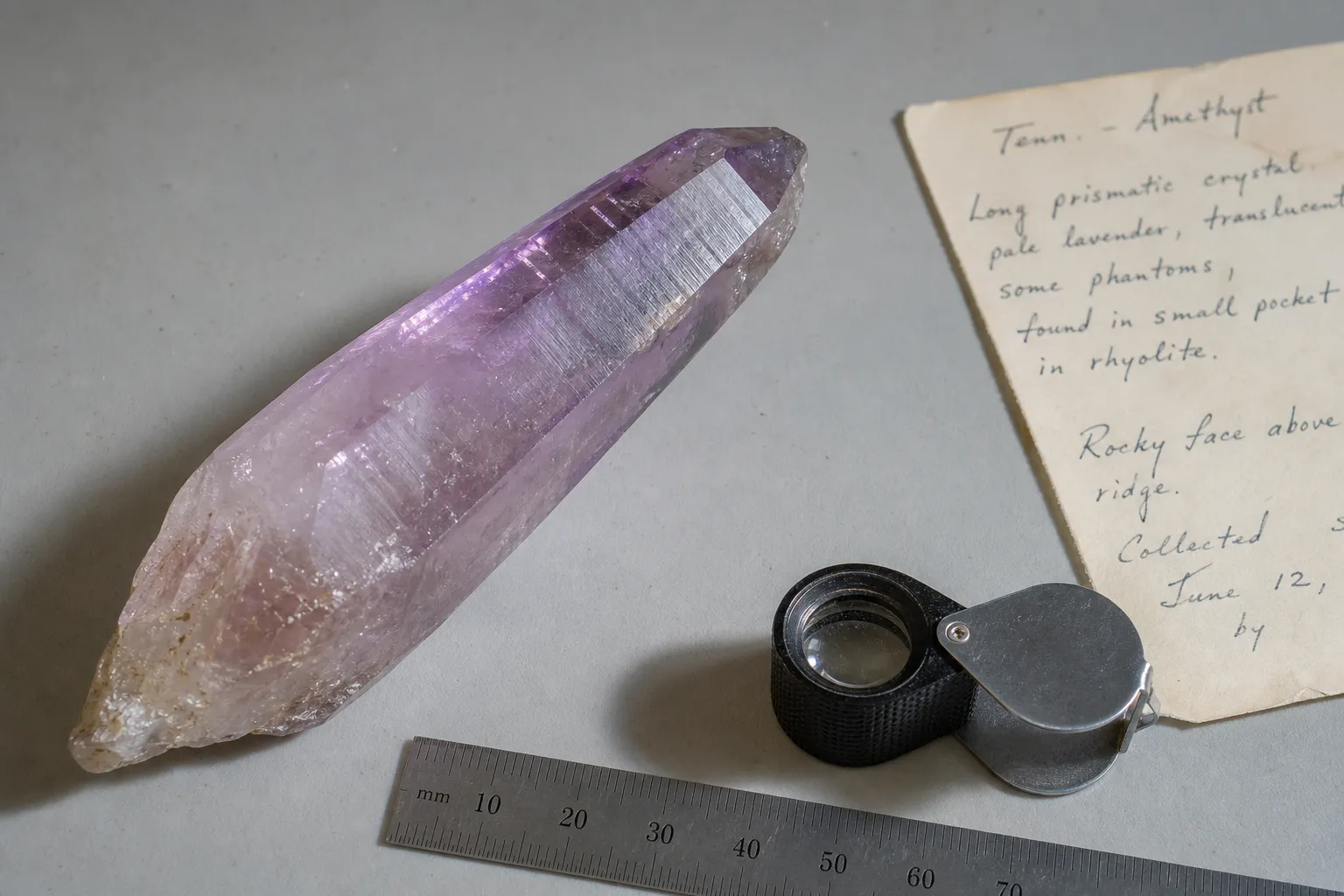
A tapered amethyst point does not prove Veracruz provenance. Locality needs stronger support: a trustworthy seller record, an older collection label, documented specimen history, reputable locality information, or other evidence beyond appearance. Public mineral databases can show that quartz and amethyst are recorded from Veracruz-area localities, but they cannot authenticate a loose point in your hand.
Pale lavender color also does not prove origin. Amethyst color varies. Clear sections, color zoning, and high transparency may fit the look collectors expect, but they remain observations rather than locality tests.
The shape does not prove rarity or price. Value depends on size, condition, transparency, color, termination quality, matrix, aesthetics, documentation, and seller context. This page is about shape language, not appraisal.
Nor should the shape be used to support effect-based claims. Some sellers attach spiritual or energetic wording to the long, directed form because the “laser wand” metaphor sounds focused. That is belief and market language, not a mineralogical property.
How to describe a Vera Cruz-style point without overclaiming
If you are looking at a specimen labeled Vera Cruz Amethyst, start with what is visible.
Look first at the proportions. Is the crystal genuinely long compared with its width, or is it simply a small point photographed from a flattering angle? An elongated prismatic form should be visible in the body of the crystal, not only at the tip.
Then follow the sides from base to termination. Tessin-like forms often seem to narrow upward. The taper does not need to be perfect. Natural crystals can be contacted, etched, rehealed, broken, partly hidden by matrix, or interrupted by growth changes. Still, that visual movement from wider base to narrower point is central to the term.
Next, treat clarity and color as supporting details. Pale lavender amethyst with high transparency can make the form look especially fine and delicate. Clear violet areas, zoning, or color concentrated near parts of the crystal may add to the appearance, but they should not be used alone to declare origin.
Finally, check the presentation. Is it an individual point, a small cluster of Mexican amethyst points, or a crystal on matrix? Are there broken bases, iron staining, greenish associated minerals, or old labels? These details can matter to collectors, but provenance still depends on documentation.
A careful description might read:
“This is a slender, pale lavender amethyst point with high transparency, visible prism faces, horizontal striations, and a tapering termination. It is labeled Vera Cruz, but the locality depends on the reliability of the label or seller record.”
That keeps the beauty of the specimen intact without turning appearance into proof.
Where the evidence stops
The basic concepts are well supported: amethyst is quartz, mineral habit describes external crystal form, and quartz habits can be discussed through prism development and terminations. Public locality references also support Veracruz and Las Vigas as part of the collector context for Mexican amethyst.
The narrower claims are less settled in public sources. The available material does not strongly establish exactly how often Vera Cruz Amethyst forms in Tessin habit, why that habit occurs there, or whether every slender point sold under the name truly comes from Veracruz.
So the clean answer is this: Tessin habit helps decode the recognizable shape. “Laser wand” explains the popular nickname. Neither should be stretched into a locality test, a rarity claim, a price guarantee, or an effect claim.
Short answer for collectors
If a piece of Vera Cruz Amethyst looks unusually slender, prismatic, transparent, and tapered, “Tessin habit” may be the mineral-shape language behind that appearance. “Laser wand” describes the same visual impression in looser collector and retail terms.
Use the shape to describe what you see. Use documentation to support where it came from.