Quartz origin guide
Hydrothermal Synthetics 101: How Lab-Grown Amethyst Mimics Nature
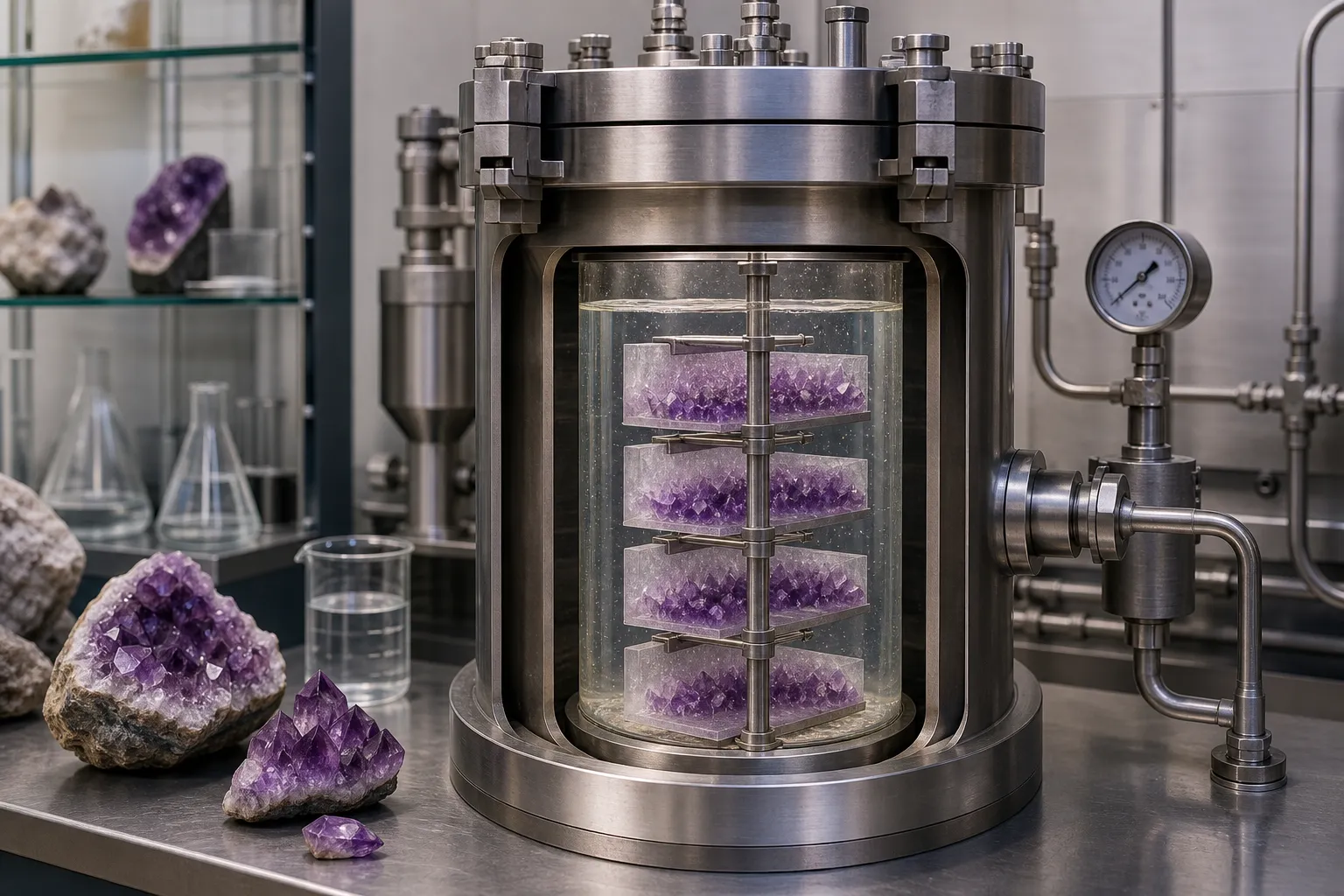
Hydrothermal synthetic amethyst is lab-grown quartz made by copying one of nature’s quartz-forming patterns: silica dissolves in hot, pressurized water-based fluid, then crystallizes on a quartz seed surface under controlled conditions. The finished material can be genuine quartz with amethyst-like purple color, but its origin is laboratory growth, not natural mining.
That distinction is the point. “Synthetic” does not mean plastic or glass. It means a human-grown crystal in the same mineral family. Natural amethyst records a geologic setting; hydrothermal synthetic amethyst records an industrial growth process designed to imitate parts of that setting.
broader context
Broader amethyst guide
This narrower page lands better after the broader amethyst context page.
The short version: real quartz, synthetic origin
Amethyst is the purple variety of quartz. Quartz is crystalline silicon dioxide, so both natural amethyst and lab-grown quartz amethyst belong in the quartz conversation. The dividing line is not simply “real” versus “fake.” It is natural origin versus synthetic origin.
Natural amethyst forms when silica-rich fluids move through rocks and crystals grow under geologic conditions. Its purple color is associated with iron-related color centers and radiation history, though the full color story can involve more than one variable.
Hydrothermal synthetic amethyst borrows the broad idea of quartz growth from a hot, water-based, silica-bearing system, but places that growth inside a controlled industrial autoclave. “Mimics nature” is fair if it means the process imitates natural hydrothermal quartz growth. It is not fair if it implies the crystal formed in the earth.
Question
Natural amethyst
Hydrothermal synthetic amethyst
Is it quartz?
Yes
Yes, when accurately described
Is it purple quartz?
Yes
Often, depending on growth and color conditions
Did it form in the earth?
Yes
No
Should it be described as natural?
Yes, if truly natural
No
Can appearance alone prove origin?
Not reliably
Not reliably
How hydrothermal quartz growth works
Hydrothermal growth is not melting glass, pouring resin, or coating a stone purple. It is crystal growth from a hot, pressurized fluid. In this process, dissolved silica is transported through a water-based mineralizer solution and deposits as quartz where conditions favor crystallization.
In a simplified industrial setup:
- A silica source is available. The process needs silicon dioxide that can dissolve under hydrothermal conditions.
- A mineralizer solution helps move silica. The chemistry allows silica to dissolve and travel through the system. Exact recipes and concentrations vary by process and should not be reduced to a casual public formula.
- Heat and pressure keep the system hydrothermal. The closed autoclave creates the broad physical environment needed for silica to dissolve, move, and recrystallize.
- A temperature difference encourages transport. Silica dissolves more readily in one zone and crystallizes in another.
- Quartz seed plates guide growth. New quartz follows the lattice of the seed surface, helping the material grow as crystal quartz rather than as an unstructured silica mass.
- Growth happens gradually. Hydrothermal synthetic amethyst is controlled crystal growth, not a quick surface stain.
Specific temperatures, pressures, growth rates, mineralizer compositions, and color-development steps depend on the producer and process. For this page, the useful answer is narrower: hydrothermal synthetic amethyst grows as quartz on quartz seed surfaces from a silica-bearing solution inside a controlled autoclave.
Why seed plates matter
A seed plate is a prepared piece of quartz used as the starting surface. Instead of asking dissolved silica to organize from scratch, the seed gives the growing material an existing quartz structure to follow. That is one reason hydrothermal growth can produce single-crystal quartz.
For an amethyst reader, the seed plate also explains the origin difference. The crystal did not begin in a natural pocket, vein, or geode. It began on a selected growth surface in a laboratory or industrial vessel. The resulting material may share quartz chemistry and optical behavior with natural amethyst, but its growth history is not geological.
Seed-related features, growth structures, twinning, inclusions, and spectroscopy can matter in trained gemological examination. They are not simple at-home tests. A clean, vivid stone is not automatically synthetic, and a stone with inclusions is not automatically natural.
Where the purple color fits in
The word “amethyst” makes color feel like the whole issue, but color alone does not settle identity or origin.
In quartz, amethyst’s violet color is commonly discussed in relation to iron-related color centers and radiation history. In natural amethyst, those conditions are part of a geologic setting. In synthetic amethyst, growth chemistry and later color development can be managed more deliberately.
That does not mean every purple lab-grown quartz follows one recipe. Gemological and academic discussions of amethyst color include iron, radiation, heat response, and structural details in quartz. The safer plain-language summary is this: lab-grown amethyst color belongs to a controlled quartz-growth and color-center context, not to simple surface painting.
This is where marketing language can blur the answer. A seller may say lab-grown amethyst is “identical” to natural amethyst. In a narrow mineralogical sense, synthetic material can be quartz and can closely resemble natural amethyst. But “identical” can hide the origin difference. A clearer phrase is: synthetic amethyst is lab-grown quartz that can imitate the composition and appearance of natural amethyst, while remaining synthetic in origin.
Why “fake” is the wrong first question
“Fake” is understandable, but it is too blunt.
A purple glass imitation sold as amethyst is different from hydrothermal synthetic amethyst. Glass is not quartz. Plastic is not quartz. A dyed imitation may only imitate the look. Hydrothermal synthetic amethyst, when accurately described, is lab-grown quartz.
But it is also not natural amethyst. Calling it “natural” because it is chemically quartz blurs the origin. Useful wording keeps both parts visible:
- synthetic amethyst
- laboratory-grown amethyst
- lab-grown quartz amethyst
- hydrothermal synthetic quartz
- synthetic quartz with amethyst color
Vague phrases such as “created amethyst” or “real amethyst” can confuse readers if they do not include origin. “Real” may mean mineral identity to one person and mined origin to another.
In the United States, the FTC jewelry guides treat synthetic, laboratory-grown, and similar origin descriptors as important consumer-facing language. This article is not legal advice, but the practical boundary is simple: if the material is hydrothermal synthetic amethyst, the lab-grown origin should stay attached to the description.
Can you identify synthetic amethyst by looking at it?
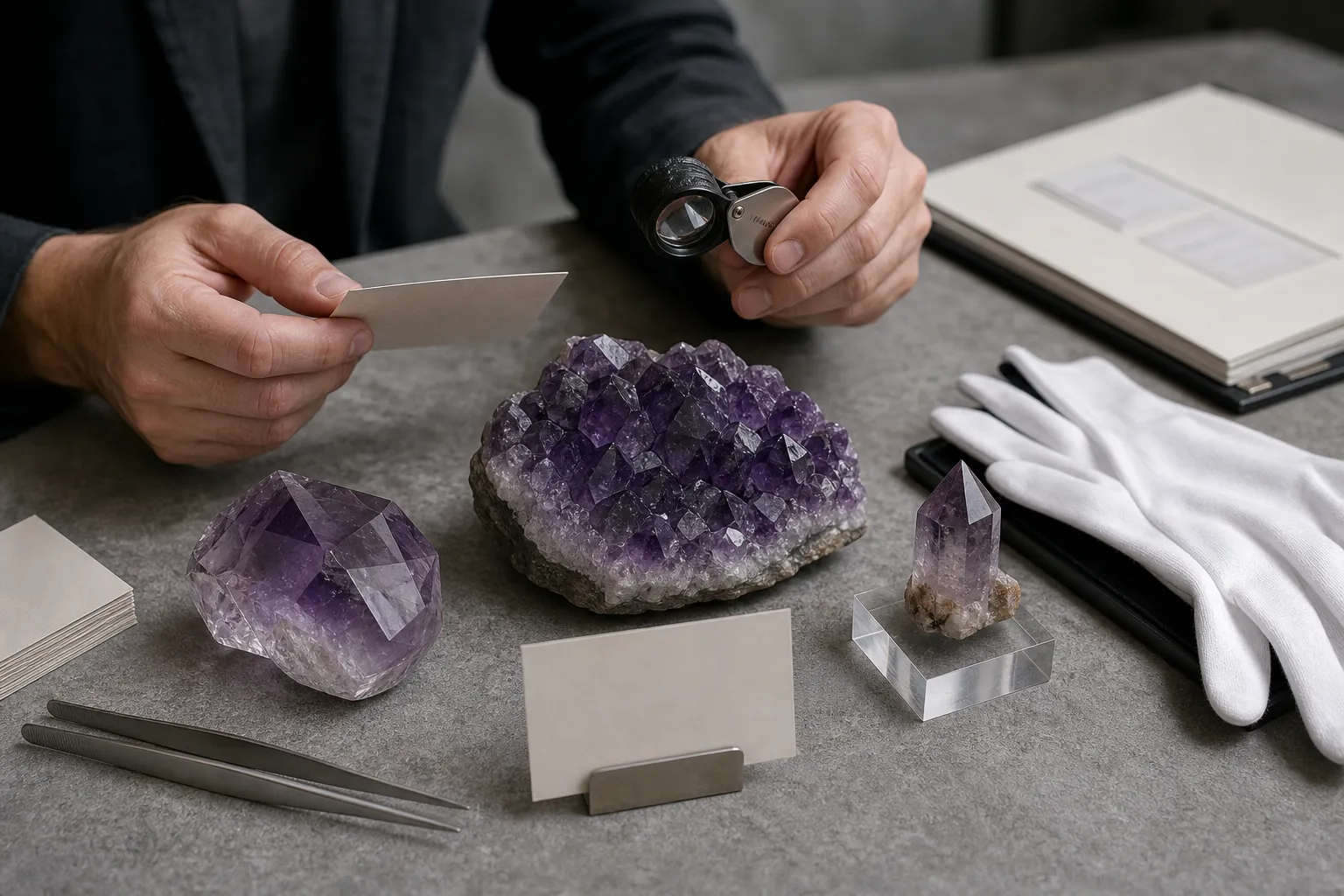
Sometimes visual features raise questions, but appearance alone is not reliable proof.
A very clean, vivid, evenly colored stone may make a collector pause. That is reasonable. Controlled autoclave growth can produce material that looks tidy compared with many natural stones. But natural amethyst can also be clean and attractive, and synthetic quartz can include features that complicate easy judgment.
Gemological separation may involve trained observation and instruments. Research on natural versus synthetic amethyst has discussed infrared absorption features, growth structures, twinning, inclusions, and other diagnostic clues. Those details belong in laboratory interpretation, where sample type, orientation, instrument resolution, and unusual material can all affect the reading.
For a collector, the better standard is:
- Do not rely only on a “too perfect” look.
- Do not rely only on color intensity.
- Do not assume inclusions prove natural origin.
- Ask for clear origin disclosure when buying.
- For higher-stakes identification, use a qualified gemological laboratory or credible documentation.
Visual clues can start the question. They do not settle the origin by themselves.
What hydrothermal synthesis imitates—and what it cannot
Hydrothermal synthesis imitates the broad physical-chemical idea behind many natural quartz growth settings: hot water-based fluids carrying silica, temperature and pressure differences, and quartz depositing as crystals.
What it cannot imitate is geologic history.
A natural amethyst may reflect a volcanic cavity, vein, geode, or other mineral environment. Its growth may include interruptions, zoning, inclusions, fractures, later alteration, or associations with other minerals. Those features are not just decoration; they are part of the stone’s origin story.
A lab-grown crystal has a different story: seed selection, autoclave conditions, controlled chemistry, and industrial crystal growth. That story is not “less real” as material science. It is simply not natural formation.
This matters because amethyst buyers and collectors may care about different things. Some care mainly about quartz identity and purple color. Others care about natural formation, locality, inclusions, or geologic age. Hydrothermal synthetic amethyst may satisfy the first interest while not satisfying the second.
A careful wording test
If you want to describe hydrothermal synthetic amethyst accurately, test the sentence with two questions:
- Does it say the material is quartz? That respects the mineral identity.
- Does it say the origin is laboratory-grown? That respects the origin disclosure.
A strong description would be:
“Hydrothermal synthetic amethyst is laboratory-grown quartz produced by controlled hydrothermal crystal growth on quartz seed plates.”
That sentence avoids both mistakes. It does not reduce the material to fake glass, and it does not call it natural amethyst.
The bottom line
Hydrothermal synthetic amethyst forms when lab-grown quartz crystallizes from a hot, pressurized, silica-bearing solution inside an industrial autoclave, usually on quartz seed plates that guide crystal growth. The process mimics natural hydrothermal quartz formation in broad principle: water, heat, pressure, dissolved silica, and crystal growth surfaces all matter.
But “mimics nature” is not the same as “comes from nature.” The material can be quartz. It can be purple. It can look very much like natural amethyst. Its correct identity still includes its synthetic origin. That is the cleanest way to hold the two truths together: hydrothermal synthetic amethyst can be real quartz and still not be natural, mined amethyst.