2026 buyer guide
Buying at the Source: A 2026 Guide to Direct Mine Sourcing
Direct Mine Sourcing can be a smart way to buy amethyst when the purchase is large enough to justify wholesale terms, freight planning, and documentation checks. It can also help serious collectors understand where a specimen entered the market. But “direct from the mine” is not a quality grade, an authenticity certificate, or a promise of lower total cost.
The better 2026 approach is to treat mine-direct language as a supply-chain claim. It still needs ordinary buying discipline: quality inspection, seller identity, payment terms, packing, shipping responsibility, import paperwork, and written disclosure.
The appeal is real. A large amethyst geode near its source has a different pull than a finished retail piece under showroom lights. The catch is that “direct” can mean several different things.
broader context
Begin with the main amethyst page
This narrower page lands better after the broader amethyst context page.
What “direct from the mine” usually means
In amethyst buying, “direct” is often used loosely. Before comparing prices, ask which version of source buying is actually being offered.
A seller may be offering:
Mine-run amethyst
Rough or mixed material as it comes out of production, often unsorted or partly sorted. Expect variation, damage, pale pieces, host rock, broken points, and material that still needs preparation.
A mine-associated workshop
Pieces cleaned, trimmed, opened, polished, stabilized, or mounted near the production area.
A mine-adjacent exporter
A local or regional business that buys from miners or mines, consolidates goods, and handles export-facing sales.
A wholesale dealer
A seller with inventory from one or more source regions, sometimes using “direct source” to describe a buying relationship rather than mine ownership.
A gem-show seller
For example, a dealer encountered through Tucson Gem Show sourcing, where collector minerals, wholesale lots, and display pieces move through established market channels.
A retail specimen marketed as direct-to-collector
A finished geode, cathedral, cluster, polished slice, or decorative piece sold with source language as part of its story.
Only the first sits close to the romantic idea of buying straight from the ground. The others may still be legitimate, but they are not the same thing. A prepared cathedral geode with a polished rim, repaired base, or custom crate has already passed through value-adding steps. That may be useful; it also means the price includes labor, selection, preparation, export handling, and margin.
The useful distinction is simple: being closer to the source may reduce some middle layers, but it often gives the buyer more responsibility. If the seller is not providing retail-level inspection, photography, return handling, and delivery protection, those risks may move to you.
Quality still comes before the source story
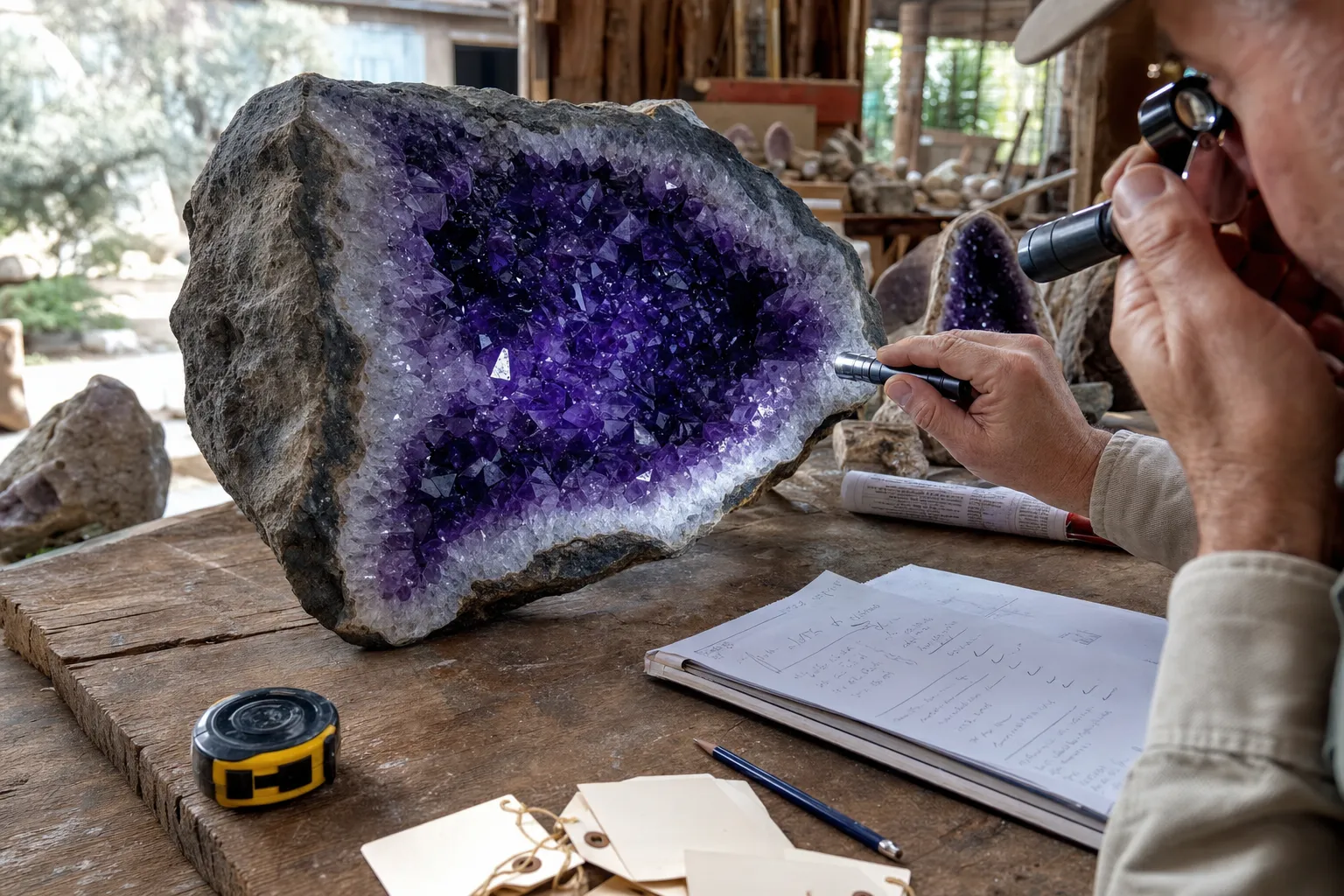
A mine name or regional label does not replace amethyst quality evaluation. Amethyst is the violet variety of quartz, and buyers usually judge it by visible features such as color, clarity, preparation, size, and condition.
For practical buying, ask for clear evidence on:
| Buyer check | Why it matters |
|---|---|
| Color | Strong purple is attractive, but photos can exaggerate saturation. Ask for daylight images, video, and disclosure about lighting. |
| Crystal condition | Chips, bruised points, cloudy zones, internal fractures, iron staining, and broken edges can affect appeal and resale expectations. |
| Preparation | Cutting, polishing, cleaning, trimming, base work, and edge finishing should be disclosed. |
| Stability | Large geodes and clusters may have weak matrix, repaired zones, filled areas, or structural concerns. |
| Size and scale | Close-up photos can make a small pocket look much larger. Ask for dimensions, weight, and scale images. |
| Repairs and alterations | Ask directly about stabilization, glued repairs, coatings, dyeing, heating, filled fractures, or altered bases. |
| Category | Mine-run rough, a prepared specimen, a polished slice, and a finished cathedral should not be priced the same way. |
This is where some direct-from-mine claims become misleading. A seller may truly be near the source and still offer low-grade, damaged, poorly prepared, or selectively photographed material. The reverse can also be true: a dealer farther from the mine may provide better sorting, stronger disclosure, and more reliable condition reports.
Terms such as “premium,” “museum quality,” “deep purple,” “display-grade,” or “Artigas direct source” are sales language unless they are supported by photos, measurements, condition notes, and documentation. They may describe the seller’s opinion; they are not universal amethyst grades.
Provenance: what documents can and cannot prove
For amethyst, provenance is usually a chain-of-custody question, not a simple label. Origin claims are strongest when records connect the material to a seller, lot, region, shipment, or mine relationship. Marketing language alone is weak support.
Analytical proof of origin can be possible for some raw materials, but it depends on reference samples, measurable features, databases, and a clearly defined question. That level of testing is not what most ordinary amethyst buyers receive.
For everyday sourcing, ask for the practical version of provenance:
- What country, region, district, or mine is being claimed?
- Is the seller the miner, a mine representative, an exporter, a wholesaler, or a dealer?
- Does the invoice identify the material clearly?
- Are mine names, lot numbers, export documents, or supplier records available?
- Does the documentation connect to this exact specimen, or only to a general inventory batch?
- If the seller says “Uruguayan,” “Brazilian,” or “Artigas,” what supports that claim?
- Is any third-party report available, or is the origin seller-declared only?
Artigas amethyst sourcing is a useful example. Northern Uruguay, including the Los Catalanes and Artigas context, is a real and studied amethyst-agate geode region. That supports the region’s importance. It does not prove that a particular geode is from a specific mine, fairly priced, untreated, or better than another specimen.
The same applies at gem shows. Tucson is a legitimate mineral-market setting where dealers, collectors, and source-linked material meet. But buying at Tucson from someone who says “mine direct” is still buying from that seller. The show setting alone does not verify origin, condition, treatment status, or wholesale value.
Wholesale terms change the risk
Direct sourcing becomes more realistic when the buyer is purchasing at wholesale scale: multiple cartons, a pallet, a mixed lot, or a large geode where freight becomes a major part of the final cost. It may also mean fewer consumer-style protections.
Clarify these points before paying:
- Minimum order quantity: Is the seller expecting one specimen, a lot purchase, or ongoing wholesale buying?
- Selection method: Are you choosing exact pieces, buying from photos, accepting a mixed lot, or taking mine-run material?
- Payment terms: Is payment due in full before shipment? Is there a deposit? Is there escrow, card protection, bank transfer only, or another arrangement?
- Inspection window: When can you inspect, dispute, or reject damaged or misrepresented goods?
- Return terms: Are returns possible after export, or unrealistic because of freight cost and customs complexity?
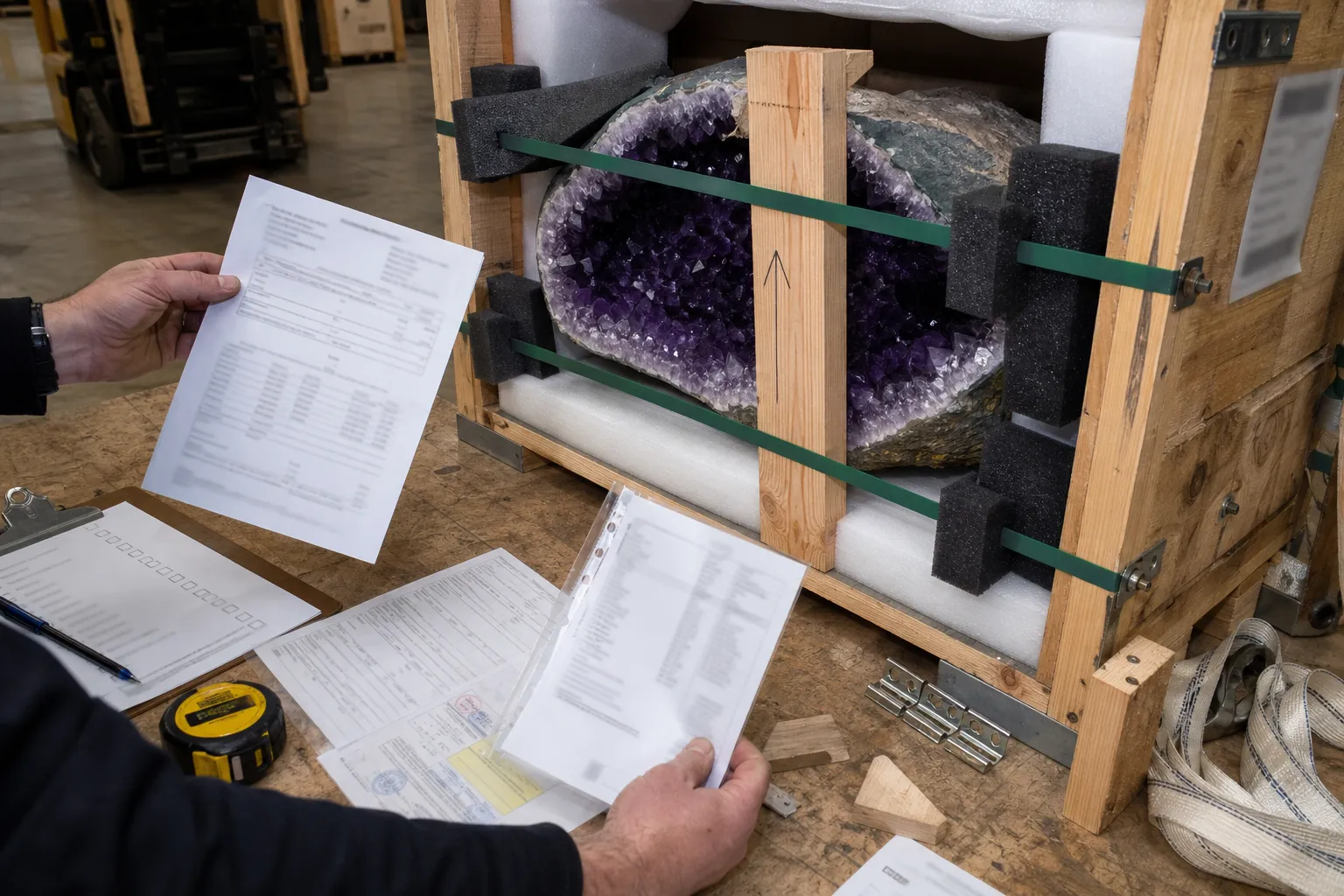
- Packing responsibility: Who crates, braces, pads, labels, and photographs the shipment before dispatch?
- Damage responsibility: Who bears the loss if a geode cracks, a point breaks, a base separates, or a crate arrives compromised?
- Insurance: Is freight insurance included, available, limited, or excluded?
Mine-run amethyst is especially risky for buyers expecting showroom-ready specimens. It may be cheaper per pound or kilo than prepared retail pieces, but sorting loss, breakage, cleaning, cutting, labor, rejected material, and freight can change the real cost. A low price for unsorted material is not the same as a low price for display-ready amethyst.
For heavy geodes, the buying decision is also physical. Good geode freight handling can determine whether the specimen arrives intact. Large pieces may need bracing, custom crating, loading equipment, and a clear delivery plan. If the seller’s answer is vague, the risk has not disappeared; it has moved to you.
Import logistics are part of the price
For U.S. buyers, overseas amethyst direct mine sourcing can create import questions that a domestic retail purchase may hide. Official U.S. sources such as CBP and the USITC Harmonized Tariff Schedule are the right places to check current import and classification boundaries. The main point is not that every shipment has the same outcome; it is that a casual “there will be no issue” from a seller is not enough.
Before importing, clarify:
- Who is the importer of record?
- What commercial invoice, packing list, and shipment description will be supplied?
- How will the goods be described: rough quartz, mineral specimen, cut stone, decorative geode, or another category?
- Who determines tariff classification and declared value?
- Will a customs broker or freight forwarder be involved?
- Are destination taxes, duties, brokerage fees, storage fees, or inspection delays possible?
- Who pays if customs questions arise?
- What happens if the shipment is damaged while waiting, being inspected, or being transferred?
Do not assume the freight quote is the landed cost. Freight may be only one part of the expense. Duties, taxes, broker charges, port fees, storage, inspection delays, re-crating, local delivery, and damage claims can matter more than expected, especially with dense stone material and large display geodes.
A mine-adjacent exporter may be experienced in shipping mineral goods, but destination-country requirements still need current checking. Be cautious if import paperwork is treated as an afterthought while payment terms are irreversible.
A practical decision rule for 2026
Direct Mine Sourcing is worth considering when the source claim is specific, the seller identity is clear, the material can be evaluated on its own merits, and the logistics are written down before payment. It is not worth pursuing simply because the word “mine” appears in a listing, caption, or wholesale pitch.
Consider direct sourcing if:
- You can inspect exact pieces or receive detailed photos and video.
- The seller explains whether the material is mine-run, prepared, or finished.
- Origin claims are supported by invoices, supplier records, export documents, or other meaningful records.
- Repairs, stabilization, damage, and preparation are disclosed.
- Wholesale payment terms are clear and proportionate to the risk.
- Packing, freight, insurance, customs responsibility, and damage claims are assigned in writing.
- You are comfortable with the possibility that a lower source price may be offset by sorting loss, freight, fees, or breakage.
Pause or walk away if:
- “Direct from mine” is the only proof offered.
- The seller cannot identify their role in the chain.
- Photos are heavily filtered, cropped, or missing scale.
- Quality words replace condition details.
- Import responsibilities are brushed aside.
- Payment is irreversible and inspection terms are vague.
- A large geode is sold without a serious crating and damage plan.
Buying closer to the source can be rewarding. It can connect a collector to the material history of amethyst in a way ordinary retail buying often does not. But the strongest purchase is still made with calm eyes: judge the stone, test the source story, read the terms, and count the landed cost before letting the romance of the mine decide for you.