Chemistry of crystal cleaning
The Chemistry of Cleaning: How Fe(C2O4)33− Reactions Reveal Clarity
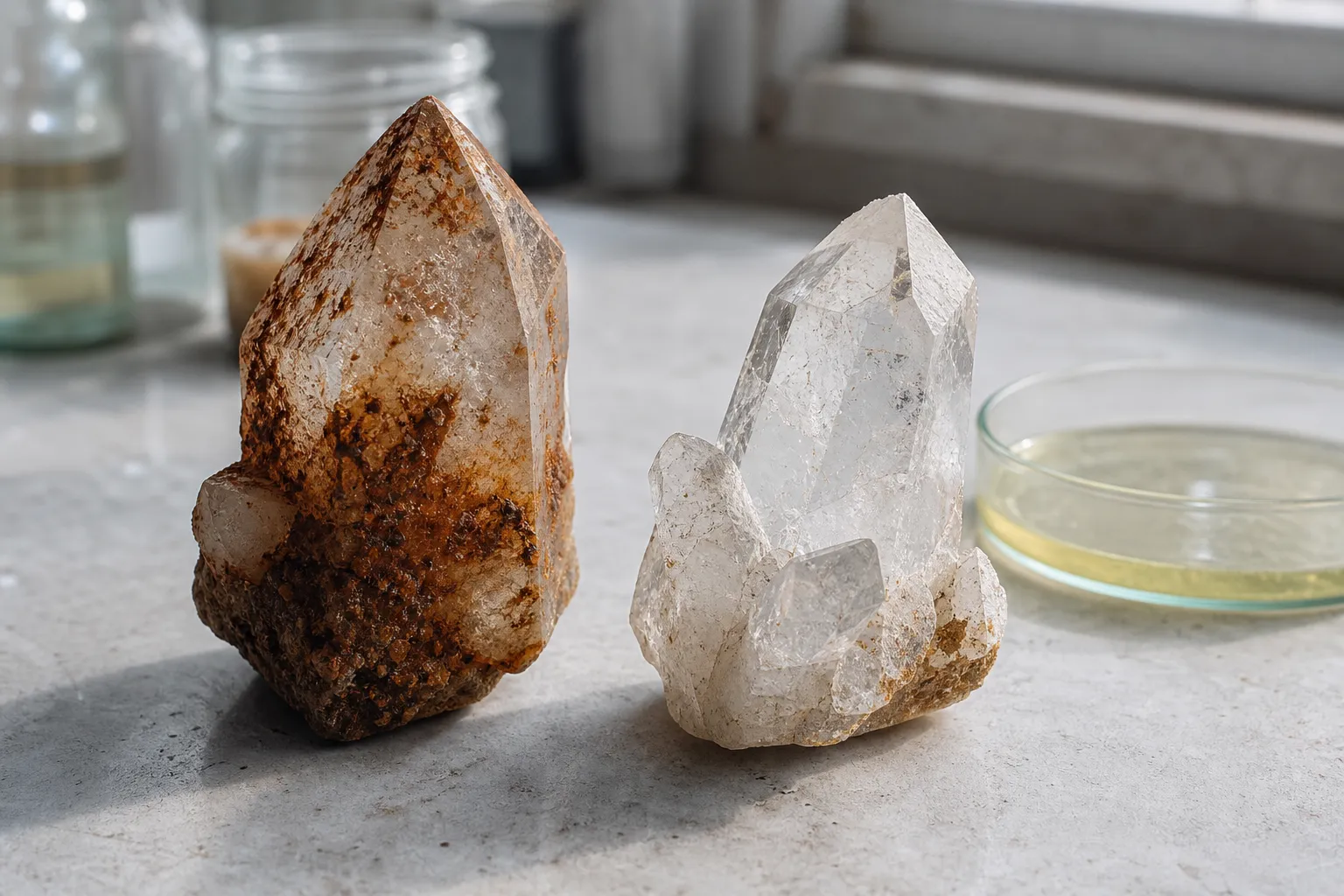
A rusty-looking quartz point is often not dirty in the everyday sense. The reddish-brown coating may be iron oxide or iron oxyhydroxide sitting on the surface, tucked into fine cracks, or spread through the matrix around the crystal.
Oxalic acid can make an iron-stained quartz specimen look clearer because it can help move some of that iron from an insoluble stain into iron-oxalate chemistry. In plain terms, the acid attacks iron-bearing stain, and oxalate can bind dissolved iron into soluble iron complexes, including ferrioxalate-style species under some conditions. That is the practical meaning of the Iron oxalate chemical reaction in oxalic acid crystal cleaning.
The stain is not being “lifted” by magic. Some iron is being dissolved, complexed, and carried away in solution when the specimen and conditions allow it. “Revealed clarity” is best read as a visual metaphor: if brown iron staining was masking quartz faces, reducing that stain may let more light and surface detail show through.
broader context
Amethyst context note
This narrower page lands better after the broader amethyst context page.
What oxalic acid does to iron stains
Collectors may call the problem rust, red iron, mineral stain, or a dull brown film. Chemically, those words often point toward iron oxides and iron oxyhydroxides, such as hematite-like or goethite-like material. These stains can be stubborn because they are not just loose dirt; they may cling to surfaces or sit in tiny features that brushing cannot reach.
Oxalic acid matters because it has two useful roles:
- It provides acidity that can help attack iron oxide surfaces.
- It supplies oxalate, a ligand that can bind iron ions into coordination complexes.
With iron, oxalate can form several species depending on pH, concentration, oxidation state, light exposure, temperature, and impurities in the bath. Ferric oxalate species such as [Fe(C2O4)3]3− are part of that chemistry, but they are not the only possible form.
A simple, cautious version of the process is:
- 1The visible stain contains iron in a relatively insoluble surface form.
- 2Oxalic acid interacts with that iron-bearing material.
- 3Some iron dissolves from the stain.
- 4Oxalate binds dissolved iron into iron oxalate or ferrioxalate-style complexes.
- 5Once iron is in solution rather than fixed as a stain, rinsing can remove more discoloration.
The important word is “some.” A real specimen may have surface rust, iron-rich inclusions, clay, manganese staining, iron-bearing matrix, or several of these at once. Oxalic acid is most relevant when the unwanted color is accessible iron staining, not when the color is locked inside the quartz or belongs to another mineral.
Why [Fe(C2O4)3]3− is a clue, not the whole answer
The formula [Fe(C2O4)3]3− describes a ferrioxalate complex: iron in the +3 oxidation state coordinated by three oxalate ligands. It is useful because it shows why oxalic acid can do more than wet the stain. Oxalate can hold iron in a soluble complex, making it easier for the iron to leave the surface.
Still, a crystal-cleaning container is not a controlled chemistry demonstration. Studies of iron oxide dissolution in oxalic acid describe a condition-sensitive process. The iron oxide phase, acidity, oxalate level, light, temperature, particle size, and other dissolved materials can all affect what species form. Some pathways include ferric and ferrous oxalate complexes; under other conditions, solid iron oxalate phases can appear.
That is why a neat equation should be treated as a model, not as a claim that every successful cleaning bath is dominated by one species.
The same caution applies to the familiar “dark green spent solution” mentioned in collector circles. A green or dark green liquid can fit the idea that iron has entered solution and formed colored complexes. It does not, by itself, prove that [Fe(C2O4)3]3− is the dominant species. Color can be affected by concentration, mixed iron species, suspended material, lighting, and other impurities.
A more accurate sentence is: oxalic acid can move part of an iron stain into soluble iron oxalate complexes, and ferrioxalate speciation is one plausible part of that chemistry.
Why quartz may look clearer afterward
Quartz is relatively resistant to many acids compared with carbonate minerals, which is one reason acid leaching appears in quartz purification literature. In specimen cleaning, though, the target is usually not the quartz framework. The target is the iron-bearing film hiding it.
When that film is reduced, dissolved, complexed, and rinsed away, a quartz point or cluster may look less rusty and more open to light. Faces, terminations, veils, fractures, smoky zones, or amethyst color zoning may become easier to see. The crystal has not become a different material; more of the existing surface is visible.
Several variables shape the result:
Type of iron stain
Some iron oxides and oxyhydroxides dissolve more readily than others.
Access to the stain
Surface films are easier to affect than iron sealed in cracks, inclusions, or matrix.
Solution chemistry
Ferrioxalate and ferrous oxalate species depend on conditions, not just the presence of oxalic acid.
Light and temperature
Research shows condition sensitivity, but that does not make home heating a casual shortcut.
Specimen composition
Quartz may tolerate exposure that harms calcite, carbonate cement, porous host rock, or associated minerals.
Time in solution
Longer exposure is not automatically better; over soaking quartz specimens can increase risk to matrix and attachments.
The practical point is modest: oxalic acid is best understood as an iron-stain treatment for compatible quartz specimens after testing, not as a universal clarity enhancer.
Common confusion around oxalic acid and rust removers
Many people reach this topic through product names rather than chemistry. That can blur important differences.
“Wood bleach oxalic acid” is a market phrase, not a full chemical explanation. In this context, the useful action is acidity plus iron complexation. It is not the same mechanism people usually mean when they say household bleach.
Not all rust removers are oxalic acid. A product sold as a rust-stain remover powder may use different chemistry, including reducing agents such as sodium dithionite. Phosphoric acid products, muriatic acid products, and stone or metal cleaners belong to still other categories. They should not be treated as interchangeable just because they all appear near rust-removal searches.
“Stronger” also does not mean “better.” Industrial-grade acid language can sound more effective, but specimen cleaning is not industrial quartz purification. Research and processing settings may control pH, heat, agitation, particle size, and measurement. A collector with a mixed mineral specimen has a different problem: reducing stain without damaging the piece.
The specimen compatibility boundary
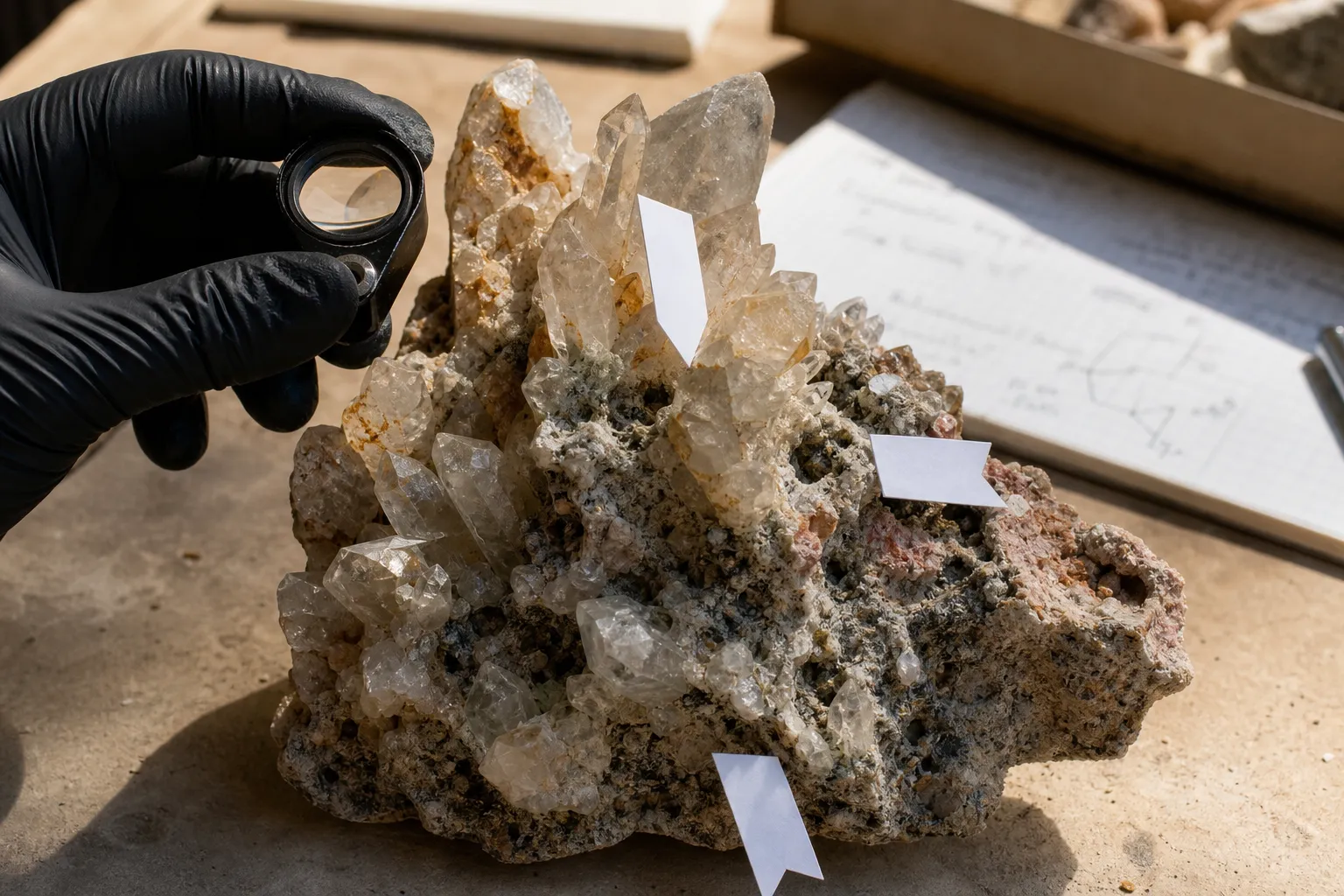
The key distinction is between quartz as a mineral and a specimen as a whole object. Quartz may be the main visible crystal, but the piece may also include matrix and associated minerals. Those materials can change the answer.
Carbonates such as calcite are acid-sensitive. Porous host rock can absorb solution and release it slowly. Iron-bearing matrix may continue to bleed color. Fragile clusters can loosen if the material holding them together is altered. Metallic sulfides and unknown associated minerals may respond unpredictably in acidic conditions.
Testing before oxalic acid is therefore not just a cautious phrase. It is a compatibility check. A sensible order of judgment is:
- 1Decide whether the discoloration is likely iron staining rather than natural color or another mineral.
- 2Look for calcite, carbonate matrix, porous host rock, fragile attachments, and unknown associated minerals.
- 3Test on a low-value specimen or less important area before exposing a valued piece.
- 4Stop when the stain has been reduced enough rather than assuming more time will improve the specimen.
- 5Rinse and handle the material according to the product label, Safety Data Sheet, and local requirements.
Cleaning can reveal attractive detail. It can also flatten contrast, remove patina, or expose damage that the stain concealed.
Acid handling cautions that belong here
Oxalic acid should not be described as a harmless crystal-care liquid. It is a hazardous chemical, and practical handling should be guided by the product label, Safety Data Sheet, and local rules.
At a general level, acid handling cautions include eye protection, chemical-resistant gloves suitable for the product, ventilation, splash control, and avoiding skin or eye contact. Cleaners should not be mixed casually. Acid solutions should not be heated as a home shortcut. Disposal and neutralization should not be improvised from hobby chatter; they depend on the material, concentration, contaminants, label directions, SDS guidance, and local regulation.
These cautions do not make the chemistry mysterious. They keep the explanation honest: the same oxalate chemistry that can bind dissolved iron is still happening in an acidic chemical environment.
Bottom line
Oxalic acid can make iron-stained quartz or crystal specimens look clearer because it can attack iron oxide or iron oxyhydroxide staining and help move some iron into soluble iron oxalate complexes. Ferrioxalate species such as [Fe(C2O4)3]3− are legitimate chemistry vocabulary for understanding how oxalate binds ferric iron, but real cleaning baths are condition-dependent and may contain multiple iron species.
For a collector, the visual effect is simple: less iron stain can mean more visible quartz surface and a cleaner-looking specimen. The boundary is just as important. Oxalic acid is not a universal crystal cleaner, not every rust remover is oxalic acid, green solution does not prove one exact complex, and specimens with matrix or associated minerals may be damaged.
The clearest answer is chemical, cautious, and specimen-specific: oxalic acid may reveal clarity when the problem is accessible iron staining and the specimen is compatible, but it should be treated as acid chemistry rather than a guaranteed transformation.