Reflective Relationship Clarity
How Cognitive Clarity Transforms Your Romantic Decision Making
An amethyst beside the bed is still quartz before it is a symbol: purple color zoning, crystal habit, a visible object you may choose to associate with quiet. Cognitive clarity works best in the same modest way. It can transform romantic decision making by helping you pause before reaction, separate fear from values, and notice relationship patterns without treating a spiritual image as proof.
For readers exploring Crown chakra romantic decisions, the crown chakra can be used as a reflective lens for perspective and personal meaning-making. It should not be used to assess love, compatibility, safety, another person’s motives, or the future of a relationship. The practical answer is simple: cognitive clarity does not choose your partner for you. It changes the quality of the questions you ask before you choose.

broader context
Amethyst context note
This narrower page lands better after the broader amethyst context page.
What Cognitive Clarity Changes Before a Romantic Choice
Cognitive clarity, in this page’s limited sense, means having enough mental space to tell the difference between a passing emotional surge and a steadier value. It is not a special power, a clinical state, or a guaranteed path to relationship wellness. It is a reflective condition: you can name what you feel, what you want, what you fear, and what you can actually observe.
That shift matters because romantic choices often arrive under pressure. Attraction, longing, family expectation, past disappointment, hope, and uncertainty can crowd the same inner room. You may ask, “Is this intuition, fear, or desire?” Clarity does not make that question answer itself, but it can slow the moment enough to sort the pieces.
Used carefully, crown chakra symbolism can support that pause. In popular spiritual language, the crown is often associated with higher perspective, quiet awareness, or a sense of connection beyond ordinary noise. Without strong public sources for a specific mechanism or outcome, the safest use here is personal and reflective. Treat the image of the crown as a reminder to look from above the immediate drama; not to escape the facts, but to see them more cleanly.
Questions that make the pause useful
- What am I directly observing, rather than imagining?
- What value am I trying to protect?
- What am I afraid will happen if I choose slowly?
- Is my urgency coming from affection, anxiety, pressure, or avoidance?
- What pattern have I seen before, in this relationship or in myself?
These questions do not produce certainty. They reduce confusion enough to make the next step more honest.
Crown Chakra Symbolism Is a Lens, Not a Verdict
Crown chakra romantic decisions become risky when symbolic language is treated as authority over real-world evidence. A crystal, meditation image, dream, mood, or sudden feeling should not be used as proof that someone is right for you, wrong for you, spiritually assigned to you, or secretly unsafe. Those conclusions require more than atmosphere.
A better use is to let the symbolism create distance from the immediate pull of the situation. If amethyst is part of your practice, it can remain a specimen first and a symbol second: quartz with visible form, then an object you associate with calm reflection. Sitting near it, holding it, or placing it in a quiet room may serve as a personal ritual for slowing down. The meaning comes from your reflective use, not from the stone deciding the relationship.
“What does my wiser self notice?” is a useful prompt. “This proves the relationship is destined” gives the symbol more authority than it can responsibly carry.
The same boundary applies to cognitive awakening. In spiritual writing, that phrase may suggest a moment when confusion gives way to insight. Here, it should be read modestly: a personal experience of seeing your own motives more clearly. It is not evidence that you have hidden knowledge about another person, and it should not override behavior, communication, consent, safety, or trusted outside support.
Mental clarity is most useful when it returns you to observable reality. What has been said? What has been done? What changes have held over time? What still feels unresolved after the emotional wave passes? A reflective lens is valuable when it brings you back to the ground.
When Clarity Helps Most
Cognitive clarity works best when it is paired with time. If a romantic choice feels urgent, the first transformation may be the decision not to decide immediately. A pause can reveal whether the urgency belongs to the relationship itself or to an inner fear of abandonment, conflict, loneliness, or regret.
It also helps when you separate fear from values. Fear often speaks in emergency language: “If I do not act now, I will lose everything.” Values speak more steadily: “I need honesty,” “I need mutual respect,” “I want affection without losing myself,” or “I cannot ignore repeated harm.” Writing the two voices separately can make them easier to recognize.
Clarity is also strengthened by pattern awareness. One isolated moment rarely tells the whole story. A tender apology, a confusing silence, a sudden attraction, or an intense disagreement may matter, but romantic choices become more grounded when you look for repetition. Does the relationship regularly leave room for your voice? Do difficult conversations lead to repair, or only to another cycle? Do you become more truthful in this connection, or more edited?
This is where spiritual self reflection can be useful without replacing judgment. You might use a quiet practice to ask what your body and mind keep returning to, then compare that inner material with facts. If the reflective moment says, “I feel uneasy,” the next question is not “What mystical message is this?” but “What, specifically, feels uneasy, and what evidence do I have?”
Scale matters
A decision about sending a message, naming a need, or taking time alone may fit private reflection. A decision involving shared housing, finances, children, coercion, legal concerns, severe distress, or possible danger requires more than an inward ritual. Serious relationship situations deserve trusted human support and, when relevant, qualified professional, legal, emergency, or safety-planning resources.
Where Romantic Clarity Is Commonly Misread
The most common confusion is mistaking intensity for truth. A strong feeling may be meaningful, but intensity alone does not establish compatibility. Longing can feel luminous. Fear can feel like intuition. Relief after conflict can feel like certainty. Cognitive clarity asks you to slow the interpretation before you build a life decision around it.
Another confusion is using spiritual language to soften uncomfortable evidence. If someone repeatedly crosses your boundaries, dismisses your concerns, pressures you, or makes you feel unsafe, crown chakra symbolism should not turn those facts into a lesson you are expected to endure. Personal meaning-making can help you understand your inner response; it should not ask you to ignore harm.
A third confusion is treating calmness as automatic approval. Sometimes a quiet state means you have found enough space to think. Sometimes it means you have gone numb, shut down, or stopped expecting change. This page cannot assess that difference for you. It can only offer a careful question: after the calm, do you feel more able to tell the truth, or less able?
There is also a subtler error: believing clarity must feel beautiful. Real clarity may feel plain. It may tell you that you need another conversation, not a dramatic decision. It may reveal that you are not ready to choose. It may ask you to admit that attraction and alignment are not the same thing. In romantic choices, the clearer path is not always the most poetic one.
Amethyst symbolism can fit this moment if it remains modest. A stone on the table can remind you to look again, breathe, and distinguish visible evidence from inner projection. It cannot certify the meaning of a relationship.
A Careful Process for One Romantic Decision
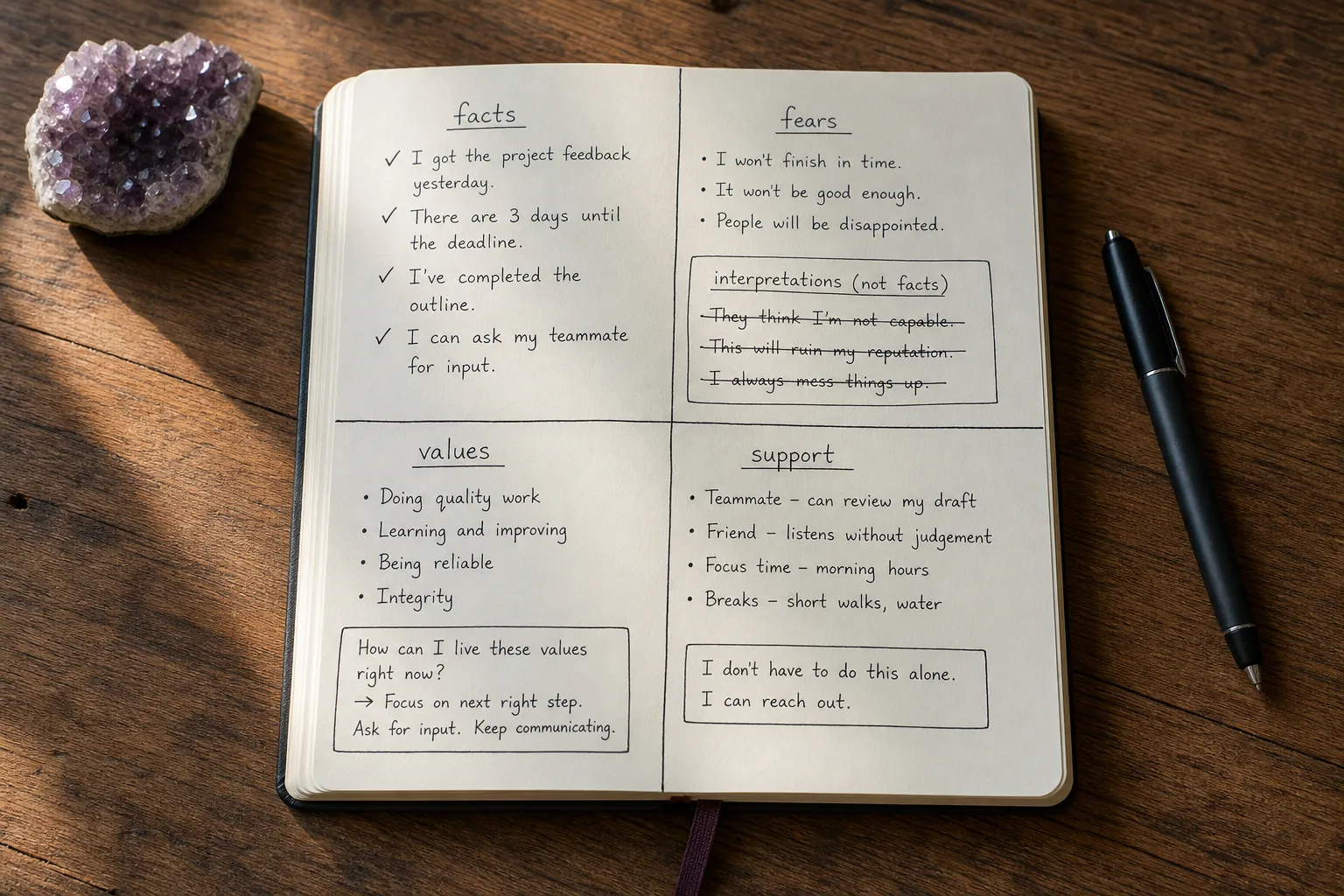
If you want a simple way to use cognitive clarity before a romantic choice, keep the process narrow. Do not try to solve the whole relationship at once. Choose one decision: whether to continue a conversation, ask for space, define a boundary, accept a commitment, end a pattern, or seek support.
Name the decision plainly
Avoid spiritual shorthand at this stage. “Should I stay?” may be too large; “Do I want to agree to this next step now?” is easier to examine.
Separate facts from interpretation
Facts are words, actions, timing, agreements, repeated behaviors, and practical consequences you can point to. Interpretations are the stories you build around them.
Write fear and value separately
Fear may say, “I will be alone.” A value may say, “I want a relationship where I can speak honestly.” This helps you hear each voice without making either one wrong.
Use symbolism only as a pause
If you meditate, sit quietly, hold amethyst, or imagine a higher vantage point, let that practice create room for reflection. Do not ask it to deliver a verdict.
Fifth, decide what kind of support the situation requires. A private reflective practice may be enough for a low-stakes romantic choice. If the situation involves emotional safety, coercion, fear, major disruption, mental health strain, legal questions, or possible danger, reflection should be paired with appropriate outside help. Relationship safety guidance belongs in the real world, not only in private symbolism.
This process does not promise the right outcome. Its purpose is smaller and more useful: it helps you make romantic choices with fewer hidden motives and a clearer view of what is actually at stake.
What This Page Can and Cannot Claim
Because there are no public reference links available for this page, the claims here stay narrow. This article treats cognitive clarity, crown chakra language, and amethyst symbolism as reflective tools, not established systems for predicting romantic outcomes.
That limit matters. The page can say that reflective practice may help some readers pause, clarify values, and notice patterns. It cannot responsibly say that crown chakra work improves decision quality, identifies the right partner, determines compatibility, resolves serious emotional wounds, predicts relationship wellness, or guarantees safety.
The useful boundary is also the practical one: use spiritual symbolism to ask better questions, not to bypass reality. Use mental clarity to compare feeling, value, and evidence, not to force certainty. Use amethyst as a chosen object of reflection if it helps your room feel quieter, while remembering that its mineral surface and your symbolic meaning are different kinds of truth.
A romantic decision becomes more grounded when it can survive both atmosphere and scrutiny. Let the crystal remain on the table; then look carefully at the pattern, the conversation, the boundary, and the next honest step.