Household Ritual Boundary
Setting Up a Geometric Grid to De-Escalate Household Tension
A Crystal grid for conflict can be used as a quiet, symbolic pause point in the home: choose a small visible surface, place one central stone for your intention, arrange a few supporting stones in a balanced pattern, and let the setup remind you to slow down before an ordinary disagreement gets sharper. Its role is modest. It is not a conflict-resolution method, a safety plan, therapy, or a way to change another person’s behavior. It only belongs in situations that are already safe enough for reflection.
broader context
Broader amethyst guide
This narrower page lands better after the broader amethyst context page.
A simple grid for a softer tone
For this household practice, the grid does not need to be elaborate. A small sacred-geometry-inspired layout on a shelf, side table, windowsill, or entryway surface is enough. The point is not to make the room act differently. The point is to create a visible cue for the people who choose to use it.
Pick a place that will not be bumped, resented, or turned into another household issue. A shared dining table may be too active unless everyone agrees. A hallway shelf or quiet living-room corner often works better because the grid can be noticed without forcing anyone to participate.
Choose one center stone. If amethyst is part of your personal practice, it can sit in the middle as the focus stone. If you use other crystals, keep the selection small. This page is about structure, intention, and use—not a claim that a mineral produces a guaranteed emotional result.
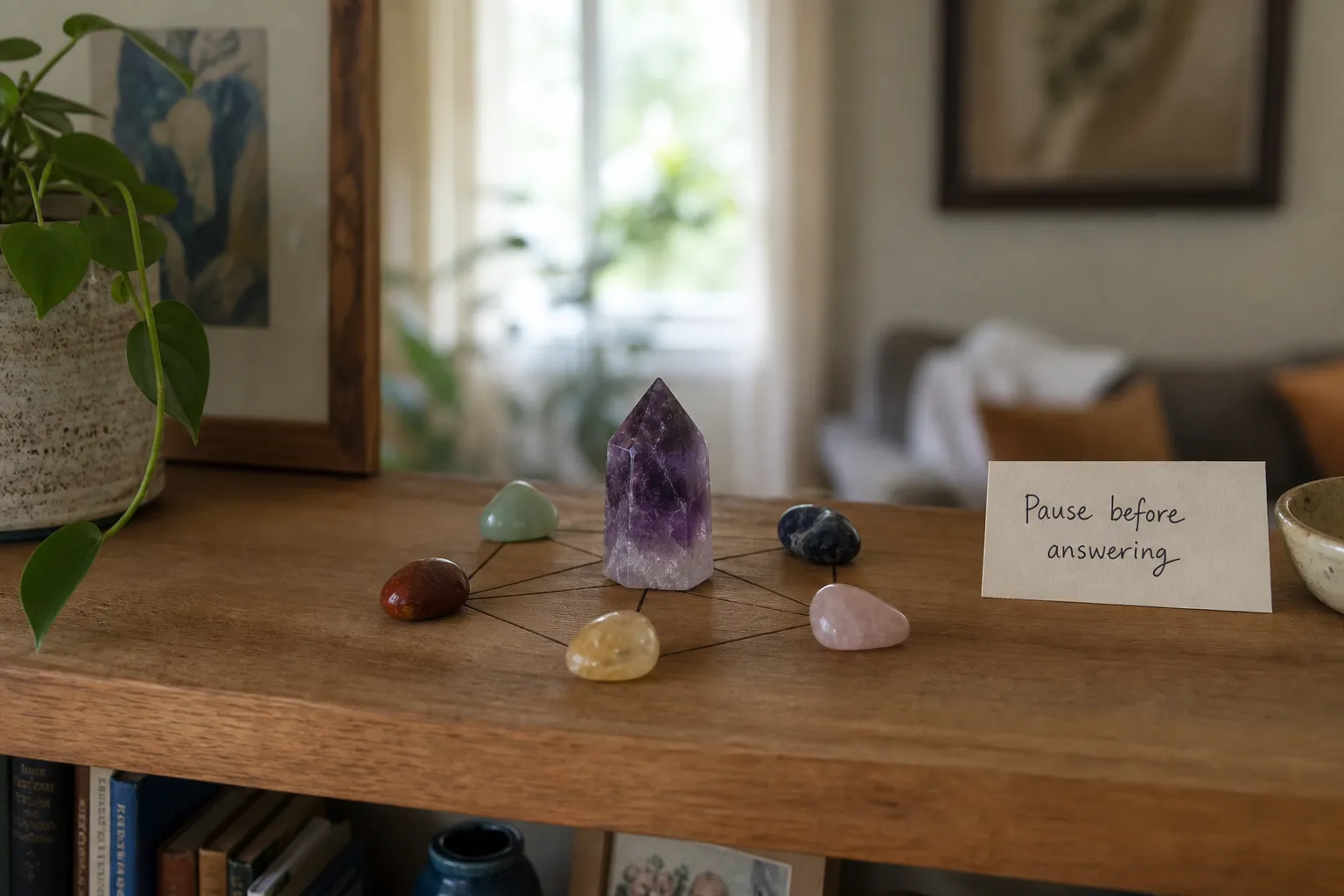
Around the center, place four to six stones in a balanced shape. A circle, square, diamond, or simple six-point arrangement can all carry the same symbolic meaning: steadiness, space, and restraint. In this context, sacred geometry is being used as a visual language of order and intention, not as an evidence-backed mechanism.
A basic layout can be as simple as:
- One central stone for the main intention.
- Four surrounding stones for pause, listening, space, and restraint.
- A small note with a sentence such as “Pause before answering.”
- Enough open space around the grid so it feels deliberate rather than cluttered.
That is the whole practice. The grid is not a household command center. It is a symbolic crystal grid that quietly marks the wish for less reactivity.
Use it as a cue, not an argument tool
A household tension crystal grid works best before tension peaks. Set it up during a calm time, not in the middle of a heated exchange. If someone is already upset, presenting a ritual object as the answer can feel dismissive or controlling.
Keep the meaning personal and voluntary. A clean version is: “I’m setting this up as a reminder for myself to pause before I speak sharply.” That keeps responsibility where it belongs. The grid becomes a reflective practice for the person using it, not a judgment placed on everyone else.
The phrase “non-verbal intervention” can sound stronger than this practice really is. In plain terms, this is a non-verbal calming ritual or a visual cue for pausing. It may remind a willing person to lower their voice, delay a reply, take a breath, or choose a softer tone. Those are personal choices, not effects produced by the stones.
If others in the home are open to it, invite them to add one word of intention, such as “patience,” “listening,” or “space.” If they are not interested, do not press. A crystal grid meant to soften family arguments should not become one more thing to argue about.
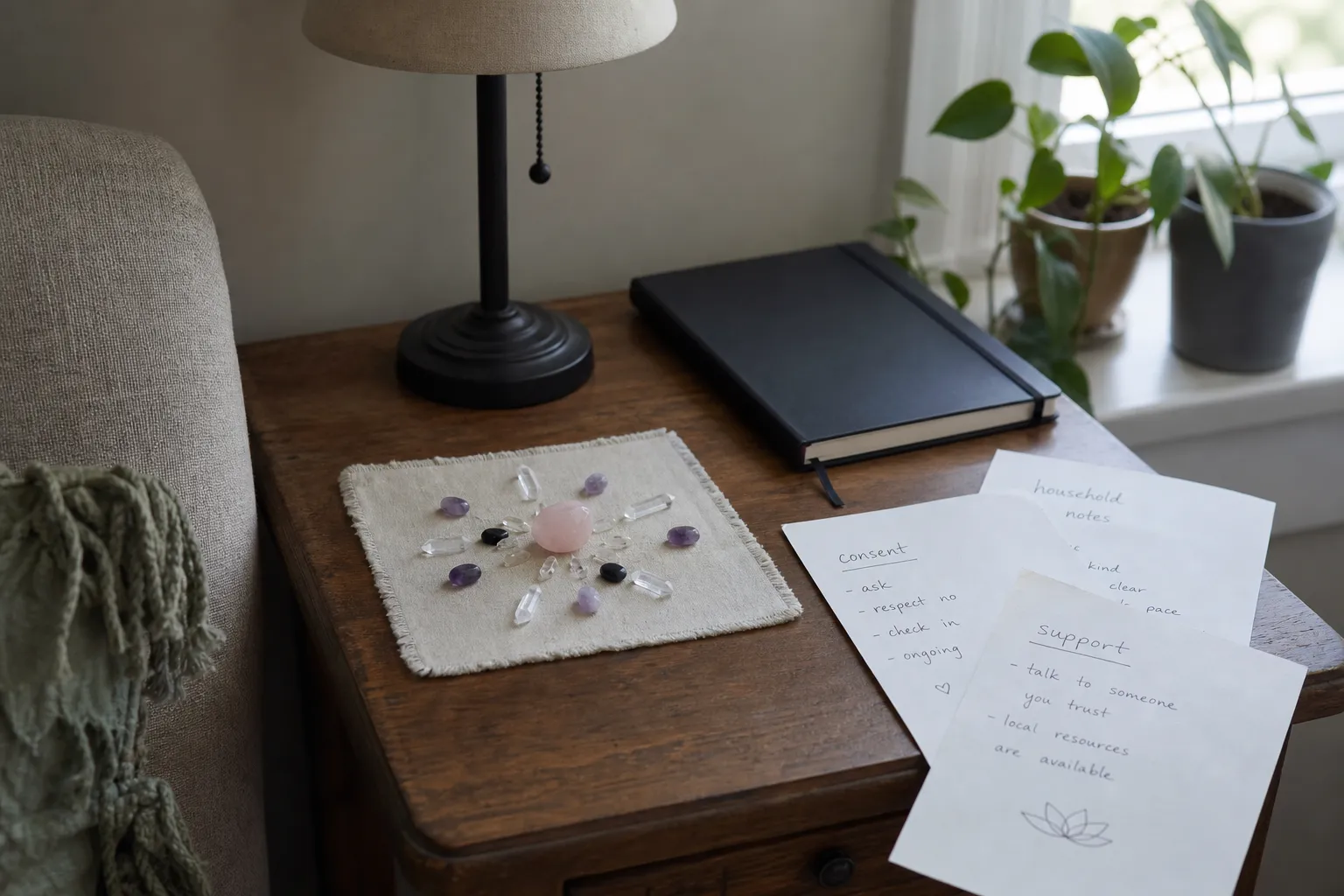
Consent is part of the setup. In a shared home, avoid placing the grid in someone’s bedroom, workspace, or personal area without permission. Do not hide it as a way of “working on” another person. The more transparent and ordinary the practice is, the less emotional pressure it carries.
A calm-time setup sequence
Keep the sequence short enough to repeat without turning it into a performance.
- First, clear the surface. Dust the area, remove stray objects, and leave a small open space around the grid. The physical act helps the practice feel intentional.
- Second, name the kind of tension you are addressing. Keep it ordinary and specific: rushed mornings, clipped replies, repeated small irritations, or the aftertaste of a minor disagreement. The grid belongs to everyday friction, not fear.
- Third, choose one sentence of intention. Avoid wording that tries to change another person. “Make them stop yelling” puts the practice outside its proper boundary. “I will pause before escalating” is clearer. “I will ask for a break when I feel myself tightening” is also within your control.
- Fourth, place the center stone. Let it stand for the intention, not for a promised result.
- Fifth, place the surrounding stones evenly. You might assign each one a word: pause, listen, soften, space. If the shape helps you feel grounded, use it. If it starts to feel fussy, simplify it. The point is a quiet reminder, not perfect geometry.
- Sixth, choose a reset gesture. This could be touching the table beside the grid, reading the intention silently, or stepping away for a few minutes. Keep it unobtrusive. The gesture is for slowing your own response, not managing the whole household.
- Finally, decide when to refresh or dismantle the grid. A useful rhythm might be after a difficult week, after a resolved disagreement, or when the setup starts to fade into decor.
What changes the answer
The right setup depends less on the exact geometry and more on the household situation around it.
Shared comfort
If everyone involved is curious or neutral, the grid can sit in a shared area as a gentle signal. If one person dislikes crystals or spiritual objects, keep the practice personal and private. A ritual that overrides someone’s comfort is not calming.
Mild tension only
If the tension is mild, the grid can serve as a prompt for quieter behavior. Mild means irritation, stress, miscommunication, or repetitive small arguments where people still feel physically and emotionally safe. In that setting, an ordinary household tension ritual may help create a pause in the flow of reaction.
Serious risk boundary
If the conflict includes fear, threats, violence, coercion, stalking, child safety concerns, self-harm risk, substance-related danger, or escalating danger, do not rely on a crystal practice. Seek appropriate human support, local emergency help, crisis resources, or qualified professional guidance. The grid may remain meaningful as a private object, but it should not be mistaken for protection or intervention.
Wrong role warning
If the grid is being used to avoid a necessary conversation, it is serving the wrong role. A crystal layout can symbolize the desire to speak more carefully. It cannot replace an apology, a boundary, a repair conversation, a household agreement, or outside help when needed.
If the practice increases resentment, stop or simplify it. Some people feel comforted by visible rituals; others feel pressured by them. The most peaceful version is the one that does not demand belief.
Common confusion around crystal grids and conflict
One common mistake is expecting the grid to stop arguments. A grid can be framed as a reminder to pause, but not as a reliable way to change another person’s words, moods, or decisions.
Another mistake is treating sacred geometry as a confirmed de-escalation mechanism. Pattern, symmetry, and symbolism may be meaningful in spiritual practice, but this page does not have source support for claims that sacred geometry changes household conflict. Here, the geometric form is best understood as symbolic structure.
A third mistake is choosing stones as though the exact combination guarantees a result. A more grounded approach is to choose a few pieces you already associate with calm, reflection, or restraint, then let the grid’s meaning come from your intention and behavior.
The last confusion is using spiritual language to bypass responsibility. If you speak sharply, the grid is not the reason to be kinder; it is only a reminder. If a disagreement needs repair, the stones do not perform that repair for you. The human part remains central.
Where the evidence boundary sits
No public references were available in the supplied research set for crystal terminology, sacred-geometry history, cultural lineage, or measurable de-escalation outcomes. That limits what this page can responsibly say.
It can describe a simple intention-setting grid, respectful placement, and a quiet way to use the grid as a reminder. It can also name the safety boundary clearly.
Claims this page does not make
It should not claim that crystal efficacy has been demonstrated for household conflict. It should not present the grid as a clinical technique, a domestic safety tool, or a method for preventing family arguments. It should not imply that this practice has been tested by the site, endorsed by professionals, or confirmed by user reports.
Within those limits, the practice can still have a place. Many home rituals matter because they help a person notice what they are about to do. A bowl by the door can remind someone to put down keys. A note on the fridge can remind a family to buy milk. A sacred geometry crystal grid, used modestly, can remind a willing person to pause before adding more heat to the room.
That is the most responsible promise: not that the grid de-escalates conflict by itself, but that it can become a chosen visual cue for gentler conduct when the situation is ordinary, safe, and open to reflection.
Quick checklist before you set it up
Use the grid only if these points are true:
- The household situation is safe enough for a reflective ritual.
- The grid is for your own pause, tone, and intention.
- The placement does not intrude on another person’s private space.
- The wording is simple and behavior-based.
- Anyone expected to notice or use it has room to decline.
- Serious risk is handled outside the ritual.
A good intention is plain: “I will pause before I answer.” Another is: “I will ask for space before I raise my voice.” These sentences keep the practice honest because they point back to your own next action.
A crystal grid for conflict is most useful when it stays small, visible, and humble. Let the geometry hold the idea of order. Let the stones mark the wish for steadiness. Let the real work remain human: noticing tension early, choosing a softer response when possible, and knowing when the situation is beyond what any symbolic ritual should be asked to carry.