Functional Earth Art: Positioning Oversized Pink Geodes for Room Flow
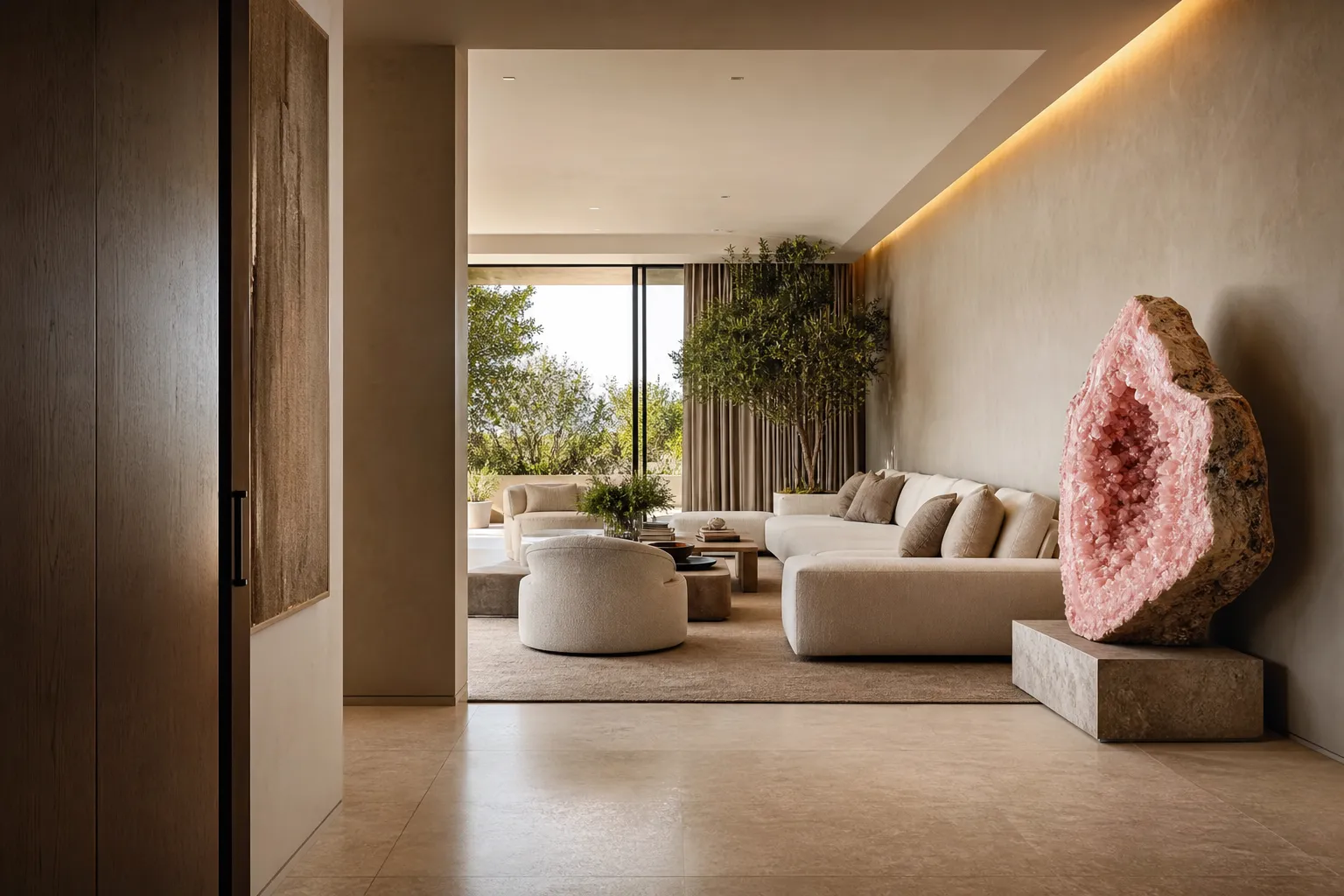
Place an oversized pink geode where it behaves like a grounded architectural feature, not a loose accent: near a strong wall, outside the main walking path, visible from the room’s natural entry line, and visually tied to the largest furniture grouping. Through a Feng Shui energy mapping lens, the best position is the one that makes arrival, movement, and attention feel more settled—not more crowded.
In practical terms, decide placement by checking five things: the geode’s open face, the first sightline from the doorway, the walking route, the stability of its base, and how it relates to nearby furniture.
broader context
Begin with the main amethyst page
This narrower page lands better after the broader amethyst context page.
The placement answer: anchor the room without blocking it
An oversized pink geode has two kinds of weight. One is physical: it may be heavy, uneven, and unsuitable for narrow stands or lightweight furniture. The other is visual: its color, cavity, sparkle, and scale pull attention immediately. Good functional earth art placement respects both.
A strong placement usually does the following:
- Lets people see the geode early without forcing them to walk around it.
- Angles the open face toward the room, not into clutter or a tight passage.
- Connects the piece to a wall, console, plinth, built-in niche, or substantial furniture group.
- Keeps door swings, seating access, and circulation routes clear.
- Uses the pink mineral tone as a soft focal point rather than a cue to crowd the room with more crystal objects.
In a living room, this often means placing the geode near the side of the main seating group, backed by a wall or balanced by a console. In an entry, it can work as a threshold marker if it sits to the side of the arrival path rather than directly in the route. In a bedroom, the answer is usually more restrained: low, stable, off the walking line, and not visually looming over the bed.
The simplest test is to enter the room as a guest. If the geode gives the eye a place to land and the body an easy path forward, the placement is working. If your first response is to dodge, squeeze, or worry about bumping it, the room is telling you to move it.
Turn “energy mapping” into visible room decisions
Feng shui is historically concerned with arrangement, orientation, and harmony in the built environment. For this kind of modern interior decision, it is most useful as a symbolic spatial lens—not as a promise that one object will create a fixed result.
For an oversized geode, that lens becomes practical when you translate it into observable choices.
Entry line
Stand at the main doorway and notice what the room asks you to see first. A pink geode can be powerful on this first sightline, but it should not sit like an obstacle at the threshold. Slightly offset from the path inward, it can feel like a welcoming anchor rather than a visual barricade.
Circulation path
Walk the normal route through the room: door to sofa, sofa to window, kitchen to seating, bed to closet, hallway to entry table. If the geode forces awkward turns, narrows a passage, or sits where bags, pets, or children may collide with it, the placement is not supporting flow.
Sightline positioning
A geode’s open face is visually active. Angling it toward the main viewing position can make it read as intentional sculpture. Turning it toward a side wall, messy shelf, or dead corner can make it feel stored rather than placed.
Room orientation
The room’s existing orientation matters more than an abstract rule. If seating already faces a fireplace, view, artwork, or media wall, the geode should either support that direction or balance it from a quieter side position. If it competes with every focal point at once, the room can feel restless.
Furniture relationship
Large geodes look more resolved when their scale has a companion. A substantial console, stone plinth, low cabinet, broad wall plane, or built-in niche can make the piece feel architecturally integrated. A delicate side table can make the same object look tense or mismatched.
This is where symbolic feng shui planning and spatial architecture meet. The useful question is not only “Where is the energy?” It is also “Where does the room already move, pause, and gather attention?”
Where an oversized pink geode usually works best
The exact answer depends on the room, but a few placement patterns are more coherent than treating a large geode like a small tabletop crystal.
Near an entry, but not in the entry path
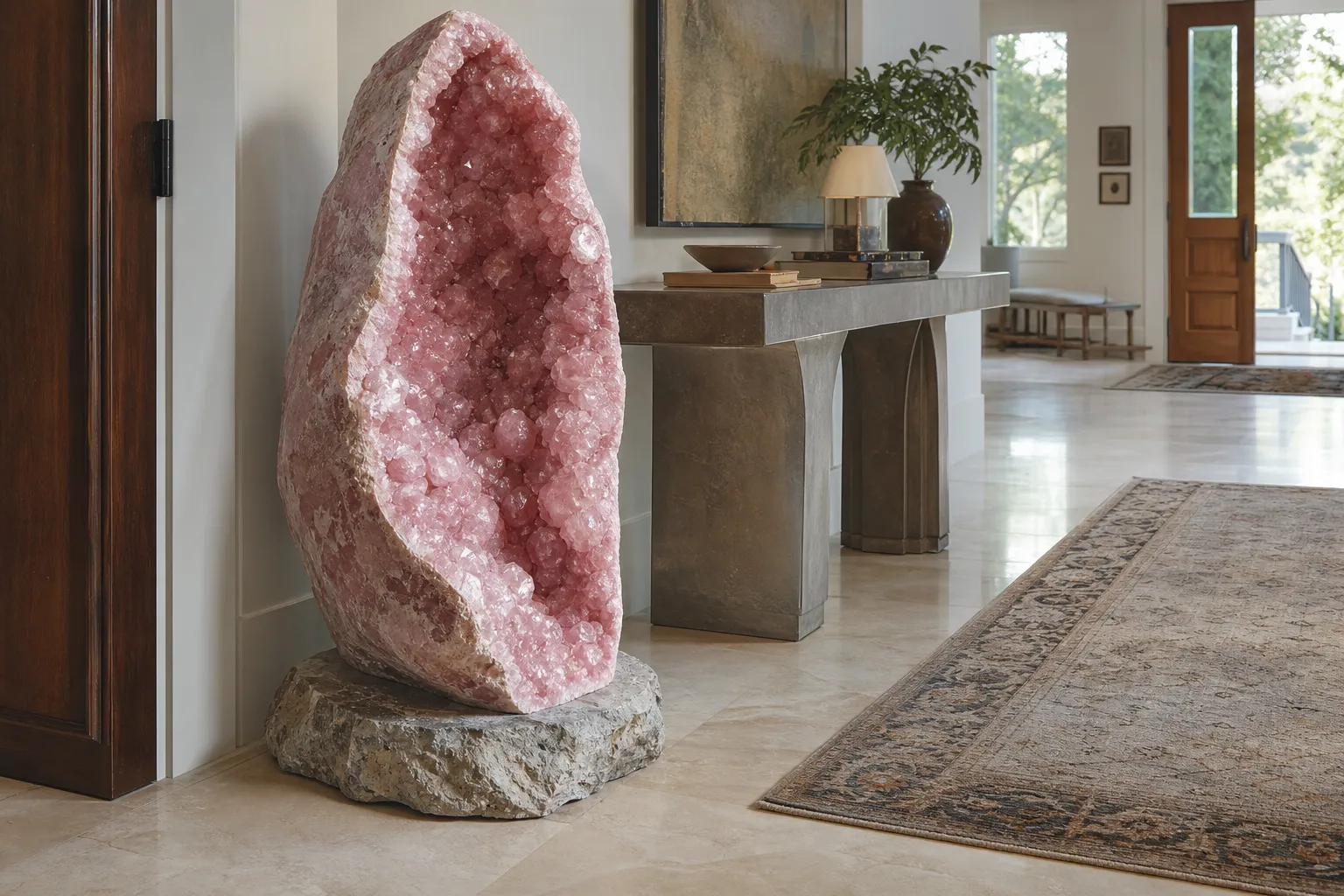
A large pink geode can work near an entry because it marks transition. It gives the arrival sequence a point of interest and can make the home feel curated from the first step inside.
The better version is usually placed along the side of the entry line, backed by a wall, niche, console, or architectural edge. Avoid placing it directly opposite the door if that creates a stop-sign effect, especially in a narrow foyer. Also avoid locations where coats, shoes, deliveries, swinging doors, or bags will hit it.
A geode entry line placement should feel like a threshold accent, not a checkpoint.
Beside a seating group as a grounding counterweight
In a living room, an oversized geode often works well beside a sofa, lounge chair, or low cabinet, especially when the room needs a counterweight to a large window, fireplace, or artwork. The pink tone can soften heavier materials such as dark wood, black metal, leather, or stone.
The key is to avoid floating it in the middle of unused space. A large mineral object needs a visual reason to be where it is. If it sits beside a chair, under a wall light, near a console, or within a furniture grouping, it reads as functional earth art. If it sits alone in a random corner, it may read as an object waiting to be moved.
In a quiet corner that needs presence
A corner can be a good location when the geode is too visually strong for the center of the room. But the corner still needs breathing room. If the geode is wedged between a plant, floor lamp, basket, and chair leg, its sculptural quality gets lost.
A quiet corner works best when the open face angles into the room. That keeps the object in conversation with the space instead of turning it into a static display. For room flow with geodes, a slight angle often feels more natural than rigid front-facing placement.
Near a bed only if the scale stays calm
A large pink geode in a bedroom needs particular restraint. Bedrooms usually benefit from fewer heavy visual interruptions around circulation routes. If the geode belongs there, it should be stable, low enough to feel grounded, away from narrow bedside movement, and not placed where it dominates the first view of the bed.
This is a design boundary, not a promise about personal outcomes. The bed already carries strong visual importance. Any heavy sculptural object nearby should support that calm center rather than compete with it.
What changes the answer
There is no single correct position because oversized pink geode placement changes with the room’s architecture, the specimen’s scale, and the people who use the space.
The size of the geode changes its role. A modest display piece may sit on a console. A truly oversized geode behaves more like furniture or sculpture. The larger it is, the more it needs floor-level planning, a stable base, and a clear relationship to walls and walking paths.
The base changes both safety and mood. A stable base for geodes is not only a practical detail. It affects the whole reading of the room. A low, broad, weight-appropriate support can make the object feel calm and permanent. A narrow pedestal can make it feel visually nervous, even if the color is beautiful.
Children and pets change the rules. General consumer guidance on furniture and heavy objects emphasizes stability and tip-over prevention. The same principle applies here without needing a geode-specific rule. If a child can climb near it, pull on its support, or run into it, the symbolic location comes second to stable placement and access control.
The floor and furniture matter. Uneven floors, lightweight tables, narrow shelves, and overloaded cabinets are poor partners for heavy sculptural objects. Before considering orientation or harmony, confirm that the support surface suits the object’s weight and shape.
The existing focal point matters. If the room already has a fireplace, large artwork, dramatic window, or prominent media wall, the geode does not need to become the loudest object in the room. It can echo, soften, or balance the dominant feature from a supporting position.
Pink geode wording: a beautiful label, not always a precise mineral ID
“Pink geode” is often a decorative or marketplace description rather than a precise mineral identification. A pink-toned geode may be described by color, trade name, treatment, mineral association, or seller convention. Mineral references can explain quartz-related naming in general, but they do not identify an individual object without provenance or mineral data.
For this placement question, that distinction keeps the advice honest. You can position the object beautifully without claiming more than you know about its mineral identity. If exact identification matters, ask for reliable provenance or use a qualified mineral reference process. If your purpose is room flow, treat the piece as a large pink-toned mineral display with significant visual and physical mass.
The same restraint applies to symbolic language. It is reasonable to use the geode as a personal symbol of softness, grounding, beauty, or earth connection. It is not responsible to present placement as guaranteeing wealth, romance, personal protection, health outcomes, or measurable changes in a room.
A quick placement check before you commit
Before settling the geode into its final position, use a short walk-through rather than judging only from a photo.
- Enter the room normally. Does the geode welcome the eye, or does it block the first movement?
- Walk the main circulation path. Can people pass naturally without turning sideways or guarding their steps?
- Sit in the main seat. Does the geode feel balanced with the furniture, or does it pull attention away from everything else?
- Look at the base. Is the support broad, stable, load-appropriate, and unlikely to tip?
- Check daily life. Will doors, pets, children, bags, vacuuming, curtains, or chair movement interfere with it?
- Step back under evening lighting. Does the geode still feel integrated when lamps are on and daylight is gone?
If it passes those checks, the placement is likely doing what this kind of object does best: making the room feel more grounded, intentional, and spatially composed.
The practical boundary
Feng shui-inspired placement can be a meaningful way to think about orientation, threshold, harmony, and the felt atmosphere of a room. But for an oversized pink geode, symbolism should never overrule structure. A location is not successful if it overloads furniture, narrows movement, creates a tipping concern, or makes the room feel crowded.
The strongest placement is usually the quietest one: stable, visible, slightly offset from traffic, connected to the architecture, and scaled to the furniture around it. In that position, the geode can function as luxury earth art without asking the room to work around it.