Sound practice and mineral symbolism
Acoustic Alignment: Pairing 852Hz Frequencies with Hematoid Quartz Lattices
Pairing 852Hz Solfeggio-style audio with hematoid quartz works best as a symbolic meditation practice, not as a demonstrated acoustic crystal mechanism. The sound can create a steady atmosphere for attention, breath, prayer, or journaling. The stone can serve as a tactile and visual focal point. That is a fair ritual frame.
What the available evidence does not support is the stronger claim that hematoid quartz lattices physically align with 852Hz, amplify Solfeggio frequency alignment, or create predictable health, neurological, or spiritual outcomes.
broader context
Amethyst context note
This narrower page lands better after the broader amethyst context page.
The honest separation
- Hematoid quartz is a real mineral object with quartz and hematite-related naming context.
- 852Hz is a tone used in contemporary Solfeggio listening culture.
- The meaning of the pairing comes from the listener’s reflective practice, not from a confirmed mineral-and-sound mechanism.
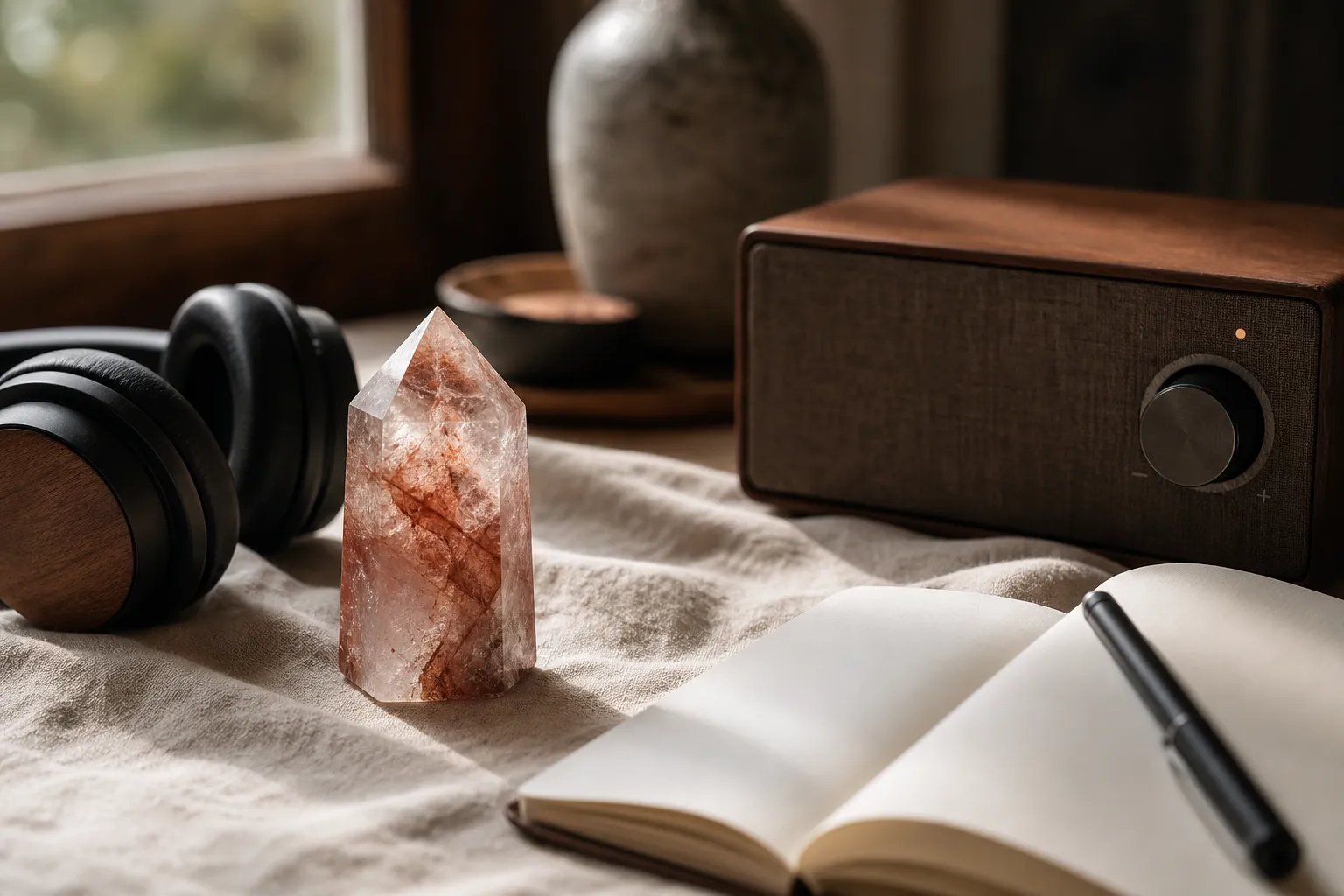
A workable 852Hz and hematoid quartz pairing
If you want to use the pairing without overstating it, make the session simple. Choose an 852Hz track or tone that feels soft enough to sit with. Hold the hematoid quartz, place it near your journal, or set it where you can see it. Let the audio provide the sound environment and let the stone give your attention somewhere concrete to return.
A modest structure is enough
- Pause briefly before starting the audio.
- Keep the volume comfortable, especially with headphones.
- Hold or place the hematoid quartz without assuming it needs a precise direction, grid, or body placement.
- Use breath awareness, a short intention, or a few lines of journaling as the main practice.
- Stop if the tone feels irritating, pressured, or overstimulating.
This is not a “more is better” practice. Louder volume, longer sessions, or repeated exposure should not be treated as stronger alignment. Hearing-safety guidance does not evaluate Solfeggio audio specifically, but it does support the practical boundary of moderate volume and reasonable duration for listening routines.
The cleanest wording is: “I am using 852Hz listening and hematoid quartz as a meditative focal pairing.” That leaves room for personal meaning without turning the ritual into a claim about measurable acoustic interaction.
What the mineral language can support
Hematoid quartz belongs in the quartz family context, with reddish, orange, brown, or iron-toned visual character commonly associated with hematite or iron-oxide-related material. Mineral references can support the basic language: quartz is a mineral, hematite is an iron oxide mineral, and “hematoid quartz” is used for quartz showing hematite-related coloration or inclusions.
That gives the stone a real material basis. It does not show that the stone’s crystal structure tunes to 852Hz, stores the sound, or changes what the audio does for the listener.
Material description
In mineralogy, lattice language refers to crystal structure.
Symbolic language
In a ritual setting, people may use lattice language more loosely to imagine pattern, order, or resonance.
For this page’s question, the distinction matters. Hematoid quartz can be valued for its color, weight, texture, inclusions, and visual contrast. Those features may help attention settle because they give the mind something tangible to notice. That is a meditation design choice, not evidence of a special 852Hz response.
Where 852Hz and 396Hz fit
In Solfeggio-style listening spaces, 852Hz is often associated with intuition, inner clarity, or spiritual perception. 396Hz is often discussed with grounding, release, or emotional-clearing themes. These associations belong to contemporary wellness and energy-practice language. They may be meaningful to people who use sound reflectively, but the available source base does not validate special outcomes for those exact frequencies.
That does not make the practice empty. It means the category should stay clear.
Music and sound practices are discussed in wellness and health contexts, and many people use sound for relaxation, focus, meditation, prayer, or mood setting. That general context does not prove that 852Hz creates a specific internal result, and it does not show that hematoid quartz changes the sound’s action.
If 396Hz feels more grounding to someone, that is a personal preference rather than proof that one number is more effective than another. The frequency label should not matter more than comfort, setting, and the listener’s actual response.
The main confusion: resonance language
“Energy resonance” can mean very different things depending on the context. In spiritual or symbolic language, resonance may mean that a tone, object, color, or idea feels personally meaningful. In physics or acoustics, resonance has a more specific meaning involving vibration and material response. Those meanings should not be blurred.
The unsupported jump is this: because quartz has a crystal structure, and because 852Hz is a frequency, the two must interact in a beneficial way. The available sources do not show that. Mineral references can identify quartz and hematite. Hearing-safety sources can help set listening boundaries. General music-and-wellness material can show that sound is used in wellness settings. None of that establishes hematoid quartz acoustic alignment with 852Hz.
More grounded wording
- Use “resonance” when you mean personal symbolism or felt meaning.
- Use “lattice” as mineral context unless you are discussing crystal structure.
- Avoid stating that the stone activates, charges, or amplifies the tone as a fact.
- Do not use Solfeggio listening or crystal ritual in place of qualified support for serious concerns.
- Let the session be reflective rather than outcome-driven.
This does not flatten spiritual language. It keeps metaphor in its proper place. A ritual can be meaningful because it gives shape to attention, not because every symbol in it has been established as a mechanism.

A cautious symbolic ritual framework
For a short 852Hz and hematoid quartz session, the most defensible framework is symbolic, sensory, and reflective.
Start with the stone before the sound. Notice its color, internal markings, opacity or translucency, surface temperature, and weight. Hematoid quartz often draws attention because it combines quartz’s clear or structured appearance with warmer iron-toned presence. That contrast can make it a strong meditation object without needing a stronger claim.
Then begin the audio. Keep it low enough that you can breathe naturally and think clearly. If you use headphones, be especially conservative with volume. If you have hearing concerns, tinnitus, sound sensitivity, seizure triggers, intense distress, or medical or mental-health concerns, treat this as a personal ritual only and seek qualified professional care when needed.
Choose one narrow focus
- “I will sit with one question and not force an answer.”
- “I will notice where my attention wanders.”
- “I will use the stone as a reminder to return to the present.”
- “I will write three ordinary lines after listening.”
The hematoid quartz does not have to touch the body, sit on a particular chakra point, or be arranged in a special geometric pattern for this cautious purpose. Those choices may matter within specific belief systems, but the current evidence base does not require or validate them. A simple placement beside a journal, candle, plant, or quiet seating area is enough for a symbolic ritual.
End by turning off the audio before interpreting the session. Notice whether it felt calming, distracting, neutral, or irritating. That observation is more useful than assuming the frequency “worked” because of its label.
When the answer changes
The answer depends on the claim being made. If the question is, “Can I pair 852Hz listening with hematoid quartz as a personal meditation ritual?” the answer is yes, with moderate volume and clear expectations. If the question is, “Does hematoid quartz create a special acoustic reaction with 852Hz?” the available material does not establish that.
The answer also changes with the listener and the setting. A soft speaker in a calm room is different from high-volume headphones. A five- or ten-minute reflective session is different from prolonged exposure. A person casually exploring ambience is in a different situation from someone trying to navigate serious distress, hearing symptoms, or health concerns.
For collectors and crystal-curious readers, authenticity matters in a separate way. A genuine mineral specimen may be meaningful as an object of study, beauty, or symbolism, but authenticity does not turn symbolic claims into sound evidence. A mislabeled or dyed specimen may still function as a personal visual prompt, but it should not be described as hematoid quartz without care.
The clean boundary is this: use mineral sources for naming, public-health sources for sound caution, and personal practice language for the ritual. Do not ask one category to prove what belongs to another.
Bottom line
852Hz Solfeggio listening and hematoid quartz can be paired as a quiet, symbolic ritual for attention, intuition language, grounding imagery, or reflective atmosphere. The practice is most responsible when it stays modest: comfortable volume, reasonable duration, no pressure for results, and no claim that the quartz lattice physically aligns with the tone.
Hematoid quartz gives the session a material focal point. The 852Hz audio gives it a sound field. The meaning comes from the way the listener uses both in meditation, not from evidence that the stone and frequency form a confirmed acoustic wellness mechanism.