Quartz lattice mechanism
The Crystal Lattice Secret: Why Only Specific Clear Quartz Can Become Amethyst
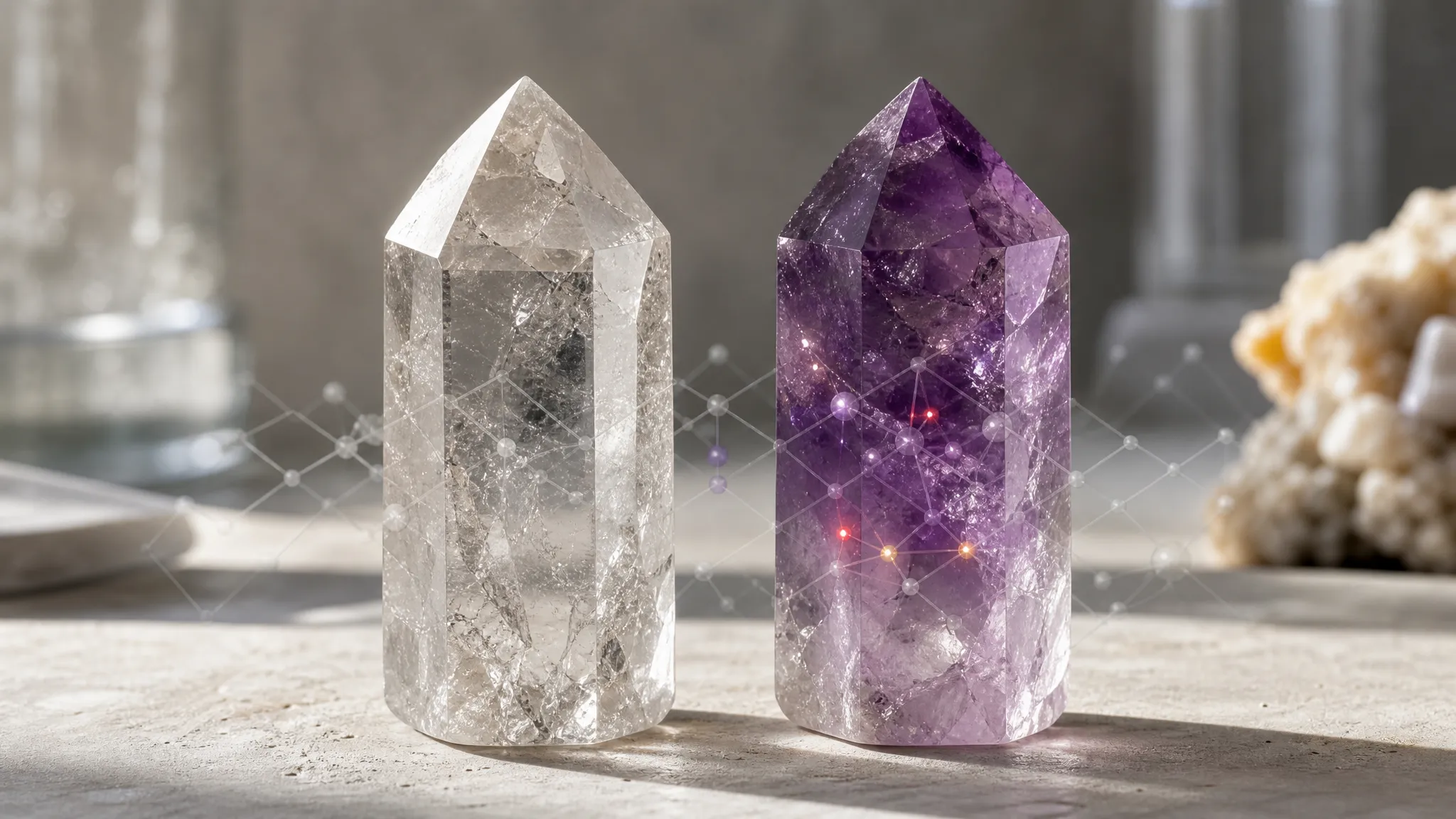
Clear quartz and amethyst are both quartz: crystalline SiO₂. The difference is not purple “paint,” and it is not as simple as “iron plus radiation.”
The better answer starts with isomorphic ion substitution. In some quartz, ions such as Al³⁺ or Fe³⁺ can occupy positions normally associated with Si⁴⁺. Because those ions carry a lower charge than Si⁴⁺, the lattice has to compensate with nearby ions, vacancies, hydrogen-related defects, or other charge-balancing arrangements. That hidden defect pattern can later interact with iron behavior and natural radiation to create amethyst color centers.
That is why only specific clear quartz has the internal setup to become amethyst. The SiO₂ framework is necessary, but it is not enough.
broader context
Amethyst context note
This narrower page lands better after the broader amethyst context page.
The short answer: amethyst is a selective color-center story
Quartz may look chemically simple from its formula, SiO₂. In a real crystal, though, trace impurities and tiny structural differences matter. Clear quartz can contain foreign ions, charge-compensating defects, hydrogen-related defects, fluid inclusions, growth-sector differences, or open-channel sites that are invisible to the eye.
Amethyst color comes from color centers: defect-and-electron arrangements inside the crystal that absorb certain wavelengths of light. A color center is not a pigment smeared through quartz. It is an electronic state tied to the lattice.
A useful shorthand
- Quartz supplies the SiO₂ framework.
- Al³⁺ or Fe³⁺ can substitute into sites associated with Si⁴⁺.
- That substitution creates charge imbalance.
- The imbalance must be compensated by other ions or defects.
- Iron may also sit in interstitial positions, meaning open spaces in the structure rather than silicon sites.
- Ionizing radiation can shift electrons or create trapped-hole states.
- Only certain combinations produce the violet amethyst absorption.
So the real answer is not “any clear quartz plus radiation.” It is: only quartz with the right defect architecture can form amethyst color centers.
What isomorphic ion substitution changes in quartz
Isomorphic ion substitution means one ion enters a crystal structure in a site normally occupied by another ion of compatible size and coordination. In quartz, the important comparison is with Si⁴⁺. When a 3+ ion such as Al³⁺ or Fe³⁺ occupies a site associated with Si⁴⁺, the lattice is short one positive charge.
The crystal cannot ignore that mismatch. It compensates.
That compensation may involve H⁺, Li⁺, Na⁺, or other local defect arrangements. In smoky quartz, for example, Al³⁺ replacing Si⁴⁺ is central: radiation can create aluminum-related trapped-hole centers that produce smoky gray to brown color.
Amethyst overlaps with that defect chemistry, but it does not follow the same path. The simplified statement “Fe³⁺ replaces Si⁴⁺ and makes quartz purple” leaves out too much. Iron in quartz can occur in different valence states and structural settings. Some may be substitutional. Some may be interstitial, occupying channels or open positions in the lattice.
For amethyst, that difference matters. One influential model emphasizes interstitial Fe³⁺ in certain growth areas. Under ionizing radiation, that iron-related defect system can contribute to the violet amethyst absorption, while also interacting with aluminum-related trapped-hole behavior.
Si⁴⁺ replacement opens charge-balance and defect possibilities; aluminum-related centers help set the background; iron must be present in the right structural and valence context; radiation then activates the color-center state that makes amethyst violet.
Why hydrothermal growth can make quartz eligible
Hydrothermal growth does not automatically make amethyst. It can, however, build quartz with the right trace-element and defect history.
Amethyst is commonly associated with fluid-rich settings such as veins, cavities, geodes, and amygdaloidal spaces. These environments can influence which impurities enter quartz, how charge compensation develops, and where iron-related defects occur. A clear quartz crystal that grew under different conditions may share the same SiO₂ identity but lack the hidden lattice ingredients needed for purple color centers.
During growth, quartz can record microscopic differences in:
This is why two clear quartz crystals are not equivalent. One may have the prepared lattice needed for amethyst. Another may remain colorless, smoky, yellowish, greenish, or only weakly colored because its defect chemistry follows a different path.
Why amethyst color often appears in zones
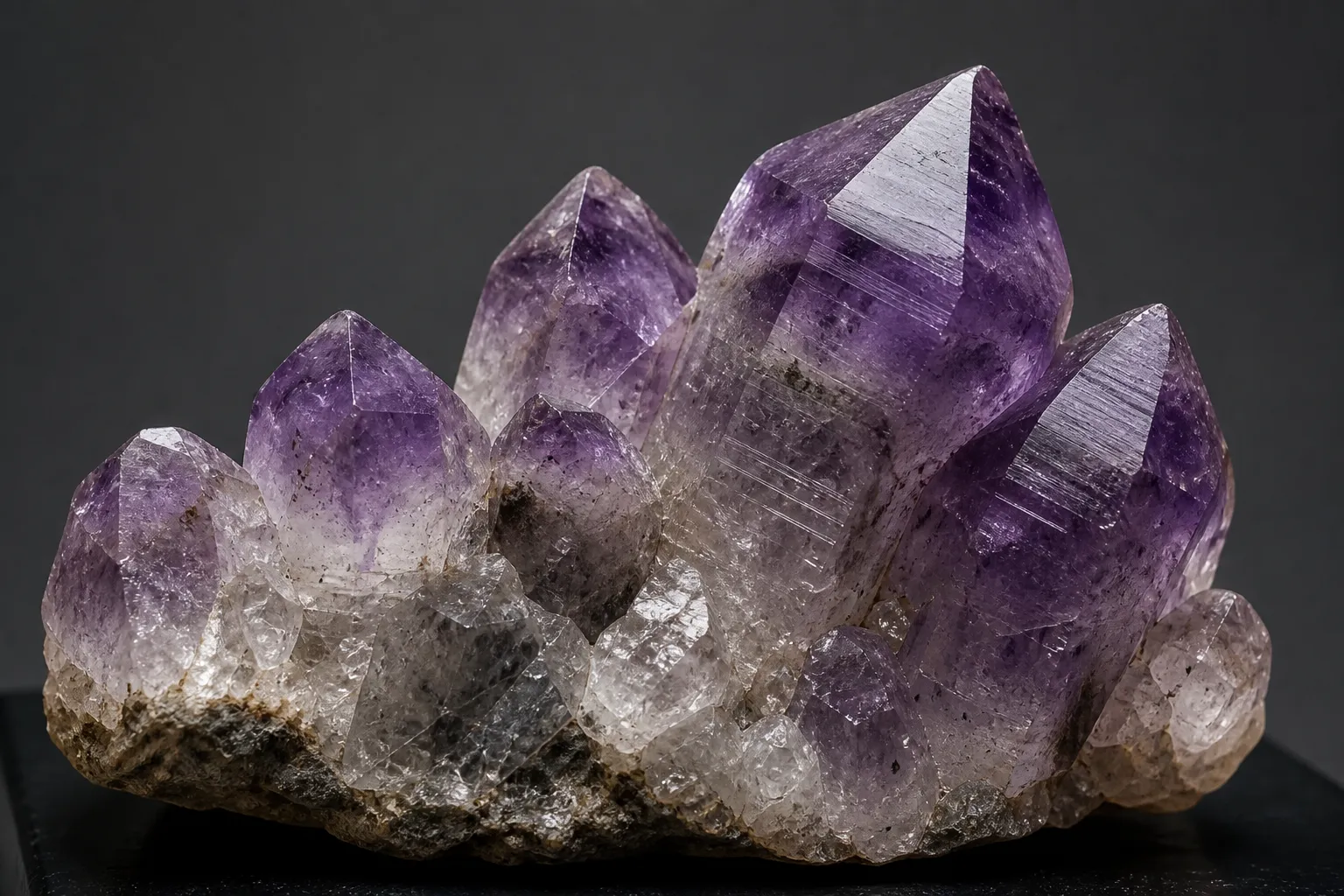
Amethyst is often uneven: purple tips, pale bands, smoky areas, colorless zones, or sharply divided sectors can occur in the same crystal. That zoning is a clue, not a flaw in the explanation.
Quartz does not always grow with the same impurity pattern in every direction. Growth sectors can incorporate trace elements differently. They can also differ in channel structure, twinning, and local defect populations. Studies of amethyst have connected violet color with particular growth loci, including major rhombohedral sectors, and with Brazil-law twinning in some samples.
This helps answer a common puzzle: if radiation reaches quartz, why does the whole crystal not turn evenly purple?
Because radiation can only alter defect centers that are already present and suitably arranged. One sector may contain the right aluminum-related and iron-related conditions. Another sector in the same crystal may lack them and remain pale, smoky, or colorless.
That is also why “clear quartz becomes amethyst” needs a little care. More precisely, some quartz that may look clear or pale contains lattice defects that can become amethyst-producing color centers after natural radiation exposure over geologic time.
Amethyst versus smoky quartz: the useful comparison
Smoky quartz shows why radiation does not have one universal effect on quartz.
In smoky quartz, aluminum-related trapped-hole centers are central. Al³⁺ substitutes for Si⁴⁺, charge compensation occurs, and radiation can create a trapped-hole state that absorbs light as smoky gray or brown.
Amethyst requires a different balance. In the amethyst model discussed above, iron-related behavior changes the outcome. Interstitial ferric iron is described as interacting with aluminum-related trapped-hole centers and contributing to the violet absorption pathway.
In plain terms, quartz can contain competing defect routes:
- If aluminum trapped-hole centers dominate, smoky color can result.
- If the right iron-related process operates in the right growth sector, amethyst color can result.
- If the necessary impurities and charge-compensating defects are missing, quartz may remain clear.
- If color centers are changed by heat or treatment, the visible color may shift or fade.
Radiation does not “add purple.” It changes electronic states within available defect sites. The final color depends on what the lattice was prepared to do.
So can any clear quartz be turned into amethyst?
Not reliably, and not by the simple logic people often imagine.
A clear quartz crystal would need the right hidden lattice conditions before radiation could produce amethyst color centers. If it lacks the necessary substitutional defects, charge-compensating arrangements, aluminum-related centers, and iron in the relevant structural positions, radiation alone will not make it amethyst.
Heat and irradiation studies are useful because they show that quartz color centers are real physical states and can change under controlled conditions. But that is a laboratory or gemological treatment context. It should not be read as a home experiment or as evidence that every piece of clear quartz is waiting to become amethyst.
Careful conclusion
Only some clear quartz can become amethyst because only some quartz grew with the right invisible substitutions, charge-compensating defects, iron behavior, growth-sector structure, and radiation history. The purple color is not added from outside. It appears when the internal crystal architecture can form amethyst color centers.
Evidence limit
The mineralogical picture is strong enough to reject the oversimplified “iron plus radiation is the whole story” explanation. The sources support a color-center model involving quartz lattice defects, charge imbalance, iron behavior, aluminum-related centers, radiation, and growth history.
The fine details remain specialized. Different studies emphasize Fe³⁺, Fe⁴⁺, trapped holes, interstitial iron, substitutional Fe³⁺–H⁺ centers, optical absorption, or electron-paramagnetic-resonance evidence. That does not overturn the main answer. It simply means amethyst color is a defect-chemistry outcome, not a one-ingredient recipe.