Symbolic display guide
Amethyst Metaphysical Origins: Amethyst Symbolism and Display Guide
Turn an amethyst geode toward the light and the first meaning comes from the object itself: rough stone outside, purple quartz points inside, a hidden space made visible. That is the grounded starting point for amethyst metaphysical origins amethyst symbolism. A geode can symbolize inward attention, containment, reflection, and a quiet center. A vein-like or seam-forward piece can symbolize direction, passage, transition, and outward connection.
“Geode energy” and “vein energy” are best read as symbolic display language, not measurable forces or guaranteed effects.
broader context
Amethyst context note
This narrower page lands better after the broader amethyst context page.
Direct answer
Use a geode when the visible form suggests an inner chamber; use a seam-forward or vein-like piece when the line suggests route, transition, or outward connection. The reading is interpretive, not a claim of proven crystal effect.
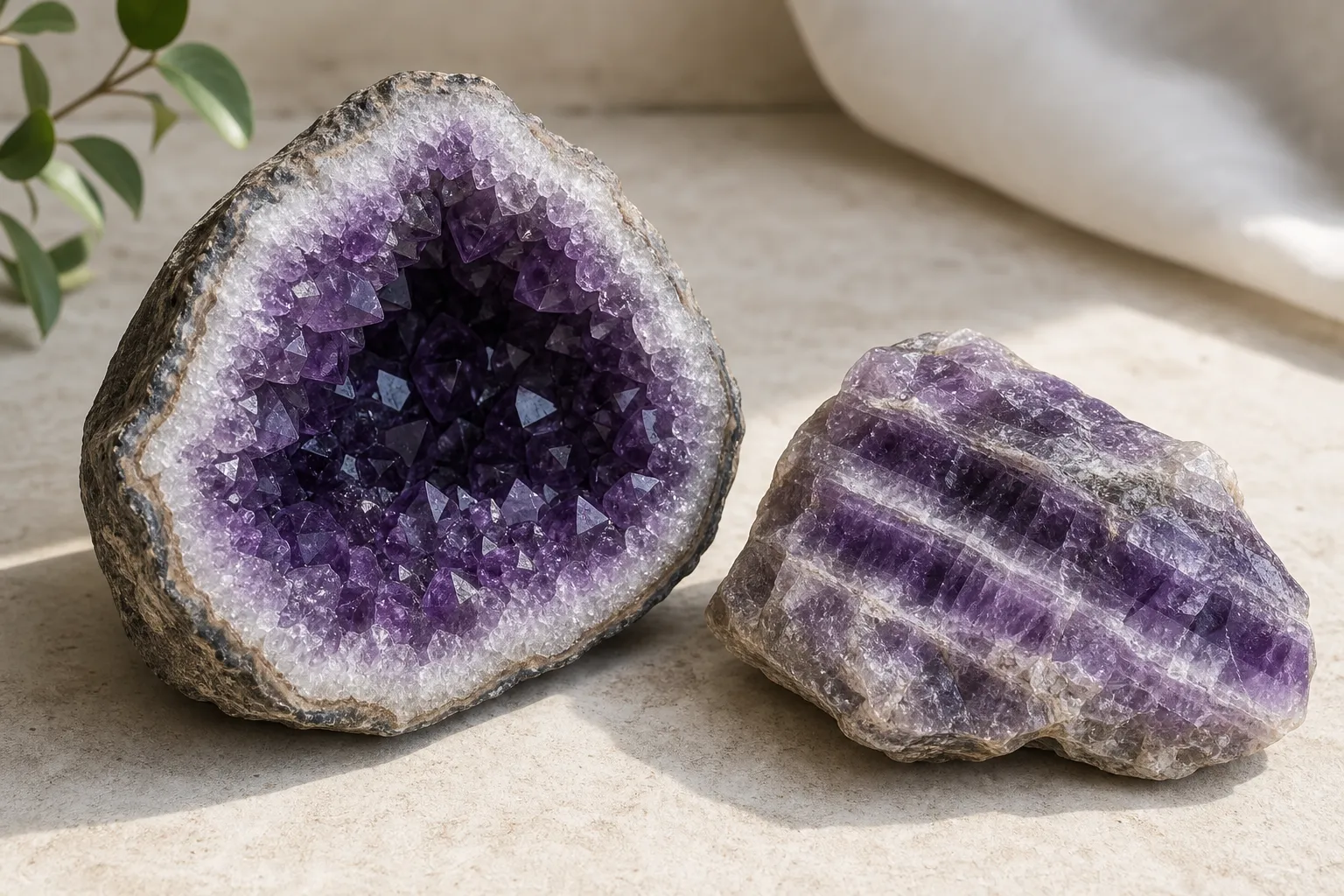
The Origin Story Behind Amethyst Symbolism
Amethyst is purple quartz, and the most useful origin image here is the crystal-lined cavity. Museum collection records support the narrow factual point that amethyst can occur as crystals lining cavities or voids in volcanic rock, forming geodes. That is enough to ground the symbolism without turning this leaf page into a full geology lesson.
The form gives the metaphor its shape. A geode is not only a purple crystal; it is an opening, a chamber, an interior revealed by a broken or cut surface. In display symbolism, that makes it easy to associate with privacy, contemplation, enclosure, and a pause from outward noise. Those meanings are interpretations placed on the visible form, not proof that the mineral produces a spiritual outcome.
Cultural lore adds a second layer. Gemological history often connects amethyst with older ideas of clear-headedness, restraint, religious ornament, royal color, and February birthstone identity. Greek amethyst lore is commonly tied to sobriety symbolism through ancient associations between amethyst and wine. That background helps explain why modern readers often link amethyst with clarity, discipline, and spiritual steadiness. It does not show that a stone changes a person’s mind, body, luck, or surroundings.
The simplest formation meaning is therefore modest: amethyst’s origin gives symbolism a physical grammar. A crystal-lined geode suggests an inner chamber; a seam or vein suggests a line of movement. The meaning comes from human interpretation layered onto form, lore, and personal use.
Geode Energy Versus Vein Energy as Symbolic Language
Geode reading
“Geode energy” works best as shorthand for how a geode behaves visually in a room. The hollow or cavity-like structure draws the eye inward. The crystals face into a contained space, even when the specimen is large or dramatic. For display, that makes an amethyst geode a natural symbol for reflection, private attention, quiet beauty, and a protected center in the symbolic sense of enclosure.
A geode can also become a focal object. It sits like a small mineral room within a larger room, especially when the crystal points face the viewer. This is why many people place geodes on shelves, desks, meditation surfaces, or entry tables. The careful claim is not that the geode changes the room in a measurable way; it can serve as a visual reminder of calm, clarity, or inward attention for the person who chooses that meaning.
Vein reading
“Vein energy” is looser language. The available source set does not support a formal vein-specific amethyst metaphysical system, so it should be treated as metaphor. A vein, seam, band, or line-like mineral expression suggests passage: something moving through rock, crossing a surface, or connecting one area to another. Symbolically, that can support ideas of direction, path, transition, and outward flow.
This is why some readers describe geode versus vein energy almost like yin yang crystals: one form reads as inward, cave-like, and contained; the other reads as linear, active, and connective. The comparison is useful for arranging objects, not for creating a fixed rule. A dramatic geode can feel commanding and outward. A narrow seam can feel quiet and subtle. Size, color zoning, orientation, setting, and personal association all change the reading.
How to Display Geode and Vein Symbolism
Use the form first, then choose the placement. If the piece is an amethyst geode with a clear crystal-lined interior, place it where the opening can be seen without making it feel staged. A shelf at seated eye level, a reading corner, or a small altar-like surface can emphasize the inward-facing quality. The symbolism is strongest when the geode has enough surrounding space to register as a chamber, not just another purple object.
Desk or study area
For a desk or study area, a smaller geode can symbolize focus and containment. That does not mean it improves concentration; it means the object can be chosen as a reminder to gather attention. If the geode is heavy, fragile, sharp-edged, or unevenly based, practical placement comes first. A stable surface and a low-risk location matter more than metaphysical language.
Entryway or living room
For an entryway or living room, an amethyst geode often reads as a threshold object. Its rough exterior and bright interior can suggest welcome, contrast, and hidden depth. Some owners use this kind of symbolic crystal placement to mark peaceful arrival or quiet transition. Keep that language personal: the display expresses an intention; it does not guarantee a result.
For vein-like amethyst, banded pieces, or specimens where purple appears as a line, seam, or directional streak, use orientation deliberately. A horizontal placement can suggest continuity, rest, or a path across a surface. A vertical placement can suggest rising, alignment, or movement between levels. A diagonal line can feel more dynamic. These are design readings as much as spiritual ones.
If you like the geode-versus-vein contrast, display them as a pair. Let the geode act as the inward anchor, then place the line-forward specimen nearby as the path. The arrangement creates a simple symbolic grammar: center and route, chamber and direction, stillness and motion. It works because the forms speak clearly, not because they prove a hidden technical system.
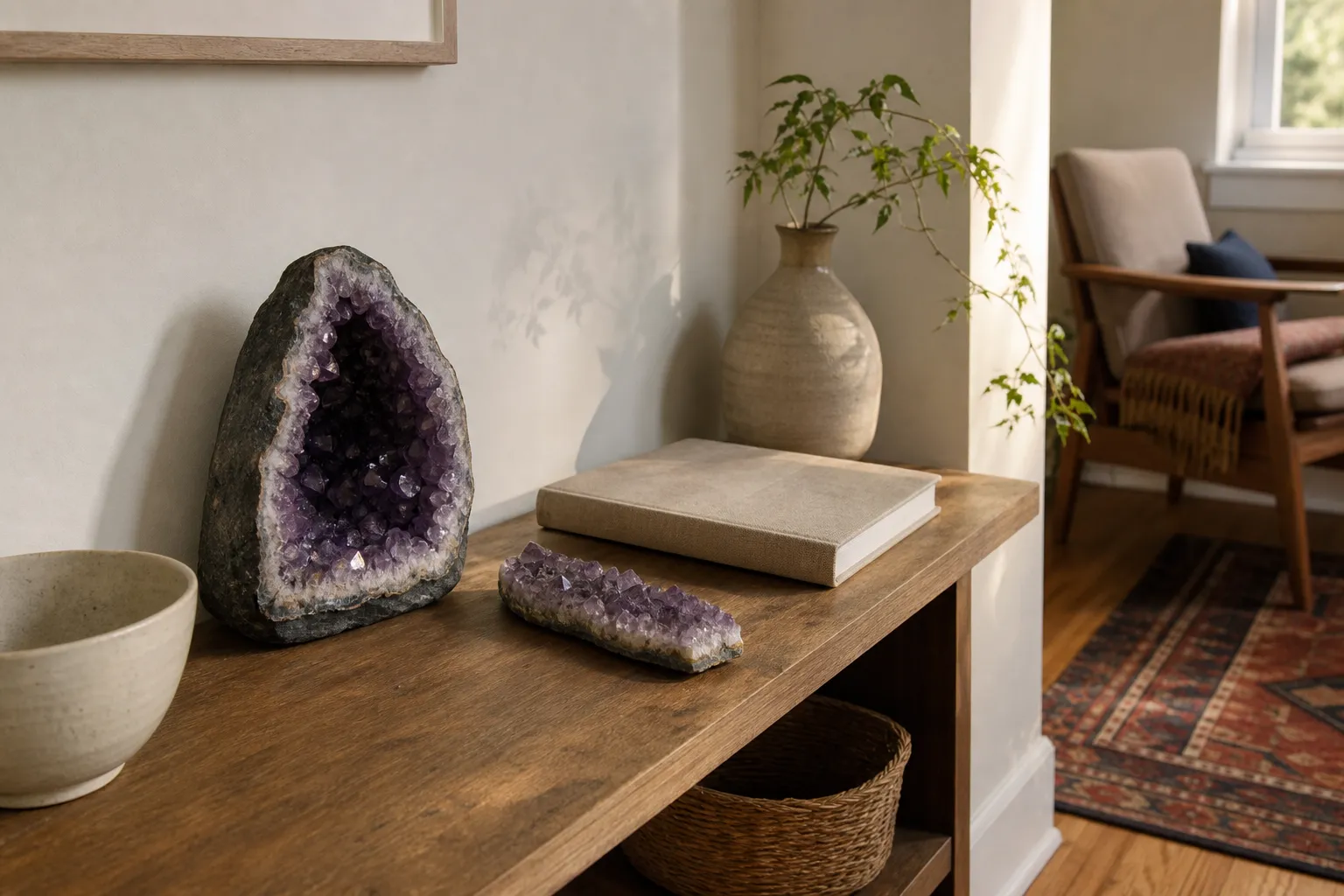
What Changes the Meaning in Real Display
The same amethyst can carry different symbolic weight depending on how it is shown. Orientation is the first variable. A geode turned slightly inward becomes more private and sculptural; turned outward, it invites the viewer into the crystal-lined space. A seam-like specimen laid flat reads differently from one standing upright.
Scale changes the reading too. A large geode can dominate a room and feel ceremonial or architectural. A small one may feel intimate, like a pocket of color. Neither size is more spiritually valid. The difference is visual presence and the role the object plays in the room.
Color zoning also affects interpretation. Deep purple areas often attract associations with richness, depth, wisdom, or spiritual seriousness, while pale lavender may read as softer and more atmospheric. These are color-language associations and cultural habits. They should not be confused with quality guarantees, rarity claims, or stronger metaphysical status.
Context can strengthen or blur the symbolism. A geode placed among books, candles, plants, or personal objects becomes part of a reflective setting. The same geode beside cluttered receipts and charging cables may still be beautiful, but the intended meaning becomes less legible. For spiritually curious readers, display becomes practice when the setting helps carry an intention; the stone itself is not a substitute for medical, psychological, safety, or professional advice.
Care concerns should stay practical and modest. The visible sources for this page do not provide a detailed conservation rule for every display condition, so avoid turning care tips into certainty. Treat a valuable or meaningful specimen as more than disposable decor: choose a stable location, avoid obvious knocks, and keep it away from harsh conditions when possible.
Common Confusion Around Amethyst Formation Meaning
Origin is not proof of effect
A volcanic cavity can explain why a geode looks like a hidden chamber. It cannot prove that the chamber creates calm, protection, clarity, or spiritual growth. Those words belong to tradition, market language, ritual vocabulary, and personal meaning.
Not every geode says the same thing
A deep cave-like opening may suggest containment. A shallow plate-like piece may feel more like sparkle, display, or abundance. A broken fragment may read as texture rather than interiority. The symbolism should follow the specimen you actually have, not a generic caption.
Vein energy is not a formal category here
Veins and seams are useful symbolic images because they suggest direction and flow, but the curated material for this page does not support a formal geode-versus-vein energy system. Use the phrase if it helps you describe the object; do not let it sound more authoritative than it is.
Retail language is reader context, not proof
Sellers and short posts often use strong terms around purification, protection, chakras, focus, and transformation. Those words can explain what readers are searching for, but they are not evidence that a specimen produces those outcomes. A more careful sentence is: “I use this amethyst geode to symbolize a quiet center.”
A Simple Placement Framework
- Choose a geode when you want the display to emphasize inward attention. The best symbolic fit is a place where the opening can be seen and the crystal-lined interior can act as a visual pause. Reading shelves, bedside tables, meditation corners, and quiet seating areas often suit this role.
- Choose a vein-like or line-forward amethyst when you want the display to emphasize movement. Let the line point across a shelf, toward a doorway, along a desk, or upward on a stand. The symbolic reading becomes path, transition, continuity, or direction.
- Choose both when you want balance. This is the most natural use of the yin-yang idea without forcing it. The geode holds the center; the vein suggests movement away from or toward that center. Together, they make a display that speaks through form rather than promises.
Let the specimen remain a specimen. Its color, crystal habit, matrix, chips, polish, and weight are part of the object before any meaning is added. When those material facts stay visible, amethyst symbolism becomes sturdier: a grounded way to arrange a room, mark an intention, or appreciate a mineral surface without asking the stone to prove more than the evidence can support.