Amethyst Sleep Rituals
The Cave Effect: Why Basaltic Geodes Are Superior for Sleep Rituals
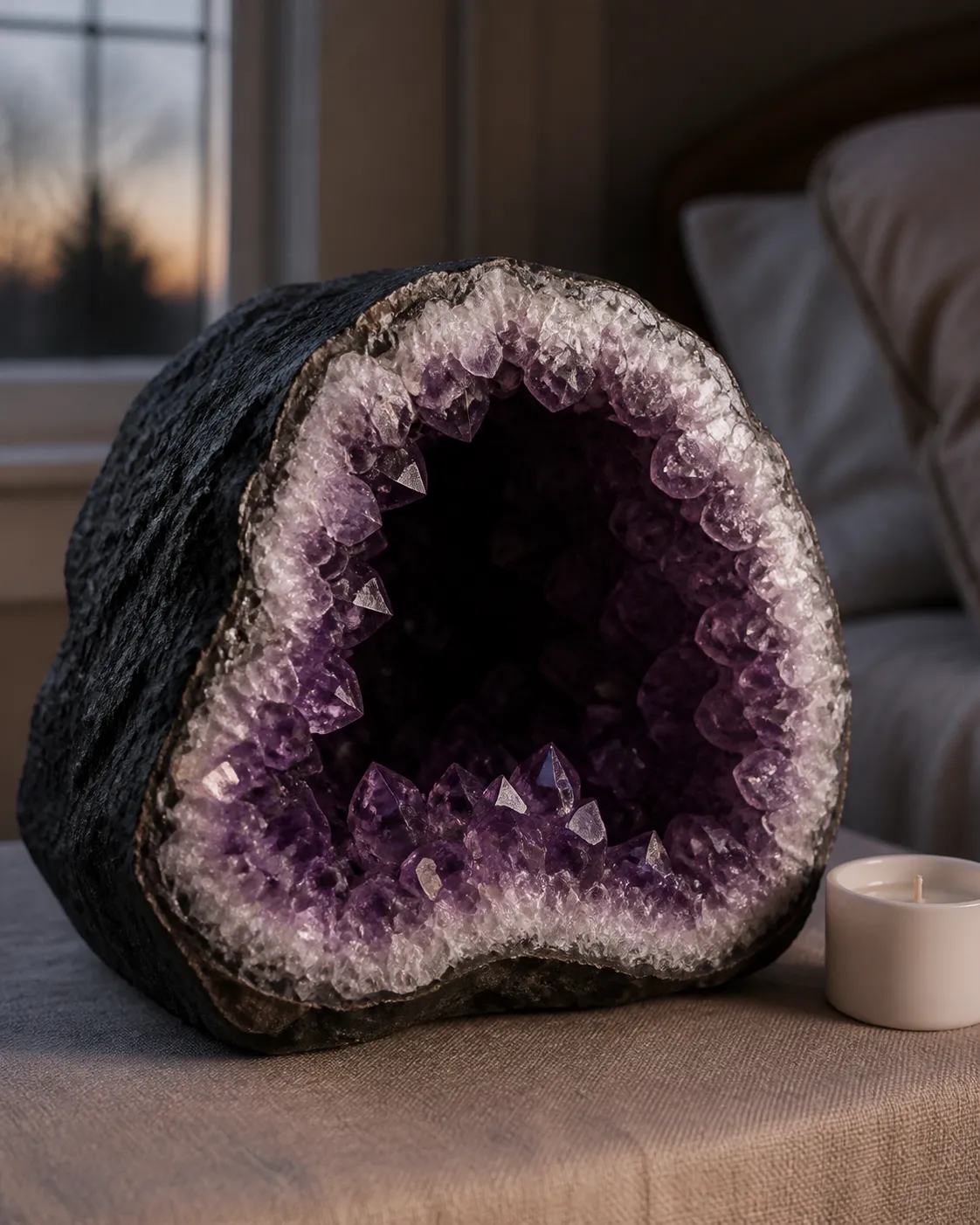
A deep amethyst geode has a visual quality a flat cluster rarely carries: it gives the eye a small interior to enter. For Amethyst Sleep Rituals, that is the “cave effect.” A basaltic geode can be superior as a bedtime ritual object because its enclosed form suggests retreat, shelter, and closure; not because it has verified effects on sleep.
The dark outer shell, inward-facing crystal points, and hollow center make the specimen useful as a symbolic cue at night. It can help mark a personal shift from daytime attention to a quieter evening routine. That value belongs to ritual design, bedroom atmosphere, and meaning; it should not be framed as an insomnia aid or a health-outcome tool.
broader context
Amethyst context note
This narrower page lands better after the broader amethyst context page.
What the Cave Effect Means
The cave effect begins with structure. An enclosed geode has an outside and an inside, a rim and a hollow, a visible boundary between exposure and retreat. Before any spiritual language is added, the form already suggests entry and shelter.
For amethyst readers, the purple interior usually carries the pull. The crystal points face inward, so the piece does not feel like a display pushing energy outward from a shelf. It reads more like a chamber. That chamber-like quality is what makes cave-like geode forms attractive for bedtime ritual design: the object seems to hold attention rather than scatter it.
This is symbolism, not mineral proof. The cavity, color zoning, crystal habit, and stable outer form can be observed. The meaning placed on those features is chosen. A collector might say, “This specimen has an enclosed hollow and an inward visual pull.” A spiritually curious reader may use that same feature as a reminder to turn inward at night. Those claims sit near each other, but they are not the same claim.
Language such as “nurturing energy” belongs in the meaning layer. It may describe how someone experiences the ritual mood: protected, softened, less exposed. It should not be treated as a measured property of basalt, quartz, or amethyst. A cleaner wording is that the geode can be used as a nurturing symbol within a personal evening practice.
Why the Enclosed Form Works Better Than an Open Cluster
An open amethyst cluster can be beautiful on a dresser, shelf, or altar, but its visual language is different. Points, sparkle, and exposed surfaces can make the piece feel more active. A geode with a cave-like interior gives the eye a boundary; there is an edge, an opening, and a contained field of crystals.
That contained field is the careful reason “superior” can be used here. For a basaltic geode sleep ritual, superior means better suited to the symbolic job of enclosure. It does not mean scientifically stronger for sleep, more powerful as an energetic object, or more reliable for insomnia. It means the form naturally supports the story of retreat.
A geode usually serves this purpose best when it has:
- A clear hollow or pocket, so the specimen reads as an interior.
- A stable base, so it can sit quietly without adjustment.
- A modest opening, so the piece feels sheltered rather than busy.
- A color field the owner finds calm, whether pale lavender, deep purple, or visibly zoned.
- A size that belongs in the room without dominating the bedside area.
These are aesthetic and ritual-design considerations. They explain why some readers prefer an enclosed geode form for symbolic sleep ritual objects: it already looks like a place of withdrawal.
The word “basaltic” also needs restraint. In market language, it often points to the rock context associated with many geode forms, but this page is not using that word to make detailed formation claims. The practical point is visible structure: an outer shell, an inner cavity, and inward-facing amethyst. If those features are present, the cave effect is legible in the room.
Bedroom Placement Without Turning It Into a Sleep Device
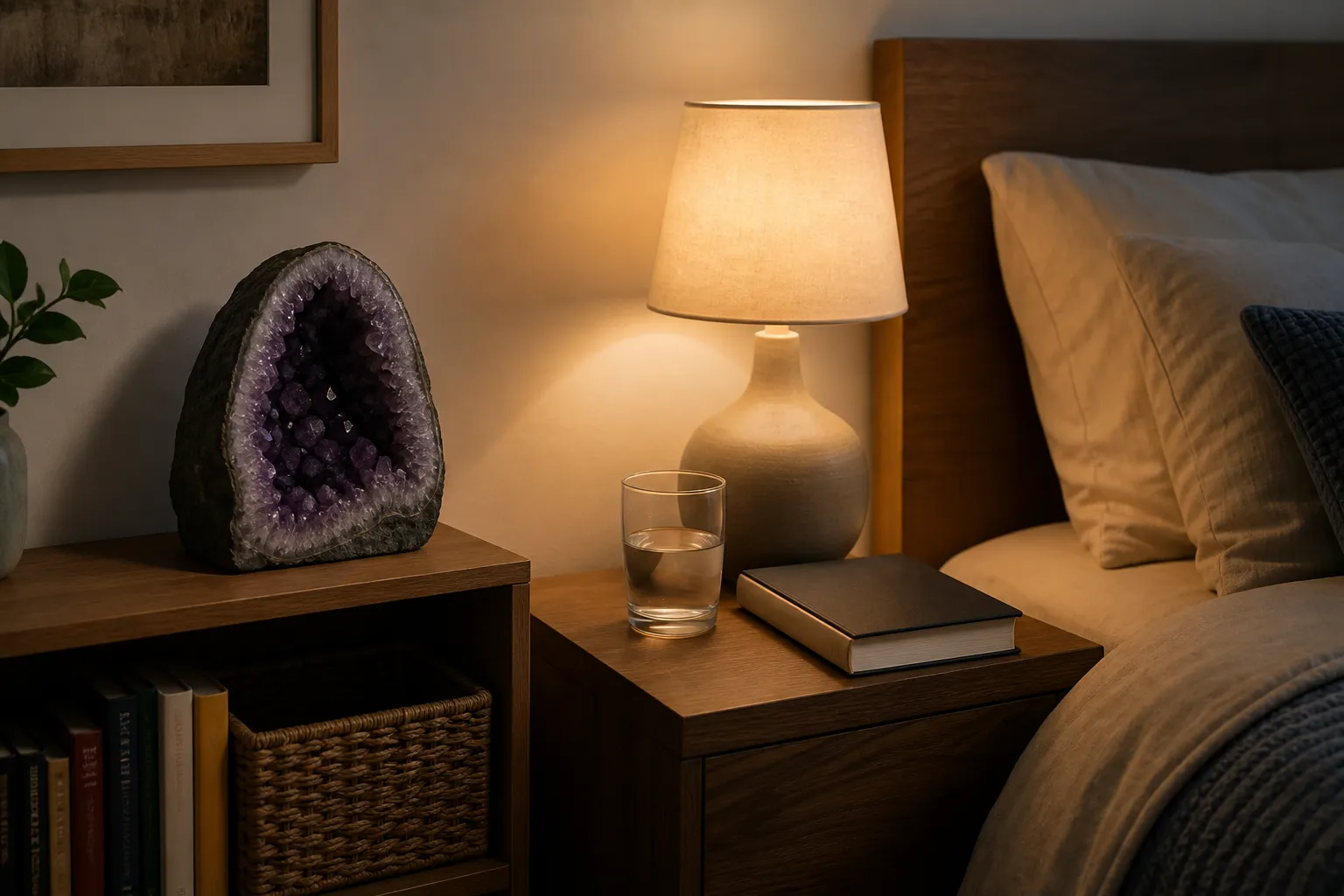
Amethyst geode bedroom placement works best when the stone is treated as a visual cue. It should support the behavior around bedtime: dimming the room, setting down the phone, sitting quietly, or closing a journal. The geode is the marker, not the mechanism.
A bedside table can work if the specimen is stable, not sharp near the hand, and not visually overwhelming. Many readers want it close because the ritual feels personal. That closeness is a placement preference, not a proximity-based sleep claim. If the object sits where the evening routine happens, it is simply easier to use as a cue.
A dresser or low shelf across the room may suit larger pieces better. The geode becomes part of the room atmosphere rather than another object competing with lamps, books, water, chargers, and glasses. In that position, the cave-like form can still mark the sleep area without crowding the nightstand.
Avoid placement that creates friction. A heavy geode should not sit where it can be knocked over. A sharp crystal edge should not be placed where hands move in the dark. A visually intense piece may be better angled away from the pillow if it keeps pulling attention. A ritual object that creates clutter, worry, or maintenance anxiety is not serving the ritual.
The useful test is ordinary: does the geode help the room feel more settled to you when the lights are low? If yes, it belongs where that feeling is easiest to notice. If no, the specimen may be better as a daytime display piece. Not every amethyst belongs beside a bed.
A Small Bedtime Ritual Around the Geode
A basaltic geode sleep ritual should be small enough to repeat. If it becomes elaborate, it risks turning into another task at the end of the day. The enclosed form works best when it anchors a short sequence.
One restrained version:
- Place the geode where it can be seen in soft light.
- Let the hollow interior become the visual focus for a few breaths.
- Name one thing from the day that can be mentally set down.
- Turn the geode slightly inward, or leave it facing a quiet part of the room.
- End by lowering the light or moving away from screens.
None of these steps depends on a claim about crystal effects. The sequence uses the geode as a symbolic threshold: outside the cave is the unfinished day; inside is the image of enclosure. The action is reflective, not clinical.
Some readers pair the geode with a written note, a small cloth, or one other bedside object. That can work if the arrangement stays uncluttered. The amethyst should remain the focal point, not one item in a crowded ritual scene. The cave effect depends on negative space as much as sparkle.
The ritual can also be silent. There is no need to borrow phrases that feel like market language. If “nurturing energy” is meaningful to you, keep it as private wording. If it feels vague, use more grounded language: shelter, quiet, inwardness, closure. The object can carry the mood without carrying an exaggerated promise.
Where the Language Can Mislead
The most common confusion is “insomnia aid.” It appears in crystal-market language because people search around sleep, restlessness, and nighttime unease. On this page, it should not be used as a promise. A geode can be part of a calming routine, but it should not be presented as an answer to persistent sleep difficulty or as a replacement for qualified support when sleep problems affect daily life.
“Superior” can mislead in a different way. In a collector or ritual-design sense, an enclosed geode may be superior to a flat cluster because its form better expresses retreat. In a health-outcome sense, the claim goes beyond what this page can support. The available material does not justify saying that amethyst, basaltic geodes, or bedroom placement reliably change sleep outcomes.
There is also an authenticity issue. Calling a geode protective, nurturing, or cave-like does not authenticate it, grade it, or prove its origin. Those words describe how the specimen is being used in a room. Collector literacy still depends on visible features, seller clarity, and careful purchase judgment; spiritual symbolism cannot replace that work.
For this question, the boundary is simple: use the geode to shape attention and atmosphere, not to make sleep-health claims. That boundary protects the reader and the ritual. It lets the object remain meaningful without turning it into a device.
When a Geode Is Not the Right Bedtime Object
The cave effect is not universal. Some amethyst geodes feel too bright, too visually complex, or too commanding for a sleep space. A large specimen may make a bedroom feel more like a display room than a place of rest. A small polished stone, a simple cluster, or no crystal at all may suit the evening better.
The room matters as much as the specimen. If the bedside area is already crowded, adding a geode can create more visual noise. If the piece needs frequent dusting, repositioning, or worry over damage, it may become an obligation. A sleep ritual should reduce friction, not add another object to manage.
Personal association matters too. Some people find cave imagery comforting; others may find enclosed forms heavy or inward in the wrong way. That response does not need correction. Symbolic sleep ritual objects work through meaning, memory, and preference. If the meaning does not settle well, the object is not the right anchor.
So the exception is part of the answer: basaltic geodes are only “superior” when the reader wants enclosure, inwardness, and a quiet visual threshold. If the desired mood is openness, lightness, or simplicity, another form may serve the bedroom better.
The Careful Version of the Claim
The strongest responsible claim is narrow: an enclosed amethyst geode is especially well suited to a symbolic sleep ritual because its cave-like form visually supports retreat, containment, and the closing of the day. It is a design and meaning advantage, not a verified sleep advantage.
That wording keeps the specimen in view. The outer form, inner hollow, color, stability, and placement can all be considered directly. The spiritual layer is then added as interpretation: the geode becomes a chosen cue for slowing down, not evidence that the crystal changes sleep.
For Amethyst Sleep Rituals, that is enough. Place the geode where it can quietly mark the transition into night. Let the enclosed form do its symbolic work. Keep insomnia language out of the promise, keep health needs separate from crystal practice, and let the bedroom object remain what it can responsibly be: a specimen first, a symbol second, and a calm point of return at the edge of the day.