Collector-resale lens
The Investor's View: Rough Geodes vs. Precision Cut Points
For Amethyst Investment 2026, the safer answer is not “rough is better” or “cut is better.” A rough geode or a precision cut point only makes sense from a collector-resale perspective when its quality, condition, authenticity, display appeal, and likely resale path are easy to explain.
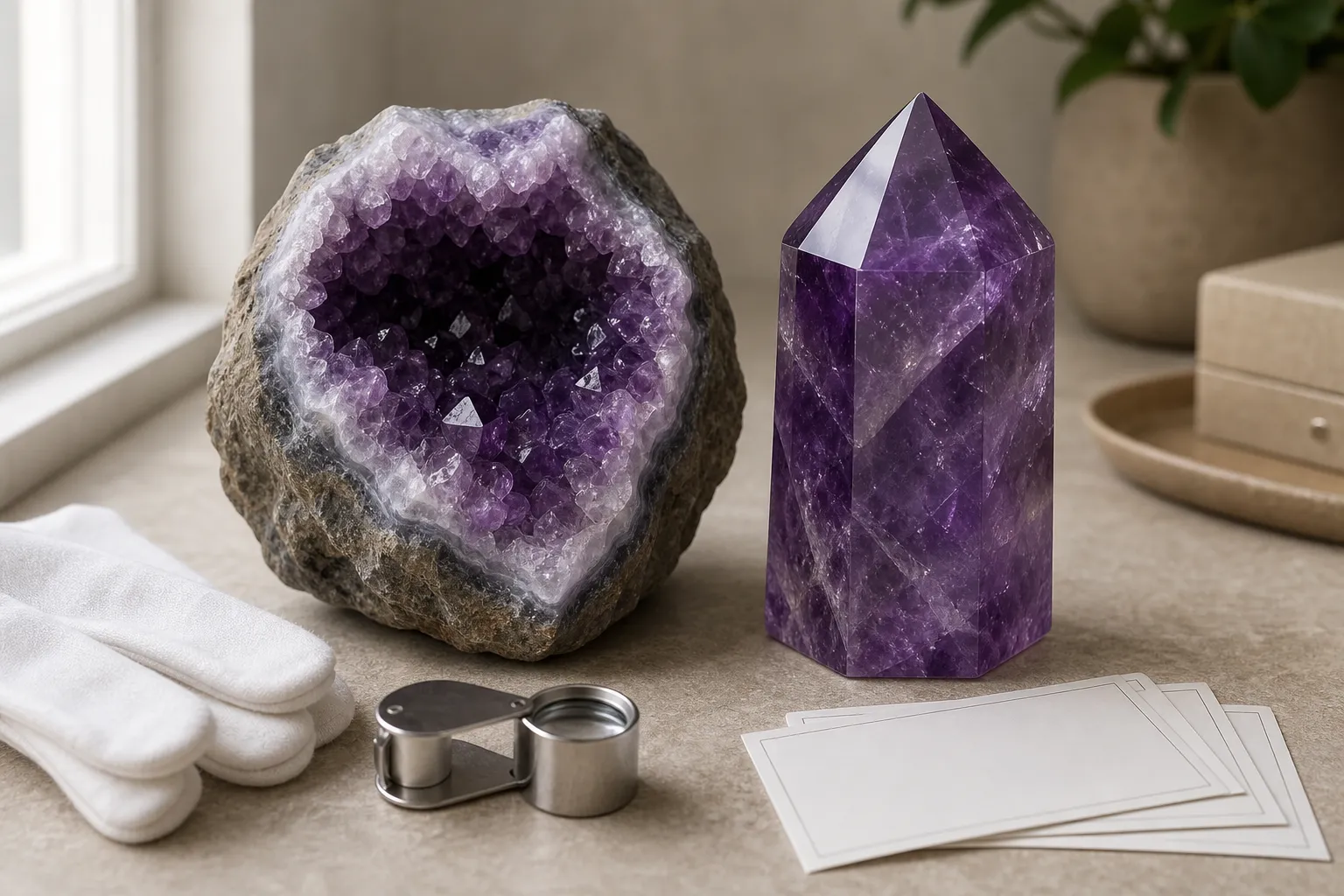
Rough amethyst geodes can offer stronger natural presence, but they are often heavier, more fragile, harder to compare, and harder to ship. Precision cut amethyst points can feel cleaner, more display-ready, and easier to photograph, but cutting alone does not create a reliable resale advantage. With no verified public evidence available here for 2026 price movement, ROI, or category-level performance, this page should be read as a practical buying lens, not financial forecasting.
broader context
Broader amethyst guide
This narrower page lands better after the broader amethyst context page.
The Practical Answer: Buy the Form You Can Explain Later
The useful question is not whether raw or cut amethyst is “more investable.” It is whether a future buyer can quickly understand why the individual piece is desirable.
Rough geode conversation
A rough geode asks the buyer to respond to the natural specimen: the crystal pocket, color distribution, formation, matrix, visual depth, and room presence.
Cut point conversation
A precision cut point asks the buyer to value finish, polish, symmetry, clarity, color, and the way the object works as a finished display piece.
Those are different resale conversations.
A large geode may have strong display value, but size can also bring higher shipping cost, storage difficulty, breakage risk, and a narrower buyer pool. A polished point may be easier to place in a home or collection, but the retail premium for cutting may not carry into resale if the color is ordinary, the finish is weak, or the buyer does not care about the workmanship.
For a cautious 2026 purchase, ask:
- Can I describe the appeal without relying on hype?
- Is the condition easy to inspect and document?
- Would the likely buyer pool understand this form?
- Can the piece be stored, photographed, shipped, and resold without unusual friction?
- Is the asking price tied to visible quality rather than a vague investment story?
That is the collector-investor decision in its most useful form. It does not predict appreciation. It helps you avoid buying a piece whose resale case is too hard to explain.
How Rough Amethyst Geodes Compare
Rough amethyst geodes appeal because they preserve the mineral as a specimen rather than turning it into a fully shaped object. Their case usually starts with visual impact: an open cavity, clustered crystal points, color depth, contrast between outer matrix and inner crystals, and the way the piece holds attention in a room.
That appeal can be real. It is not the same as predictable market value.
For resale, geodes have a few clear strengths. They are visually distinctive, so two pieces rarely feel identical. They can suit buyers who want natural mineral character, a statement display object, or a specimen that still shows its geological form. A good geode may also photograph well when the crystal pocket is clean, stable, and visually balanced.
The tradeoff is that rough pieces are harder to standardize. A buyer may need more photographs, measurements, and reassurance about stability. Chips, loose crystals, repaired areas, staining, uneven bases, and awkward viewing angles can all affect confidence. Weight and shape matter too: a geode that looks impressive in person may be expensive to pack, risky to ship, or difficult to place.
That is where amethyst resale liquidity becomes uncertain. A geode may attract a serious buyer, but the number of people willing to handle a large, heavy, irregular specimen can be smaller than the number willing to buy a compact finished point. That does not make geodes weaker by default. It means the resale venue matters. Local sales, mineral-show settings, collector marketplaces, or in-person viewing may suit a substantial geode better than a quick online listing with limited images.
The best reason to choose a rough geode is not that raw material always performs better. It is that the specific specimen has clear visual identity, sound condition, credible provenance, manageable logistics, and a buyer audience that would understand why it is special.
How Precision Cut Amethyst Points Compare
Precision cut amethyst points sit closer to the decorative and lapidary side of collecting. Their appeal depends less on natural outline and more on finish: clean geometry, polish quality, symmetry, termination shape, clarity, color, and overall balance.
For some buyers, that makes the value case easier to read. A well-cut point can be simple to display, easier to photograph, and less visually complex than a rough specimen. It may fit shelves, desks, design-led interiors, or personal display spaces without asking the buyer to know much about mineral specimen collecting.
But a cutting premium is not automatically a resale premium. The labor used to shape and polish a point may raise the retail price, while resale buyers may focus only on the finished object’s beauty. If the point is small, common-looking, poorly polished, unstable on its base, or weak in color, careful cutting may not be enough to support a stronger resale case.
Cut points also blur categories. Some buyers see them as collector objects; others see them as decor or symbolic objects. That broader buyer pool may help in some venues, but it can make pricing less consistent. A mineral specimen buyer may prefer natural form. A decor buyer may care more about surface, shape, and ease of placement than geological context.
The strongest case for a cut point is clarity of presentation. If the color is appealing, the polish is clean, the shape is balanced, the condition is easy to document, and the object is practical to ship, the resale conversation may be simpler than with a large geode. Still, the point should be judged as a specific object, not as proof that cut amethyst is always more liquid or more profitable.
What Changes the Answer
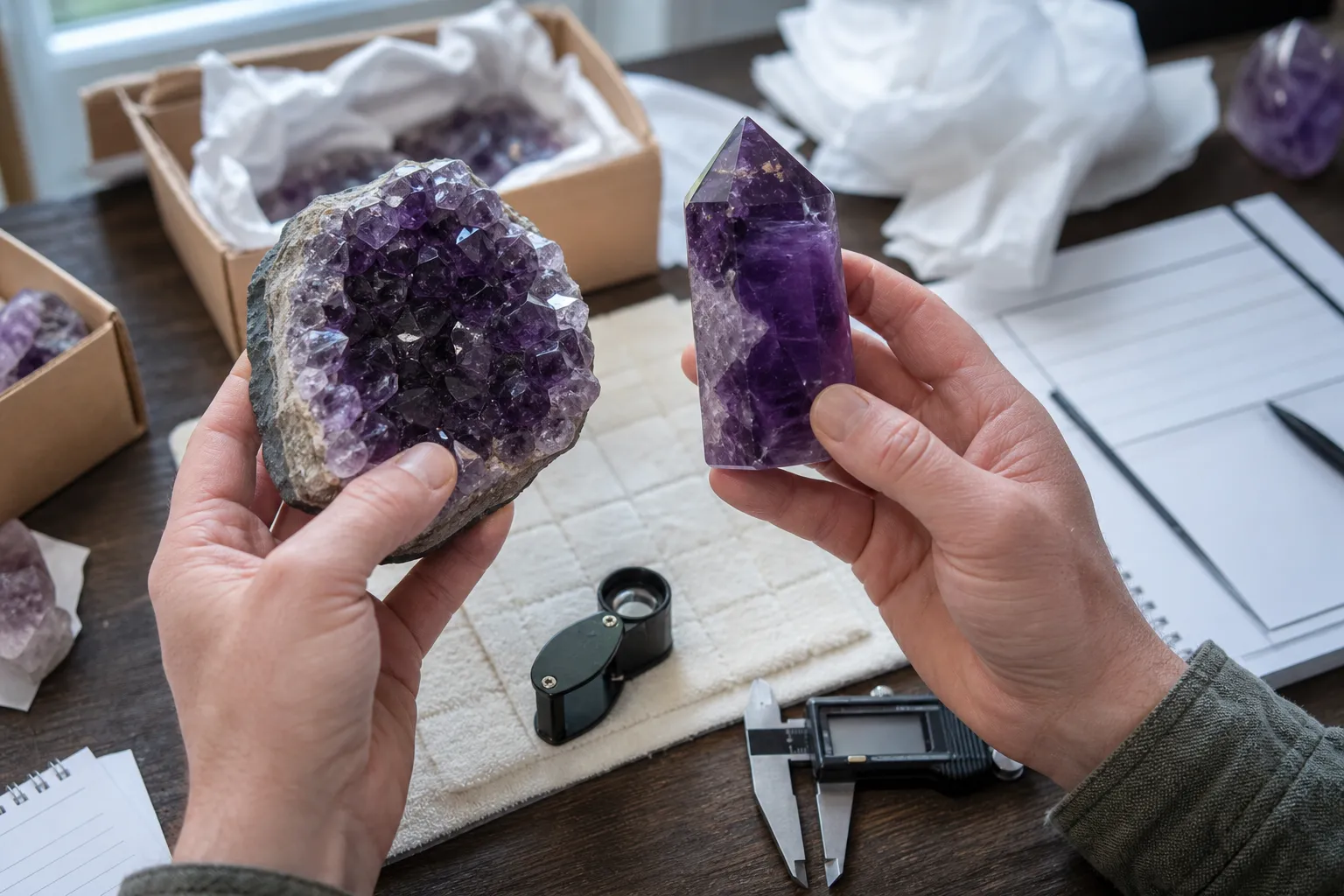
The raw versus cut question changes once you stop comparing labels and start examining the actual piece. A modest geode with dull color, unstable matrix, or obvious damage may be less compelling than a clean, well-proportioned point. A striking geode with strong display presence may be more memorable than a polished point that feels generic.
Condition
For geodes, inspect crystal tips, edges, matrix stability, repaired zones, and whether the piece sits securely. For cut points, look at polish, chips, base stability, symmetry, and surface wear. Damage does not always make a piece unbuyable, but the price and resale expectations should reflect it.
Authenticity and provenance
Provenance does not need to be dramatic to be useful. Basic information about where the piece was acquired, what the seller can document, and whether any treatments or repairs are known can help a future buyer make sense of the object. Without documentation, the resale case depends heavily on photographs and trust.
Display value
Amethyst often enters homes as both a mineral and a visual object. A piece that is unstable, too heavy for ordinary furniture, difficult to place, or attractive only under perfect lighting may be less flexible than it first appears. A smaller cut point may offer easier display convenience, while a geode may offer stronger presence if the buyer has the right space.
Shipping, storage, and venue fit
Heavy geodes may need stronger packaging and carry more breakage concern. Delicate crystal pockets can be vulnerable if packed poorly. Cut points are often easier to wrap and ship, but polished faces and tips can still chip. A general decor marketplace, a collector platform, a local sale, and an in-person mineral setting may all reward different qualities. The better choice is the one whose likely venue matches the object’s strengths.
Common Confusion Around Amethyst ROI
The biggest misunderstanding is treating amethyst ROI as if it can be inferred from form alone. “Raw versus cut” is not enough. Neither a rough geode nor a precision cut point carries an automatic resale advantage based on the evidence available for this page.
A second mistake is assuming bigger means better. Large amethyst can be visually commanding, but it can also narrow the buyer pool if shipping is expensive or display space is limited. A smaller object with strong appeal and easy handling may be more practical for resale than a larger object that is difficult to move.
A third mistake is assuming workmanship guarantees value. Cutting, polishing, and shaping may improve presentation, but the finished piece still needs to appeal to buyers. If the color, finish, or proportions are not convincing, the labor behind the piece may not carry the resale conversation.
The last mistake is reading “market value trends” too confidently. No authoritative public sources, auction records, market reports, or verified firsthand evaluations were available for this page to support claims about 2026 amethyst price movement. It is reasonable to compare decision factors. It is not reasonable here to claim that one category is rising, outperforming, or reliably appreciating.
Keep three ideas separate:
- Collector value: why the object is appealing, distinctive, and worth owning.
- Resale value: whether another buyer may understand and pay for that appeal.
- Investment return: whether the purchase produces a financial gain after costs, time, risk, and selling friction.
This article can help with the first two as evaluation lenses. It cannot responsibly promise the third.
A Short Decision Checklist for 2026 Buyers
Choose a rough amethyst geode when
The natural form is the main attraction, the crystal pocket has strong visual presence, the condition is easy to inspect, and the size is still practical for storage or resale. A geode makes more sense when you can show it clearly in photos or when the likely buyer can view it in person. It is less convincing when its appeal depends only on being large, heavy, or described with inflated language.
Choose a precision cut amethyst point when
Finish, color, shape, and display convenience are the main strengths. A cut point makes more sense when it is easy to photograph, easy to ship, and easy for a buyer to imagine in a home or collection. It is less convincing when the cutting is used to justify a premium but the finished object does not look especially refined or distinctive.
For either form, avoid buying only because a seller frames the piece as an investment. Ask for clear photos, dimensions, condition notes, and any available provenance. Think about where you would resell it before you buy it. If the only resale story is “amethyst will go up,” the reasoning is too thin.
The Bottom Line
For a cautious 2026 collector, rough amethyst geodes and precision cut amethyst points should be compared as objects first and speculative assets second. A geode may win on natural drama, specimen character, and room presence. A cut point may win on polish, portability, and straightforward display value. Either can be a weak resale purchase if condition, authenticity, buyer fit, or logistics are poor.
The most balanced answer is this: choose the piece whose quality you can verify, whose story you can document, whose risks you can manage, and whose likely buyer you can realistically imagine. That is more durable than trying to predict amethyst market value trends without reliable evidence.
This is educational collector-resale framing, not financial advice. Amethyst can be beautiful, meaningful, and collectible, but mineral specimens can also be illiquid, condition-sensitive, and difficult to value consistently. If you want to treat a purchase as an investment, the responsible next step is not to pick “raw” or “cut” in the abstract. It is to research comparable sales, inspect the individual piece carefully, and be honest about the costs and uncertainty between buying and resale.