Placement Boundary
Feng Shui Geometry: Strategic Placement Rules for Giant Amethyst Geodes
A giant amethyst geode changes a room before any placement belief is added: it has weight, height, color zoning, a rough outer shell, and a crystal mouth that pulls the eye. For Amethyst Feng Shui Placement, the grounded rule is this: place the geode where it supports the room’s intended atmosphere, stays clear of movement paths, feels visually anchored, and remains a symbolic choice rather than a promised source of wealth, health, protection, or magnetic-field change.
The practical framework is modest. Let the geode face into the room, give it enough breathing space, keep it away from unstable edges or crowded thresholds, and use Feng Shui-style geometry as a language for intention and balance. If you borrow Vastu-adjacent ideas, treat them the same way: as cultural or belief-based placement vocabulary, not as verified outcome rules.
broader context
Begin with the main amethyst page
This narrower page lands better after the broader amethyst context page.
Start With the Room Geometry, Not the Claim
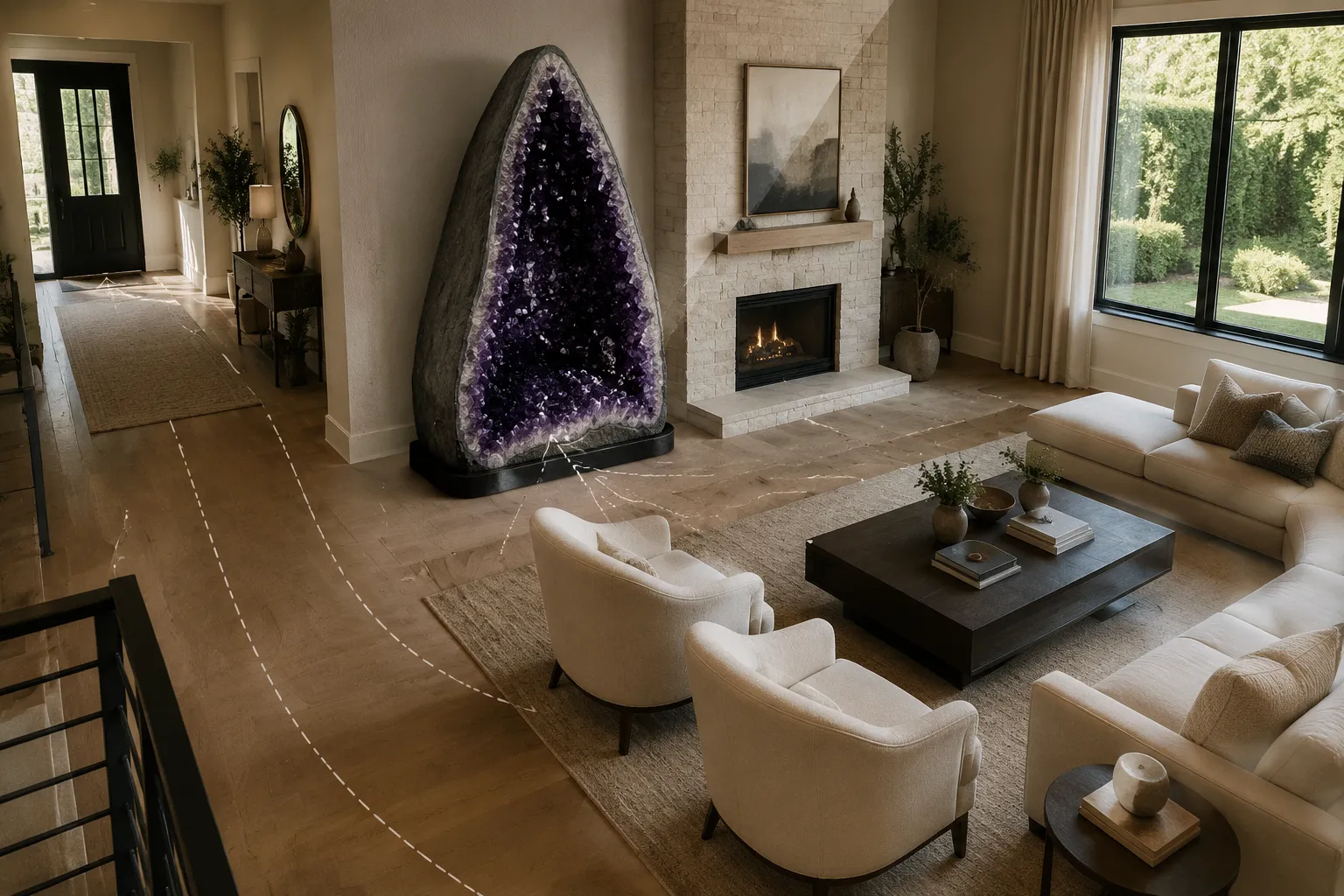
Giant amethyst geode placement works best when the room gives the first instruction. A tall, dark-purple geode can act like a sculptural anchor; a smaller cathedral-style pair may feel more like a threshold marker. Before choosing a symbolic sector, check three visible conditions: where people enter, where the eye naturally lands, and where the specimen can stand without becoming an obstacle.
In a Feng Shui-style room plan, spatial geometry is the relationship between entry lines, corners, focal points, circulation paths, and intentional zones. For a large crystal, this matters more than forcing a fixed rule onto a room that cannot physically support it. A geode in a cramped walkway may feel meaningful to the owner, but it still interrupts room flow. A specimen set against a stable wall, with its open face angled gently toward the main seating area, usually reads as calmer and more deliberate.
The geode’s “mouth” is part of that geometry. Many large amethyst geodes have a clear opening, with crystals pointing inward from the cavity. In symbolic amethyst placement, people often prefer that opening to look into the room rather than into a wall. That is not a scientific energy claim; it is a visual and ritual decision. The color is easier to see, the stone feels present, and the display looks intentional.
Avoid three placements unless the room gives a strong design reason:
- Directly behind a door swing.
- In the middle of a narrow passage.
- On a weak stand that makes the stone look temporary.
The geode should feel settled before it feels symbolic.
A Bounded Amethyst Placement Framework
For a single-room layout, think in four layers: stability, sightline, symbolic zone, and orientation. This keeps the decision grounded while still leaving room for Feng Shui belief-based placement.
Stability
What to check: does the base sit securely?
A heavy specimen needs a level, supported position where it is unlikely to tip or be bumped.
Sightline
What to check: is the crystal face visible?
The opening usually works best when seen from the room’s main approach or seating area.
Symbolic Zone
What to check: what is the room intention?
Use the geode as a marker for reflection, welcome, beauty, or abundance symbolism.
Orientation
What to check: which way does it “speak”?
Angle the open face into the room, not toward clutter or a dead corner.
This framework does not say that amethyst creates measurable outcomes. It says that a large purple quartz specimen can organize attention in a room, and that symbolic traditions may give the owner a language for that attention.
In a living room, a strong placement is often a side wall or corner visible from the entry but outside the main walking line. In an entry area, the geode should not crowd the door or make the threshold feel defensive. In a reading or meditation corner, the placement can be more intimate, with the crystal face oriented toward the seat.
If the reader is thinking in terms of wealth flow symbolism, wording matters. A geode may be placed in an area the owner associates with prosperity, receiving, gratitude, or abundance. That is a symbolic layout choice. The current source base for this page does not support claims that a geode changes financial outcomes or proves any wealth-flow effect. The better interpretation is interior ritual: the object helps mark what the space is for.
Where Feng Shui and Vastu Language Should Stay Symbolic
Feng Shui and Vastu principles often appear together in online crystal placement language, but this page does not have authoritative sources to verify specific directional rules, doctrinal claims, or traditional requirements. The safest treatment is to use those terms only when they are clearly framed as cultural, symbolic, or belief-based.
If a reader already follows a specific Feng Shui school, bagua map, compass method, or Vastu tradition, that existing practice may guide where the geode belongs. Without qualified sources for those systems in the present research set, this page should not invent precise rules such as “always place it in the southeast” or “never place it in the bedroom.” Those rules circulate in commercial and spiritual content, but they are not established here.
A softer alignment method works better:
- Choose the room purpose first: welcome, reflection, beauty, quiet, display, or symbolic abundance.
- Place the geode where that purpose already feels natural in the room.
- Let the crystal face support attention rather than dominate the layout.
- Keep the surrounding area edited; clutter weakens the design reading.
- Avoid using placement language to promise health, money, relationship, or protection outcomes.
This respects the reader’s interest in vastu alignment for amethyst without pretending that the current evidence proves a directional system. It also keeps the geode tied to observable qualities: scale, color, presence, and how the room is used.
Visual Balance With Geodes: Scale, Color, and Orientation
A giant amethyst geode is rarely neutral. Its rough exterior, sparkling interior, pale matrix, and purple crystal points create contrast before anyone adds spiritual symbolism. That visual force should be balanced, especially in rooms with clean lines or smaller furniture.
Scale is the first issue. A very tall geode beside a low chair can feel imposing; beside a bookcase, console, or plant grouping, it may feel integrated. A pair of geodes can frame a fireplace, altar shelf, or entry console, but symmetry should not be forced if the pieces differ strongly in size or color. Natural crystal habit is irregular, and the display often looks more honest when that irregularity is allowed.
Color zoning also affects placement. Deep purple areas may read as formal and heavy; pale lavender zones can feel softer. In a dark corner, the structure may disappear. In bright direct sun, the display may look harsh, and many collectors prefer to avoid long direct exposure for colored specimens as a general care habit. The practical point is simple: place the geode where its color can be appreciated without making the room feel visually strained.
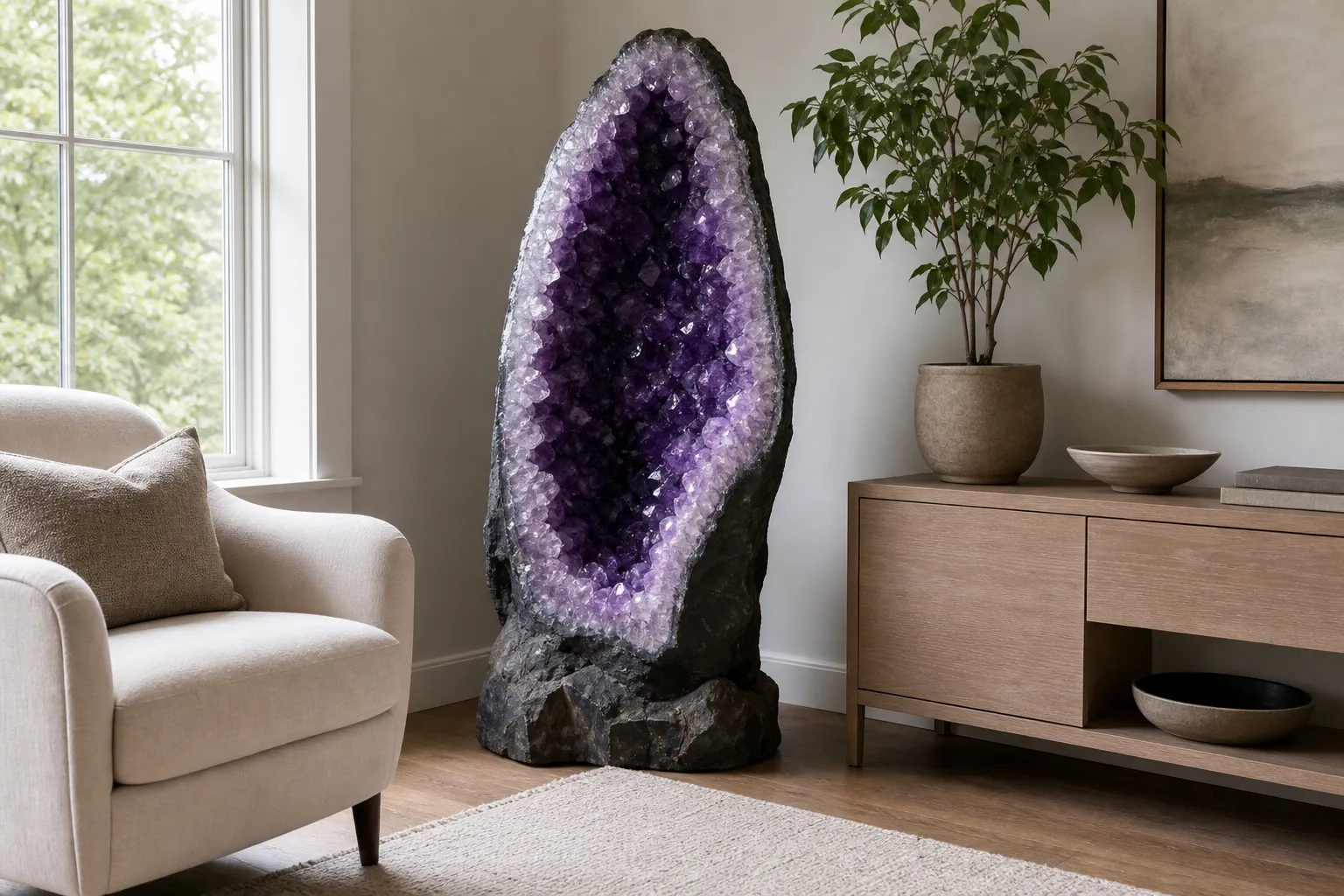
Orientation should be adjusted after the geode is physically in place. A few inches of rotation can change the whole reading. Face the opening toward the place where the room gathers attention: a seating group, a meditation cushion, an entry sightline, or a display wall. If the geode points into a cluttered corner, it may sound symbolically active in language, but visually it will feel unresolved.
Heavy Geode Placement Considerations
Large geodes are real objects before they are symbols. They can be heavy, uneven, sharp along some edges, and awkward to move. The research material for this page does not provide technical thresholds for floor load, stand construction, or installation, so safety language here stays common-sense rather than engineering-specific.
Use a stable base. Avoid narrow tables, lightweight shelves, wobbly pedestals, or any surface that shifts when touched. If children or pets use the room, keep the specimen away from paths where it might be bumped, pulled, or climbed. If the geode is exceptionally large, awkwardly balanced, or placed above floor level, professional handling or furniture advice may be prudent, but this page cannot provide technical approval.
Sharp crystal edges are another practical detail. The display should allow people to admire the interior without brushing against it. This matters in entryways, narrow hallways, and social rooms where guests move close to furniture. A geode that makes people step around it has failed the room-flow test, regardless of symbolic placement.
For renters or apartment dwellers, keep the plan conservative. Choose a lower, more stable placement; avoid blocking exits or door movement; and do not rely on a delicate stand just because it looks elegant. The object’s physical behavior sets the boundary for every symbolic choice.
Magnetic Field Optimization and Other Misread Claims
“Magnetic field optimization” appears in some crystal-placement language, but the current research set provides no source that supports treating giant amethyst geodes as tools for changing a room’s electromagnetic conditions. Amethyst is quartz; within this page’s evidence limits, it should not be described as optimizing magnetic fields, neutralizing devices, or altering measurable environmental forces.
The same caution applies to stronger spiritual-outcome language. A geode can be used as a personal symbol of calm, beauty, reflection, abundance, welcome, or sacred attention. It should not be presented as producing guaranteed effects. The distinction is not hostile to spiritual practice; it protects the reader from confusing meaning with proof.
If you mean wealth flow
Say “a symbolic abundance area” or “a place associated with prosperity intention.”
If you mean energy activation
Say “a ritual or visual focal point.”
If you mean magnetic field optimization
Say “not supported by the current evidence for this page.”
If you mean protection effect
Say “a personal or cultural protection symbol, if that fits the owner’s practice.”
If you mean a health-outcome claim
Say “outside the scope of this placement page.”
This wording lets the article answer the placement question without turning unsupported claims into certainty. A household may choose symbolic amethyst placement because it feels beautiful, contemplative, or aligned with ritual practice; those meanings are still different from verified physical effects.
A Simple Placement Checklist Before You Decide
Before settling a giant geode into a Feng Shui-style plan, walk the room once without thinking about symbolism. Then walk it again with intention in mind. The best placement usually survives both passes.
Use this quick check:
- The geode is not in a walkway, door swing, or crowded threshold.
- The base feels stable for the specimen’s weight and shape.
- The open crystal face is visible from the room’s main approach or use area.
- The surrounding objects make the geode look placed, not stored.
- The symbolic meaning is phrased as intention, not as a promised outcome.
- Any Feng Shui or Vastu language reflects the owner’s practice rather than an unsupported universal rule.
- Magnetic field optimization, financial certainty, and health-result claims are left out of the placement decision.
If two locations both work symbolically, choose the one with better physical stability and room flow. If a location is symbolically attractive but physically awkward, it is not the right place for a giant specimen. The stone’s size has veto power.
FAQ
Should a giant amethyst geode face the front door?
It can face toward an entry sightline if the placement is stable and welcoming, but it should not block the door, narrow the path, or crowd the threshold. Treat this as visual and symbolic orientation, not as a proven rule.
Can I use Vastu principles for amethyst placement?
You can use Vastu-adjacent language as part of a personal or cultural placement practice, but this page has no verified source base for specific Vastu rules about amethyst geodes. Keep the claim modest: alignment can guide intention, not prove results.
Is amethyst placement proven to improve wealth flow or magnetic fields?
No evidence available for this page supports those claims. A geode may serve as a symbolic abundance marker or a strong visual focal point, but wealth outcomes and magnetic field optimization should not be presented as effects of placement.
A giant amethyst geode belongs where its weight is respected, its crystal face can be seen, and its meaning remains honestly named. Let the specimen be purple quartz with presence first; then let Feng Shui geometry shape the room’s intention without turning symbolism into certainty.