Why Uruguayan Amethyst Sets the Standard for “High Crystal Character”
Uruguayan Amethyst is treated as a reference point for “high crystal character” because the better-known display pieces from northern Uruguay often combine several things collectors can see at once: saturated violet color, lively crystal faces, geode depth, and enough translucency for the crystals to feel dimensional rather than flat.
That phrase is not a formal gemological grade. It is not a guarantee that every specimen from Uruguay is darker, clearer, or more valuable than amethyst from elsewhere. It is collector-facing language for the way a geode, cluster, or cut piece presents itself to the eye.
The useful answer is visual first, geological second: the specimen has to show the character, and the Artigas / Los Catalanes context helps explain why this material has earned such attention.
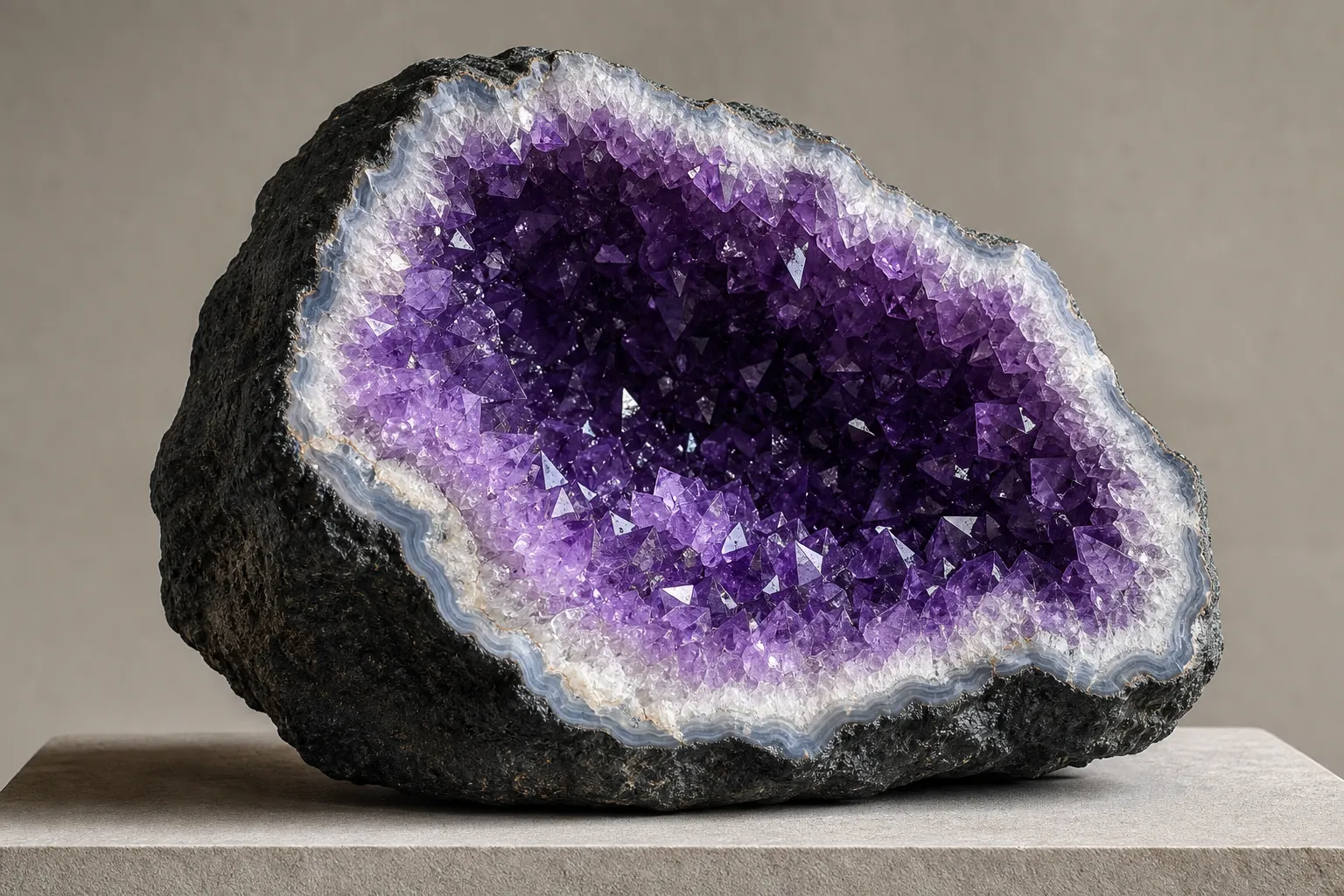
What “High Crystal Character” Means
“High crystal character” is not a lab term like refractive index, hardness, or specific gravity. In the amethyst market, it usually means presence: the piece does more than show purple quartz. It shows form, light, depth, and structure.
For Uruguayan Amethyst, collectors often use the phrase when a specimen has several of these traits:
Saturated purple color
Color that appears rich rather than pale or grayish.
Defined crystal points
Visible faces, not a dull or sugary-looking surface.
Translucency or transparency
Light at the tips, edges, or thinner areas.
Coherent geode or cluster shape
A natural arrangement that reads as one object.
Color zoning or internal depth
Visual movement within the crystals.
Display contrast
Contrast between darker outer rock, possible agate or chalcedony banding, and the violet crystal interior.
This is why deep purple geodes from Uruguay can look so striking in photographs and in interior displays. The geode itself acts like a natural frame: an outer rock rind, possible banding, and a crystal-lined cavity inside. When the crystals are sharp, saturated, and clean enough to catch light, the whole object can feel more dramatic than a loose amethyst point of similar size.
Still, “high character” should not be confused with “all Uruguayan amethyst is superior.” Locality gives context, not a score. A pale, chipped, poorly prepared Uruguayan cluster is still a weak specimen. A strong piece from another locality can easily be more attractive than a weak one from Uruguay.
Why Artigas and Los Catalanes Matter
The reputation of Uruguayan Amethyst is closely tied to northern Uruguay, especially the Artigas region and the Los Catalanes gemological district. Geological studies describe Los Catalanes, south of the city of Artigas near the Brazil border, as an important amethyst-agate geode district in basaltic lava units of the Arapey Formation. Recent research also notes the long mining history of the district and its recognition among the first 100 IUGS Geological Heritage Sites in 2022. That recognition reflects scientific and natural heritage importance, not a retail quality ranking.
For collectors, the locality matters because it explains why so much Uruguayan Amethyst is discussed as geode material rather than only as isolated crystals or faceted gems. The setting supports cavities lined with quartz and amethyst. Those cavities create the familiar visual language of Uruguayan pieces: a hollow or semi-hollow form, an outer rock rind, banded layers in some specimens, and a violet crystal interior.
The geology also makes the common “gas bubbles in basalt” explanation too simple. Published work on Los Catalanes describes low-temperature hydrothermal and epigenetic processes involving basalt alteration, fluid movement, fracturing, dissolution, and later mineral filling. In collector terms, a good geode is not just a rock bubble with purple crystals inside. It is the visible result of a longer cavity-forming and mineral-precipitating history.
That background helps explain the appeal. It does not prove that every Uruguayan specimen has strong color, high transparency, or exceptional value.
The Visible Traits That Create the Reputation
When buyers search for a Uruguayan amethyst geode, cluster, ring, pendant, or bracelet, they often run into the same phrases: deep purple, high transparency, premium Artigas material, collector grade. Some of that language is useful when it points to visible traits. It becomes misleading when it sounds automatic because of origin.
A clearer way to judge Uruguayan Amethyst is to separate the features.
Color Depth
The most admired Uruguayan pieces often show strong violet to purple color. In geodes, that color can look especially intense because many small crystal points line the cavity and reflect light from different angles. A darker outer shell can also make the violet interior appear richer by contrast.
Amethyst is the violet variety of quartz. General mineralogical research connects its color with structural and trace-element conditions involving iron, irradiation, and color centers. Heat can also change amethyst color under the right conditions. That does not prove that all Uruguayan Amethyst is untreated, or that it is naturally darker than all amethyst from other origins. It simply supports a careful point: color has a real mineralogical basis, can be affected by conditions, and should be judged in the actual specimen.
For a collector, “deep purple” should mean what the piece visibly shows, not what the country name promises.
Crystal Face and Luster
A geode with strong crystal character usually has points that still look crisp. Even small crystals can feel lively when the faces are well defined and reflective. Broken tips, dull coatings, heavy chipping, or worn surfaces reduce that effect.
This is where display-quality Uruguayan Amethyst often gets attention. A cabinet piece or room display does not need to be flawless under magnification, but it needs to read clearly at normal viewing distance. If the points sparkle, the cavity has depth, and the violet surface does not look muddy, the piece carries itself well.
Transparency and Internal Light
“High transparency” needs careful wording. Some amethyst crystals are transparent at the tips. Some are translucent. Others appear dense, dark, or more opaque. In a geode, transparency can also be hard to judge because the crystals overlap and the cavity may be shadowed.
The better question is not, “Is all Uruguayan Amethyst highly transparent?” There is no good basis for treating that as a universal rule. The better question is, “Does this specimen let light move through the tips, edges, or thinner areas in a way that creates depth?”
If it does, the piece may deserve clarity-focused language in a collector sense. If it is attractive but dark and dense, it may still be a beautiful display piece, just not for the same reason.
Geode Architecture
A cluster can be appealing, but a full or partial geode often has more visual drama because it preserves the cavity setting. The rim, shell, banding, and crystal interior tell a material story at a glance.
This is a major reason “crystal character” feels natural for Uruguayan geodes. The viewer is not only looking at purple quartz. They are looking into a mineral-lined space. In a strong specimen, the outer context, agate layers, and amethyst points work together as one object.
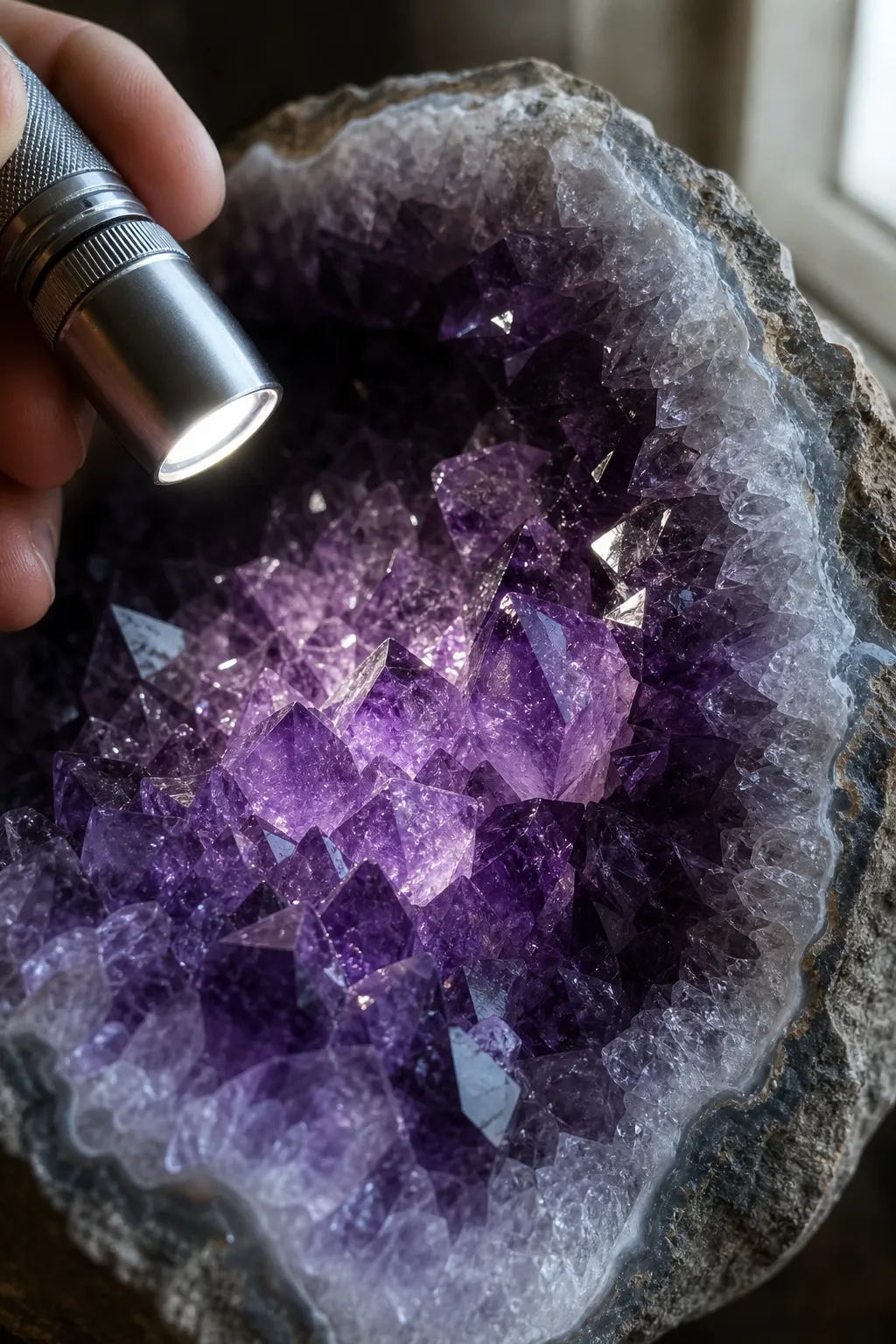
What the Basalt Cavity Context Can and Cannot Tell You
The basalt cavity context matters, but it should not be stretched too far. Research on Los Catalanes and the wider Paraná volcanic province supports the connection between amethyst-agate geodes and volcanic rock settings in Uruguay and southern Brazil. It also shows that formation models involve fluids, alteration, cavities, and mineral precipitation rather than one simple event.
For a buyer or collector, that means three practical things.
- First, the geode form is part of the specimen’s identity. A cut base, polished rim, or opened half-geode may be prepared for display, but the cavity-grown crystal surface is the center of the object.
- Second, origin language is meaningful only when it is specific and supportable. “Uruguay” is useful. “Artigas” or “Los Catalanes” is more informative when documented responsibly. “From a famous mine” is too vague on its own. Public geology can support the district context, but it does not authenticate an individual retail piece.
- Third, formation setting does not automatically determine beauty. Basalt-hosted geodes vary in size, color, crystal development, and preservation. A notable geological environment does not replace visual evaluation.
Common Misunderstandings
The biggest misunderstanding is treating “Uruguayan” as a quality grade. It is an origin description. A piece may be from Uruguay and still be pale, damaged, uneven, or poorly prepared. Non-Uruguayan amethyst can also be excellent.
Another misunderstanding is assuming darker always means better. Deep color is often desirable, especially in display geodes, but an overly dark specimen can lose internal light. Some collectors prefer vivid medium-dark purple with visible translucency over crystals that look nearly black in normal room light.
Jewelry creates a separate confusion. A Uruguayan amethyst ring, bracelet, or pendant is judged differently from a geode. Jewelry depends on cutting, setting, wearability, mounting quality, and how the stone performs under light. A geode or cluster depends more on natural crystal form and display impact. “High crystal character” fits geodes and clusters most naturally, because the growth surface remains visible.
There is also a symbolic-language issue. Some buyers encounter amethyst through cultural, decorative, or personal-practice contexts where purple crystals are associated with calm or contemplative spaces. Those associations may explain why someone chooses amethyst for a room display, but they are not geological evidence or a property that can be verified by locality.
A Practical Way to Judge a Specimen
If you are looking at Uruguayan Amethyst for sale, especially online, use “high crystal character” as a prompt for inspection rather than a conclusion. Ask what the photos and description actually show.
A strong specimen should answer most of these questions well:
- Does the purple color look saturated without becoming flat or overly dark?
- Are the crystal points intact enough to show distinct faces?
- Is there visible translucency or transparency at the tips, edges, or thinner areas?
- Does the geode or cluster have a pleasing overall shape?
- Are chips, repairs, coatings, suspicious color areas, or heavily polished surfaces clearly disclosed?
- Is the origin described with reasonable specificity, such as Uruguay, Artigas, or Los Catalanes?
- Do the photos show more than one angle or lighting condition?
Price, wholesale language, and “mine direct” claims should be judged separately from crystal character. Uruguayan amethyst price can vary with size, color, crystal condition, preparation, shipping weight, provenance detail, and seller positioning. The available research does not support a single pricing rule or a claim that Uruguayan material is always more valuable.
The Bottom Line
Uruguayan Amethyst sets the standard for “high crystal character” in collector language because notable Artigas and Los Catalanes geode material can bring together saturated violet color, reflective crystal faces, natural cavity architecture, and strong display presence. Northern Uruguay’s geology gives that reputation a serious context: these are amethyst-agate geodes associated with basaltic volcanic rocks and complex hydrothermal formation histories.
But the phrase remains descriptive, not official. It should be earned by the individual specimen. Let Uruguay and Artigas guide your attention, then let color, transparency, crystal condition, and geode structure decide whether the piece truly has character.