Collector evidence note
Trapiche-Like Amethyst: Hunting for the Rarest “Fixed Star” Patterns
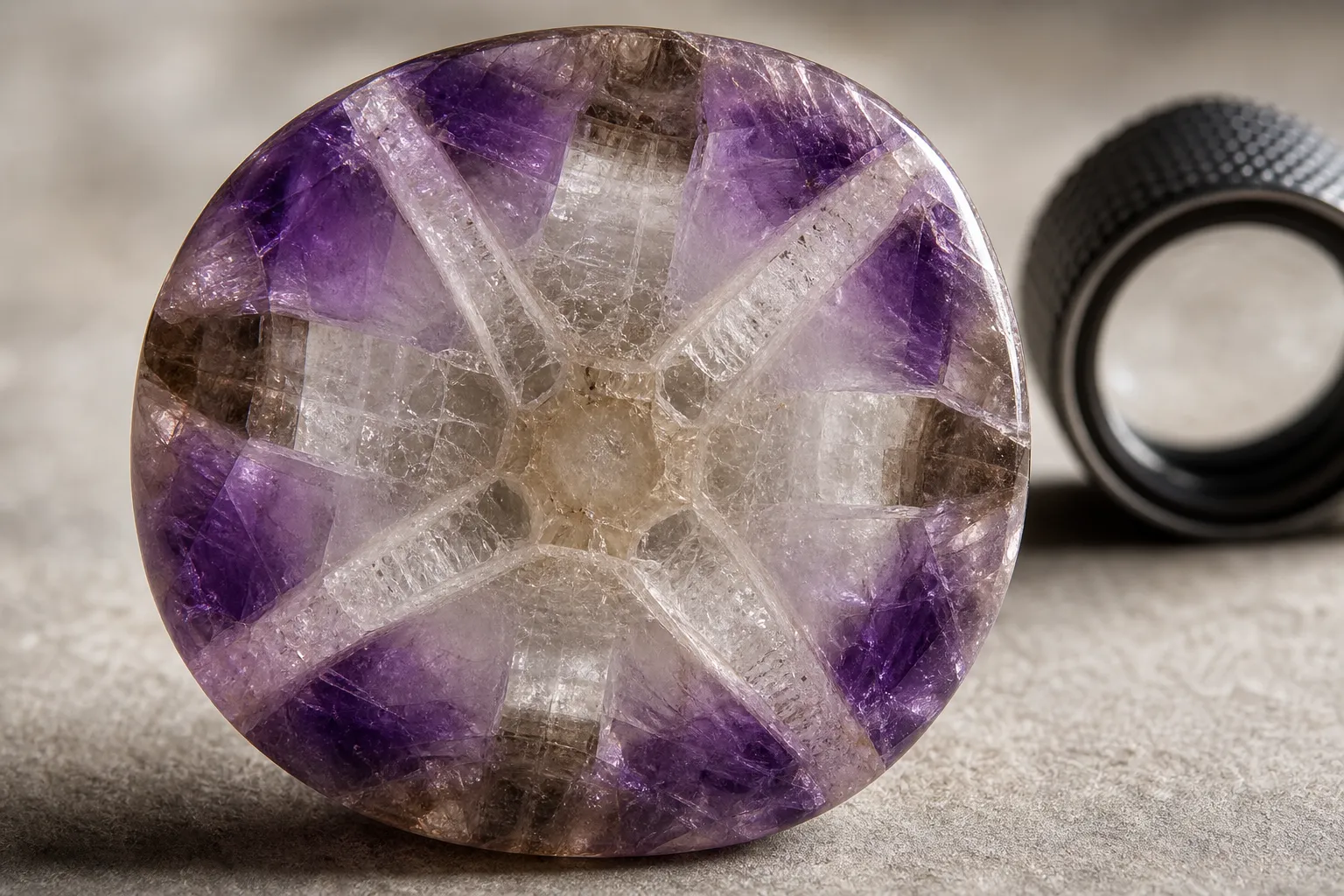
A specimen sold as Trapiche Amethyst is usually not a separate mineral species. It is better understood as amethyst, or amethyst-bearing quartz, described as having a trapiche-like radial pattern: a fixed, spoke-like structure that may show a central hub, six arms, and sector-defined growth when viewed or cut in the right orientation.
The careful phrase is trapiche-like amethyst. Public evidence for amethyst examples is limited, while trapiche-like patterns in quartz more broadly have been studied. For collectors, the useful question is not just “Is it purple?” It is: does the specimen show a real internal radial pattern, and is that claim documented well enough to affect value?
broader context
Amethyst context note
This narrower page lands better after the broader amethyst context page.
What “trapiche-like” means in amethyst
“Trapiche” refers to a wheel-like or star-like structure best known from certain emeralds and other gemstones. In amethyst, the term needs more caution. The pattern is usually being claimed as a growth- or inclusion-related feature inside quartz, not as a new variety of amethyst.
Amethyst itself is purple quartz. Standard amethyst is judged by familiar factors: richness and evenness of purple color, clarity, size, crystal form, cutting quality, damage, and overall display appeal. A trapiche-like claim adds another layer. The feature being valued is the internal architecture: radial arms, contrast between arms and sectors, and whether the slice, cabochon, sphere, or polished face makes the structure readable.
Research on trapiche-like quartz shows that quartz can carry a genuine radial pattern with a central core, six arms, and growth sectors. In one studied quartz group from Dongwuqi, the visible texture was associated with white fibrous chalcedony in growth sectors, along with other inclusions in some samples. That research is useful as a mechanism example, but it should not be stretched into a claim that every purple “trapiche amethyst” formed the same way.
For a buyer, the practical test is simpler: the star should look like a structure inside the quartz, not a surface design, random cracking, or ordinary color zoning dressed up with a rare label.
The “fixed star” look: what to examine first
The appeal of trapiche-like amethyst is the fixed star: a star that does not flash across the surface, but appears to sit inside the stone as part of its growth record. That is also the first clue. A credible radial pattern should remain visible as the specimen is moved, even if the contrast changes with lighting.
A central hub
Many trapiche-like quartz descriptions involve arms radiating from a core or central area. A loose purple cloud with no center is weaker evidence.
Spoke-like arms
Six arms are often discussed because quartz has hexagonal symmetry, though real specimens may be incomplete, uneven, or distorted.
Sector boundaries
The pattern should suggest growth sectors, not just a star-like patch of color.
Readable contrast
White, gray, dark, or translucent differences may appear, but the contrast should look internal and consistent with the stone.
Correct orientation
Trapiche-like patterns are often easiest to see in slices cut across the crystal. A poorly oriented cabochon, point, pendant, or sphere may hide or distort the structure.
Depth
The pattern should appear within the quartz body, not only on the polished surface.
This is why slices are often easier to judge than rings, pendants, or small cabochons. A slice gives the radial face a flat viewing plane. A sphere may be attractive, but curvature can magnify, bend, or obscure the pattern. A point may show only part of the structure unless the orientation is clear.
Trapiche amethyst versus standard amethyst
Standard amethyst is collected for color, crystal form, locality, inclusions, and display presence. Trapiche-like amethyst is collected as a rarer visual oddity within that world: a piece where the internal growth structure becomes the main event.
That difference changes the buying logic. A modestly colored amethyst with a strong radial pattern may interest a pattern-focused collector more than a deeply purple but ordinary crystal. One buyer is chasing the fixed-star structure; another may care more about saturation, transparency, or classic crystal habit.
Standard amethyst
- Main identity: purple quartz.
- Main visual appeal: color, crystal shape, clarity, geode or cluster form.
- Best viewing form: crystal, cluster, geode, cut stone, or carving.
- Evidence needed: basic mineral identity and treatment disclosure.
- Pricing logic: more established amethyst quality factors.
Trapiche-like amethyst claim
- Main identity: purple quartz with a reported radial growth pattern.
- Main visual appeal: central hub, radial arms, sector-defined pattern, and contrast.
- Best viewing form: often a slice or well-oriented polished face.
- Evidence needed: mineral identity plus evidence that the radial pattern is internal.
- Pricing logic: specimen-specific and harder to compare.
Naming can also mislead buyers. “Trapiche” is commonly approximated in English as trah-PEE-chay, but pronunciation does not strengthen the identification. The specimen has to carry the claim.
Common confusion: radial pattern, asterism, phantoms, and dye
Several features can create a star impression in quartz. They are not the same thing.
Trapiche-like radial pattern
A trapiche-like radial pattern is usually discussed as a fixed internal structure: arms, sectors, and a central area. It does not depend on a moving band of light.
Asterism
Asterism is different. It is an optical star effect produced when light interacts with oriented inclusions. The star shifts as the stone or light source moves. If a seller calls a piece “star amethyst,” ask whether they mean a fixed radial pattern or an optical star.
Phantom quartz
Phantom quartz can also confuse the eye. Phantoms are ghost-like outlines of earlier growth stages inside a crystal. Amethyst phantoms can be beautiful, but stacked triangular or crystal-shaped outlines are not automatically trapiche-like arms.
Color zoning and treatment concerns
Color zoning is another common source of overstatement. Amethyst often has uneven purple distribution. Sector zoning can matter in quartz, but not every purple sector creates a trapiche effect. A stronger claim needs a clearer radial structure.
Finally, consider dye, assembly, backing, coating, or surface treatment when the color looks unusually vivid, the pattern seems too flat, or the stone is set in jewelry where the back is hidden. The point is not to assume every unusual piece has been altered. The point is to match the evidence to the asking price.
Why rarity is real but hard to price
Trapiche-like amethyst can reasonably be called rare in collector language, but the stronger wording is rare as a specimen feature, not rare by a known percentage. Public documentation is thin for specimen-level trapiche-like amethyst, and pricing is not standardized.
That creates a pricing gap. Sellers may price the romance of the fixed star, while buyers need to price the evidence.
Features that can support stronger collector interest
- Complete or nearly complete radial arms.
- A readable six-ray trapiche pattern.
- Clear contrast between arms and sectors.
- Attractive purple amethyst color.
- A cut or polish that shows the pattern cleanly.
- Minimal cracks, chips, staining, or distracting repairs.
- Credible locality information, if available.
- Reputable documentation for expensive pieces.
- Direct, high-resolution images from more than one angle.
Features that weaken the claim
- A pattern visible only in one promotional photo.
- Vague origin language.
- No side or back view.
- A hidden setting.
- Dramatic value language without documentation.
- A “trapiche” label applied to any roughly star-shaped purple quartz.
There is no dependable public formula such as a fixed multiplier over ordinary amethyst. A small, well-documented collector specimen may be more meaningful than a larger piece with a weak or ambiguous pattern. A decorative sphere with a partial radial look may still be desirable, but it is not automatically a strong trapiche-like example.
How to evaluate a specimen before buying
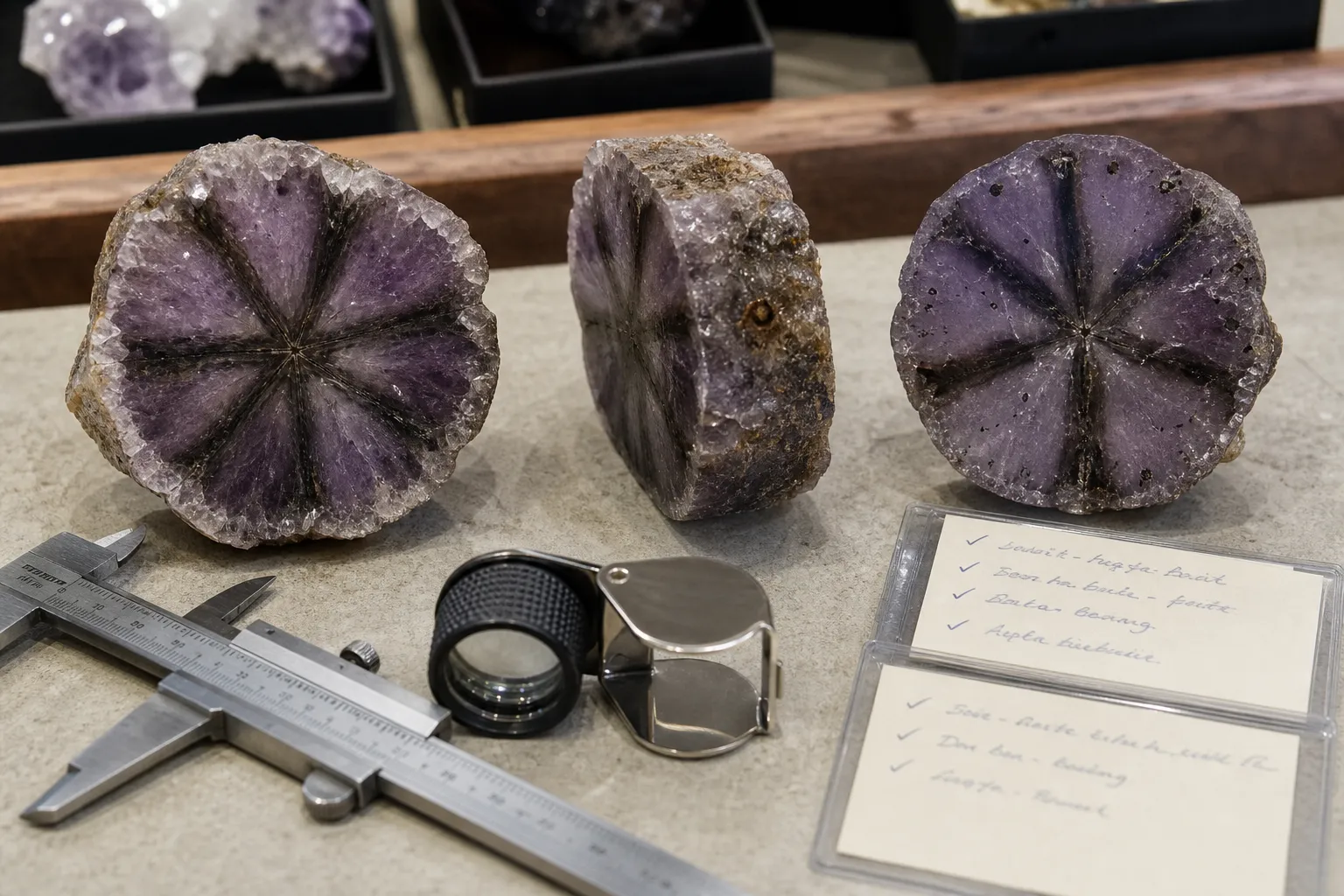
If you are considering trapiche amethyst for sale, ask for evidence that matches the claim. A low-cost curiosity may only need clear photos. A higher-priced collector specimen deserves more support.
- A straight-on photo of the radial face. The image should be taken as close as possible to perpendicular to the viewing plane.
- Side or back views. These help show whether the pattern continues inside the stone or is only surface-related.
- Lighting variation. Ask for images in diffuse and direct light. A fixed internal pattern should not disappear completely when lighting changes.
- Size and thickness. A thin slice, cabochon, pendant, ring stone, point, or sphere should be described clearly.
- Treatment disclosure. Ask whether the piece is dyed, heated, stabilized, backed, assembled, coated, or fracture-filled if those possibilities are relevant to the form.
- Origin and documentation. Treat locality claims cautiously unless supported. For expensive pieces, a gemological report or reputable documentation can matter more than a dramatic story.
A seller who describes the piece as “trapiche-like” and explains the radial pattern is using more careful language than one who insists every star-like purple quartz is “true trapiche amethyst” without photos, context, or disclosure.
Where symbolic meaning fits
Searches for trapiche amethyst meaning, spiritual meaning, or metaphysical properties often sit beside collector searches. The fixed-star pattern is easy to read symbolically: a center, radiating arms, order within growth, and stillness inside movement. Some people may use a trapiche-like amethyst pendant, sphere, or display piece as a focus object for reflection or atmosphere.
That symbolic language is separate from mineral identification. It should not replace evidence when the price depends on the claim. For a collector-minded buyer, the stronger foundation remains material: quartz identity, amethyst color, internal pattern, orientation, condition, and documentation.
The cautious collector’s bottom line
Trapiche Amethyst is best understood as amethyst or amethyst-bearing quartz with a reported trapiche-like radial pattern, not as a separate mineral species. The most convincing examples show a fixed internal structure: a central area, spoke-like arms, sector-defined growth, and enough contrast to make the pattern readable in the chosen form.
The rarity is part of the appeal, but pricing remains specimen-specific. Look for the star, but buy the evidence: clear orientation, visible internal structure, honest disclosure, and documentation when the price moves beyond casual curiosity.