Grounded Crystal Practice
Intention Setting Practices with Goethite-Included Amethysts
A grounded Intention Setting Practice with goethite-included amethyst is simple: choose one clear intention, place the stone where it can serve as a visual or tactile reminder, write or speak a short affirmation, and revisit the wording over time. The stone does not make the intention happen, and the goethite inclusions should not be treated as proof of stronger results. In this practice, the amethyst works best as a symbolic companion for reflection.
That distinction keeps the routine useful. Many people are drawn to goethite-included amethyst because it looks earthy, layered, and more visually complex than clean purple amethyst. That appearance can make it feel like a fitting object for a serious intention. Still, the practice belongs in the realm of meaning, attention, and follow-through—not claims that a mineral changes outcomes, rewires the mind, guarantees manifestation, or carries a verified effect.
broader context
Broader amethyst guide
This narrower page lands better after the broader amethyst context page.
A Grounded Way to Set an Intention with the Stone
Start by deciding what the intention is actually for. A useful intention is not a wish list or a demand. It is a concise statement about the direction you want to return to.
Instead of “Everything will change immediately,” try something closer to your own choices:
- “I will make one steady decision at a time.”
- “I will give my attention to what is honest and workable today.”
- “I will pause before agreeing to what I cannot sustain.”
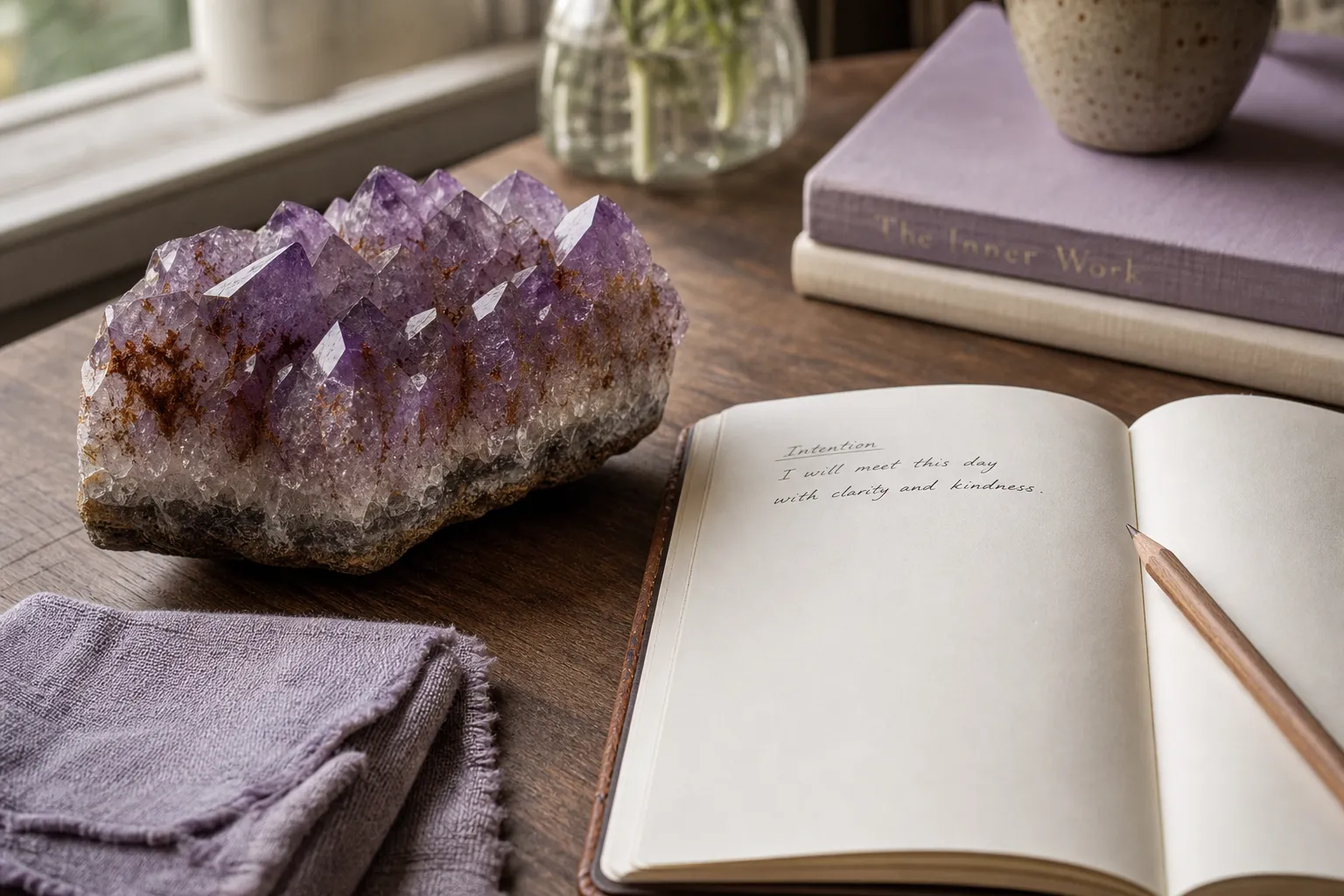
Place the goethite-included amethyst near your journal, on a small cloth, beside an unlit candle, or simply in your hand. The exact arrangement matters less than making the moment deliberate. If the stone is fragile, sharp-edged, rare, or part of a display collection, it can stay on a shelf. Intention setting does not require gripping it, sleeping with it, soaking it, or putting it through special treatment.
A short routine can look like this
- Sit somewhere quiet enough to think clearly.
- Name one intention in plain language.
- Write it in a journal or on a card.
- Look at or hold the amethyst as a symbolic focus.
- Say the affirmation once or twice without forcing emotion.
- Note one practical action that matches the intention.
- Revisit the wording later and adjust it if needed.
This keeps the crystal intention routine modest and usable. The stone is part of the setting, not the source of the result. The meaningful work is choosing an intention, returning to it, and noticing whether your actions still match what you wrote.
Choosing an Intention That Does Not Ask Too Much of the Crystal
The most helpful intentions are usually narrow enough to guide behavior. “I want my whole life to transform” may sound powerful, but it gives you little to return to tomorrow morning. “I will give focused time to the work I keep postponing” gives the practice a clearer shape.
With goethite-included amethyst, some crystal users connect the stone with depth, grounding, patience, or inner steadiness because of its visual character and community symbolism. Those associations can be meaningful, but they should be understood as personal or symbolic language rather than confirmed mineral effects. The inclusions may make the stone feel more contemplative to its owner; they do not establish that the stone produces a measurable spiritual, emotional, or cognitive outcome.
Present enough
It is stated in the present or near-present.
Choice-based
It points toward a choice you can revisit.
Not guaranteed
It avoids promising a guaranteed external result.
For example, “This crystal will bring me the relationship I want” gives the object too much responsibility. “I will speak more honestly about what I need” keeps the intention closer to your own agency.
This is also the safest way to understand cognitive focus in this context. Here, the phrase simply means where you place your attention during the ritual. It does not mean the crystal has been shown to improve cognition or produce a clinical result. The stone may help you mark the moment because you have chosen it as a reminder. That is enough for this kind of practice.
Using Affirmations Without Turning Them into Guarantees
Affirmations for intention setting work best as wording tools. They give the intention a repeatable sentence, so you do not have to rebuild the practice every time. The sentence should feel clear rather than dramatic.
You might use wording such as:
- “I return to what is steady and truthful.”
- “I give my attention to one honest next step.”
- “I can choose patience without becoming passive.”
- “I am willing to revise what no longer fits.”
- “I let this stone remind me of the intention I chose.”
These are not formulas with promised effects. They are practical language for reflection. If a sentence feels artificial, shorten it. If it feels too grand, bring it closer to the day in front of you. An affirmation does not need to be beautiful; it needs to be believable enough that you can return to it without resistance.
Some readers speak the affirmation while holding the stone. Others write it under the stone, place it next to the stone, or keep the stone on a desk as a quiet prompt. All of these can work as personal ritual forms. None of them need to be presented as a verified mechanism.
A useful test is this: if the crystal were not present, would the sentence still point you toward something real? If yes, the stone can serve as a symbolic focus. If no, the practice may be relying too heavily on the object and not enough on the intention itself.
What “Crystal Lattice Programming” Should Mean Here
Readers may encounter the phrase “crystal lattice programming” in crystal communities or commercial descriptions. For this page, it should not be treated as a literal technical process. The available material for this article does not support the claim that a person can program the lattice of goethite-included amethyst in a scientific, measurable, or mineralogical sense.
A more careful interpretation is that “programming” means assigning personal meaning to the stone. You are not altering the mineral. You are deciding what the stone will remind you of when you see it.
Personal cue
“This stone will remind me to pause before reacting.”
That is a personal cue. It does not require a claim about energy storage, crystal memory, or physical change. The “programmed” element is your relationship with the object, not the object’s structure.
This distinction protects the practice from overstatement. Goethite-included amethyst can still feel meaningful without exaggerated claims attached to it. The inclusions make the piece visually compelling; the intention gives it personal context; the routine gives you a way to return.
A Simple Routine for Revisiting the Intention
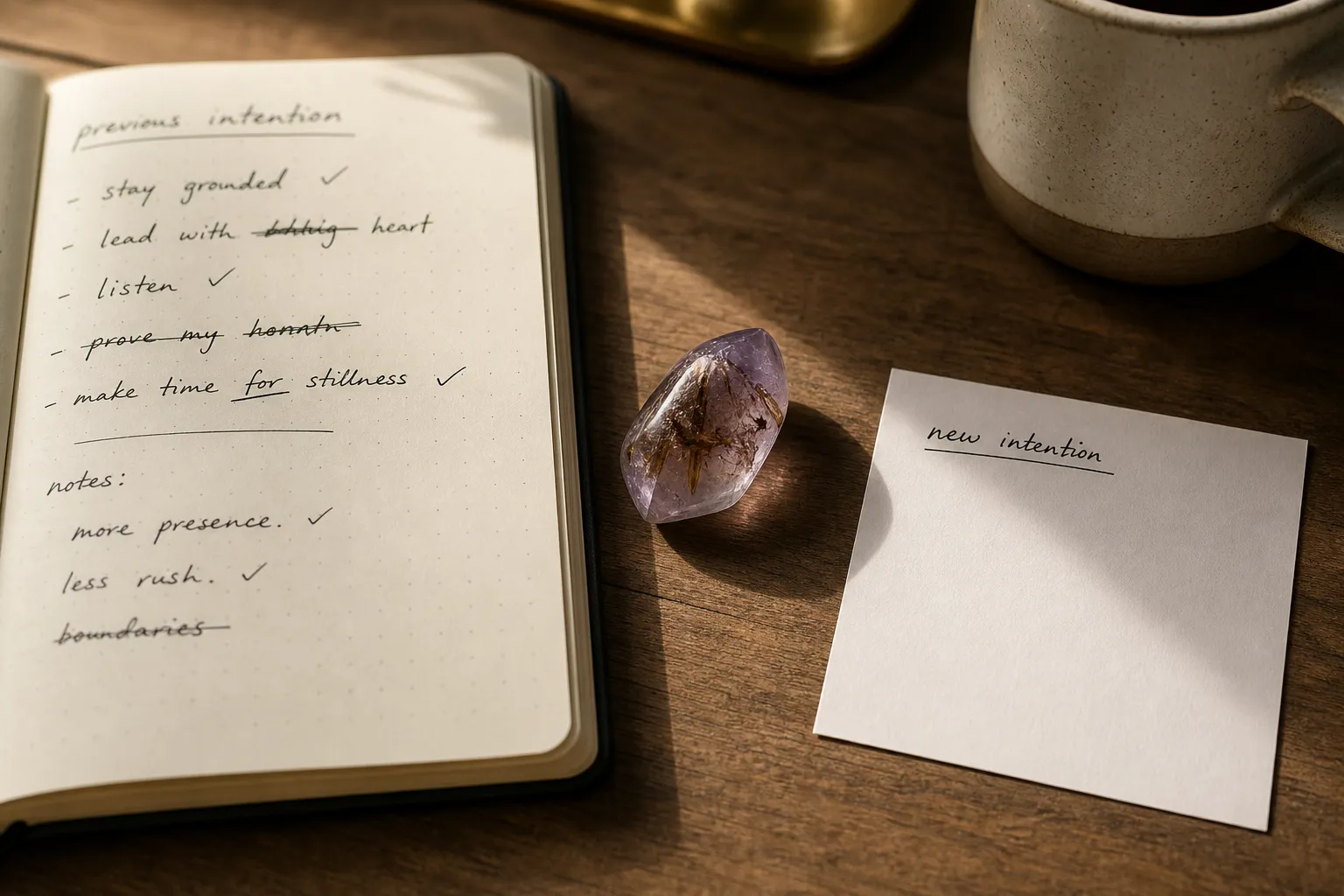
An intention should not be frozen forever. After a few days or weeks, the original wording may feel too broad, too forceful, or no longer accurate. Revisiting an intention is not a failure of the ritual. It is part of keeping the practice honest.
A five-minute review can be enough
- Read the original intention.
- Look at or hold the stone.
- Ask whether the wording still fits.
- Write one sentence about what changed.
- Keep, soften, or replace the intention.
For example, “I will finish everything I started” may become “I will finish what still matters and release what no longer does.” That revision is not weaker. It may be more precise.
The stone can sit beside the journal during this review as a continuity object. It marks the thread between the first statement and the later reflection. For collectors and spiritually curious readers, this can be one of the more satisfying uses of a ritual object for intentions: it gathers meaning over time without needing claims about power or proof.
If the intention relates to a serious life problem, keep the ritual in its proper place. It can support reflection, naming, and personal organization, but it should not be framed as a substitute for qualified support, practical planning, or necessary conversations. The amethyst can be part of the atmosphere around the work, not a replacement for the work.
Common Confusions About Goethite-Included Amethyst Intention Work
The inclusion does not make the intention stronger by default
The presence of goethite may make a specimen more visually distinctive or personally attractive, but this article has no evidence basis for saying it increases metaphysical, emotional, or cognitive force. If the stone feels resonant to you, that can be enough as a personal reason to use it.
Intention setting is not guaranteed manifestation
A reflective intention may help you name what matters to you, but it does not promise that outside conditions will rearrange themselves. A grounded practice keeps the focus on clarity, attention, and the next action you can take.
A more elaborate ritual is not automatically more meaningful
Some people enjoy layered practices with candles, cards, music, or moon phases. Others prefer a stone, a notebook, and one sentence. For this specific question, the simpler version is often easier to keep honest because it does not bury the intention under performance.
Doubt does not ruin the practice
You do not have to believe the stone causes anything in order to use it as a personal reminder. You can approach the amethyst as a beautiful object, a symbolic focus, a collector’s piece, or a quiet marker of a promise you are making to yourself.
Where the Evidence Boundary Belongs
The available research set for this page does not provide public sources that verify mineralogical mechanisms, psychological effects, historical traditions, outcome claims, or firsthand reports for goethite-included amethyst intention work. Because of that, the responsible version of this article is practical and symbolic rather than evidentiary.
That does not make the practice meaningless. It means the meaning is personal, reflective, and chosen. The stone can hold a place on your desk, in your hand, or beside your journal as a reminder of the intention you named. The affirmation can give the intention language. The review can keep it current. But none of these steps should be presented as proof that the crystal changes your mind, health, future, or external circumstances.
Grounded closing practice
“I choose this stone as a reminder to ______.”
Fill the blank with something you can return to tomorrow. Keep the wording modest. Let the goethite-included amethyst be present without asking it to carry more than it can responsibly carry: beauty, symbolism, attention, and a quiet invitation to come back to what you meant.