Quartz naming for astrological work
Natural Amethyst vs. Baked Citrine: What Astrologers Need to Know
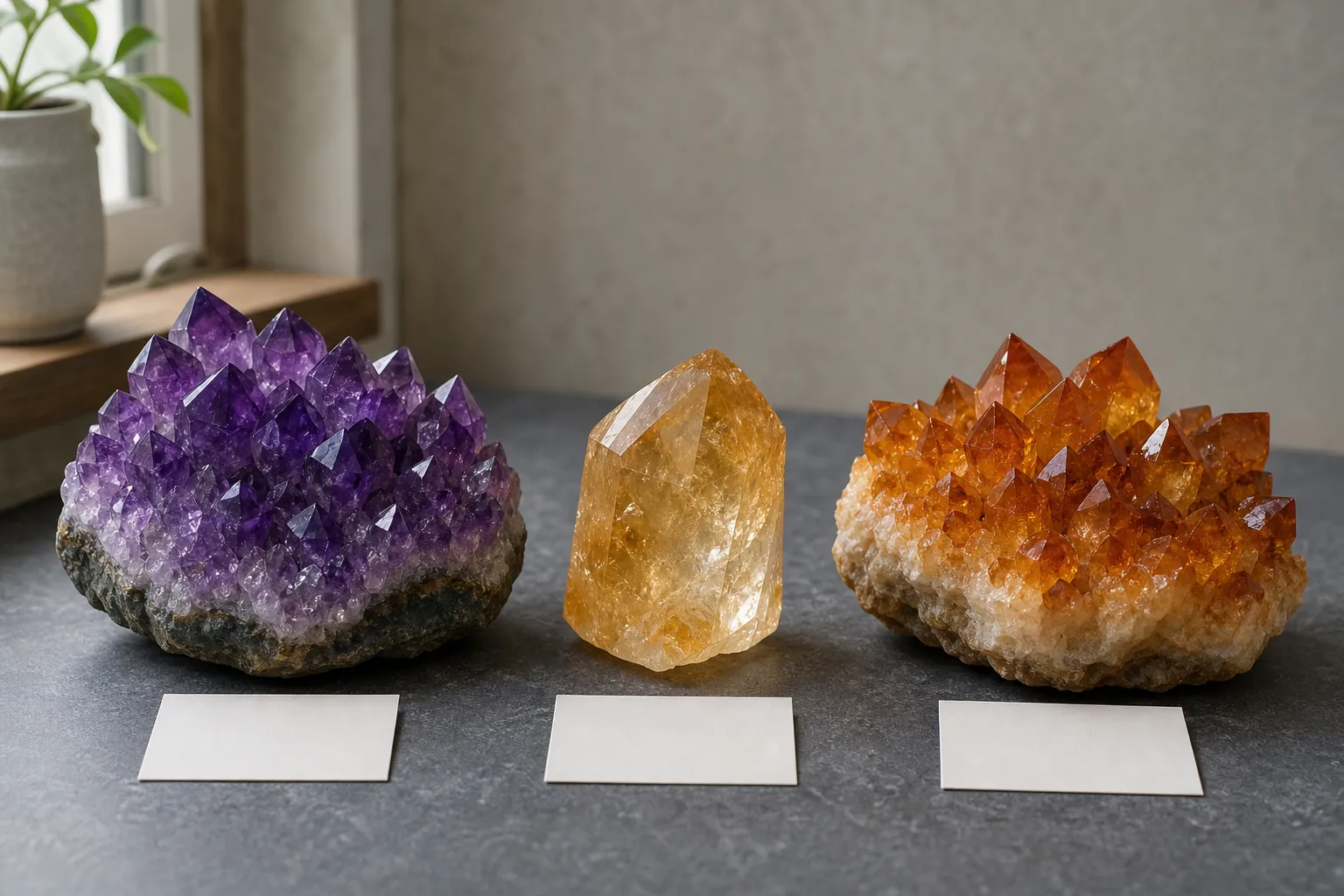
A purple amethyst cluster that turns honey-orange after heating has not become natural citrine in the geological sense. It has become heat-treated citrine: real quartz, often amethyst by origin, with a treatment history that should be named clearly. For astrologers, the working distinction is simple: use “natural citrine” only when the yellow-to-orange color is understood to have formed naturally; use “heat-treated citrine” or “heat-treated amethyst” when purple quartz was heated into a citrine color.
That wording leaves room for symbolic practice without overstating the stone. Geology can describe the crystal’s material history; it cannot prove stronger ritual results, weaker energy, or a guaranteed astrological effect.
broader context
Amethyst context note
This narrower page lands better after the broader amethyst context page.
The Three Names to Keep Separate
Amethyst and citrine are both quartz. Under ordinary surface conditions, quartz is commonly described as alpha-quartz, so the question is not whether the material is “real quartz.” The useful question is how the color formed, and whether the name being used matches that history.
Natural amethyst
Natural amethyst is purple quartz. Its color is commonly discussed through iron-related color centers in the quartz structure, with scientific work connecting amethyst color behavior to charge-transfer processes involving iron and oxygen. That technical point keeps the conversation grounded: the purple is a visible material feature, not an astrological credential.
Natural citrine
Natural citrine is transparent yellow-to-orange quartz. GIA describes citrine in that color range and connects its color discussion to trace iron. It also notes that natural citrine is relatively rare and that much citrine in the market is produced by heating amethyst. For astrologers, that is the central literacy point: “citrine” on a label may describe appearance, but it may not prove natural formation.
Baked amethyst
Baked amethyst is the plain-language phrase buyers often use for amethyst heated after mining until it reaches yellow, orange, amber, or brown tones. “Baked” is not a formal grade. In public writing or teaching, “heat-treated citrine” or “heat-treated amethyst sold as citrine” is usually cleaner. The ethical issue is disclosure, not automatic fakery.
What Heat Treatment Changes
Amethyst heat treatment is not merely a symbolic shift from purple to gold. Laboratory work has observed staged color changes in amethyst under heat, including a citrine-colored stage above about 440 °C, with one Scientific Reports study describing around 560 °C as suitable for obtaining citrine color from amethyst. That does not mean every orange specimen in a shop followed the same temperature path. It means the color-change mechanism is real and documented under controlled conditions.
For a nontechnical astrologer, the translation is practical: heat can alter color centers that affect how quartz absorbs and reflects light. The stone remains quartz, but its color story changes. A crystal that formed as purple amethyst and was later heated has a different material history from transparent yellow quartz whose color formed without that post-mining treatment.
That difference is enough to affect naming. It does not settle spiritual suitability. If your practice gives symbolic weight to origin, treatment, fire, earth process, or human intervention, you can say that as interpretation. What you should not do is present the distinction as mineral proof of a specific astrological outcome.
Careful language protects the reading. “This is quartz that likely began as amethyst and was heated into a citrine color” is more accurate than “this is fake,” and more honest than calling an unsupported orange cluster “natural citrine.”
Visual Clues Help, but They Do Not Finish the Question
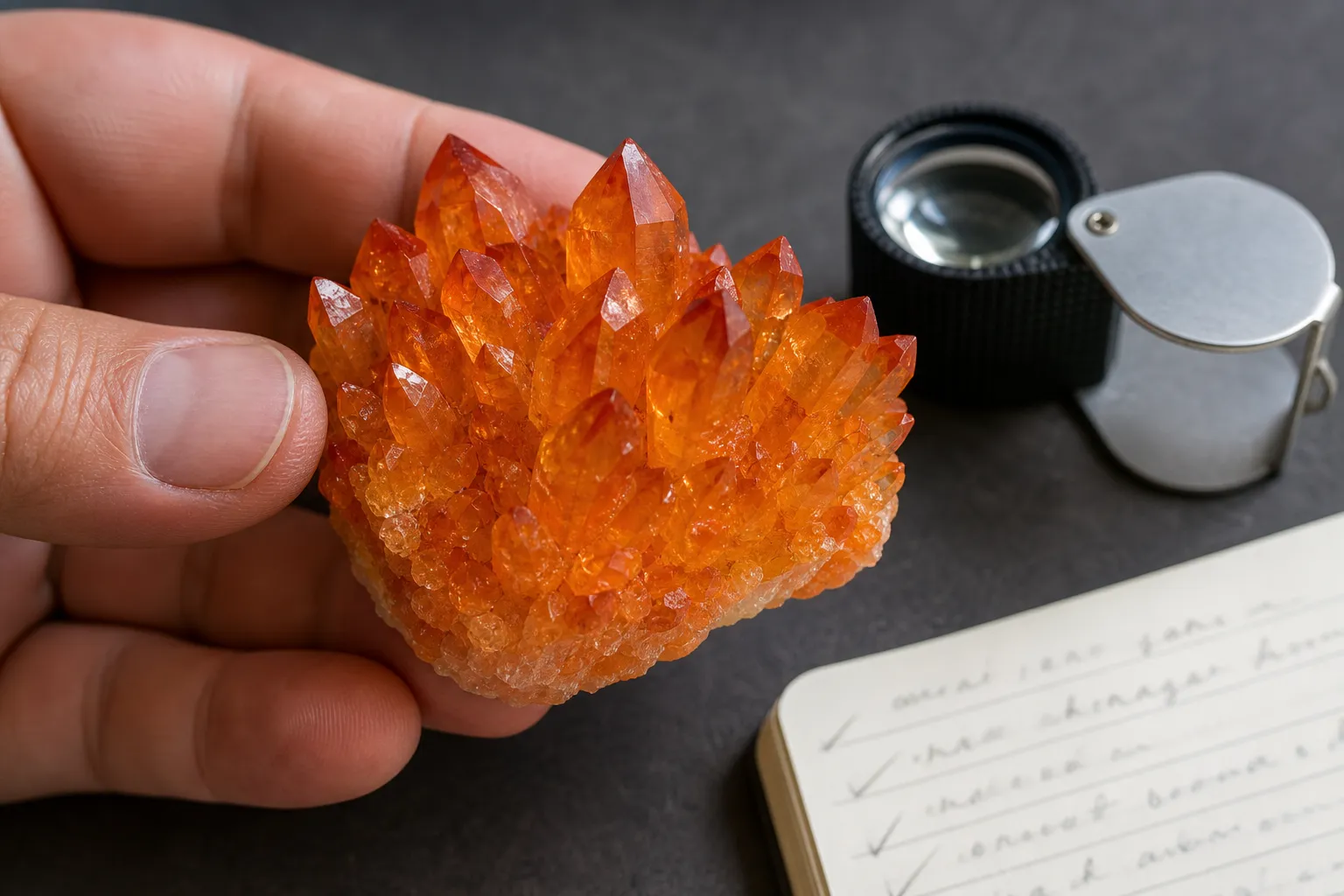
Collectors often discuss citrine visual clues. Natural citrine is commonly described in softer yellow, smoky champagne, brownish yellow, or pale lemon tones, while many heated amethyst pieces appear more vivid orange, amber, or reddish-orange. Orange clusters, points, and cathedral-like geodes also raise questions because amethyst specimens are often heated and sold in those forms.
Clues are prompts, not verdicts
Those clues are useful for asking better questions, not for declaring certainty by sight. Color varies. Photographs can exaggerate saturation. Lighting, camera processing, iron staining, inclusions, and seller presentation can all change what you think you are seeing. A pale stone is not automatically natural citrine, and a bright stone is not automatically treated amethyst.
Crystal habit can add context. If a specimen has the familiar form of an amethyst geode but appears burnt orange across the tips, it is reasonable to ask whether it is heat-treated. If a seller provides locality, treatment disclosure, and restrained mineral wording, the conversation is already more grounded. Still, habit is a clue, not a verdict.
The same caution applies to “yellow quartz.” The Quartz Page draws a useful terminology boundary: not every yellow quartz should be treated as citrine in the narrower mineralogical sense, especially when color comes from inclusions rather than lattice-related coloration. For astrologers, “yellow quartz,” “natural citrine,” and “citrine-colored quartz” are not identical origin claims. A beautiful yellow crystal can be meaningful in practice without being mislabeled as naturally colored citrine.
The Honest Labeling Rule for Astrological Use
Name the material history before you name the meaning. If a piece is natural amethyst, call it amethyst. If it is natural citrine, use that phrase when the formation claim is supported by credible information such as reliable provenance, treatment disclosure, or gemological context. If it is heated amethyst, call it heat-treated citrine or heat-treated amethyst, especially when teaching, selling, writing chart notes, or preparing a public ritual description.
This does not require hostile language. “Treated” is not the same as “worthless.” Gem materials are often treated, and heat-treated citrine can still be attractive, durable quartz for display, jewelry, or symbolic use. The problem begins when treated material is presented as naturally colored citrine, or when an origin-based interpretation is built on a stone whose origin has not been established.
Useful wording
- “This is citrine-colored quartz, likely heat-treated amethyst, so I am using it for golden color symbolism rather than claiming natural citrine origin.”
- “This piece was sold as citrine, but I do not have enough treatment information to call it natural citrine.”
- “This is natural amethyst; its purple color and quartz identity are the material basis for how I describe it.”
Those sentences keep the symbolic layer intact while making the factual layer cleaner. They also reduce the pressure to turn every specimen into a purity test. The central practice is honest labeling, not panic over every orange crystal.
Where Spiritual Interpretation Should Stop
Astrology and crystal symbolism often use citrine language around solar tone, confidence, abundance, or manifestation. Those associations may belong to personal practice, tradition, or community language. The available gemological and scientific sources, however, do not establish that natural citrine has a different astrological effect from heat-treated citrine.
That boundary is not an attack on spiritual practice. It is a distinction between kinds of claims. A geological claim can say the stone is quartz, that citrine is yellow-to-orange transparent quartz, that trace iron belongs in the color discussion, and that heat can move amethyst through a citrine-colored stage. A spiritual claim belongs to interpretation, ritual language, or inherited symbolism. It should not be dressed as mineral proof.
For astrologers, the most respectful approach is to make origin part of the reading rather than hiding it. Natural citrine may be chosen when natural formation matters to the practitioner. Heat-treated citrine may be chosen when color, availability, display mood, or personal symbolism matters more than origin. Natural amethyst remains its own material and symbolic presence, not merely a before-picture.
The specimen is a specimen first; the meaning is chosen afterward.
A Short Check Before You Say “Natural Citrine”
Before calling a yellow or orange quartz “natural citrine” in an astrological setting, pause over four questions.
What exactly was disclosed?
“Citrine” alone may describe the retail color category. “Natural citrine” is a stronger formation claim. “Heat-treated citrine” signals treatment, though it may still leave open whether the starting material was amethyst, smoky quartz, or another quartz variety.
Does the appearance raise questions?
Very saturated orange, reddish tips, or a familiar amethyst-cluster habit can justify caution. These are not proof, but they are reasons to avoid overconfident language.
Is the source giving provenance or only atmosphere?
Locality, treatment disclosure, and restrained mineral wording carry more weight than dramatic rarity language or guaranteed energetic promises. Commercial language can reveal what buyers worry about; it should not carry the factual burden by itself.
Does your interpretation depend on natural origin?
If yes, choose material with stronger documentation or say that the origin is uncertain. If no, you can still work symbolically with color and quartz identity while naming the uncertainty.
The most accurate astrological language is not the most dramatic. It lets visible beauty, treatment history, and symbolic use remain distinct enough that none has to pretend to be the other.
FAQ
Is heat-treated citrine fake?
Not necessarily. Heat-treated citrine can be real quartz, and it may have begun as real amethyst. The issue is whether it is disclosed as treated material rather than sold or described as naturally formed citrine.
Can I identify baked amethyst by color alone?
No. Bright orange or reddish-orange color can be a clue, especially in cluster forms associated with amethyst, but visual inspection alone is not definitive. Provenance, treatment disclosure, crystal habit, and color consistency all matter.
Should astrologers avoid heat-treated citrine?
That is a practice choice, not a scientific rule. If natural formation is important to your symbolic system, choose documented natural citrine or use more cautious language. If you are working with color symbolism, display atmosphere, or personal association, heat-treated citrine can still be named honestly without claiming natural origin.
A yellow-orange crystal on a reading cloth can carry beauty, story, and uncertainty at the same time. Call natural amethyst purple quartz, call natural citrine naturally colored yellow-to-orange transparent quartz when the support is there, and call baked amethyst by its treatment history when that is the clearer truth. That small act of naming keeps the astrology grounded without asking geology to promise what it cannot.