Grounding with clear limits
Escapism Grounding Techniques Every Pisces Should Know
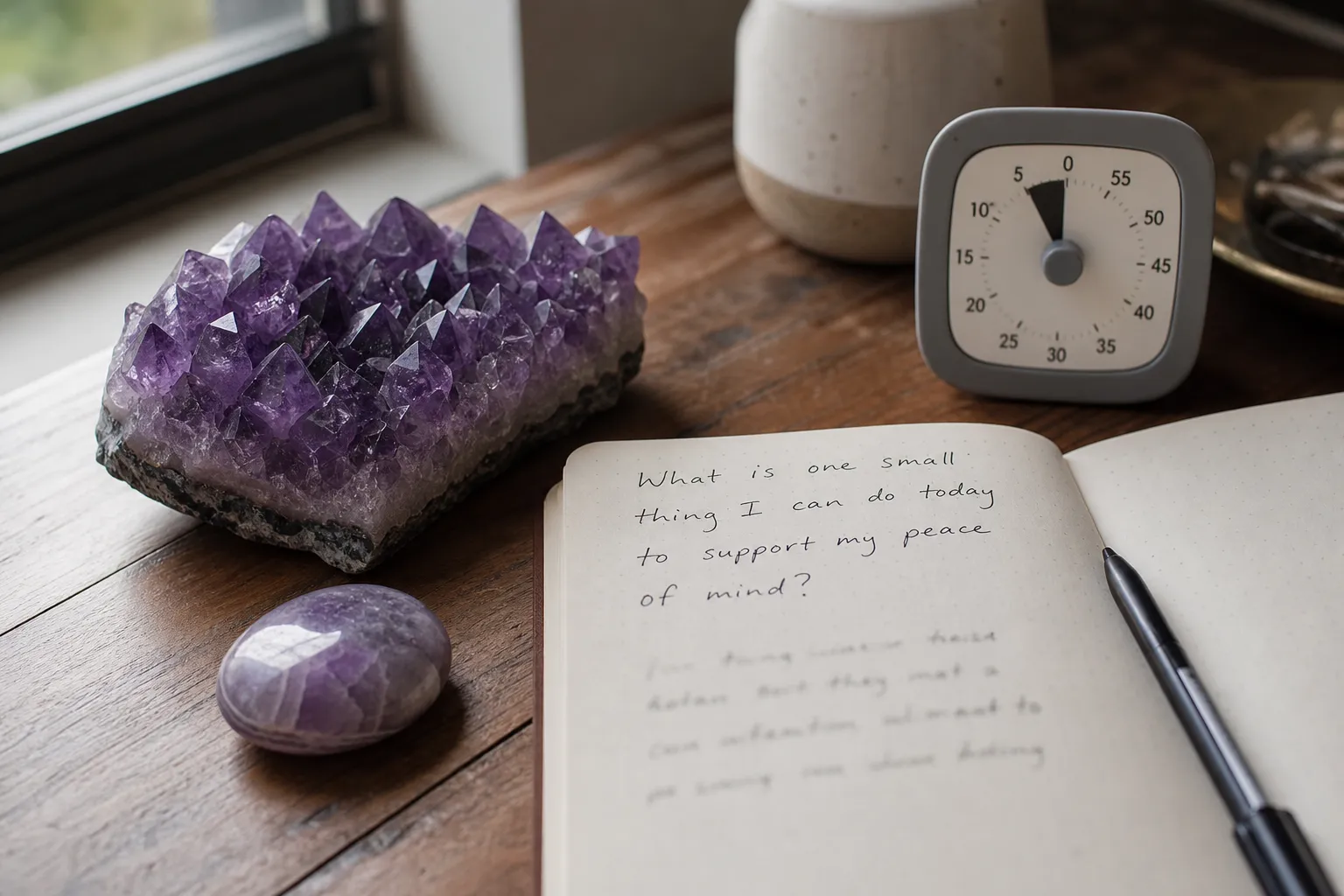
An amethyst cluster on a desk is still quartz before it is a symbol: its purple zoning, points, and weight can be observed; the meaning someone gives it belongs to interpretation. That same distinction helps with Pisces escapism grounding. Escapism grounding techniques for Pisces-oriented readers work best as gentle self-awareness practices, not clinical tools or proof that a zodiac sign causes avoidance.
The direct answer: choose small, repeatable cues that bring attention back to the present through ordinary contact—a texture in the hand, a written question, a daily carry object, a timed pause, a room reset, or a symbolic root chakra reminder. Pisces language can be a compassionate lens for sensitivity, imagination, and drifting inward; it should not become a diagnosis, an excuse, or a promise that change will happen.
broader context
Broader amethyst guide
This narrower page lands better after the broader amethyst context page.
The Aim: Return Without Shaming the Escape
Pisces escapism grounding has a modest goal: notice the drift, name what is happening, and choose one concrete next step. The “escape” might look like fantasy scrolling, over-romanticizing a situation, postponing a hard message, or disappearing into a mood. Those are ordinary patterns in this article, not clinical labels.
A grounding practice, here, is a reminder that brings attention back to the body, room, schedule, or responsibility. It can help you notice the difference between rest and avoidance. It can also show when a soothing ritual has become another way to postpone the thing already asking for attention.
For Pisces readers, tone matters. A harsh productivity script often misses the point. The better question is not “How do I stop being escapist?” but “What small anchor helps me return without turning imagination into a hiding place?” Symbolic practice can help with that, as long as the symbol stays honest about its limits.
Pisces Grounding Techniques That Stay Practical
These Pisces grounding techniques are simple by design. They are optional self-reflection practices you can try, adapt, or skip; they are not presented as clinical guidance, spiritual certainty, or validated mechanisms.
Use a Sensory Orientation Pause
A sensory orientation practice starts with the immediate environment. Look for one visible edge, one color, one sound, one texture, and one object with weight. If amethyst is nearby, notice it as a physical specimen first: cool surface, uneven points, pale and deep purple areas, dust on the base, or the way light catches a crystal face.
This keeps the exercise tied to observable reality. The point is not that amethyst changes your state in a confirmed way. The point is that a real object can give attention somewhere specific to land.
A short version:
- Name one thing you can see clearly.
- Touch one stable object.
- Say what task or choice is actually in front of you.
- Pick the next action small enough to complete.
For Pisces escapism grounding, the last step matters. Without it, the pause can become a pretty ritual with no return.
Choose a Psychological Anchor, Not a Magical Fix
A psychological anchor, used carefully here, means a personal cue that reminds you of a chosen behavior. It might be a smooth stone, a note in your wallet, a ring, a phone wallpaper, or an amethyst piece placed near a notebook. The object does not need to be rare, expensive, or spiritually charged to be useful as a reminder.
For example, a daily carry grounding object could mean: “When I touch this, I ask what I am avoiding and what I can do in five minutes.” That is a self-awareness cue. It is not evidence that the object produces a mental health result.
If you like amethyst, treat it as a specimen first and a symbol second. Consider durability, setting, and practicality. A sharp cluster belongs on a shelf more than in a pocket. A tumbled piece or small pendant may suit daily carry better, though no object is necessary. The anchor is the agreement you make with yourself; the object is only the prompt.
Use Root Chakra Language as Symbol, Not Proof
Root chakra language can feel meaningful for readers who use chakra symbolism, especially around steadiness, physical presence, routine, and belonging. In this article, symbolic root chakra grounding means using that vocabulary as imagery, not as a claim about the body.
A Pisces-friendly version can stay plain:
- Put both feet on the floor before answering a difficult message.
- Place your chosen object near your planner, not only near a candle or altar.
- Ask, “What would make this day more grounded in ordinary life?”
- Choose one practical repair: food, laundry, sleep timing, a bill, a conversation, or a boundary.
The symbolic value is in the association. Root language can remind a dreamy reader to return to the base of the day: body, home, time, promises, and physical surroundings. Keep it there; do not turn it into certainty about energy or outcomes.
Build a Gentle Routine Cue
Routine building for grounding is less dramatic than ritual, but often more useful for this single problem. Escapism is easier to notice when there is a familiar checkpoint.
Try one cue at a predictable time:
- Morning: write the one thing you are tempted to avoid.
- Midday: touch your anchor object and name the next concrete step.
- Evening: note where imagination restored you and where it distracted you.
- Before sleep: remove one avoidant loop from the next day’s first hour.
This is a reflective grounding technique, not a discipline system. If it becomes another perfection project, shrink it. A single sentence is enough. A checkmark is enough. The practice should bring you back to the day, not create a new identity to perform.
What Changes the Best Technique
The best grounding choice depends on what kind of escape is happening. A beautiful symbolic practice can be the wrong tool if the situation needs a plain action. A practical checklist can also feel too dry if the real issue is exhaustion, grief, or emotional overload.
If your escapism is mostly mental wandering, sensory orientation may be enough to interrupt the fog. If it shows up as task avoidance, a routine cue tied to one next step may be more useful. If it appears as romantic fantasy or spiritual over-reading, journaling can help separate what is observed from what is hoped.
“What do I know, what am I imagining, and what action belongs to today?”
That question fits the amethyst sensibility. A crystal’s color zoning can be seen; its symbolic meaning is chosen. In the same way, a text message, deadline, bank balance, or messy room is observable. The story around it may be tender, fearful, or poetic, but it should not erase the visible facts.
There is also a threshold. If avoidance is persistent, distressing, connected to self-neglect or unsafe behavior, or interfering with work, relationships, sleep, safety, or daily functioning, symbolic anchoring is not enough. Support from a qualified mental health professional, or an appropriate crisis resource when immediate safety is involved, may be the more suitable next step. A non-clinical grounding guide should know where it stops.
Common Confusion Around Pisces Escapism Grounding
Pisces is not a fixed explanation
Astrology can provide language, mood, and archetype; it does not prove that a person is escapist or determine how that person responds to stress, responsibility, or imagination. A Pisces lens may feel recognizable, but it should not become a box.
Grounding is not the opposite of dreaming
For many spiritually curious readers, imagination is part of meaning-making. The issue is not fantasy itself. The issue is whether fantasy helps you return with more clarity or keeps you away from the choice in front of you.
The object should not carry the whole job
A daily carry stone, charm, note, or piece of jewelry can be a gentle grounding reminder. It should not replace action, conversation, rest, practical support, or material care. If you carry amethyst, remember its ordinary needs too: a fragile point or decorative piece can chip, scratch other items, or become inconvenient.
Root chakra language remains symbolic here
Root chakra language should remain symbolic unless stronger sources are brought in for a different kind of article. Here it works as a metaphor for base, weight, routine, and return. That is enough for this page’s purpose.
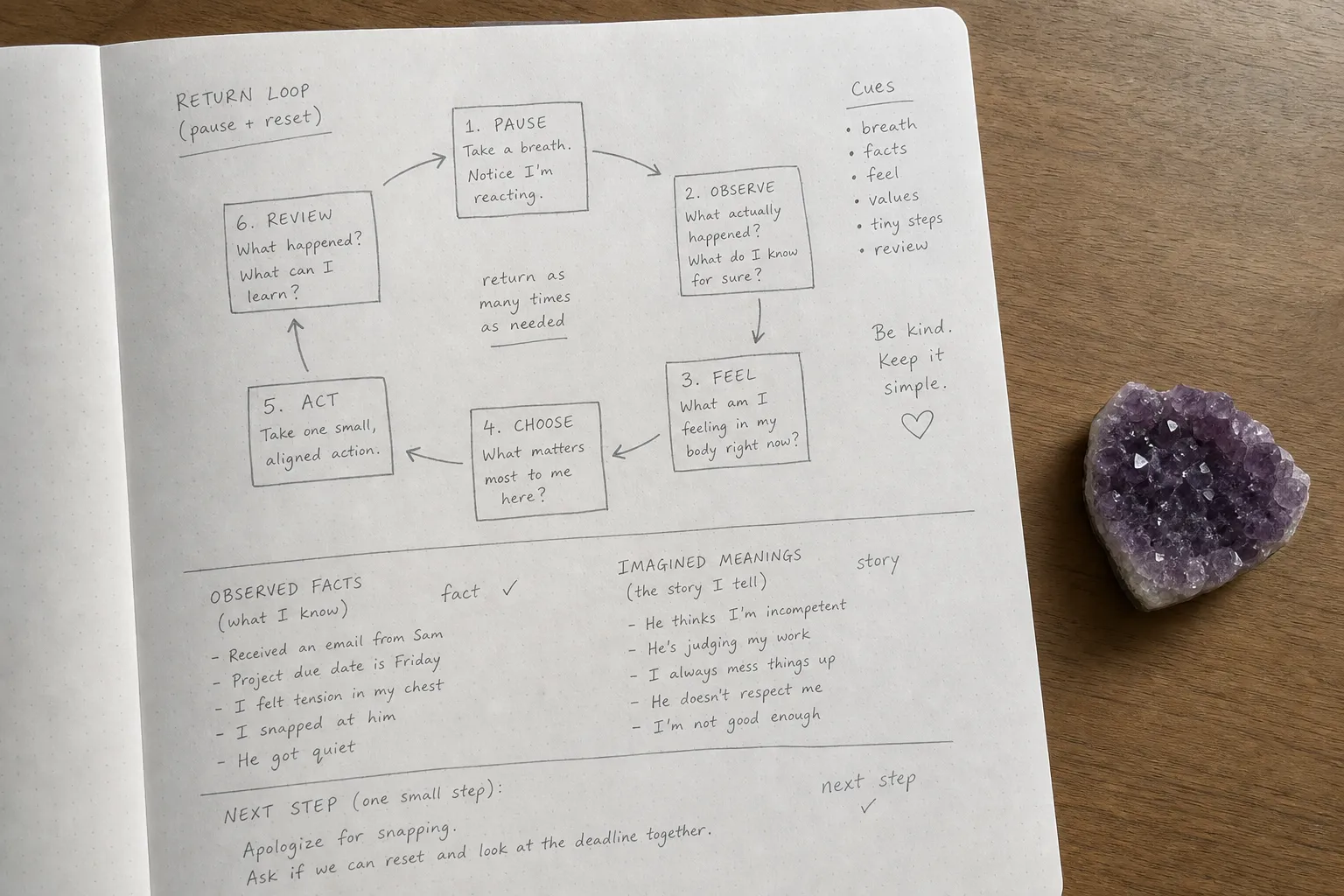
A Small Pisces Grounding Sequence
Use this when you notice yourself drifting into avoidance and want a short return path.
- Name the drift. “I am leaving the present by scrolling, fantasizing, postponing, or over-reading.”
- Touch the anchor. Use a stone, ring, notebook, mug, or desk edge; choose something real and ordinary.
- Orient to the room. Identify one color, one sound, one surface, and one object with weight.
- Separate fact from story. Write one observable fact and one imagined meaning.
- Choose the next repair. Send the message, open the document, drink water, tidy one surface, or set a time to return.
- Close the loop. Mark the action complete or name the exact point where you stopped.
This sequence is intentionally plain. It does not promise calm, clarity, transformation, or spiritual results. It gives a Pisces-oriented reader a way to move from symbol back to contact with the day.
Grounding Limitations to Keep Visible
The research pack for this page supplied no citation-quality public sources, no confirmed firsthand testing, and no professional review. That limits what can be responsibly said. The practices here are reflective, symbolic, and practical suggestions; they are not evidence-validated clinical methods.
That does not make the ideas useless. It makes their category clear. A journal prompt can clarify your own thinking. A daily carry object can remind you of a promise. A sensory pause can redirect attention to the room. A symbolic root chakra cue can give language to steadiness. None of those statements needs to become a medical, spiritual, or scientific claim.
For Pisces readers, the most grounded approach may be the simplest: let imagination remain a source of beauty, but ask it to walk beside ordinary evidence. The amethyst on the table can hold color, crystal habit, care needs, and personal meaning at once; the grounded choice is knowing which part you are looking at before you decide what to do next.