Bedside cue, not a cure
A Nightstand Arrangement to Soothe Relationship Overthinking
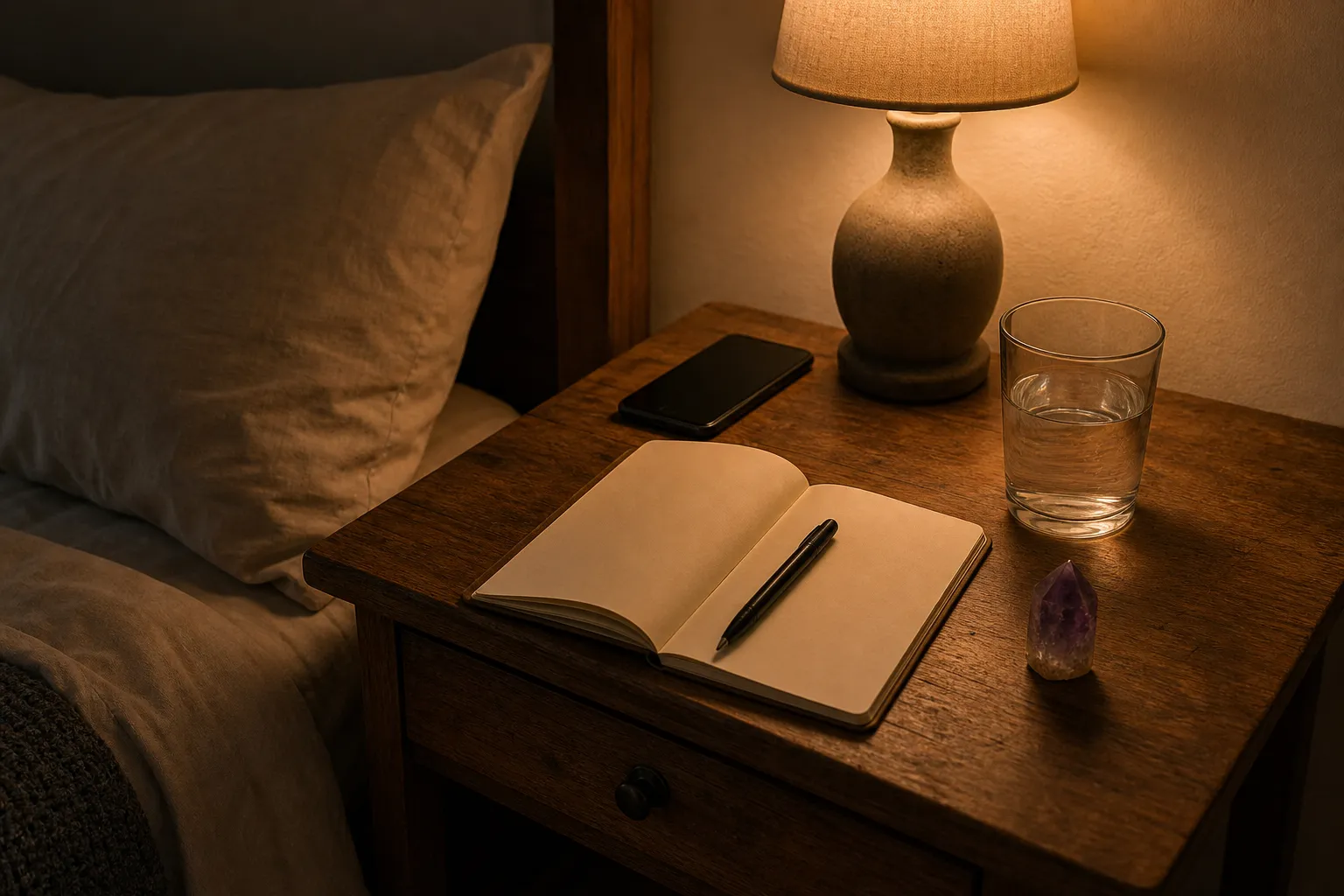
A small amethyst point on a nightstand is still quartz before it becomes a symbol; its color zoning, crystal habit, and placement are visible, while its meaning is chosen. For relationship overthinking at bedtime, the most useful arrangement is modest: a clear surface, warm low light, a notebook or card, a phone placed out of reflex reach, water if you normally keep it nearby, and one calming object such as amethyst or blue lace agate used as a personal cue.
This Sleep layout for anxiety is not a clinical plan. Its value is smaller and more practical: it gives the evening a softer edge and a repeatable stopping point.
broader context
Begin with the main amethyst page
This narrower page lands better after the broader amethyst context page.
The Nightstand Arrangement
Keep the top of the nightstand simple enough that your eyes do not have to sort through unfinished tasks. A crowded surface can start to feel like a private museum of messages, decisions, receipts, old worries, and emotional loose ends. A gentle nightstand setup works best when each object has a narrow job.
Warm low light
Place a small lamp or warm light source toward the back corner, not directly in your face. The goal is not a designed glow for photographs; it is a calmer bedtime environment that makes the room feel less interrogating. If the lamp is too bright, use a lower setting, a warmer bulb, or move it farther from the pillow.
A writing surface
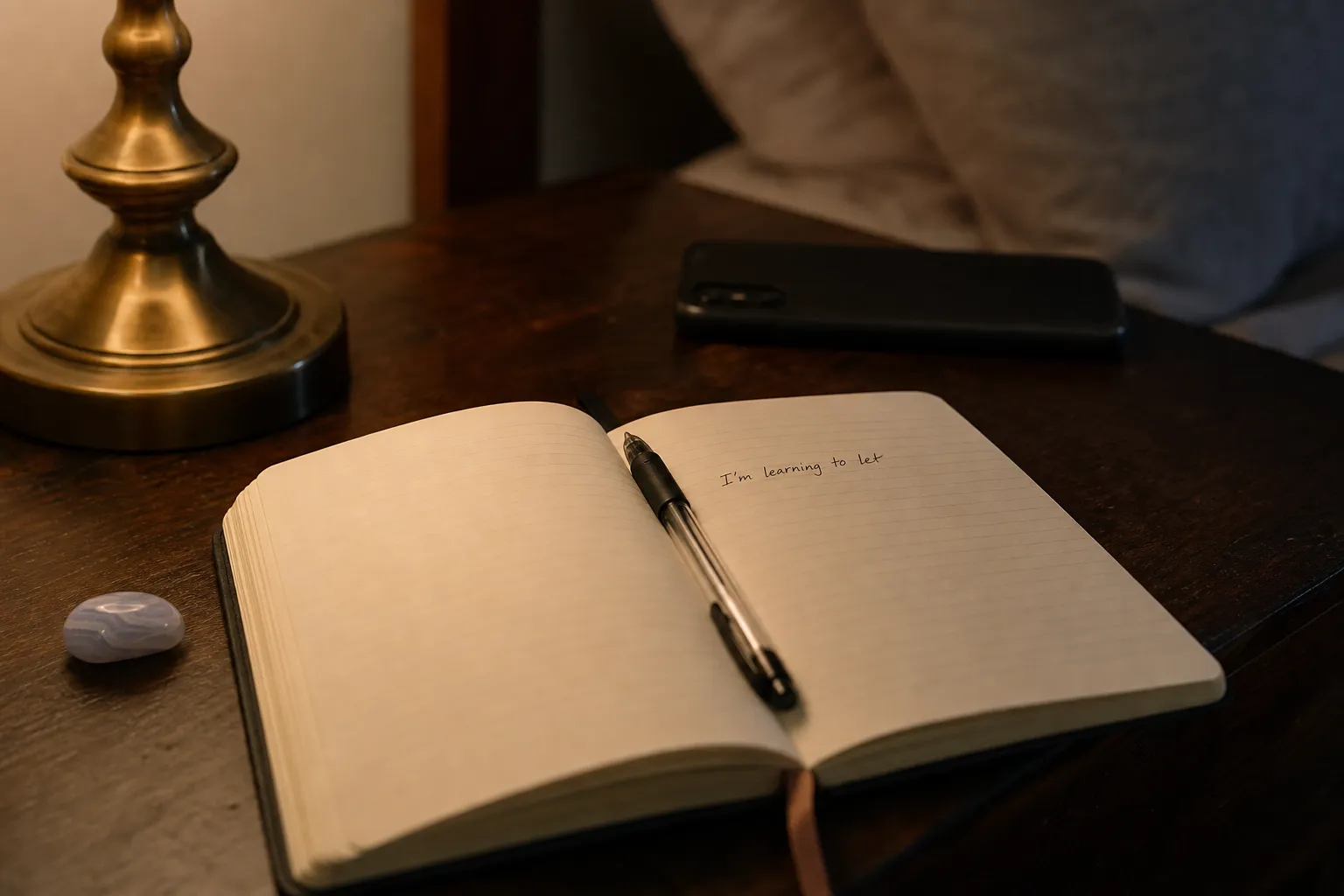
Leave one open area for a journal, folded card, or small pad. This is the practical center of the arrangement. Relationship overthinking often feels urgent because it has no container: a sentence becomes a trial, a silence becomes evidence, and bedtime becomes the room where every interpretation returns. A page gives the thought somewhere to land without pretending it has been solved.
One chosen object
Beside the paper, place one chosen object. For an amethyst reader, that might be a polished stone, a small cluster, or a point set where it will not be knocked down in the dark. If blue lace agate feels visually quieter to you, use it the same way: as a symbolic bedtime cue, not as proof of an effect. The stone does not need to be rare, large, expensive, or described with dramatic seller language. The best piece here is one you can look at without turning the nightstand into another performance.
Less automatic checking
Finally, reduce the object most likely to restart the loop. For many readers, that is the phone. If you use it as an alarm, place it just far enough away that checking a message becomes a deliberate movement rather than a half-asleep reflex. The arrangement is less about perfect sleep hygiene and more about making the first anxious reach slightly less automatic.
How to Use It When the Loop Starts
The arrangement works as a sequence, not as decoration alone. When the thought begins — “What did they mean?” “Why did they not answer?” “Did I say too much?” — turn on the low light before picking up the phone. That small order matters because it gives the body and room a different first cue.
- 1. Name one concern. Write one short line that names the concern plainly. Avoid building an entire case on the page. A useful form is: “The thought I am having is…” followed by one sentence.
- 2. Separate fact from interpretation. The fact may be that no reply has arrived yet; the interpretation may be that the relationship is in danger. This is not a diagnostic exercise. It is a journaling bedtime transition that keeps one feeling from becoming the whole room.
- 3. Use the stone as a cue only. After writing, touch or look at the chosen stone if that feels grounding to you. With amethyst, keep the distinction clean: the mineral does not verify the relationship, predict an outcome, or change another person’s feelings. Its role is symbolic and sensory. Its cool surface, purple color, and stable placement can mark the moment when you stop feeding the thought for the night.
- 4. Keep technical-sounding language modest. If you use language such as “deep neural relaxation” or “brainwave frequencies” in personal notes, let those phrases stay atmospheric rather than authoritative. This page does not have vetted sources showing that a nightstand arrangement, sound cue, crystal, or phrase changes brain states or reliably reduces anxiety. You can still choose soft sound, silence, or a familiar sentence because it feels gentle to you; just do not turn the words into a promise your room is required to keep.
- 5. Close the loop physically. A simple ending line can help: “I can revisit this tomorrow when I am not trying to sleep.” Put the pen down, turn the page over, or close the notebook. The physical closing is the point. The relationship question may remain unresolved, but the nightstand has given the overthinking a boundary.
What Changes the Answer
The arrangement should become even simpler if your nightstand already carries emotional weight. Gifts from the person you are worrying about, old letters, charged keepsakes, or objects connected to an argument may not belong beside the bed for now. They may be meaningful elsewhere, but the nightstand is not the best place for items that invite review when you are tired.
The answer also changes if the crystal becomes part of the anxiety. Some readers begin with a soothing object and then start wondering whether it is the right stone, the right grade, the right placement, or the right ritual. That turns collector literacy into pressure. For this page, authenticity and rarity are not the central decision. Choose a stable, clean, ordinary piece that you like looking at; do not let seller language become another spiral.
If blue lace agate feels more restful than amethyst, that is a personal aesthetic choice. The caution is simple: do not frame it as a mechanism for changing sleep, anxiety, communication, or relationship outcomes. Its pale bands may fit your room and your mood. That is enough for a bedside symbol.
If you share a bed or room, the setup needs consent and subtlety. A low light that keeps someone else awake, a scented object that bothers them, or a ritual that requires talking through the relationship every night may create more strain. In a shared space, the best nightstand arrangement for overthinking is quiet, compact, and easy to use without asking the whole room to participate.
The important exception is distress that feels unmanageable. Persistent anxiety, panic, fear, unsafe relationship dynamics, or severe sleep disruption deserves support from a qualified professional or a trusted local resource. A nightstand layout can be a gentle environmental cue; it should not be asked to carry problems that need human help, planning, or protection.
Common Confusions About Crystals, Sleep, and Relationship Anxiety
The nightstand is not a control panel
The lamp, notebook, and crystal cannot make someone reply, soften a conflict, or prove that the relationship is secure. They can only shape the immediate bedtime environment so you have fewer invitations to keep checking, rehearsing, or decoding.
Symbolism is not material proof
Amethyst has a real physical identity as quartz, and collectors can discuss color, form, treatment questions, and care. Spiritual symbolism belongs to another layer: it is meaning made through use, tradition, personal association, and room atmosphere. Those layers can sit near each other on the nightstand, but one does not prove the other.
Precise phrases still need evidence
Brainwave frequencies, deep neural relaxation, and similar phrases can sound precise even when a page has not supplied evidence for them. In this context, they should not become the spine of the practice. If you like a quiet audio track, a breathing count, or a phrase on a card, use it as a personal cue, not as a verified process.
A beautiful setup will not feel calm every night
Some nights the notebook will help. Some nights the phone will still be tempting. Some nights the amethyst will look like a quiet anchor, and other nights it will simply be a purple stone on a table. That does not mean the arrangement has failed; it means the object was never supposed to guarantee an inner state.
A Compact Version for Difficult Nights
When you do not have the patience to rearrange the room, use the smallest possible version:
- Clear away anything that asks for action: bills, receipts, extra jewelry, unrelated books, or visible reminders of unfinished decisions.
- Put the phone outside easy reach, or turn it face down if moving it is not realistic.
- Keep one writing surface and one pen nearby, with no expectation of long journaling.
- Place one calming object where you can see it without handling it repeatedly.
- Use one closing sentence: “This can wait until morning unless there is an immediate safety concern.”
That last clause matters. Sleep hygiene boundaries should never become avoidance of real danger, urgent communication, or a situation where you need help. The arrangement is for rumination that swells at night, not for ignoring immediate needs.
If the setup begins to feel like a rulebook, loosen it. The nightstand is not an altar of performance. It is a small, practical surface beside a tired person. Its job is to reduce friction between the thought and the next gentle choice.
Where the Evidence Ends
No high-quality public sources were available for this page. That means the article should not claim evidence-backed anxiety reduction, sleep improvement, relationship rumination mechanisms, crystal effects, brainwave changes, or deep neural relaxation outcomes. The suggestions here are deliberately modest: reduce clutter, soften light, create a written stopping point, move the phone out of reflex range, and use a crystal only as a personal or symbolic cue.
That boundary does not make the arrangement useless. It makes the claim smaller and more honest. Many people already use rooms, objects, notes, and repeated gestures to mark transitions in daily life. This page keeps that idea in the realm of comfort, attention, and personal meaning, without turning it into clinical authority or spiritual certainty.
For an amethyst nightstand, the cleanest choice is also the most respectful one: let the specimen remain a visible mineral, let the symbolism remain optional, and let the bedside surface support one quieter decision at a time. The relationship may still need daylight conversation; the room only needs to stop becoming the place where every fear must be settled before sleep.