Collector and market boundary
Why Rare Star Stones Are Leading the Decentralized Finance Crystal Boom
A star stone earns attention before the wallet, token, or market pitch appears: under the right light, a bright star seems to move across a smooth domed gem. That visible effect is the real beginning of the tokenized star stones story. The appeal comes from joining something people can see and desire—a rare-looking gemstone—with the DeFi promise of digital transfer, fractional claims, and possible real-world-asset access.
The careful answer is narrower than the headline. Tokenized star stones are not proven to be leading a verified DeFi boom. They are leading a story because they fit the story unusually well: visible rarity, celestial symbolism, collectible scarcity, and blockchain language all point in the same direction. The available public sources support the gemology of asterism and the broad mechanics of real-world asset tokenization; they do not prove deep secondary trading, reliable redemption, inflation protection, or safe-haven behavior for tokenized gemstone claims.

broader context
Begin with the main amethyst page
This narrower page lands better after the broader amethyst context page.
The appeal starts with optical asterism
In gemology, asterism is the star-shaped light effect seen in certain stones. The American Gem Society describes star stones through this visible star pattern, and GIA’s public material shows how asterism can appear in quartz when inclusions and viewing conditions align.
That distinction matters. The star is not merely a brand mark placed on a token. In many star stones, the effect is tied to aligned inclusions that reflect light when the gem is cut and lit properly. A cabochon cut—a smooth, rounded surface rather than a faceted one—is often part of what makes the star visible.
For gem-curious DeFi readers, that gives tokenized star stone claims a stronger hook than a generic digital collectible. A star pattern in gemstones feels observable, memorable, and scarce in the collector’s ordinary sense. It can be photographed, compared, displayed, and described without requiring a white paper to make it interesting.
The symbolic pull should still stay in its own lane. Asterism can explain fascination; it does not confirm market value, legal ownership, custody quality, or DeFi utility.
What tokenization actually adds
Tokenization does not turn the physical gemstone into software. It creates a digital representation, claim, or ownership interest that is linked to an off-chain object. For a tokenized star stone, the token should point to a specific gem, a custody arrangement, appraisal or identification records, and a defined set of holder rights.
That is where the DeFi appeal enters. Real-world asset tokenization is often discussed as a way to connect physical or traditional assets with blockchain-based markets. In theory, a tokenized physical asset may be transferred more easily than the object itself, divided into smaller interests, or designed to interact with smart contracts.
For a star stone, the pitch becomes tidy:
- the gemstone supplies visible rarity and collector appeal;
- the token supplies a transferable digital wrapper;
- the platform may claim custody records, ownership tracking, or fractional access;
- DeFi language suggests possible secondary trading, collateral use, or programmable settlement.
The practical question is what the token represents. It might be an ownership interest, a contractual claim, a redemption right, platform exposure, or something weaker. Those are not interchangeable.
A careful reader should ask who holds the stone, who verifies the appraisal, whether redemption exists, what happens if the platform fails, and whether the token’s terms are enforceable where disputes would actually be handled. Those details decide whether the token is a meaningful claim or mostly a themed digital wrapper.
Why the “boom” language spreads faster than proof
The crystal boom language works because two vocabularies overlap. Gem language emphasizes wonder, scarcity, beauty, and celestial visual character. RWA language emphasizes transferability, liquidity, blockchain rails, tokenized commodities, and market access. Put together, they make a rare physical stone sound like a programmable asset.
The weak point is evidence. Broader interest in tokenized real-world assets does not automatically prove that tokenized gemstones have comparable demand, depth, or legal clarity. Tokenized credit, treasury-style products, money-market-like instruments, equities, and gold-linked products all have different structures. They are useful comparisons for understanding the concept, not proof that tokenized star stones are liquid or widely accepted.
So the strongest supported claim is this: rare star stones are well suited to the narrative of a DeFi crystal boom. They are tangible, visually distinctive, and easy to imagine as collectible collateral. That makes them marketable. It does not make them a mature asset class.
The verification points that change the answer
The appeal becomes more serious only when the physical and legal layers are clear. Without them, DeFi vocabulary can hide ordinary collector problems instead of solving them.
The stone must be identifiable
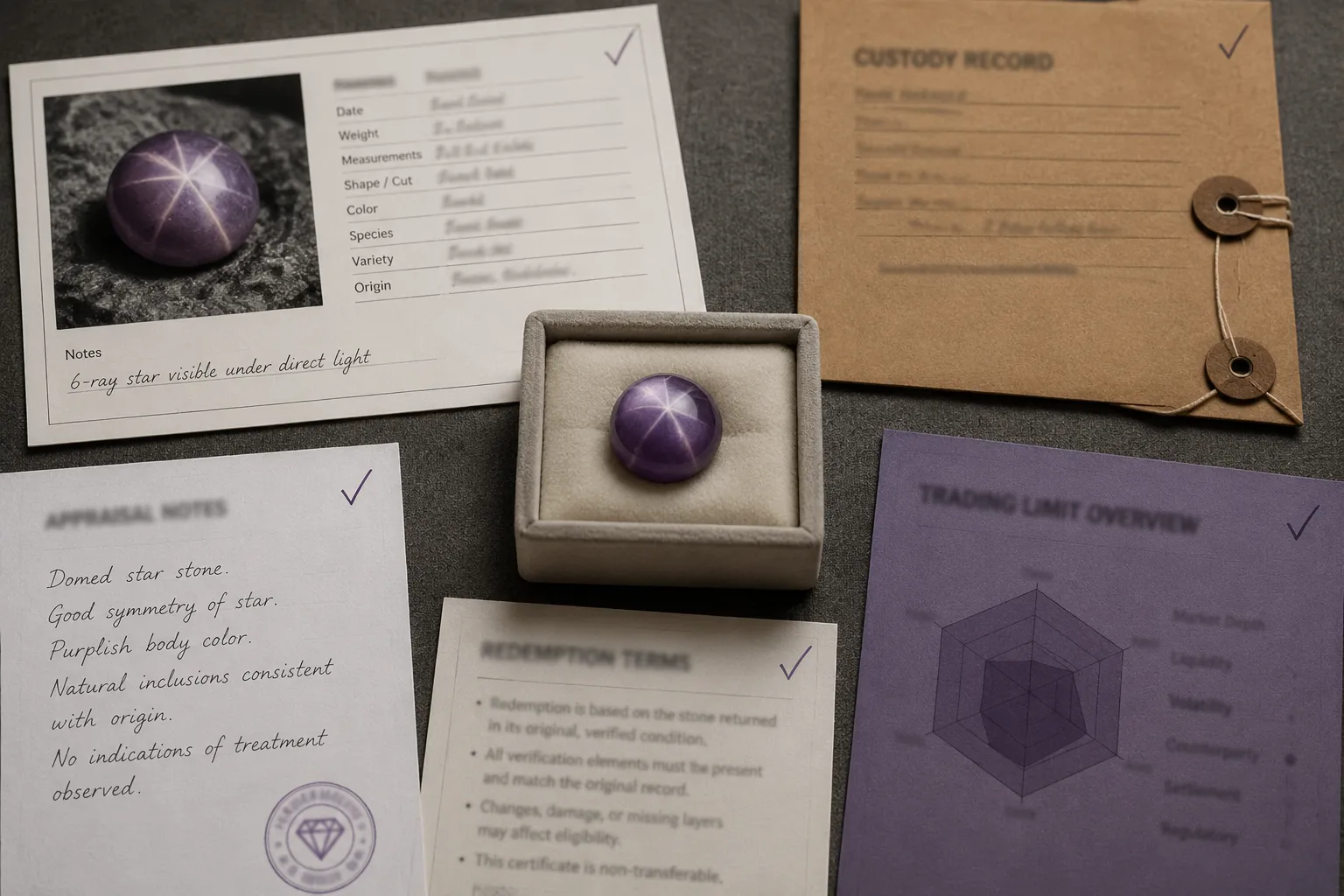
A tokenized gemstone claim should connect to a specific stone, not a vague category such as “rare star sapphire” or “star quartz.” Useful records would name the gem type, weight, cut, visible asterism, condition notes, and identifying documentation.
Asterism also needs careful wording. A star effect under suitable lighting confirms an optical feature. It does not, by itself, establish high value.
Custody must be more than a promise
Star stone custody is central because the token holder usually does not physically possess the gem. Someone must store it, protect it, account for loss or damage, and explain what happens in an insolvency or dispute.
The blockchain may record token transfers, but it does not automatically confirm that the off-chain stone is still present, properly identified, insured, or redeemable. The connection between record and object depends on people, documents, storage controls, and reporting.
Appraisal should be independent enough to matter
A platform’s own valuation is not the same as an independent gemological assessment. The available gemology sources help explain asterism; they do not validate any particular tokenized stone, grade, price, or market claim.
For collectors, a useful appraisal separates identity, visible optical effect, treatment notes where relevant, condition, provenance language, and market value. Vague rarity language gives the token holder little to examine.
Redemption rights need plain terms
Redemption is where token language meets the physical object. Can a holder redeem the stone? Must they hold every fraction? Are there fees, waiting periods, shipping limits, jurisdiction restrictions, or platform approvals?
A non-redeemable token is not automatically useless, but it is a different experience from a claim that can lead to the gem itself. The difference should be visible before anyone relies on the pitch.
Secondary trading must be real, not assumed
Secondary trading is often presented as a major benefit of tokenization. In practice, it depends on market depth, buyer interest, platform rules, transfer restrictions, fees, and trust in the custody and appraisal package.
A token can be technically transferable and still be hard to sell. This matters for unusual gemstones because each stone is specific. Desirability can depend on asterism strength, body color, clarity, cut quality, size, treatment history, documentation, and taste.
Safe-haven and inflation language needs restraint
Some readers meet tokenized star stones through anxiety about fiat inflation or through marketing that frames rare physical assets as safe-haven assets. That language should be treated as a claim needing proof, not as a settled feature of the stone or token.
The available sources do not show that tokenized star stones hedge fiat inflation, preserve purchasing power, or behave like established safe-haven assets. Even a tokenized commodities comparison has limits. A standardized gold-linked product is not the same as a unique gemstone whose value depends on appraisal, buyer taste, custody, platform trust, and exit demand.
There is also a collector’s trap here. Rarity, beauty, and spiritual symbolism can make a stone feel permanent. Asterism can make it feel exceptional. But exceptional visual character is not the same as dependable financial behavior. The collector’s eye and the market’s exit door are separate things.
For spiritually curious readers, the star may carry personal meaning: focus, sky imagery, orientation, or a quiet place in a room arrangement. That symbolic use can be meaningful without becoming an investment thesis.
A simple way to read tokenized gemstone claims
This separation keeps the attraction visible without letting every promise collapse into one claim. A rare-looking stone can be fascinating. A token can be a useful record or market wrapper. A DeFi market can offer transfer tools. None of that removes the need to verify custody, appraisal, redemption, platform risk, smart-contract risk, and actual buyer demand.
So, are tokenized star stones really leading the DeFi crystal boom?
They are leading the story more clearly than they are leading a verified market. Tokenized star stones attract attention because optical asterism gives them visible rarity that fits the imagination of DeFi: a physical object with celestial beauty, wrapped in a transferable digital claim, possibly made usable in on-chain markets.
The exception is the point. Without clear custody, independent appraisal, explicit redemption terms, enforceable rights, and evidence of real secondary trading, the “boom” remains a market narrative rather than a demonstrated asset class. Broader RWA growth can explain why the idea is appearing now, but it cannot prove that star stones themselves are liquid, inflation-resistant, or safe.
Read the star first as a gemological effect, the token second as a claim structure, and the DeFi language third as a set of conditions to verify. That order leaves room for fascination without handing collector judgment over to market haze.