Symbolic transit practice
Amethyst as a Buffer Stone for the Saturn and Neptune Aries Transits
A small amethyst point on a desk does not need to announce itself. Its violet zoning, glassy faces, and pale bands can do a quieter job: interrupting speed. For a reader who already uses astrology and crystal symbolism, amethyst can work as an Astrological transit buffer for the Saturn and Neptune Aries transits only in that symbolic sense—as a ritual pause, a tactile reminder, or a reflective stabilizer before acting on urgency, fear, inspiration, or “cosmic reset” language.
It is not a shield against transits, a prediction tool, or a measurable high-frequency device. The practical use is simpler: let the stone mark the space between impulse and response.

broader context
Amethyst context note
This narrower page lands better after the broader amethyst context page.
What a “buffer stone” means in this practice
Here, a buffer stone is not a force field. It is an object you deliberately assign a role in your practice: slow down, check the story, and choose the next step with more care.
That distinction matters because Saturn and Neptune in Aries can sound dramatic in astrology spaces. Within Western astrology, Saturn is often read through structure, limits, time, responsibility, and consequence. Neptune is often read through vision, fog, surrender, ideals, spirituality, and dissolution. Aries adds action, identity, courage, beginnings, heat, and impulse.
Together, the symbolism can feel like a pressure point: make the vision real, but do not rush blindly; act with courage, but test the ground.
Amethyst fits this practice because crystal culture often associates it with calm, meditation, intuition, and clarity. Those are symbolic associations, not established effects. Gemologically, amethyst is purple quartz; that material identity is the factual anchor. The use of amethyst as a calming symbol is the chosen interpretation.
So the cleanest wording is this: an amethyst transit buffer is a chosen pause object. It gives your hand, altar, planner, or journal a physical cue to stop before Aries-style urgency takes over.
How to use amethyst during the Saturn Neptune Aries transit
Use the specimen in a way that interrupts speed. The Aries part of the symbolism is movement; the amethyst practice should add a small amount of friction before movement becomes reaction.
- Place the amethyst where decisions happen.
Put it near your journal, calendar, laptop, meditation cushion, or bedside table. Let the placement match the place where you tend to move too fast: messaging, planning, spending, declaring, quitting, starting, or confronting. - Name the three transit themes before acting.
Ask: What is Saturn asking me to define? What is Neptune making unclear or inspiring? What is Aries pushing me to begin? This keeps the practice focused on structure, vision, and action rather than vague transit anxiety. - Use the stone as a breath cue.
Hold the amethyst, touch it, or simply look at it before sending the email, making the announcement, booking the trip, or deciding that a feeling is destiny. One slow breath is enough for the practice to become useful. - Write one grounding sentence.
Try: “The vision is ___; the structure needed is ___; the first action I can take without forcing the outcome is ___.” This turns a symbolic crystal buffer into a transit grounding practice. - Return to ordinary judgment.
If the matter involves health, money, legal decisions, safety, work obligations, or a major relationship choice, do not let the transit or the crystal carry the decision. Use appropriate records, timing, professional support when needed, and ordinary accountability.
This is where amethyst is most useful as a reflective stabilizer crystal: not because it changes the sky, but because it gives your practice a repeatable gesture. A crystal ritual for astrology works best when it makes your choices more conscious, not more dependent on signs.
When amethyst is a fitting symbol
Amethyst is a good symbolic choice if your Saturn Neptune Aries transit experience feels mentally hot: too many visions, too much urgency, or a desire to leap before the plan has a container. Its purple color and common meditation associations make it easy to cast as a cooling counterpoint to Aries fire.
It also fits a journal-based astrology practice. Amethyst beside a notebook can become a reminder to separate inspiration from instruction. Neptune may symbolize the dream; Saturn asks for form; Aries wants movement. The stone can sit at the threshold between those three.
It becomes less useful if the “buffer” idea makes you passive. If the thought becomes “the stone will handle the transit,” the symbolism has drifted. Saturn language, even inside astrology, is not usually about avoiding responsibility; it is about meeting limits, commitments, and consequences. A buffer that helps you pause is different from a charm that lets you avoid discernment.
A good test is this: after using the stone, are you more specific? If the practice helps you move from “everything is shifting” to “I need to make one plan, check one assumption, and wait before reacting,” then the symbolic buffer is doing its intended work.
Common confusion around cosmic events and crystals
The most common misunderstanding is that a buffer stone should block difficult energy. That idea appears often in crystal marketing, but it is too strong for the available support. A more useful model is spacing: the stone creates a small symbolic interval between cosmic events as interpreted by astrology and your everyday behavior.
Another confusion is the phrase “high-frequency sync.” If you like that language personally, translate it into something grounded: “I am bringing my attention back to my values before I act.” That keeps the phrase inside reflection rather than making it a claim about physics or guaranteed spiritual performance.
There is also a zodiac boundary worth naming. Western astrology commonly works with twelve signs along the ecliptic, while astronomy deals with observable constellations and planetary positions in the sky. Reference sources on the zodiac and precession note that astrological signs and current astronomical constellations are not the same framework. That does not prevent a reader from using astrology symbolically, but it does mean the practice should be understood as interpretive rather than astronomical proof.
Transit dates deserve the same care. Popular astrology sources may disagree about exact timing, ingress dates, and contact periods for Neptune in Aries or Saturn-Neptune alignments. If timing is central to your ritual calendar, check a reliable ephemeris or almanac rather than repeating a viral date range.
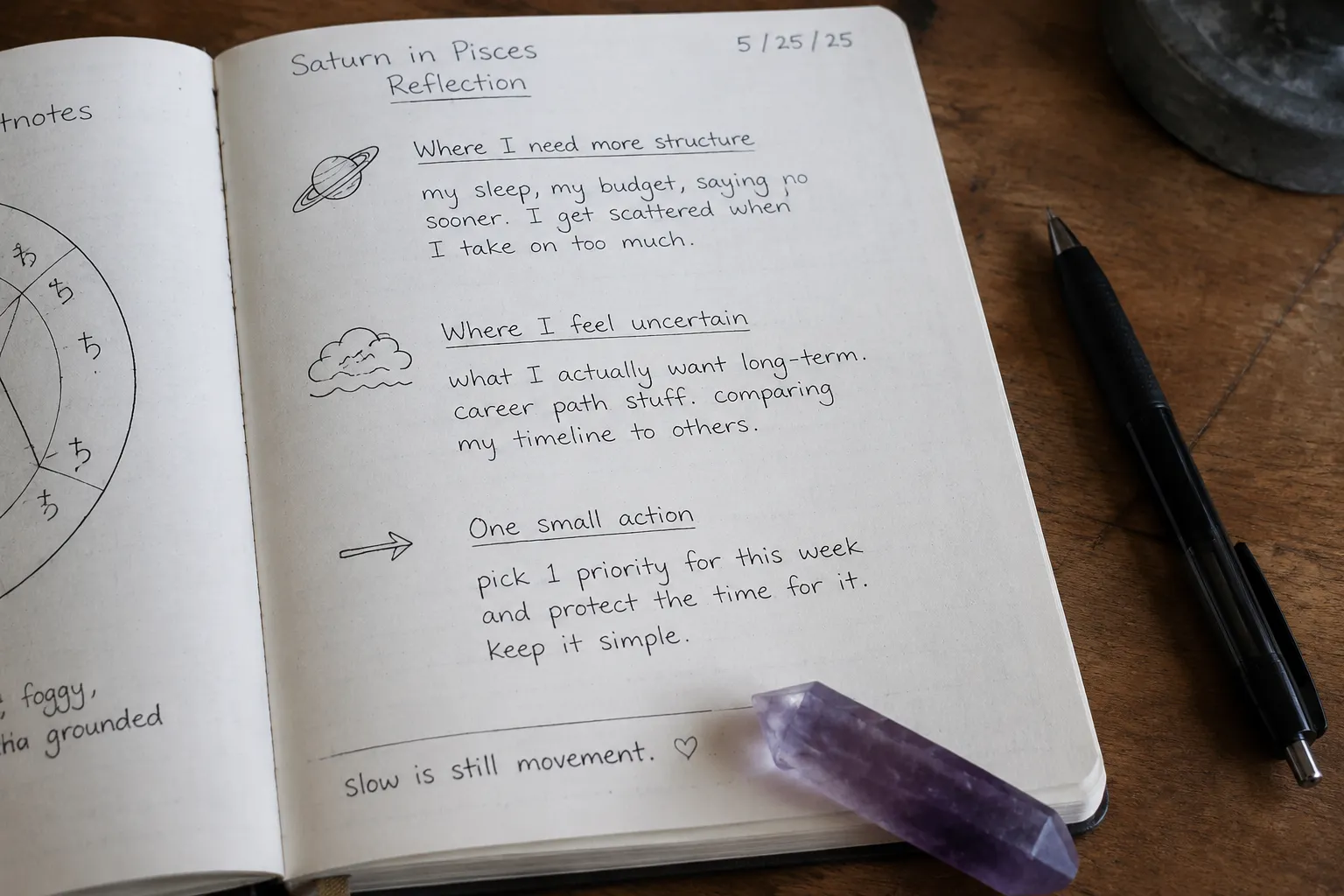
A compact amethyst ritual for Aries transits
Keep the practice short enough to repeat. The point is not to build a complex altar system; it is to make the amethyst a visible checkpoint.
Before action: Hold or touch the amethyst and ask, “Am I responding, or am I reacting?”
For Saturn: Write the limit, deadline, responsibility, or structure involved.
For Neptune: Write the dream, uncertainty, ideal, or fog.
For Aries: Write the action you want to take, then reduce it to the smallest honest first step.
To close: Put the stone down before you decide. That final gesture matters; it reminds you that the crystal is a cue, not the decision-maker.
For example, if you feel called to launch a project during a Saturn Neptune Aries transit period, the amethyst practice might look like this: sit with the stone, name the inspiration, list the required structure, and choose one action that can be completed today without overpromising. The symbolic crystal buffer is the pause before the declaration.
If the transit language you are hearing online feels inflated—world-changing predictions, identity-shift certainty, or dramatic energy talk—use the same practice to return to scale. What is actually happening in your calendar, your body, your relationships, and your obligations today? Amethyst can mark that return to proportion.
The evidence limit, stated plainly
The material claim is modest: amethyst is purple quartz. The symbolic claim is also modest: many crystal users associate amethyst with calm, meditation, intuition, and clarity, and a person can choose to use it as a ritual pause during transits.
What is not supported is the stronger claim that amethyst can measurably protect someone from Saturn, Neptune, Aries, planetary transits, or cosmic events. The available sources do not validate amethyst as a transit shield, frequency stabilizer, prediction tool, or outcome-changing object. Astrology and crystals also should not replace medical, mental-health, legal, financial, or safety advice from qualified support.
That does not make the practice meaningless. It places it in the right category. If you already speak the language of astrology and crystals, amethyst can be a meaningful reminder to slow the Aries rush, test Neptune’s vision, and give Saturn a plan. Keep the specimen on the desk, altar, or journal where it can do that small human job; let the quartz remain a crystal, and let the meaning remain chosen.