Amethyst Thermal Threshold
The 400°C Threshold: When Amethyst Permanently Morphs Into Citrine
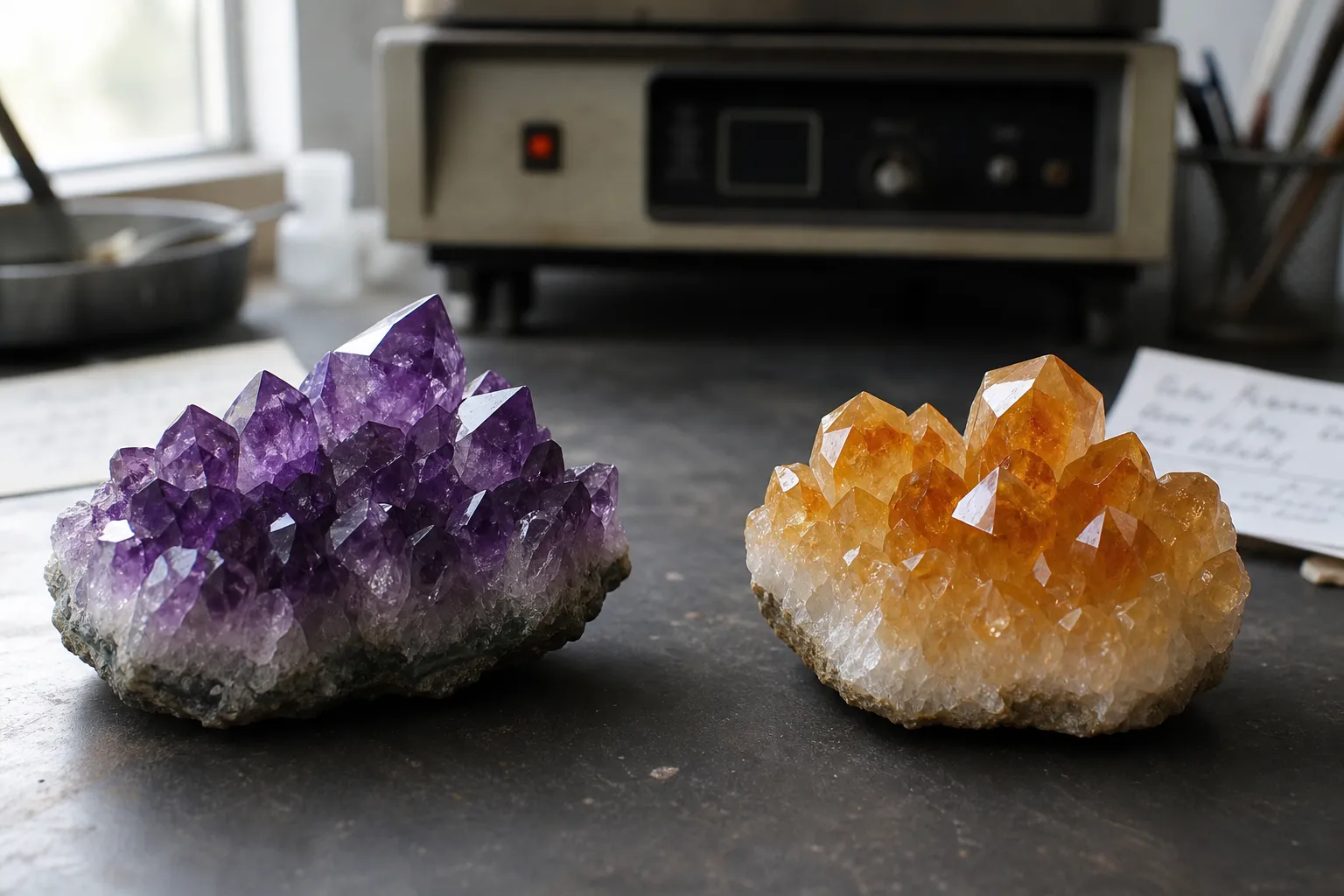
The Amethyst Thermal Threshold is not a clean switch. It should not be read as “every amethyst becomes citrine at exactly 400°C.” A more useful reading is this: high heat is often discussed as a reason some amethyst can shift toward a lasting yellow, orange, or brownish citrine-like color, but the outcome depends on the specimen and the treatment history.
So the direct answer is cautious: heat can be part of an amethyst-to-citrine color story, but 400°C is a simplified reference point, not a universal cutoff, not a home experiment target, and not proof that a stone has become citrine in every meaningful sense.
broader context
Amethyst context note
This narrower page lands better after the broader amethyst context page.
What the 400°C Idea Is Trying to Describe
People usually search this question because they want to know whether purple amethyst can become yellow or orange citrine after enough heat.
In gem-market language, heat treatment is often linked with amethyst color change. Some purple material may move toward colors associated with citrine. But the phrase “400°C threshold” compresses too much into one number. It makes the process sound more predictable than the available source basis allows.
A true threshold would imply a clean line: below it, no major change; above it, a reliable result. That is too strong for this page’s evidence boundary. Temperature, duration, material variation, treatment environment, and final appearance all matter. Naming also matters: a yellow-orange stone, a naturally colored citrine, and a heat-altered amethyst-like specimen are not automatically the same thing in collector language.
The useful takeaway is simple: high heat can be relevant to permanent amethyst color shift discussions, but the 400°C framing should be treated as shorthand, not a mineralogical rule.
Why “Amethyst Into Citrine” Is Too Tidy
“Amethyst into citrine” sounds like a neat before-and-after: purple stone goes in, golden stone comes out. That version is memorable, but it skips the parts collectors usually care about.
Color is only one part of the identity question. A stone may look citrine-like after treatment, but readers may still want to know whether the color was natural, induced, disclosed, stable, or commercially simplified. In everyday listings, “citrine” may be used for appearance. In collector-minded descriptions, origin and treatment history matter too.
That is where confusion starts. A seller may emphasize the yellow-orange color. A collector may ask whether the material began as amethyst. A mineral reader may wonder what changed inside the quartz. Those are related questions, but they are not the same question.
For this page, the bounded answer is: heat can be part of the color-change story, but the 400°C amethyst cutoff should not be treated as a universal identity rule.
What Affects the Answer Besides Temperature
Temperature alone is not enough to explain amethyst color change. Without stronger public sources for this specific page, precise claims about thermodynamics, color-center chemistry, iron states, duration effects, or thermal stability should stay limited.
Still, the main variables are easy to understand:
- Starting material matters. Pale, dark, zoned, or internally varied amethyst may not respond in the same way.
- Treatment conditions matter. A temperature number without time, environment, equipment, and handling context is incomplete.
- Final color matters. Yellow, orange, brownish, or greenish outcomes may be discussed differently.
- Naming standards matter. “Citrine-like color,” “heated citrine,” “heat-treated amethyst,” and “natural citrine” do not carry the same disclosure meaning.
- Evidence matters. Color alone may not prove how the specimen got that color.
This is also why citrine and prasiolite should not be placed on a simple temperature ladder. They often appear in the same heat-treatment conversation, but that does not make their outcomes predictable from one quoted number.
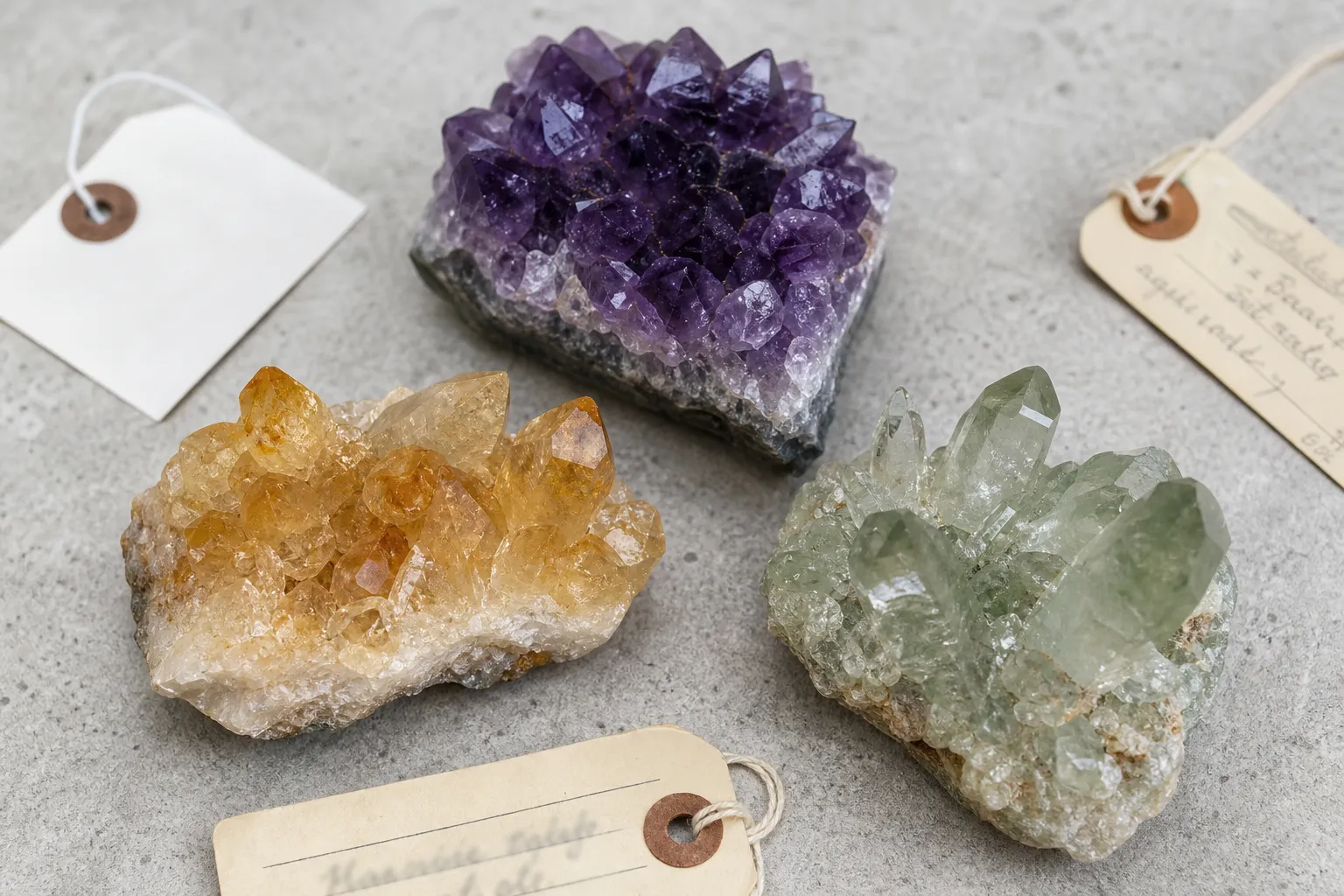
Citrine, Heated Citrine, and Prasiolite Confusion
The common mistake is mixing appearance, origin, and treatment into one label.
Amethyst is the purple quartz readers start with. Citrine is the yellow-to-orange word often used when the color changes in that direction. Prasiolite enters the conversation because green quartz outcomes are sometimes discussed beside heated amethyst and citrine outcomes.
A careful collector’s question is not only “What color is it now?” It is also “How did it get that color, and is that history being disclosed?”
That is the practical difference between a color label and a treatment-aware description. If heat treatment is known or suspected, the color name alone may not tell the whole story. Highly simplified charts, seller claims, anonymous anecdotes, and short transformation clips may explain why the question is popular, but they are not enough to establish firm mineralogical rules.
What Can Be Said About Permanence
“Permanent” needs a narrow meaning here. Readers usually mean: if amethyst shifts toward citrine-like color, does it stay that way?
A cautious answer is: some heat-associated color changes may be described as lasting, but this page cannot support the claim that every amethyst heated beyond 400°C permanently becomes citrine.
A better way to frame it:
- If a specimen has undergone a stable heat-related color change, it may be treated as a changed specimen rather than a temporary surface effect.
- If the treatment history is unknown, the color alone may not prove what happened.
- If an exact cutoff is claimed, the claim needs stronger support than market language.
- If citrine or prasiolite outcomes are presented as guaranteed by temperature, treat that as oversimplified.
This is less dramatic than “amethyst permanently morphs into citrine at 400°C,” but it is more useful. It separates the reader’s real concern—color identity after heat—from the unsupported certainty of one universal number.
Why This Is Not a Heat-Treatment Guide
This page is not a set of amethyst heat-treatment instructions. It does not give kiln settings, torch methods, timing recipes, home experiments, or specimen-handling steps.
That boundary is intentional. High-temperature treatment can involve burn, fire, fracture, equipment, and material risks, and practical guidance would need a stronger safety-aware source base than this page currently has.
For a gem reader, the better use of the 400°C idea is interpretive. It helps explain why heated amethyst, citrine-like results, and prasiolite discussions often appear together. It should not be turned into a procedure.
If you are evaluating a specimen, ask identification questions instead:
- Is the color being described by appearance only, or also by origin?
- Is heat treatment disclosed?
- Is “citrine” being used as a color word or as a treatment-aware gem description?
- Is an exact temperature claim supported by a credible source?
- Is prasiolite being folded into an overly simple heat sequence?
Those questions keep the focus on understanding the stone, not trying to reproduce a result.
The Practical Answer for Collectors
For collectors, the 400°C threshold is best understood as a warning against overconfidence. It signals that heat can matter, but it does not prove that one exact temperature decides a specimen’s identity.
If purple amethyst has been heated and now appears yellow, orange, or citrine-like, it may be reasonable to discuss it as heat-treated amethyst or heated citrine, depending on the disclosure language and cataloging standard being used. But a broad claim that “amethyst becomes citrine at 400°C” is not enough by itself.
A more careful sentence is:
“Some amethyst is discussed as capable of shifting toward citrine-like color under heat treatment, but 400°C should be treated as a simplified reference point rather than a universal cutoff.”
That keeps the useful idea without overstating the science.
Bottom Line
The 400°C figure is not a magic boundary. It is a simplified search-language hook around a real reader question: whether heat can permanently shift amethyst toward citrine-like color.
The answer is cautiously yes in concept, but not as an exact, universal, or guaranteed rule. The specimen, treatment conditions, resulting color, disclosure history, and naming standard all change the answer. Until stronger mineralogy, gemology, materials-science, and safety-aware sources are added, the Amethyst Thermal Threshold is best treated as a bounded explanation—not a recipe, not a promise, and not a final identity test.