Liquid Inclusions: The Hidden Reason Amethyst Explodes in Heat
Amethyst is quartz, but that does not mean every amethyst piece is internally simple. Gemstone liquid inclusions are tiny pockets of trapped fluid inside a crystal. When amethyst is heated, those fluids may expand, vaporize, or create local pressure. If the surrounding quartz already has fine cracks, cavities, strain, or thin edges, that pressure can help a fracture open suddenly.
So when people say amethyst “explodes” in heat, the careful meaning is not a chemical explosion. It means sudden cracking, bursting, spalling, or small-fragment release in a particular heated specimen. It is possible in some stones, not guaranteed in all amethyst.
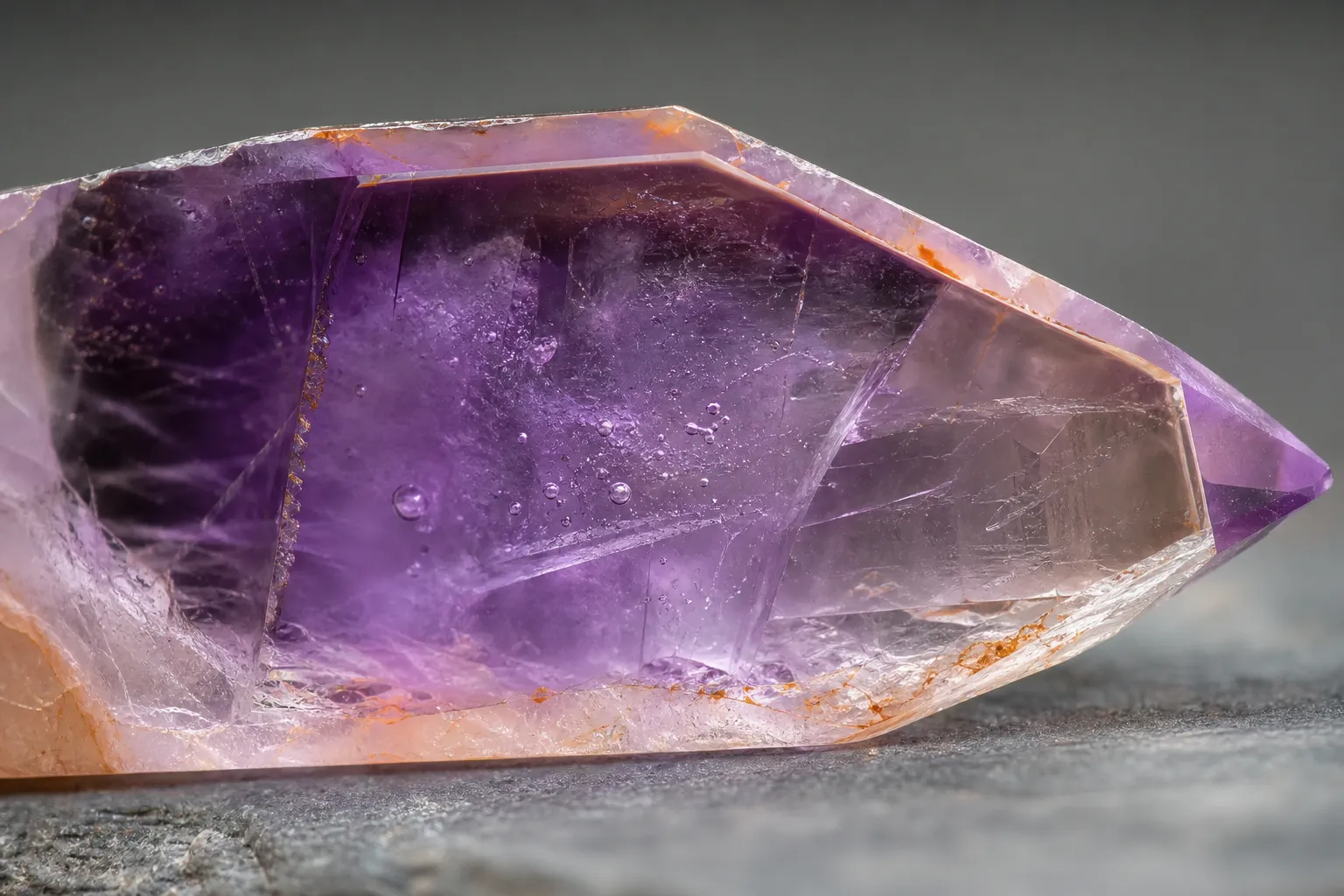
Why “amethyst is quartz” does not settle the question
The confusion is understandable. Amethyst is the purple variety of quartz, and quartz is hard and durable in many ordinary uses. That is why amethyst appears in jewelry, carvings, geodes, beads, and display pieces.
But mineral identity is only the starting point. It does not tell you whether one pendant, cluster, tower, geode lining, or tumbled stone contains:
- trapped liquid or liquid-vapor inclusions;
- resealed growth cracks or later stress fractures;
- tiny cavities from earlier inclusion changes;
- cutting, drilling, polishing, or impact damage;
- uneven thickness that heats at different speeds;
- unknown prior heat treatment.
Quartz can be stable as a mineral category while a specific amethyst specimen is still vulnerable because of its internal structure. Heat acts on the actual stone in your hand, not on a textbook mineral name.
What liquid inclusions are inside amethyst
In gemology, an inclusion is a material or feature enclosed within a gemstone. It can be a crystal, void, growth feature, fracture, or fluid-bearing pocket. In quartz and amethyst research, fluid inclusions are described in several forms, including liquid and liquid-vapor inclusions, often connected with growth zones or resealed micro-fractures.
For an owner, the key point is simple: a crystal can look solid while holding sealed microscopic compartments.
Those compartments may be too small to see without magnification. A clear stone is not automatically inclusion-free, and a cloudy stone is not automatically unsafe. Clarity gives clues, not certainty.
When an inclusion contains fluid, the fluid is trapped by surrounding quartz. At normal room conditions, it may sit there without any obvious effect. Under heat, the balance changes. The fluid and the host crystal may not respond to temperature in the same way. If the fluid expands, changes phase, or builds pressure faster than the quartz can accommodate, that inclusion becomes a stress point.
That matters most when the stress point sits near an existing weakness: a fine crack, damaged surface, thin edge, cavity, or cluster of inclusions. The risk is local, not general.
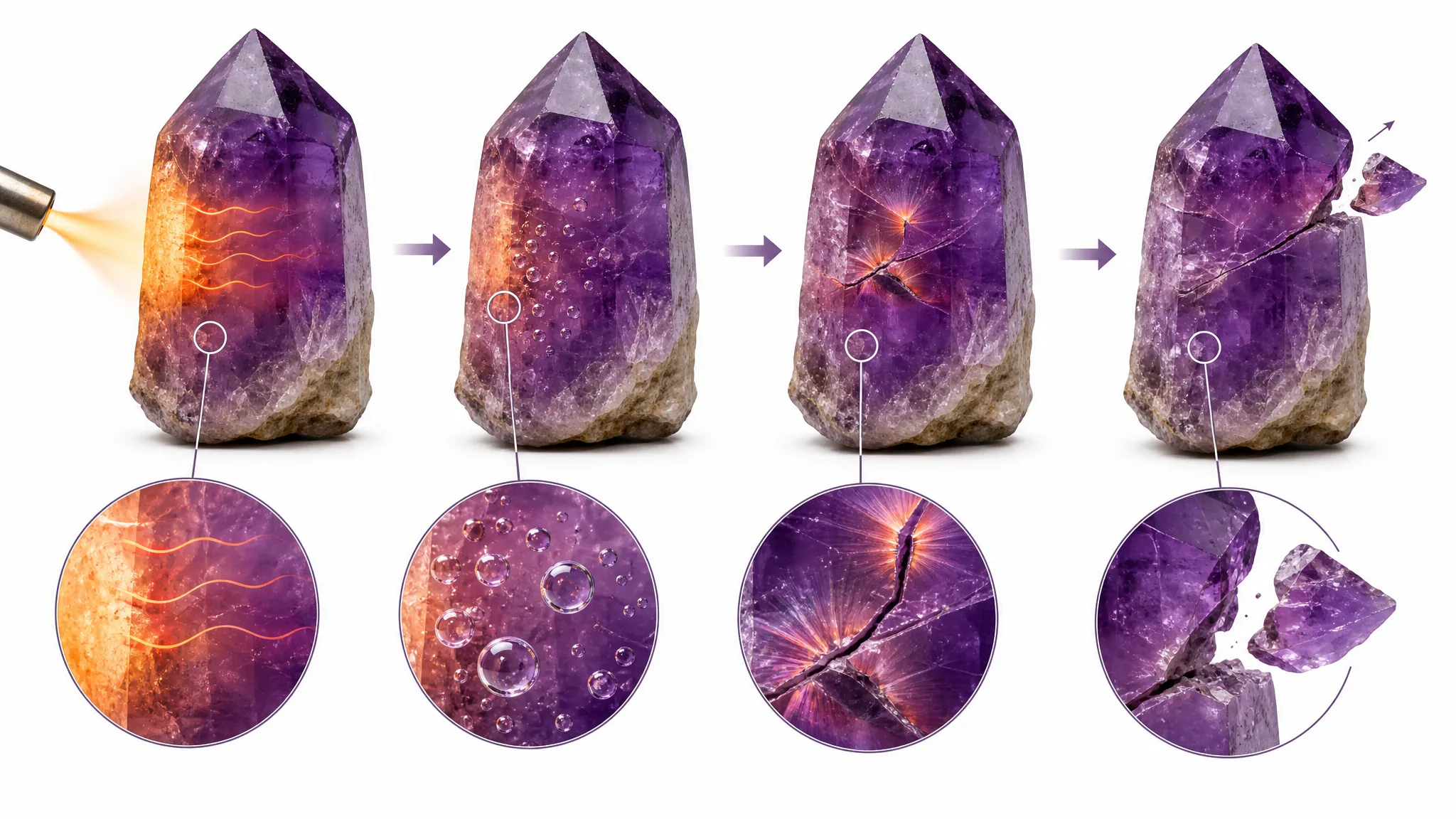
How heat can turn an inclusion into a fracture
The process is better understood as a chain than as one dramatic event.
- First, heat enters the amethyst unevenly. A small bead, thick point, geode slab, and crystal cluster will not warm in the same pattern. Surfaces may heat before interiors, and thin parts may change temperature faster than bulky parts.
- Second, trapped fluids respond. Quartz and silica studies describe fluid inclusions, volatile release, and internal pressure changes during heating. In technical language, abrupt rupture or release from inclusions is often discussed as decrepitation.
- Third, the surrounding quartz has to absorb the local stress. If nearby areas already contain micro-fractures, cavities, impurity zones, uneven surfaces, or prior damage, pressure can encourage cracks to grow. The starting flaw does not need to be a dramatic visible line.
- Fourth, the release can be sudden. That is the moment an owner may describe as “exploding.” More precise words are cracking, bursting, spalling, fragment release, or sudden fracture.
This is why neither extreme is accurate. “Amethyst is quartz, so heat is always fine” is too casual. “All amethyst will explode” is also wrong. The realistic answer is narrower: liquid inclusions in amethyst can make heat exposure less predictable, especially when the specimen also has micro-fractures or other weak zones.
What changes the risk from one amethyst to another
Two purple quartz pieces can share the same mineral name and still behave differently under heat. The main variables are practical ones.
Visible cracks, chips, or drilled areas
These are stress concentrators. Heat can make an already weak zone more important.
Cloudy veils, feathers, or internal lines
These features may be harmless visually, but they can also mark zones of fractures, inclusions, or growth irregularity. They are not a home diagnosis; they are a reason to be cautious.
Geodes and clusters
Clustered amethyst often has many tips, attachment zones, thin edges, and uneven surfaces. Those shapes can heat unevenly and may contain natural growth features.
Unknown treatment history
Some amethyst is heated intentionally in gem and mineral contexts, often for color change. That does not translate into a safe household method. A seller description usually does not tell you enough to predict fracture behavior.
Heating style
Controlled laboratory heating, industrial quartz processing, a candle flame, an oven, boiling water, a hot car dashboard, and a radiator are different conditions. The available evidence does not give a simple consumer temperature line between “safe” and “unsafe.” Sudden temperature change and uneven heating are the concerns to avoid.
Inclusion type and position
A fluid inclusion deep in a thick area is not the same as one near a surface, crack, or edge. Most owners cannot identify this confidently without gemological examination.
The practical conclusion is conservative: if the internal condition is unknown, do not use heat as a test, cleaning method, ritual practice, or display condition.
Common misunderstanding: heat does not prove a crystal is real
A lot of risky handling starts with casual advice.
One common claim is that a “real crystal” should tolerate flame, boiling water, strong sun, or other stress. That is not a reliable authenticity test. Real minerals can still crack. Natural, synthetic, treated, assembled, or dyed stones cannot be separated safely by dramatic home heating.
Another source of confusion is decorative or symbolic handling language around “charging,” “cleansing,” or placing crystals near candles. People may use those terms in personal practice, but they are not evidence that heat is harmless to the stone. Symbolic use and mineral behavior are different categories.
A third mistake is treating inclusions as only cosmetic. Inclusions can be beautiful, collectible, and useful for gem observation. But they are still physical features. If an inclusion contains fluid and the stone is heated, it becomes part of the stress system inside the quartz.
This does not mean amethyst is too fragile to own or display. Normal room display is very different from flame exposure, oven heating, thermal shock, or placing a specimen against a strong heat source.
What the evidence can and cannot say
The evidence supports the mechanism, not a precise prediction for your stone.
Gemological and mineralogical references support the identity point: amethyst is quartz, and inclusions are normal gemological features. Amethyst and quartz studies show that fluid inclusions can occur in quartz-family materials. Heating studies on quartz and silica materials support the physical pathway: trapped fluids can build pressure, release volatiles, rupture, and contribute to cracking under heating.
The limits matter. The available sources do not provide controlled tests of consumer amethyst jewelry, clusters, beads, geodes, towers, or tumbled stones under everyday household heating conditions. They do not give a probability that your stone will break. They do not establish a safe oven temperature, boiling-water rule, or sunlight threshold. They also do not show that every amethyst contains risky liquid inclusions.
A sound answer stays inside that boundary:
- amethyst is quartz, but each specimen has its own internal structure;
- liquid inclusions can create local pressure when heated;
- pressure can interact with micro-fractures and weak zones;
- sudden cracking or fragment release is physically plausible in some heated specimens;
- home heat testing is not a sound way to judge authenticity or durability.
If the amethyst is valuable, sentimental, visibly fractured, mounted in jewelry, or combined with other materials, avoid heat experiments and ask a qualified gem or jewelry professional before any cleaning or treatment involving temperature change.
A simple rule for owners
Treat amethyst as durable enough for careful ownership, not immune to heat.
Do not assume a stone is safe to heat because it is quartz. Do not assume every inclusion-like feature means it will break. The more useful middle position is this: hidden fluids, cavities, and micro-fractures can make heated amethyst unpredictable, and most owners cannot see enough to judge that risk at home.
If a practice depends on flame, aggressive warming, oven heating, hot-water shock, or placing amethyst close to a strong heat source, skip it. The possible benefit is small; the potential damage to the specimen is real.