Provenance and sourcing
From Mine to Finger: Why Blockchain Provenance Matters in 2026
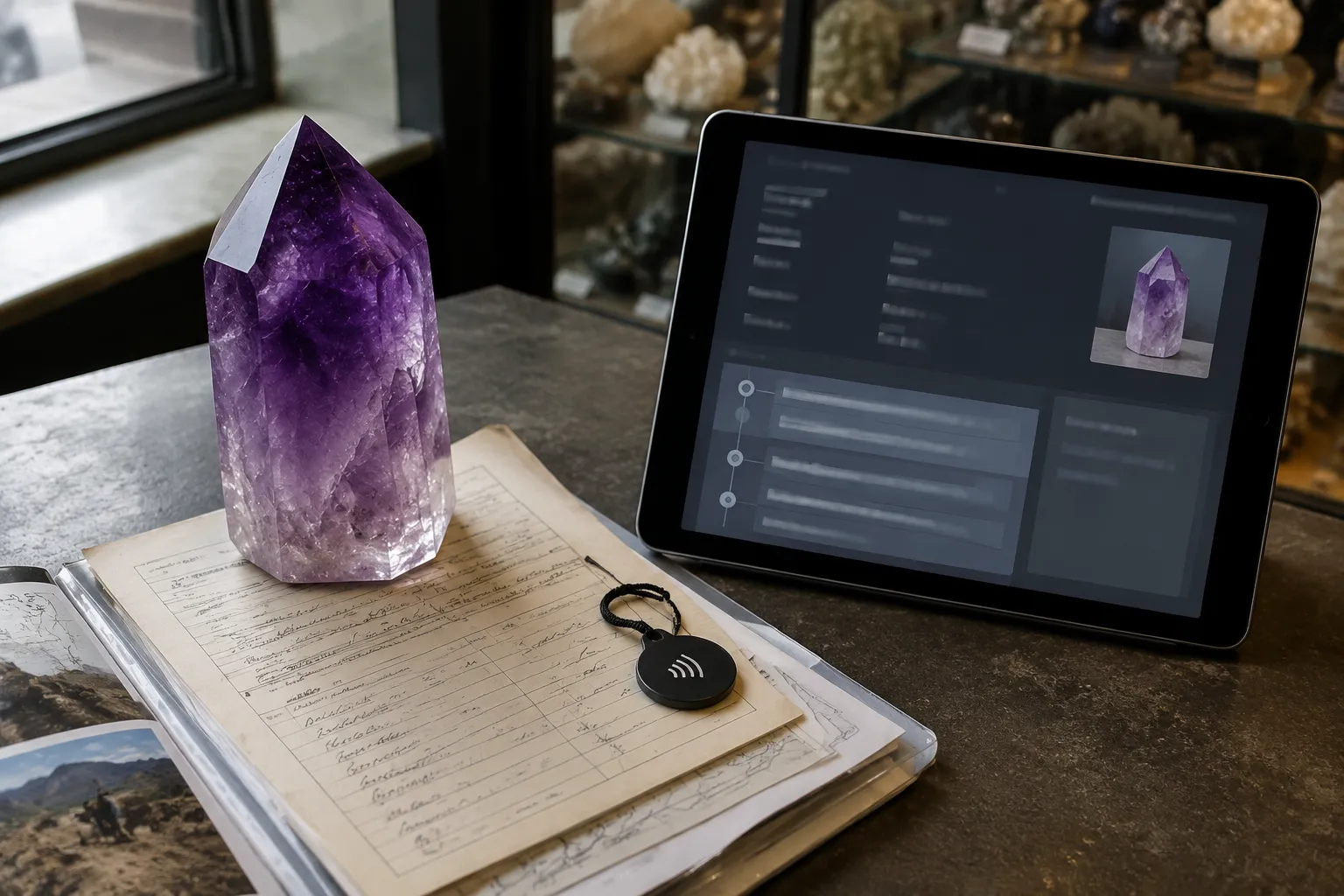
A violet amethyst point can look settled on a shelf while carrying a harder question: who handled it before it reached your hand? In 2026, blockchain provenance matters for Ethical Crystal Sourcing because it can turn a seller's origin story into a more structured, inspectable record. A digital passport may show where recording began, which transfers were documented, and whether the record follows an individual stone or only a batch.
That is useful, but it is not the same as proof that the crystal was mined under fair labor conditions, handled responsibly at every step, or fully traced from mine to finger. Blockchain helps most when it sits inside real supplier due diligence: documented transfers, chain of custody controls, verification outside the ledger, and a seller willing to name what is still unknown.
broader context
Amethyst context note
This narrower page lands better after the broader amethyst context page.
What Blockchain Can Actually Add to a Crystal Provenance Claim
For a crystal buyer, the strongest use of blockchain is not glamour. It is record discipline.
A blockchain provenance record can preserve a sequence of supply chain events: a claimed origin, a transfer from mine or first supplier, a processing step, a dealer handoff, a certificate reference, or a retail sale. Depending on the system, a buyer may see this through a QR code, NFC tag, or digital passport attached to the specimen, parcel, or batch. The record can make a claim easier to inspect than a vague label that says "ethically sourced" with no visible trail.
That matters because many crystal provenance claims are still conversational. A seller may say a piece is from Brazil, Uruguay, Zambia, or another source area; the claim may be sincere, but the buyer still has to ask how that information traveled with the stone. In responsible mineral sourcing frameworks, traceability and transparency sit inside broader due diligence: companies identify risks, document controls, respond to problems, and keep records that can be reviewed. Blockchain can support the recordkeeping side of that work. It cannot replace the work.
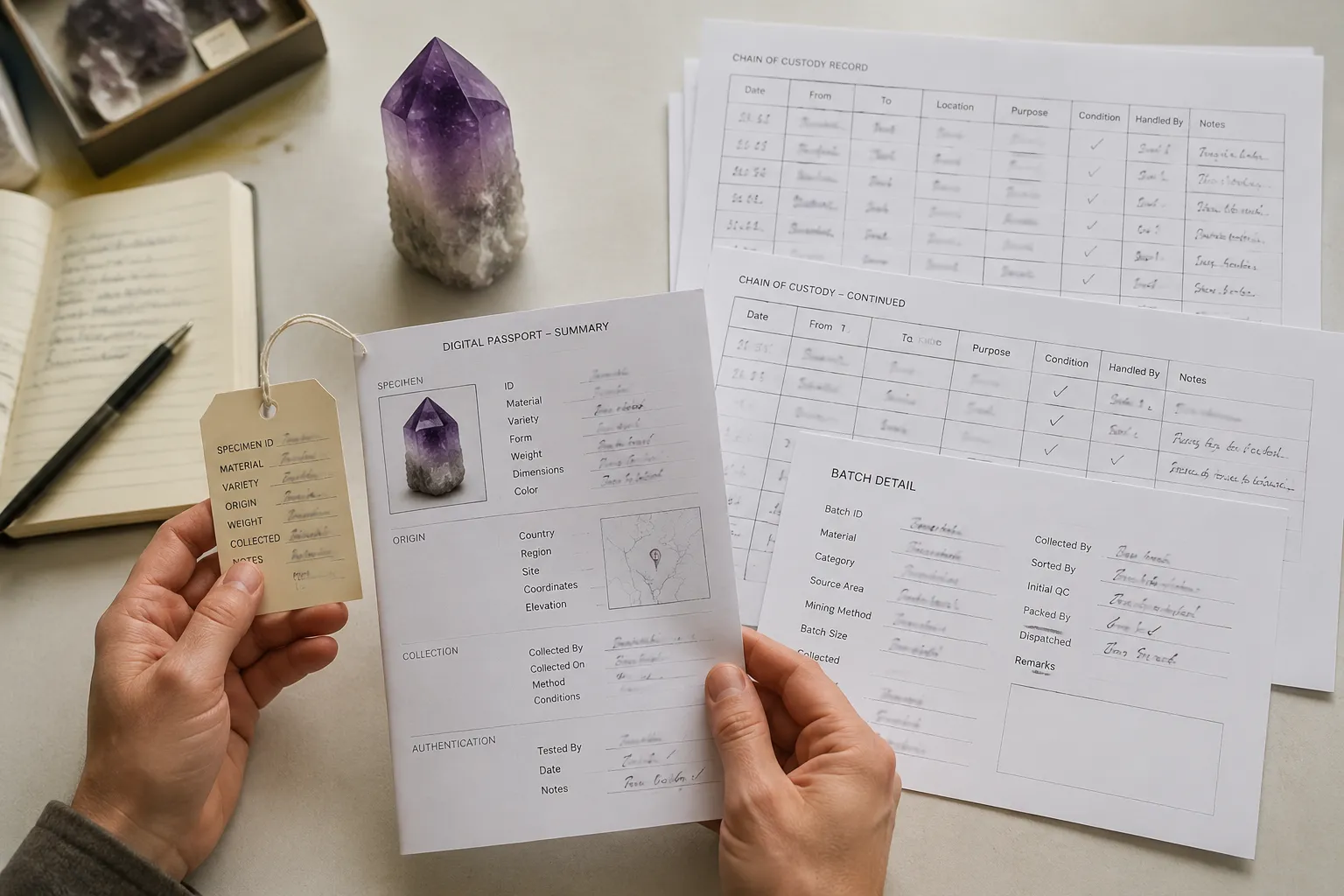
The same distinction appears in chain-of-custody language used in jewelry and mineral contexts. Provenance is stronger when transfers are documented: who had custody, what was transferred, how identity was preserved, and where the next handoff occurred. A consumer-facing passport is only the front window. The structure behind it matters more than the shine of the interface.
For amethyst, the object may be a single polished point, a cluster, a geode section, a bead strand, or a small tumbled stone. A passport that follows one identifiable specimen is different from a record attached to a mixed batch. Both can be useful, but they answer different questions. The first may help you inspect the path of that individual crystal; the second may describe a parcel, production lot, or supplier shipment.
The Buyer Test: What Was Recorded, and Where Did the Trail Begin?
A digital passport is only as useful as its starting point. If recording begins at the retailer, it may tell you about the final sale but little about mining conditions. If it begins with a cutting workshop, the mine or first trader may still sit outside the visible record. If it begins at a mine or known first supplier, the route is clearer, but the buyer still needs to know who entered the information and what checks supported it.
Before treating a blockchain-backed claim as meaningful, ask six practical questions:
- What exact object does the passport identify: an individual crystal, a parcel, a batch, or a finished jewelry piece?
- Where does the record begin: mine site, first supplier, exporter, cutter, wholesaler, retailer, or later?
- Who entered each event, and what relationship do they have to the seller?
- What chain of custody information is visible, and which parts of the mine-to-finger journey are missing?
- Are there audits, supplier due diligence documents, gemological reports, invoices, or other checks behind the entries?
- Can the physical crystal still be linked to the digital record through a tag, inscription, sealed package, batch control, or other method?
These questions keep the technology in its proper place. Blockchain can make later editing harder and can create a shared record among participants, but it cannot make a weak first entry stronger. If the original data is incomplete or self-reported without review, the ledger preserves that weakness neatly.
This is where collector literacy meets ethical concern. An amethyst's color zoning, crystal habit, polish, or matrix can help you read the specimen as a material object, but those features do not reveal labor conditions. A digital record may help with origin tracing, yet origin is not the same as fair labor. A country, region, or mine name can narrow the question; it does not answer every ethical question.
Digital Passport, Chain of Custody, and Due Diligence Are Not the Same Thing
The terms often travel together in seller language, but they are not interchangeable.
Digital passport
A digital passport is a digital identity or record attached to a physical object. It may be accessed through a QR code, NFC chip, or similar tool. In a detailed system, it can collect information about origin, handling steps, ownership changes, certificate references, repairs, or sustainability-related claims. In crystal retail, do not assume all of those fields are present. Some passports may be detailed; others may be a thin marketing page with a polished interface.
Blockchain provenance record
A blockchain provenance record is a record layer. It can make entries time-stamped, shared, and harder to quietly change. Research on jewelry and mineral supply chains often treats blockchain as a possible traceability mechanism across participants, while also noting adoption, governance, and data-quality challenges. That is the useful middle ground: stronger records can help, but participation and evidence decide how much they help.
Chain of custody
Chain of custody is the documented control and transfer of an item or material through the supply chain. If a crystal changes hands five times but only the last two transfers are recorded, the passport may still have value, but it is not a full mine-to-finger record. If stones are mixed, recut, polished, restrung, or separated from tags, the link between the physical object and the digital identity can weaken.
Responsible sourcing due diligence
Responsible sourcing due diligence is broader than all of these. OECD mineral guidance frames responsible supply chains around identifying and managing risks, documenting decisions, improving transparency, and creating accountability. A blockchain record may support that system. It is not the system itself.
For a buyer, the distinction is simple: a passport can show what someone chose to record; due diligence asks whether the right risks were investigated and acted on.
Where Blockchain Helps, and Where It Still Leaves Uncertainty
Blockchain is most useful when a seller is already doing the hard work: identifying suppliers, keeping records, separating goods carefully, documenting transfers, and explaining what is unknown. In that setting, a digital passport can reduce fog. It can help you compare a general "ethical" claim with a more specific account: source, date, transfer path, batch identity, and supporting documents.
It may also reduce a common certificate problem: claims becoming detached from the goods they were meant to support. In some supply chains, a certificate, origin statement, or sustainability claim can be reused too loosely, attached to the wrong parcel, or presented without a clear product link. A well-designed digital system can make that mismatch easier to notice, especially when the record is tied to a specific item or controlled batch.
But uncertainty remains. The strongest public evidence for blockchain traceability comes from responsible mineral guidance, jewelry chain-of-custody standards, gemstone traceability discussion, and adjacent product passport systems. That does not show that the crystal market has broad, reliable blockchain verification for amethyst or other stones. Crystals often move through fragmented supply chains, small dealers, mixed parcels, informal relationships, and lower-value unit sales where detailed tracking is harder to maintain.
There is also a difference between authenticity checks and ethical checks. A passport may help connect a specimen to a claimed source, report, or batch. It may support a seller's origin tracing. It does not automatically verify treatment status, labor practices, environmental practice, or the conduct of every intermediary. Those claims need their own support.
For spiritually curious buyers, the boundary is worth keeping clean. A stone may be chosen for beauty, atmosphere, personal ritual, or symbolism; those uses do not turn a provenance claim into proof. Ethical sourcing uncertainty is a material supply-chain question, not a feeling that can be resolved by the look of the crystal.
Common Confusion Around "Transparent," "Immutable," and "Ethical"
Seller language often uses words that sound stronger than the record underneath them. "Transparent" may mean the buyer can see some data, not that the whole supply chain is visible. "Immutable" may mean entries are difficult to alter once recorded, not that the entries were correct when first entered. "Ethical" may describe an aspiration, a supplier policy, a limited review, or a marketing position; without detail, the word is too broad to carry much weight.
The main confusion is the idea that blockchain equals trust. A better phrasing is that blockchain can support inspection. Trust still depends on who participates, what they record, how identity is preserved, and whether there are checks outside the system. If the mine is absent, the first supplier is unnamed, or the record begins after export, treat the passport as partial.
Another confusion comes from diamonds, luxury goods, and electronics. These sectors are often used to explain digital passports because high-value objects can justify more elaborate tracking. They are useful comparisons for mechanism, not proof that crystals have the same maturity. A diamond-sector platform or luxury passport example can show what a record might look like; it should not be treated as evidence that a small amethyst point has equivalent verification.
Paper documents are not automatically weak, either. A credible invoice trail, supplier declaration, gemological report, or chain-of-custody document may be more meaningful than a sleek passport with sparse entries. The real comparison is not paper versus blockchain. It is specific, reviewable documentation versus vague claims.
A Practical Reading of a Blockchain Crystal Passport
When you scan a passport for an amethyst, read it as a question sheet rather than a verdict.
Look first for the identity of the object. If the record says "amethyst batch," the passport may not follow your exact point or cluster. If it names an individual specimen, check how that identity stayed attached during cutting, polishing, shipping, and retail display. Small stones and bead strands are especially vulnerable to batch-level claims being presented as individual histories.
Then look for the earliest recorded event. A strong passport should make the starting point clear. "Entered by retailer" is not the same as "recorded at mine." "Origin: Brazil" is not the same as a documented supplier chain. "Known source" is not the same as visible chain of custody information.
Next, separate the types of claims. Origin, authenticity, treatment, labor practice, environmental practice, ownership, and spiritual meaning are different categories. A passport may speak to one and remain silent on the others. If a seller uses one record to imply all of them, ask for the missing support.
Finally, notice how the seller responds to uncertainty. A careful supplier can say where the trail is strong and where it is incomplete. That kind of answer is often more useful than a perfect-sounding phrase. In ethical crystal sourcing, honest limits are part of the evidence.
So, Should Blockchain Influence Your Crystal Purchase?
Yes, but only as one layer of judgment. A blockchain-backed digital passport can make an amethyst provenance claim easier to inspect, especially when it records documented transfers and controls from an early point in the supply chain. It can help you ask sharper questions and compare sellers with more than a mood of trust. That is a real improvement over unsupported origin language.
It should not be treated as a guarantee. The buyer-facing standard is still practical and exacting: what was recorded, who recorded it, when the record starts, whether it follows the individual stone or batch, what verification exists, and what remains outside the passport. If those answers are thin, the technology is thin too.
For a purple quartz specimen chosen for a room, an altar shelf, or a careful collection, blockchain provenance is best understood as a lamp on the paperwork, not a moral conclusion about the stone. Let the record clarify what can be traced; let supplier due diligence and authenticity checks carry the harder burden; let any symbolic meaning remain a personal choice rather than proof of the mine-to-finger story.