Collector field note
Color Zoning: The 10-Second Test for Natural Crystal Points
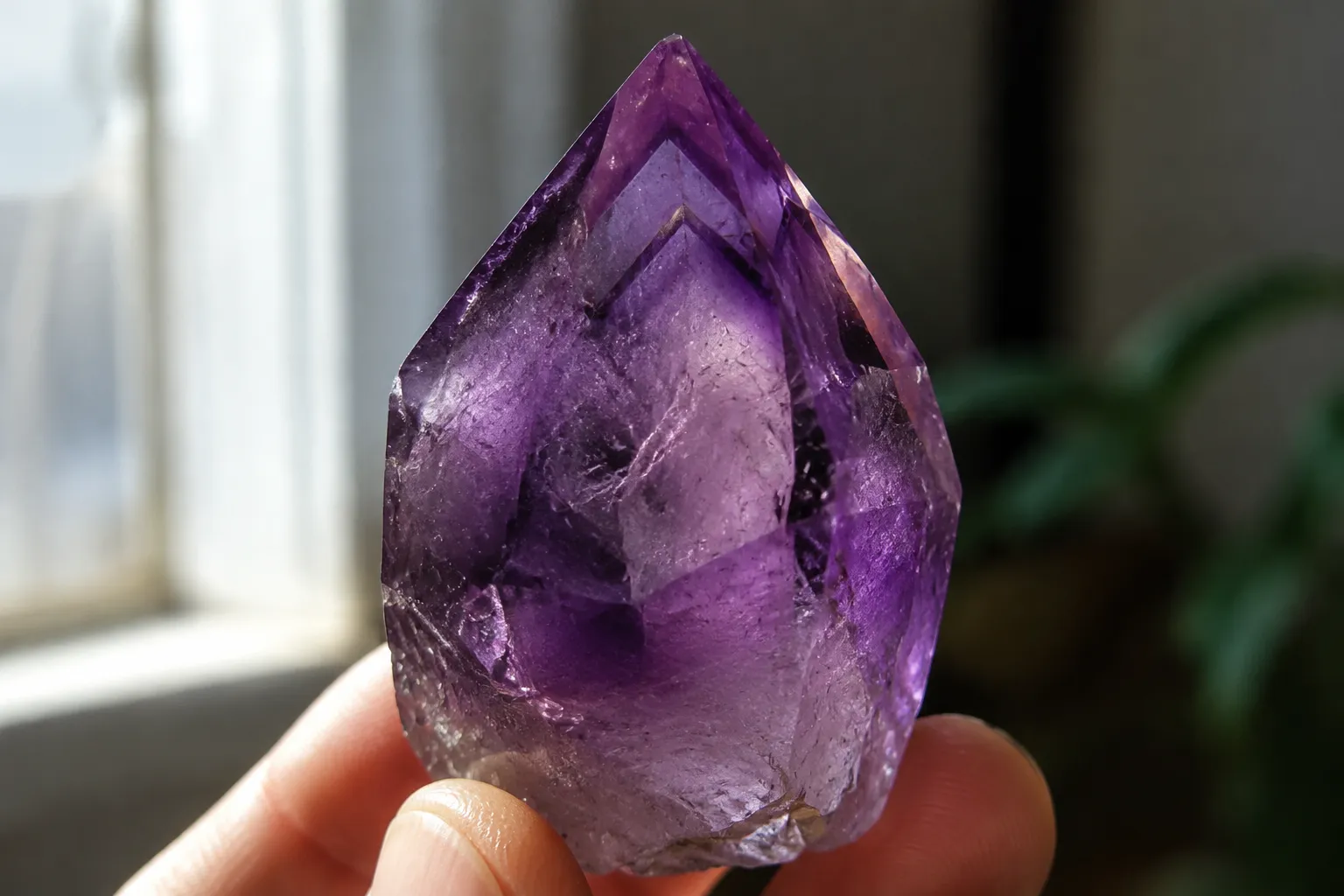
Hold the amethyst point to light and look through the crystal body, not only across the polished surface. Amethyst Color Zoning is useful when you can see darker and lighter purple inside the quartz, often in angular zones, chevron-like bands, or patchy areas that seem to follow the crystal’s growth.
That is the 10-second test: visible zoning gives you a reason to keep inspecting a natural crystal point with interest. It does not prove that the specimen is natural, untreated, non-synthetic, undyed, or valuable. It is a quick visual screen, not a final identification.
broader context
Begin with the main amethyst page
This narrower page lands better after the broader amethyst context page.
What to Look For First
Start with ordinary light. Turn the point slowly and watch whether the purple changes inside the crystal as the angle shifts. Natural amethyst is purple quartz, and gemological references commonly describe amethyst as having angular zones of darker and lighter color. On a crystal point, those zones may look like slanted patches, triangular areas, stepped bands, or darker caps near the termination.
The practical check
- Hold the amethyst to light.
- Look for darker and lighter purple inside the crystal body.
- Notice whether the zones have angular edges or chevron-like direction.
- Compare internal color zoning with cracks, pits, chips, and exposed pale areas.
- Treat the result as a clue, not a verdict.
The strongest sign here is not “uneven color” by itself. It is internal angular zoning: purple that appears to belong to the crystal structure rather than sitting only on the surface. The test works best on transparent to translucent points. Very cloudy, coated, deeply saturated, carved, polished, or mounted pieces may hide the zoning or make it harder to read.
Why Angular Banding Helps
Color zoning can reflect uneven color development during crystal growth. In amethyst, darker and lighter purple may appear as angular color zones rather than one perfectly even wash. Mineral references also describe quartz as a material that can show color zones or mixed color varieties in a single crystal.
For a buyer or collector, angular banding is useful because it helps separate growth-related color from some surface-related concerns. A point with visible internal zones may deserve closer inspection than one whose purple appears mainly as a stain, coating, or color sitting in damaged areas.
The careful collector’s sentence is modest: color zoning can be consistent with growth-related color; it does not certify origin.
The limit matters. Color zoning does not settle authenticity. Synthetic quartz and synthetic amethyst can be difficult to identify by sight alone, especially when the material looks clean or lacks obvious diagnostic inclusions.
That distinction matters in shops and online listings. Phrases such as “natural growth lines,” “deep-to-light purple,” or “not perfectly uniform” may describe what the seller sees, but they do not replace disclosure, return terms, provenance, or gemological evaluation when the purchase has real stakes.
Dye Clues Are a Different Pattern
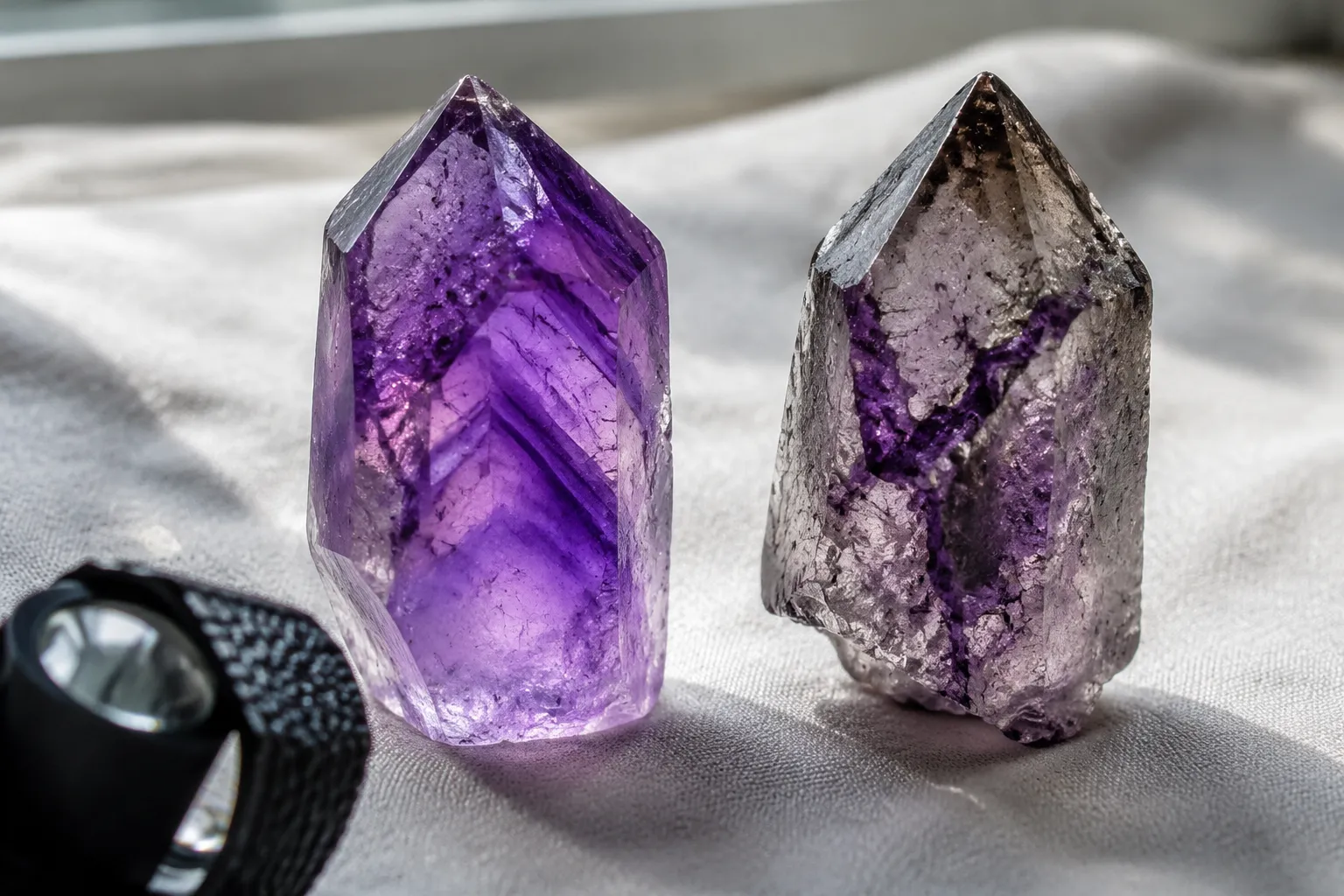
Dye suspicion usually comes from a different visual behavior. Instead of angular zones inside the crystal, look for purple concentrated in cracks, pits, rough texture, or around pale exposed material. A dyed pale quartz or altered decorative piece may show color where liquid could settle, especially in fractures or damaged areas.
That does not mean every dark crack is dye. Natural fractures, veils, inclusions, iron staining, dirt, and lighting can complicate a fast look. The pattern is still useful:
What you see
What it may suggest
How much weight to give it
Internal angular color zones
Possible growth-related color zoning
Useful visual clue
Chevron-like darker and lighter purple
Possible zoning following crystal structure
Useful visual clue
Purple concentrated in cracks or pits
Possible dye or surface-related color
Reason for closer inspection
Pale material exposed under purple surface color
Possible coating or dye concern
Reason for caution
Perfectly uniform purple
Not enough information by itself
Do not call it fake from this alone
Uniform purple needs careful handling. In faceted amethyst, strong even color can be desirable. A crystal point may also look uniform because of deep saturation, lighting, size, polish, or limited transparency. Uniform color gives you less zoning information; it is not an automatic answer.
Avoid making dye suspicion destructive. Scratch checks can damage a specimen, and solvents can affect coatings, fills, adhesives, labels, finishes, mounting materials, or dyed surfaces. Careful observation under light and magnification is the better first step for a point you plan to keep, sell, display, or compare.
When the Test Misleads
The 10-second test is useful because it is fast. It is limited for the same reason.
A point can show visible zoning and still need further verification. Treated material, synthetic material, or a misrepresented listing may still look convincing. A natural point can also look fairly uniform from one angle, especially if the color is deep, the crystal is cloudy, or zoning is hidden by inclusions or surface polish.
Lighting changes the read. Strong directional light may exaggerate zones. Dim room light may flatten them. A purple background, colored shelf, or warm lamp can make pale areas look richer. If you are comparing two points, use the same light source and viewing angle before drawing conclusions.
There is also a vocabulary trap. Buyers often search for “natural growth lines,” but not every line inside a crystal is a growth line. Some lines may be fractures, veils, phantom growths, inclusions, or surface marks. Those features can be interesting, but they do not all say the same thing about origin or treatment.
Use the result to decide what comes next
- If the zoning is internal, angular, and consistent with the crystal body, keep inspecting with reasonable interest.
- If the purple gathers mainly in cracks, pits, or damaged areas, slow down and ask better questions.
- If the price, claim, or dispute is significant, visual inspection is not enough.
- If the point is for decor or spiritual symbolism, keep personal meaning separate from material certainty.
That last distinction belongs with amethyst. A point can be beautiful on a shelf or meaningful in a mindfulness setting even when its origin is not fully known. Symbolic use does not require stronger geological claims than the specimen can support.
Common Color Patterns on Points
Some amethyst points show a darker purple termination and a paler base. Others show angular windows of deeper and lighter purple through the body. Some have smoky zones, milky areas, or phantom-like internal shapes that make the color distribution more complex. These patterns fit within the broader variation of quartz, but each specimen still needs its own reading.
Chevron-like zones are often the easiest for a beginner to notice. They may look like angled bands or nested shapes pointing toward the tip. Patchy zoning can be less tidy; color may sit more strongly on one side of the point or appear uneven across faces.
The best buyer’s question is not “Does this prove it is natural?” A better question is: “Does the color behave like something inside the crystal, or like something added to the surface or trapped in damage?”
That keeps the test useful without asking it to carry more certainty than it can.
What This Test Can and Cannot Tell You
The 10-second color zoning test can help you notice a promising natural-looking feature in an amethyst point. It can help you slow down when color looks surface-heavy, pooled, or oddly concentrated in cracks. It can also help you ask sharper seller questions: Is the piece sold as natural amethyst? Are dye, coating, heating, or other treatments disclosed? Are there clearer photos in transmitted light?
It cannot confirm the specimen’s full history. It cannot grade value. It cannot rule out synthetic quartz. It cannot show that a pale point was never dyed or that a richly colored point was never treated. It also cannot turn a decorative crystal into a guaranteed rarity.
A careful collector can still use it well. Hold the point to light, look for internal angular zones, compare them with surface dye clues, and keep the conclusion modest. The point in your hand remains a specimen first; its beauty, display presence, or spiritual symbolism may matter, but the material claim should stay tied to what the crystal actually shows.