Origin-tracing protocol
Geochemical Fingerprinting: The Ultimate Protocol for Tracing Crystal Origins
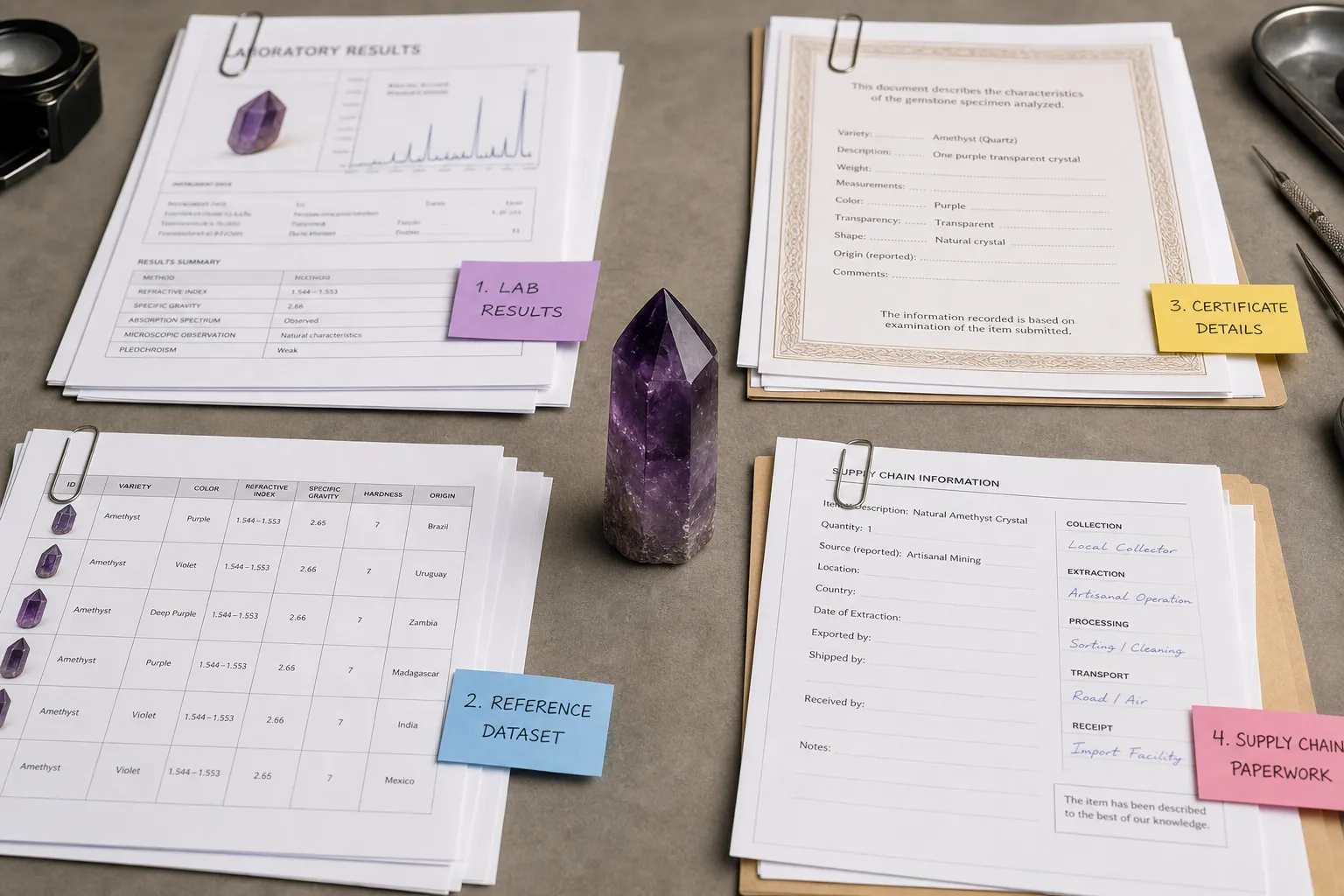
Geochemical Fingerprinting is a cautious comparison method for origin questions, not a standalone answer to where a crystal came from. In a well-supported case, a laboratory analyzes measurable chemical features in a sample, compares the pattern with documented reference material, and asks whether the crystal is consistent with a stated geological source.
For crystal buyers and collectors, the practical answer is narrower: geochemical evidence may support an origin claim only when the testing method, reference dataset, sampling history, and supply chain context are visible enough to evaluate. Without those pieces, it should not be used to confirm an exact mine, ethical status, market value, or complete trade history.
broader context
Broader amethyst guide
This narrower page lands better after the broader amethyst context page.
The Protocol in Plain Terms
A careful origin-tracing question sounds like this: “Does this crystal’s measured composition fit a documented source closely enough to support the stated origin?” That is different from asking whether the specimen looks right, whether a certificate sounds official, or whether a seller’s description feels plausible.
At a conceptual level, the process has four parts.
Relevant chemical analysis
The sample needs chemical analysis that is relevant to origin. The available source set for this page does not support naming one required instrument or universal workflow, so the important point is the principle: the measurement has to produce origin-useful information, not merely identify the broad mineral category.
A comparison structure
Terms such as elemental abundance and ratio matrices usually point to this step. In plain language, the question is often not one element by itself, but a pattern across several measured components. A ratio-based comparison can be useful only when the method is appropriate for the mineral and locality being discussed.
Reference data from known sources
This is the heart of geochemical origin work. A chemical signature has provenance value only if it can be compared with reliable material from documented localities. Thin, vague, or poorly described reference sets can make a match look stronger than it is.
Provenance records beside chemistry
Chemistry may speak to geological consistency. Mine paperwork, custody records, invoices, lot tracking, and exporter documentation speak to movement through trade. Neither evidence type automatically replaces the other.
What Makes an Origin Claim Stronger?
A stronger origin claim is layered, not dramatic. It does not rest on phrases like “lab confirmed” or “source proven.” It shows how the conclusion was reached.
Useful evidence would usually include:
- A clear description of the exact sample tested.
- Laboratory method documentation that explains the type of measurement.
- Reference data from known geological sources, not only broad regional labels.
- A comparison framework that explains why the measured pattern matters.
- Wording that states uncertainty and limits.
- Supply chain documentation kept separate from the chemical result.
The reference dataset deserves special attention. If a crystal is compared against only a narrow group of known samples, the conclusion can only speak within that narrow group. “Consistent with Source A” is not the same as “from Source A,” especially if similar deposits were not included in the comparison.
Sampling also matters. A specimen may have zoning, inclusions, coatings, repairs, attached matrix, or surface contamination. If the sampling plan is unclear, the measurement may reflect something other than the crystal’s growth environment. That does not make testing useless; it means sampling details are part of the evidence, not a footnote.
Geological overlap is another limit. Different deposits can share similar elemental abundance patterns, especially when they formed under related conditions. In those cases, the most responsible answer may be “consistent with,” “not distinguishable from,” or “insufficient reference coverage,” rather than a neat mine-level attribution.
Where Crystal Market Language Gets Slippery
Crystal listings often use origin language more loosely than a laboratory report would. A description may name a country, mine, family source, old collection, ethical sourcing claim, or certificate-style note. Those details can be useful prompts for questions, but they are not all the same kind of evidence.
Visual identification
A visual identification can describe color, habit, transparency, matrix, or broad mineral category. It cannot, by itself, establish a defensible chemical match to a specific locality.
Seller provenance
A seller provenance claim may describe where the seller believes the crystal came from. Repetition across listings does not make that claim stronger.
Certificate language
A certificate may record a commercial statement, a gemological observation, or a chain-of-sale note, depending on who issued it and what was examined. Without method details, it should not be read as a geochemical origin result.
This distinction is not meant to make collectors cynical. A specimen can still be valued for beauty, form, locality story, symbolism, or display presence. But when the question is “Can this origin be traced?”, the evidence bar is different from the bar for appreciation.
Translate market wording into testable questions
- “Brazilian amethyst” becomes: What record supports that country attribution?
- “From a specific mine” becomes: Is there reference material from that mine, and was this sample compared with it?
- “Ethically sourced” becomes: What supply chain documentation supports that claim apart from mineral chemistry?
- “Lab tested” becomes: What exactly did the lab test, compare, and conclude?
What Geochemical Fingerprinting Cannot Do Alone
Geochemical fingerprinting cannot carry claims that belong to the whole supply chain. Even a careful chemical comparison does not show who mined the crystal, how workers were treated, whether export paperwork was complete, whether lots were mixed, or whether a seller’s story is complete. Those are provenance and traceability questions as much as mineral-composition questions.
It also should not be framed as a universal fraud screen. A chemical pattern may challenge or support an origin statement under the right conditions, but the available material for this page does not support broad accuracy claims across the crystal market.
Mine-level attribution is especially demanding. A country-level or region-level comparison already depends on strong reference data. An exact mine claim requires enough coverage to distinguish that mine from nearby or geologically similar sources. If that coverage is missing, the honest answer may be that the sample cannot be assigned that precisely.
Origin is also separate from other questions collectors may ask. A crystal might be natural, treated, synthetic, altered, misidentified, or accurately represented in some ways but not others. Geochemical comparison, when properly supported, may relate to origin. It should not be stretched into a single answer for identity, value, treatment history, ethical status, and trade documentation.
That is the real meaning of an “ultimate protocol” here: not the boldest claim, but the clearest chain of evidence.
How to Read an Origin Report or Claim
When a crystal origin claim mentions chemical testing, do not start with belief or dismissal. Read it in layers.
Start with what was measured
If the report only says “tested,” “analyzed,” or “lab confirmed” without explaining the nature of the measurement, it may not support a specific origin statement.
Look for the comparison basis
A result has more meaning when it states what the sample was compared with. “Consistent with known material from a stated locality” is clearer than “matches the origin,” but it still needs context: How broad was the reference set? Were similar deposits included? Was the comparison specific to this mineral type?
Check the conclusion wording
Careful technical language leaves room for uncertainty. A restrained conclusion may be more credible than an overconfident one. Phrases such as “consistent with the tested reference material” or “not sufficient to distinguish between these sources” may sound less satisfying, but they are closer to how evidence-limited origin questions should be handled.
Separate geological origin from trade history
Chemical comparison may speak to source consistency. It does not document every hand the crystal passed through. For supply chain questions, look for custody records, lot tracking, invoices, mine or exporter documents, and other provenance frameworks.
A simple collector checklist
- What exact crystal or sample was tested?
- What kind of chemical information was produced?
- What reference dataset was used?
- Does the conclusion state uncertainty?
- Is the claim regional, mine-specific, or broader than the data supports?
- Is supply chain documentation presented separately from chemistry?
If those questions cannot be answered, the origin claim may still be interesting, but it should remain provisional.
The Bottom Line for Crystal Origins
Geochemical Fingerprinting can help crystal collectors think more clearly about origin because it moves the conversation from appearance and market wording toward measurable comparison. Its usefulness depends on conditions that are easy to overlook: suitable laboratory methods, relevant elemental abundance patterns, defensible comparison logic, strong reference datasets, careful sampling, and honest uncertainty language.
The safest interpretation is this: geochemical evidence may support an origin claim when the technical and provenance context is visible. It should not be treated as a standalone guarantee of exact mine source, ethical status, market value, or full supply chain integrity.
The strongest origin story is not the one with the boldest label. It is the one where the evidence can be followed, the limits are named, and the conclusion stays within what the material can support.