Amethyst care note
Full Moon Crystal Charging: Protecting Amethyst from UV Fading
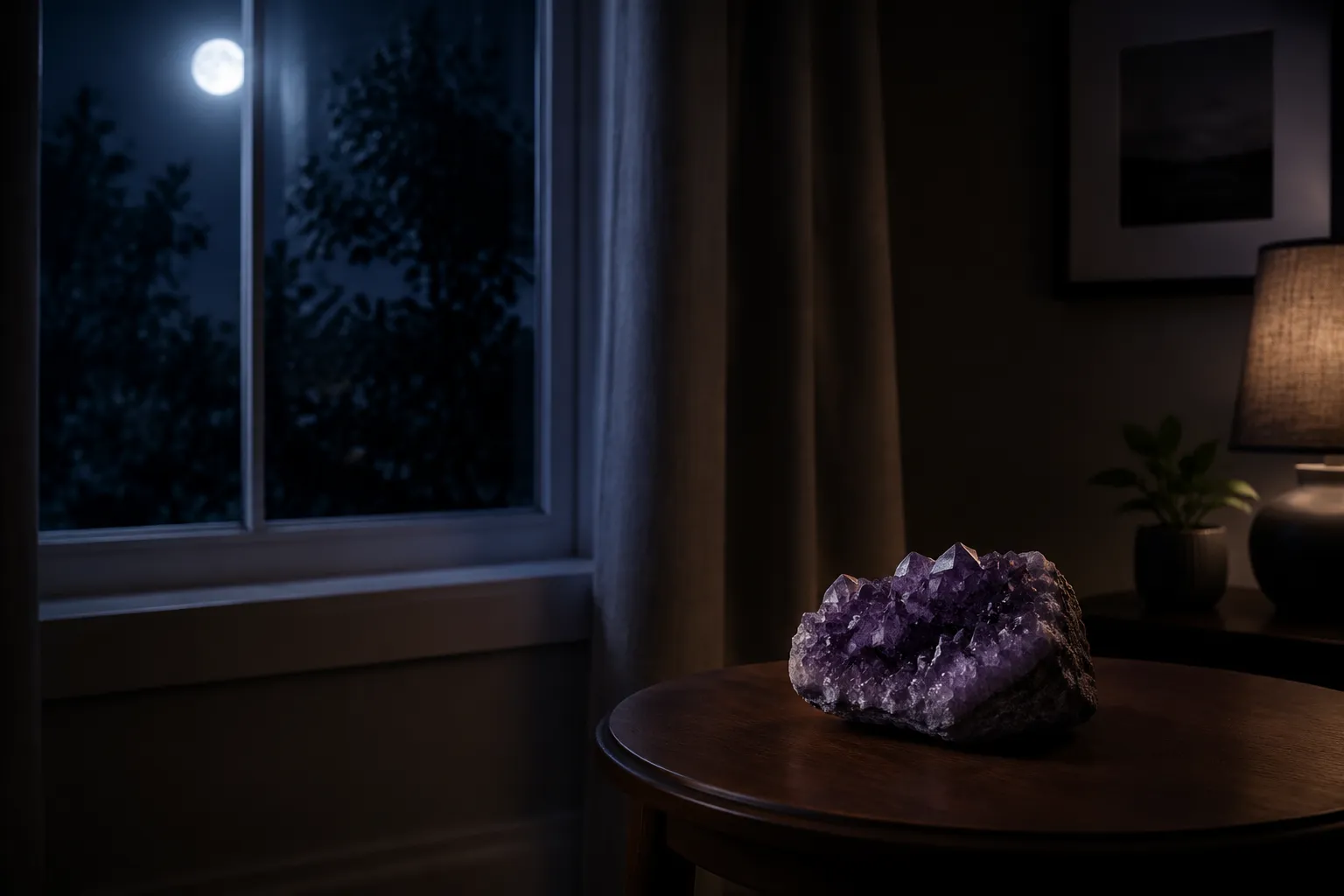
A violet amethyst cluster may look harmless on a nighttime windowsill, but the care question behind a full moon ritual is practical: how do you honor the moment without letting the crystal sit in bright light afterward? Treat Full Moon Crystal Charging as a personal or symbolic practice, not a documented physical change in the stone. Put the specimen out after dark if the ritual matters to you, then bring it back indoors before sunrise or before strong daylight reaches it.
That answer does not require knowing the exact light threshold for every amethyst. It simply avoids the preventable mistake: turning an overnight ritual into a daylong window display.
broader context
Broader amethyst guide
This narrower page lands better after the broader amethyst context page.
The practical answer for charging amethyst under moonlight
For amethyst crystal charging, the most careful routine is evening to before dawn. Set the crystal out after sunset, choose a shaded or covered spot if it will be outdoors, and retrieve it before morning light. If you use an indoor windowsill, choose one that will not catch direct sun at dawn. If you may forget, use a nearby table, tray, or altar instead of the glass.
Keep the two parts of the practice separate. The amethyst full moon ritual belongs to personal practice, spiritual crystal charging beliefs, and crystal charging tradition. The care limit belongs to the object itself: amethyst is valued for its purple color, and owners often worry about color change when crystals are left in strong light. Because no usable public reference sources were supplied for this page, this article should not claim a precise mechanism, exposure limit, or fading timeline. It can still give a conservative handling rule: do not let a symbolic nighttime practice become prolonged bright-light exposure.
Simple routine
- Put amethyst out after dark, not in late afternoon sun.
- Keep it away from spots that catch sunrise.
- Use a covered porch, shaded balcony, or indoor ritual surface if weather, dew, pets, or forgetting are concerns.
- Return the specimen to a stable display area before strong daylight.
- Treat the ritual as meaningful if it supports your practice, not as a guaranteed change in the crystal.
The main collector decision is not whether moonlight is “strong enough.” It is whether the ritual exposes the specimen to avoidable bright light before or after the moonlit period.
Why UV fading gets mentioned with amethyst
The amethyst color fading question usually appears around sunlight and amethyst fading, especially when a crystal lives on a windowsill. In everyday language, people often say “UV fading” because ultraviolet light is associated with color change in many materials. The more careful wording is narrower: for this page, prolonged bright-light exposure should be treated as a care concern, while the exact amethyst-specific pathway should not be overstated without stronger mineralogy or materials-science sources.
Technical terms such as Photodegradation, trace iron impurities, and color centers may appear in discussions about why some colored materials can change under light or heat. Here, they should stay in the background. They name the kind of mechanism a future source-backed explanation would need to support; they do not prove how every amethyst specimen will respond. Pieces vary in color zoning, depth of purple, treatment history, crystal habit, and display conditions.
That uncertainty is why the guidance stays plain. If a piece matters to you as a collector object, gift, or ritual stone, do not use it as a long-term sun catcher. Full moon charging guidance can be brief; bright light crystal care should be more cautious.
Overnight moon placement
Chosen for personal ritual meaning; keep it limited to nighttime.
Dawn window exposure
Easy to overlook; retrieve the crystal before direct daylight.
Direct sun display
Avoid as a routine habit for valued purple specimens.
Bright lamp or display case
Consider intensity and duration for long-term display.
Dark drawer or shaded shelf
More conservative for preserving appearance over time.
This table is not a lab threshold. It is a practical sorting tool for reducing unnecessary exposure.
A full moon ritual that respects the specimen
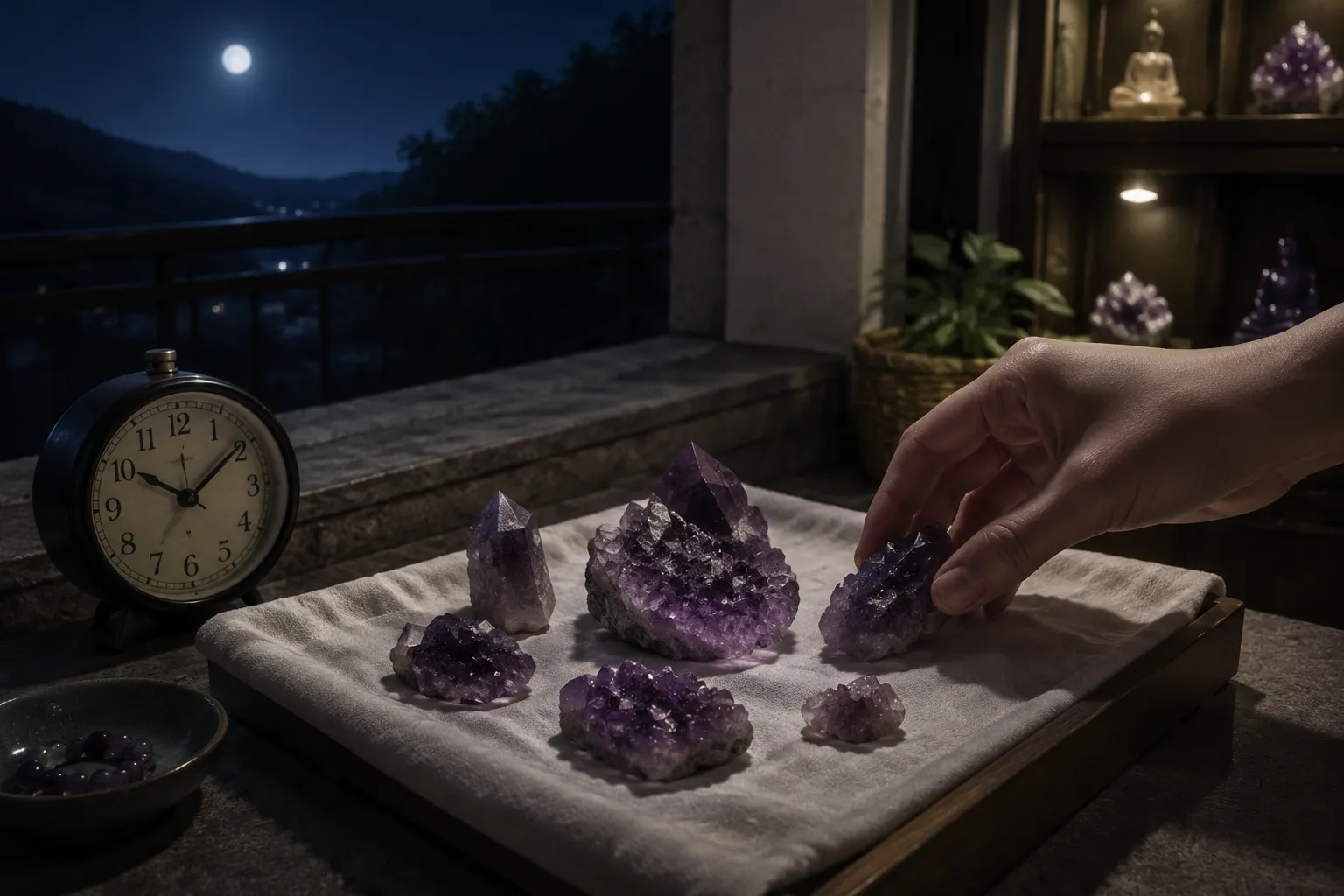
A careful amethyst full moon ritual can be quiet rather than elaborate. Decide where the crystal will go, how long it will stay there, and how you will remember to bring it back. A tray helps you move several pieces without repeatedly handling points or clusters. A soft cloth can protect polished pieces from scratches, though it should not be treated as part of a physical charging effect.
For outdoor placement, think like a caretaker before thinking like a ritualist. Avoid rain, sprinklers, soil, unstable ledges, and places where someone might step on the piece. If the crystal is a geode, cluster, or delicate point, do not place it where grit can lodge between crystals. If it is polished, avoid rough concrete or metal surfaces that could mark it.
For indoor placement, the best ritual surface may not be the brightest moonlit spot. A nearby table, shelf, or covered altar can preserve the timing without leaving the specimen pressed against glass. Moonlight and amethyst care do not need to become a test of exposure. If your practice values intention, timing, or quiet attention, those elements can happen away from the window.
Bounded routine
- In the evening, dust the surface and check the specimen for loose points or fragile edges.
- Place the amethyst on a tray or cloth in a shaded nighttime position.
- Keep ritual language personal, such as “I use this full moon as a moment of attention.”
- Bring the piece back before sunrise, or set a reminder if you may sleep past dawn.
- Return it to a shaded shelf, cabinet, or low-light display area.
This is not a claim that moonlight improves amethyst. It is a way to practice without ignoring the care limits of a colored mineral specimen.
Common confusion: moonlight, sunlight, and “charging”
The most common confusion is treating all light as the same. In ritual language, moonlight may feel gentle, reflective, or seasonal. In care language, the larger concern is avoidable exposure to strong light, especially when a crystal is forgotten in a window after the ritual. The practical problem is often not the full moon night; it is the morning after.
Another confusion is assuming that spiritual wording must be supported by mineral science. It does not. A person can use crystal charging as personal practice without claiming the amethyst has been measurably changed. That distinction protects both the ritual and the specimen. Spiritual symbolism can speak to attention, memory, atmosphere, or personal meaning; the crystal’s material care still depends on handling, display, light, moisture, and abrasion.
A third confusion is using technical terms too confidently. Saying that amethyst color may involve trace elements or color centers is not the same as proving a specific fading timeline for the piece in your hand. Saying Photodegradation can be relevant in light-sensitive contexts is not the same as proving that one full moon ritual will cause visible change. A careful owner does not need that certainty. They only need to avoid exposure they can easily prevent.
If you wonder whether a cloudy full moon “counts,” that is a ritual question, not a mineral-care question. From a care standpoint, clouds do not create a reason to leave amethyst out into the next day. If your tradition or personal habit treats the date, intention, or lunar phase as meaningful, keep the ritual short and return the crystal before bright morning light.
Where this article’s evidence stops
This page is intentionally narrow because the drafting materials did not include usable public sources, confirmed firsthand testing, or citable reference material. It should not make precise claims about UV exposure levels, exact fading speed, specimen-by-specimen response, laboratory-tested color stability, or measurable spiritual effects.
The useful boundary is simpler: if the color matters, limit bright-light exposure. If the ritual matters, keep it personal and time-bounded. If the specimen has collector value, unusual color zoning, sentimental importance, or uncertain treatment history, be especially careful about window placement.
The article should not tell you that your amethyst is protected because the moon was gentle, nor that one forgotten morning will definitely ruin it. Both statements are too strong without better evidence. The better standard is preventive care: avoid repeated conditions that create concern, especially when an easy alternative exists.
For display after charging, choose stable room light rather than direct sun. A shaded shelf, cabinet, bedside table away from the window, or low-light altar keeps the purple surface part of the room without turning it into a daily light experiment. That is enough for a leaf-level answer: short ritual, low bright-light exposure, modest claims.
Quick FAQ
Can I put amethyst in a window for Full Moon Crystal Charging?
You can if the window will not receive direct sun before you retrieve the crystal, but a nearby table is often the more careful choice. The ritual timing can remain the same without leaving the specimen against glass.
Does moonlight itself fade amethyst?
This page does not have enough citable evidence to make a firm claim about moonlight and fading. The practical care concern is avoiding prolonged bright light, especially sunlight after the ritual period.
Is crystal charging a proven physical change?
This article treats crystal charging as personal practice and spiritual symbolism, not as a documented physical result. You can value the ritual while still caring for amethyst as a colored mineral specimen.
A full moon can be part of a meaningful amethyst practice without asking the crystal to sit through sunrise. Keep the ritual brief, keep the claims modest, and return the specimen to a calmer place where its purple color, crystal habit, and personal meaning do not depend on unnecessary light exposure.