2026 outlook
The Future of Fakes: What to Expect from Synthetics in 2026
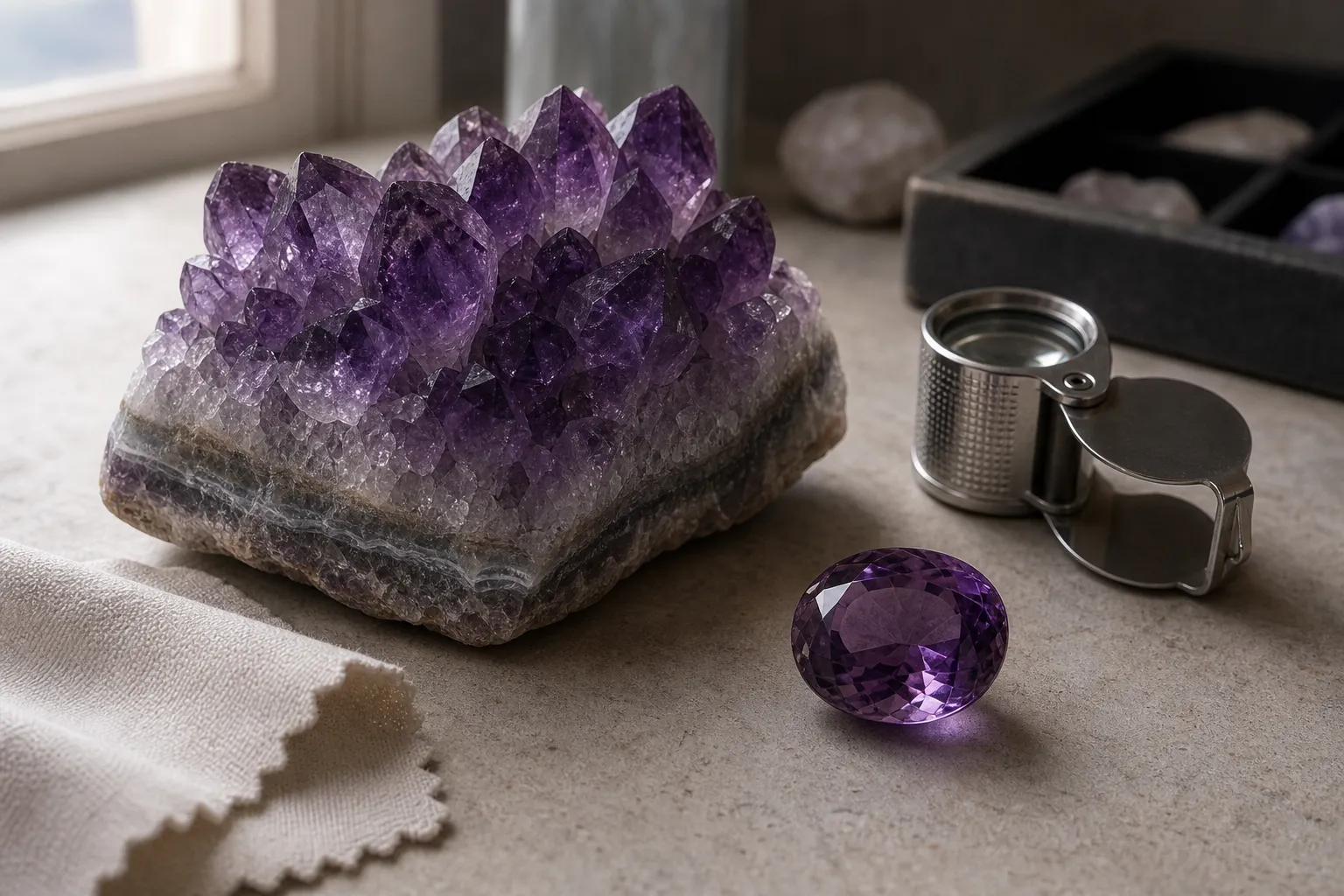
Color zoning, sharp purple saturation, and a clean crystal face can make an amethyst look persuasive before its history is clear. For ordinary buyers and collectors, the realistic answer is narrow but useful: future synthetic gems may keep authenticity questions active in 2026, but the available evidence does not support a confident prediction that synthetic amethyst will suddenly become common, newly dominant, or impossible for professionals to separate from natural material.
The practical posture is caution, not panic. Seller language, attractive photographs, and technical-sounding phrases such as “Russian synthesis” or “twinned synthetics” are not proof on their own. For higher-value amethyst, the safer next step is still professional gemological verification rather than a confident decision made from photographs or color alone.
broader context
Amethyst context note
This narrower page lands better after the broader amethyst context page.
What Buyers Can Reasonably Expect in 2026
“Future synthetic gems” sounds like a forecast, but this page has to stay closer to what can be supported. The available research packet does not include public gemological lab references, professional testing reports, standards documents, or credible market forecasts specific to synthetic amethyst in 2026. That limits the answer.
Collectors can still expect three practical things.
Listing concern remains active
Synthetic-gem concern will keep shaping how people read amethyst listings. A vivid purple stone, a decorative cluster, or a faceted gem described with confident origin language may raise questions even when no mislabeling has been shown. The concern is real as a buyer problem; it is not the same as evidence of a new wave.
Home identification stays uneven
Fake identification will remain uneven for non-specialists. A buyer can notice vague origin claims, inconsistent pricing, edited photographs, or sales copy that leans too hard on rarity. Those clues are reasons to slow down, not proof of synthetic origin.
Strong claims need support
Stronger claims need stronger support. If a seller, influencer, or broad market article says synthetic amethyst in 2026 is “exploding,” “undetectable,” “mostly Russian,” or “easy to spot by eye,” that claim needs confirmation from gemological laboratories, trade reporting, or transparent testing evidence.
For a collector, the short version is simple: treat 2026 as a year for better questions, not automatic suspicion.
Claims That Need More Proof
Some terms attract attention because they sound technical. “Twinned synthetics,” “Russian synthesis,” “evolving fakes,” and “future fake identification” can all appear important in a search journey. In the evidence available for this page, none comes with a usable public source, named laboratory result, or clear testing pathway. They should be treated as questions to investigate, not conclusions to repeat.
How to sort technical-sounding language
- Plausible but not established here: synthetic amethyst may be discussed alongside wider synthetic-gem concerns.
- Too specific without lab support: claims about national-origin synthesis, twinned synthetic material, or a particular 2026 manufacturing shift.
- Unsafe as buying certainty: shortcuts that promise easy detection from color, clarity, crystal habit, or price alone.
This matters because amethyst lives in more than one setting. It is a quartz specimen with observable features; it is also a purple object chosen for display, meditation space, or personal symbolism. Meaning can make a crystal feel important, but it does not verify origin. A calm purchase keeps those lanes separate.
If a specimen is inexpensive, decorative, and clearly bought for atmosphere, the evidence burden may be modest. If it is sold as rare, natural, untreated, locality-specific, or unusually valuable, the burden rises. That is where professional testing reports or credible gemological documentation become more than a nice extra.
Why Visual Identification Has Limits
Many buyers want one visible clue: a pattern in color zoning, a type of inclusion, a glassy surface, or a purple that looks too perfect. The available material does not support a simple rule like that. Even when visible features matter in gemology, they usually work as part of a broader assessment, not as a single home test.
Appearance can still guide caution. A specimen with no scale, heavily edited photographs, unclear origin language, or claims that outrun its price deserves a second look. A faceted amethyst sold with a premium story but no documentation also deserves restraint. These are buying signals, not identification results.
The two mistakes to avoid
- Trusting every beautiful purple stone because it feels natural.
- Rejecting every clean, vivid, or symmetrical specimen because it looks “too perfect.”
Neither response is reliable without better evidence.
A useful collector habit is to ask what the claim requires. If the claim is “decorative purple quartz for a shelf,” the question is mostly about appearance, price comfort, honest labeling, and care. If the claim is “natural amethyst of special rarity,” the question becomes authenticity, treatment history, origin language, and whether a lab or knowledgeable professional can support the description.
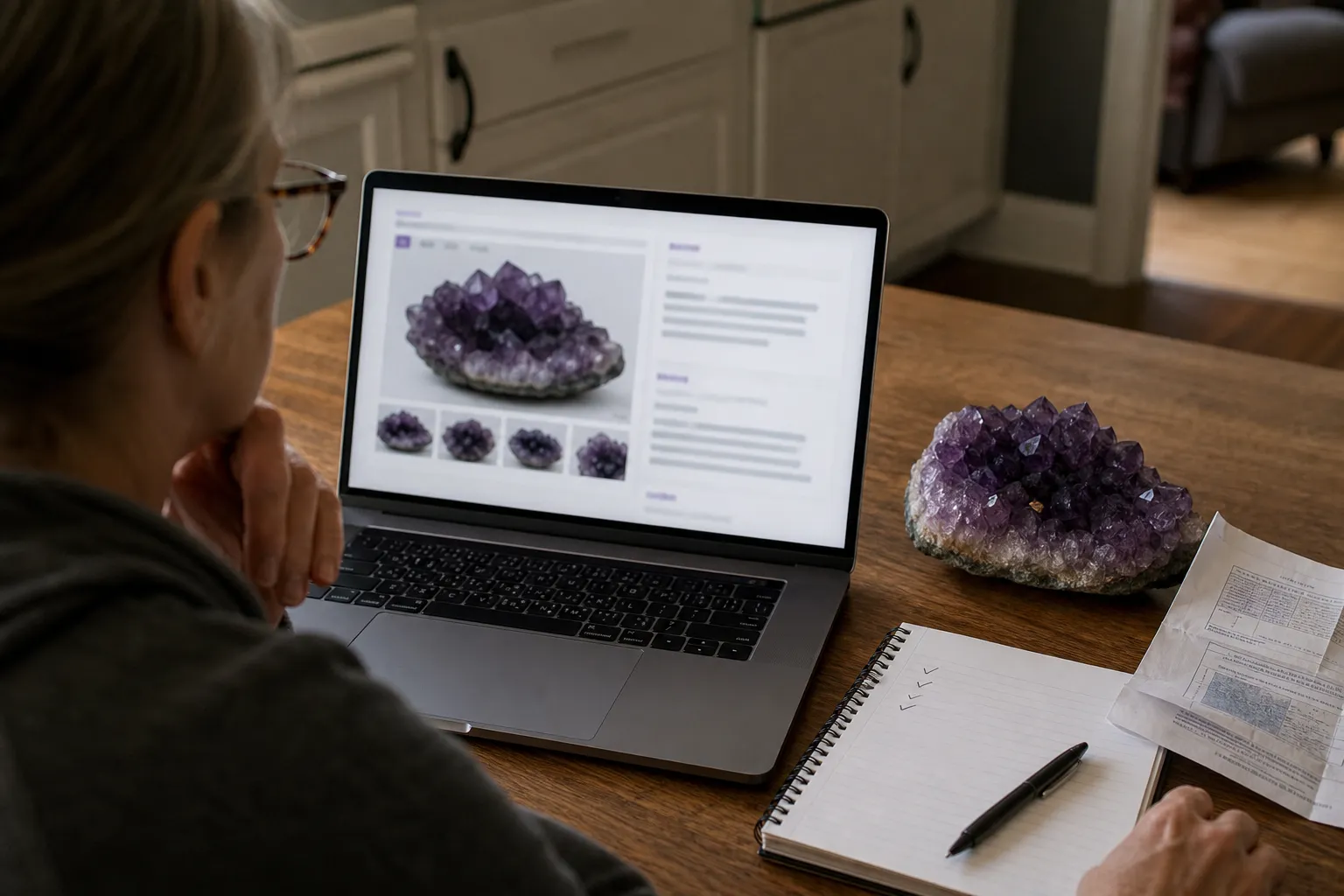
Online listings may make future fake identification feel more complicated because they compress evidence into photographs and short descriptions. From the material available here, though, it would be too strong to say detection has become definitively easier, harder, or transformed for 2026.
Where Market Prediction Gets Weak
Market prediction is tempting because it offers a clean story: more synthetics, fewer natural stones, rising risk, falling trust. This article does not have selected synthetic gems market forecasts, trade-body evidence, or credible professional reporting to quantify that story. A responsible 2026 outlook should not pretend otherwise.
That does not mean buyers should ignore the issue. It means the question should move from drama to evidence:
- What exactly is the seller claiming about natural origin?
- Is the price consistent with the proof offered?
- Does the listing distinguish natural, synthetic, treated, dyed, assembled, or imitation material?
- Is there a report, receipt, lab note, or professional opinion attached?
- Would the purchase still make sense if the claim were less special than advertised?
These questions keep the decision grounded. They also prevent one dramatic prediction from controlling the whole purchase.
For spiritually curious readers, this caution has another benefit. If amethyst is chosen for a quiet room, a reflective practice, or a certain atmosphere, the object does not need inflated rarity language to matter. But if a seller charges for rarity or natural origin, symbolic value should not replace material evidence.
What Would Change the Answer
The answer could become more definite if better evidence appears. A future update would need sources such as gemological lab articles, standards-body guidance, peer-reviewed mineralogical or materials research, professional trade reporting with named authors, or transparent firsthand testing from non-affiliate specialists.
Those sources could clarify whether synthetic amethyst trends are changing, whether certain synthesis descriptions are being misused, and how professionals are separating natural from synthetic material. Until that evidence is visible, the answer stays cautious.
What this page cannot confirm
- It cannot confirm that Russian synthesis is a defining 2026 issue.
- It cannot confirm that twinned synthetics are a common buyer-facing problem.
- It cannot confirm that ordinary buyers can identify related synthetic fakes by eye.
- It cannot confirm that synthetic amethyst is newly flooding the market.
A stronger evidence base would answer more specific questions:
- Which synthetic quartz or amethyst materials are actually appearing in gem trade channels?
- What features are laboratories using to separate natural and synthetic specimens?
- Are mislabeling cases increasing, or are buyers simply more aware?
- Which claims appear in professional testing reports rather than seller descriptions?
- Are forecasts about synthetic gems specific to amethyst, or only broad claims about the gem market?
Those distinctions matter. A broad forecast about laboratory-grown gems does not automatically describe amethyst. A technical synthesis discussion does not automatically prove consumer mislabeling. Scientific-sounding seller language does not create gemological authority.
A Practical 2026 Buying Posture
For ordinary buyers and collectors, the best 2026 posture is layered judgment.
Start with the purpose of the piece
A small display cluster, a tumbled stone, or an altar-shelf crystal may be purchased for color, mood, and personal symbolism. In that setting, the buyer still deserves honest labeling, but the decision may not require the same proof as a high-priced faceted gem or locality-claimed specimen.
Then look at claim density
The more a listing leans on words such as natural, rare, untreated, old stock, Russian, laboratory, museum-grade, or investment-style language, the more evidence it should carry. Strong words should come with strong documentation.
Know when to step outside your own eye
If authenticity affects price, collection value, resale expectations, or trust in the seller, professional gemological verification is the conservative route. It does not turn every purchase into a lab project; it recognizes that some claims exceed what photographs and casual inspection can support.
Care and display still matter. However the stone is represented, amethyst is often chosen for its purple presence in a room. Keep it away from careless handling, harsh display assumptions, and overheated claims. Let the specimen be beautiful without making it carry more certainty than the evidence gives.
Short Answers to Remaining Buyer Questions
Are synthetic amethyst concerns more important in 2026?
They may be more visible in buyer conversations, but the available material does not support a firm market prediction. Treat the concern as a reason to ask for evidence, not as proof that every vivid amethyst is suspect.
Can ordinary buyers identify future fakes at home?
Not with certainty from the evidence available here. Buyers can notice weak documentation, vague wording, and overconfident claims, but definitive identification should be left to qualified gemological assessment when the purchase warrants it.
Should spiritual or decorative buyers worry less?
They can keep the risk in proportion. If the purchase is mainly for color, atmosphere, or personal symbolism, documentation may matter less than honest pricing and clear labeling. If the seller charges for natural rarity, the evidence standard should rise.
In 2026, the wisest amethyst habit is to let beauty invite attention and let evidence decide claims. A purple crystal can still belong on a shelf, in a collection tray, or beside a quiet practice without becoming a certainty machine. Natural origin, synthetic possibility, care, rarity, and symbolism each ask for a different kind of judgment; a careful buyer does not need panic, only the discipline to keep those judgments apart.