Gem identification note
Spotting the “Breadcrumbs”: Identifying Synthetic Growth Markers
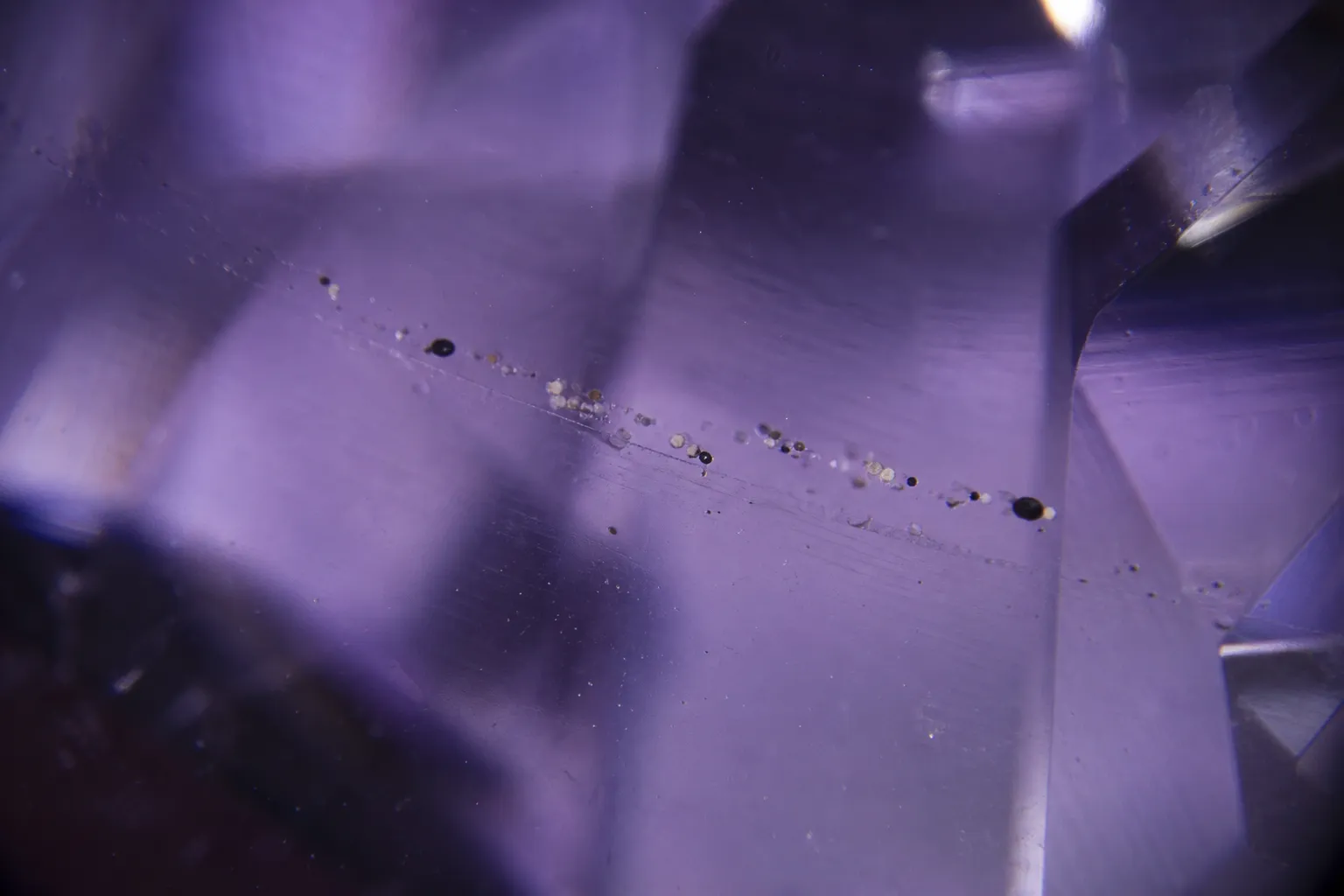
Breadcrumb-like trails can be useful warning signs, but they do not prove a gem is synthetic on their own. In practical viewing, synthetic inclusions should be read as part of the whole inclusion scene: pattern, spacing, repetition, position, host material, and nearby growth features all matter.
A line of tiny dots, residue-like particles, or dark specks may deserve closer inspection when it looks organized, repeated, or tied to a growth boundary. The same-looking speck, seen alone, may mean very little. For valuable amethyst, quartz, sapphire, ruby, emerald, spinel, diamond, or other gems, a natural-versus-synthetic call needs broader gemological evidence, not a one-feature verdict.
broader context
Amethyst context note
This narrower page lands better after the broader amethyst context page.
What “breadcrumb inclusions” usually means
“Breadcrumb inclusions” is not a universal laboratory term with one fixed definition across all gem types. In collector and consumer language, it usually describes a visual impression: tiny particles, dots, crumbs, or broken-looking bits that seem to form a trail inside a stone.
Under magnification, a breadcrumb-like feature might look like:
- a dotted line following a growth direction;
- tiny grains gathered near an internal boundary;
- a row of specks that appears unusually orderly;
- particles collected near a plane, layer, or interface;
- residue-like material close to a suspected growth zone.
The important word is “like.” A breadcrumb-like trail describes appearance, not origin. It may be consistent with synthetic growth in some settings, especially when other clues point the same way. It can also be confused with natural mineral inclusions, healed fractures, liquid veils, treatment features, surface-reaching debris, or reflections from polishing and facet edges.
Professional gemology treats inclusions as evidence because they can preserve clues about growth, treatment, and formation history. But those clues are interpreted by gem type. A dark dot in ruby is not the same evidence as a dark dot in synthetic diamond, and a line of particles in quartz-family material is not automatically comparable to one in corundum or beryl.
Four visual clues worth slowing down for
When people ask about breadcrumb synthetic inclusions, they are usually trying to understand one of four things: breadcrumb-like trails, possible flux remnants, seed-plate-related traces, or dark particles. Each can be useful. None should be treated as proof by itself.
1. Breadcrumb-like trails: look for pattern, not just dots
A few scattered dots are common in many stones. What makes a trail more interesting is organization.
Ask:
- Do the particles follow a line, curve, plane, or growth zone?
- Are they grouped at similar spacing?
- Do they sit near a boundary between two internal areas?
- Are similar trails repeated elsewhere in the stone?
- Does the surrounding crystal look unusually clean compared with the trail?
A trail becomes more suspicious when it seems connected to growth structure rather than randomly trapped material. Some synthetic growth environments can leave inclusions or residues along growth fronts, layers, or zones. Still, natural stones can also contain orderly-looking features. Crystals grow by rules, and fractures can heal in patterns.
A careful conclusion would be: “This trail deserves closer examination,” not “This trail proves synthetic origin.”
2. Flux remnants: residue-like clues from a growth medium
Flux-grown gems form in a molten growth medium that helps the crystal develop. In inclusion language, “flux remnants” refers to leftover-looking material associated with that environment. To a non-specialist, these may appear as small trapped bits, veils, droplets, or residue-like areas.
The difficulty is that “flux remnant” is an interpretation, not just a visual label. A viewer can notice something that looks like leftover growth material, but confirming what it is may require microscopy by a trained gemologist and, in some cases, additional testing.
Safer wording is:
- “There are residue-like inclusions.”
- “The particles appear grouped near a growth feature.”
- “The scene may be consistent with a synthetic growth process.”
- “This is not enough for a final origin call.”
Avoid jumping from “crumbly-looking material” to “flux-grown synthetic” unless the stone type and the rest of the evidence support that reading.
3. Seed plate residue: clues near a growth starting point
Many synthetic crystals are grown from a seed or substrate. In some hydrothermal synthetic materials, the seed plate or growth interface can leave visible clues. Research on hydrothermal synthetic red beryl, for example, has described strong growth structures and a seed plate in studied synthetic samples. That does not mean every synthetic gem will show a seed plate, or that every boundary-like feature is seed-related.
For a reader inspecting a stone, the practical question is not “Can I name the seed plate?” It is: “Is there an interface that looks structurally important?”
Look for:
- a straight or planar internal boundary;
- inclusions collected along one side of a boundary;
- growth lines that begin, stop, or change at an interface;
- a sharp change between a cleaner area and a more included area;
- repeated growth features aligned with the same plane.
This caution is especially useful in quartz-family material, including amethyst and citrine. Studies of regrown quartz from the jewelry market show that natural and synthetic portions can be visually confusing when synthetic quartz grows over natural quartz. Simple viewing may not be enough to separate the parts. A suspected seed or interface feature should therefore be treated as a clue, not a final answer.
4. Dark particles: sometimes important, often overread
Dark particles are easy to overinterpret. In some synthetic diamond contexts, studies describe black graphite inclusions or use inclusion chemistry and advanced methods to help separate natural from synthetic diamonds. That supports a narrow point: dark or opaque inclusions can matter in certain identification settings.
But dark inclusions also occur in natural gems. Research on natural rubies from Myanmar and Mozambique has examined opaque sulfide inclusions that may look broadly similar under magnification while differing chemically and mineralogically. In other words, a dark speck is not automatically a synthetic marker.
A dark particle becomes more meaningful only when the surrounding evidence supports it:
- Is it associated with a known synthetic growth structure?
- Is it repeated in a way that matters for that gem material?
- Does it appear with unusual growth zoning, an interface, or residue-like trails?
- Is the gem species one where that inclusion type has known diagnostic value?
- Has the inclusion been identified, rather than only described by color?
“Dark” is a color impression. It is not a chemical identification.

Read the whole inclusion scene
The most useful habit is to stop asking, “What is this one speck?” and start asking, “Does the whole internal scene make sense?”
A cautious inspection can follow five steps.
- First, locate the feature. Is it deep inside the stone, near the surface, along a crack, near a facet junction, or close to a color zone? Surface dirt, reflected facet edges, and polishing features can masquerade as internal inclusions.
- Second, describe the pattern before naming it. Words like dotted, grainy, clustered, veil-like, planar, repeated, isolated, cloudy, or boundary-following are safer than instantly calling something flux, seed residue, graphite, or synthetic.
- Third, compare the feature with the host gem. Synthetic ruby inclusions, synthetic sapphire inclusions, synthetic emerald inclusions, synthetic spinel inclusions, synthetic quartz inclusions, and synthetic diamond inclusions do not all follow one rule. Growth method and gem chemistry matter.
- Fourth, look for supporting features. One breadcrumb-like trail is weak evidence. A trail plus strong growth zoning, an interface-like plane, repeated residue-like clusters, and a consistent internal pattern is more meaningful.
- Fifth, decide why the observation matters. If you are simply learning, a cautious visual note may be enough. If the stone is expensive, disputed, being sold, insured, inherited, or represented as natural, visual inspection should lead to a qualified gemological assessment.
This approach protects both sides of the problem. It helps prevent a synthetic stone from being casually represented as natural, and it also helps prevent a natural included stone from being dismissed because of one misunderstood speck.
Common misunderstandings
“Synthetic means fake”
A synthetic gemstone is human-grown gem material. Depending on the gem species and growth process, it may have the same general material identity as its natural counterpart. That is different from an imitation, which only looks like another gem.
For amethyst and other quartz-family stones, this distinction matters. Synthetic quartz exists, treated quartz exists, natural quartz exists, and composite or regrown material can complicate the picture. The better question is not whether the stone is “real” in a vague sense. It is: what is the material, how was it formed or modified, and how is it being represented?
“Dark particles prove synthetic”
They do not. Dark particles in gems may be natural mineral inclusions, opaque sulfides, graphite-like material in certain synthetic contexts, trapped residues, or something else entirely. Without identifying the inclusion and reading its setting, color alone is too weak.
A black dot in a synthetic diamond discussion cannot be transferred as a universal rule to ruby, sapphire, emerald, amethyst, aquamarine, alexandrite, moissanite, spinel, citrine, or opal.
“Included means natural”
Synthetic gems can contain inclusions. Human-grown gem materials are not always perfectly clean, and different growth methods can leave internal features. Some synthetic stones may show liquid veils, particles, growth zoning, seed-related clues, or other internal scenes.
An included stone may be natural, synthetic, treated, assembled, or regrown. The presence of inclusions tells you there is something to interpret. It does not supply the conclusion by itself.
“One visible marker can authenticate a stone”
A single visible feature may be enough to raise a question. It is rarely enough to settle origin. Depending on the gem, professional identification may combine microscopy with refractive index, specific gravity, fluorescence behavior, growth structure, spectroscopy, trace-element chemistry, Raman testing, photoluminescence, or other methods.
The point is proportionality. The more money, trust, resale value, or uncertainty involved, the less you should rely on a one-feature verdict.
When a breadcrumb-like trail should change what you do
A breadcrumb trail should change your behavior when it affects disclosure, value, or confidence.
If you see tiny particles arranged in a repeated trail, do not immediately reject the stone. Instead:
- note where the trail sits;
- check whether it follows a growth zone or internal boundary;
- look for other repeated or interface-related features;
- ask how the origin was determined;
- request documentation if the stone is represented as natural and valuable;
- seek a qualified gemological opinion when the answer matters.
For casual decorative pieces, the observation may simply help you understand the stone more honestly. For collector-grade amethyst, fine sapphire, ruby, emerald, diamond, or any gem whose price depends strongly on natural origin, the same observation becomes more consequential.
A fair final sentence for many cases is: “The inclusion scene is suspicious enough to verify.” That is stronger than ignoring the clue and more accurate than declaring the stone synthetic from a dotted trail alone.
The responsible takeaway
Breadcrumb inclusions, flux-like remnants, seed-plate-related traces, and dark particles are best understood as visual prompts. They tell you where to slow down, focus the microscope, and ask better questions. They do not replace gemological identification.
The most reliable reading comes from context: pattern, grouping, interface, repetition, host material, and consistency across the whole inclusion scene. If those features point in the same direction, synthetic growth becomes a reasonable possibility. If the evidence is isolated or ambiguous, keep the conclusion open. For valuable or disputed stones, let the breadcrumb trail lead to verification, not overconfidence.