Negative Crystals vs. Gas Bubbles: The Microscopic Difference
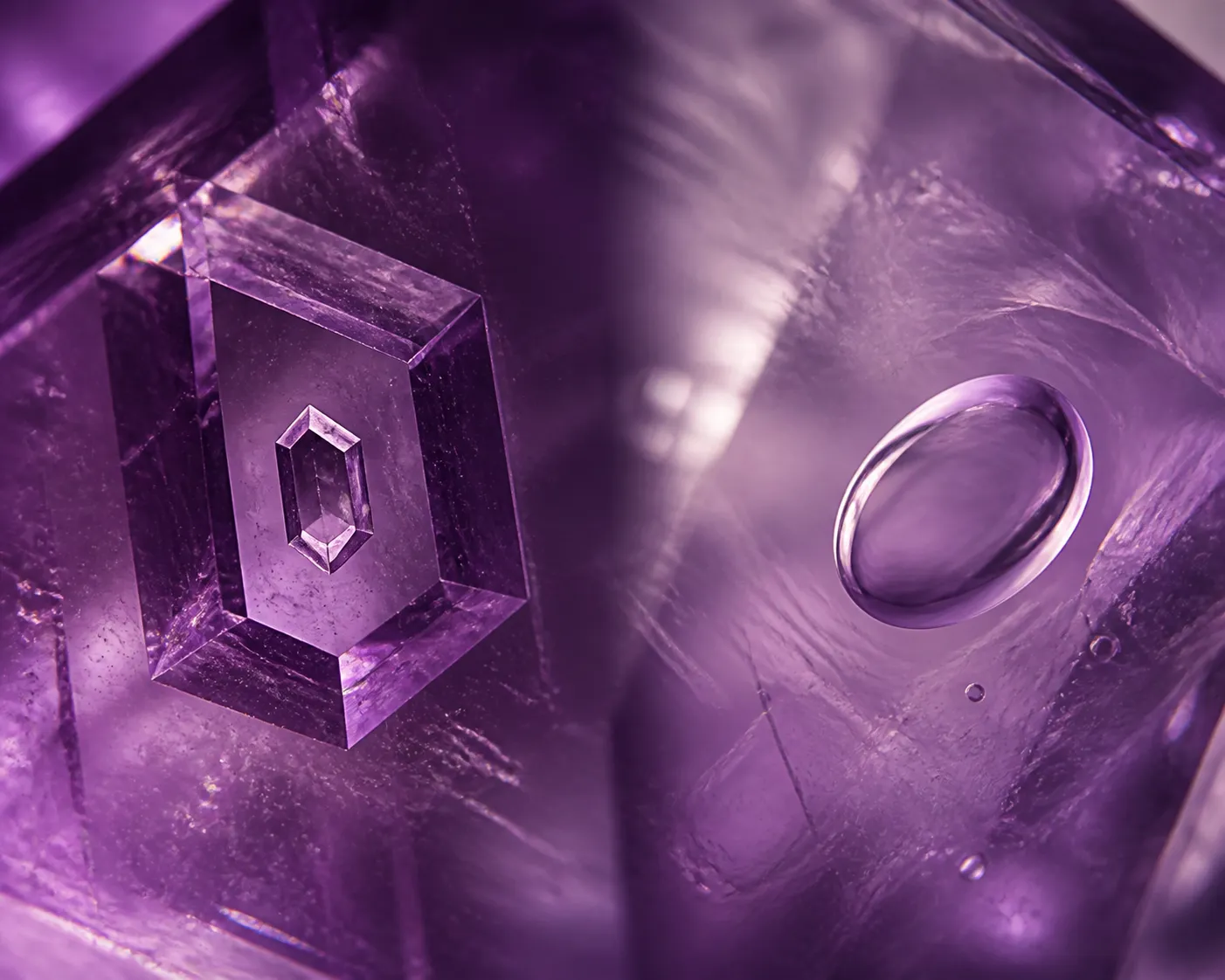
Under a 10X loupe, the quickest difference is shape. Negative crystals are internal cavities that often echo crystal geometry: angular outlines, flat-looking faces, corners, or a tiny crystal-shaped void inside the host. Gas bubbles usually look smoother and rounder—spherical, oval, bead-like, or softly edged.
In amethyst and quartz, an angular void is more consistent with a natural growth feature. A rounded bubble is more of a warning sign, especially in glass, plastic, or filling material. But “more consistent with” matters here. One tiny internal feature seen through one loupe does not identify the whole stone, establish treatment history, or settle value.
broader context
Amethyst context note
This narrower page lands better after the broader amethyst context page.
The visual difference: angular void versus rounded bubble
A negative crystal is not a little crystal growing inside another crystal. It is a cavity—sometimes empty, sometimes fluid-filled—whose outline may reflect the structure of the surrounding mineral. In quartz and other gemstones, these cavities can appear as tiny angular forms with flat planes, pointed ends, or a faceted outline.
A gas bubble is usually shaped more by trapped gas and surface tension than by crystal structure. That is why many bubbles look round, oval, or bead-like. When people mention gas bubbles in glass, they usually mean smooth rounded pockets trapped in manufactured glass or in a filling substance.
At loupe level, the comparison often looks like this:
This is where the internet rule “bubbles mean glass” becomes too simple. A rounded bubble can be a useful warning sign, especially when it appears with repeated round bubbles, swirls, or flow-like structures. But a bubble-like feature can also occur in filling material, and a gas phase can sit inside a natural fluid inclusion. An angular negative-crystal-like void is a useful natural-growth clue, but it is not a complete identification by itself.
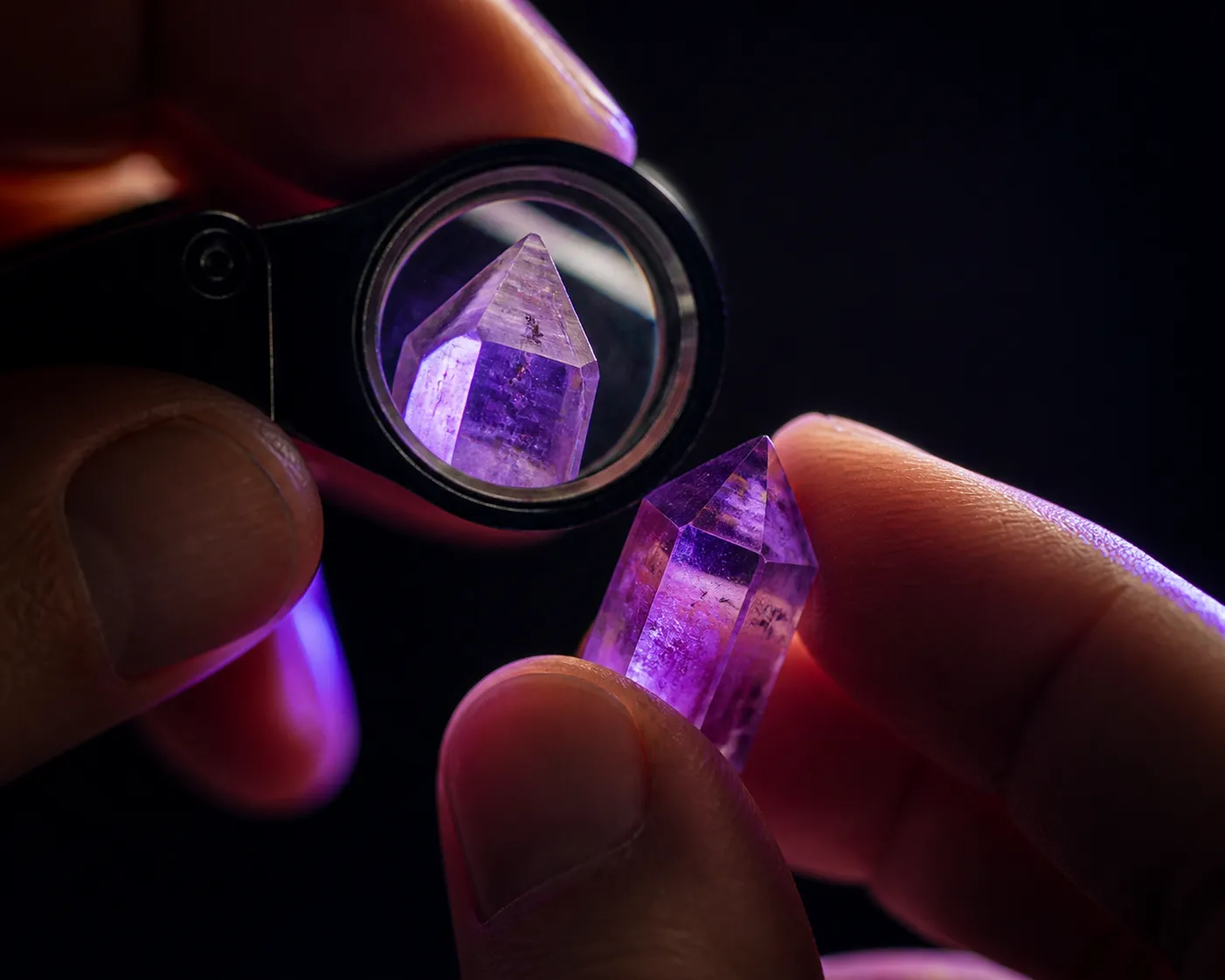
How to check the feature with a 10X loupe
A 10X loupe is a good first-pass tool for an amethyst or quartz collector. It can help you notice shape, edge quality, and placement. It cannot always tell you what the host material is, whether a feature is filled, or whether the stone has been treated.
Use the loupe to answer a few narrow visual questions:
- 1. Is the outline round or angular?
Rotate the stone slowly. A true rounded bubble tends to stay softly rounded from several angles. An angular cavity may reveal flat faces, corners, or a more geometric outline as the light changes. - 2. Are the edges sharp or soft?
Negative crystals often show more defined boundaries, especially when the cavity has flat-looking sides. A gas bubble usually has a smoother, more continuous edge. - 3. Does the feature sit alone or follow a fracture?
A bubble-like dot inside a crack, seam, or filled-looking area may be related to fracture filling. That is different from saying the entire specimen is glass. - 4. Are there many similar rounded bubbles?
A pattern of repeated round bubbles, especially with glassy flow structures, is more concerning than one ambiguous dot. - 5. Does the feature look truly internal?
Surface pits, chips, polishing marks, dust, and reflections can mimic inclusions. Change the angle and focus carefully before reading the feature as internal.
Lighting helps. Use a steady light source and a plain background. Some inclusions are easier to see with light entering from the side or against a darker background. The point is not to create sparkle; it is to see shape, depth, and context.
Why “bubbles mean glass” is useful but incomplete
The phrase “bubbles mean glass” survives because it often works as casual screening. Rounded gas bubbles and flow-like structures are reasonable warning signs when a specimen is being compared with natural quartz or amethyst. If an object sold as amethyst contains obvious round bubbles, a glass-like body, and swirl or flow patterns, skepticism is reasonable.
The problem is that the phrase turns a clue into a verdict.
A bubble-like feature does not always mean the whole stone is glass. Bubbles may occur in filling material. Fluid inclusions can contain both liquid and vapor. Negative crystals in gemstones may also contain liquid, gas, and sometimes solid phases. In quartz and amethyst, these features can be very small and may require more than a casual loupe view to interpret.
Rounded bubbles are a red flag, especially in a glass-like context. Angular negative-crystal-like voids are a natural-growth clue. Neither one is a stand-alone certificate.
That distinction matters because inclusion language is often overused. A seller may point to “inclusions” as evidence of natural origin, while a buyer may point to one rounded dot as evidence of imitation. Both readings can be too confident. Inclusions need context.
What changes the answer
The same tiny feature can look different depending on magnification, lighting, and where it sits in the stone.
Magnification quality.
A clean 10X loupe can reveal many useful clues, but fine internal shape may be too small or too deep to resolve. Higher magnification, especially with a binocular gemological microscope and controlled illumination, can make the outline clearer.
Host material.
A rounded bubble in manufactured glass means something different from a vapor bubble inside a fluid inclusion in natural quartz. The loupe view alone may not identify the host material.
Relationship to fractures.
Bubbles along a fracture or seam may suggest filling. That changes the question from “Is this quartz or glass?” to “Is there filling or another material in this area?”
Shape from multiple angles.
A flat-faced cavity may look rounded from the wrong direction. A bubble may look slightly distorted through curved or uneven surfaces. Rotation is essential.
Other clues nearby.
One dot is weak evidence. Repeated round bubbles plus flow lines, molded-looking surfaces, or glass-like swirls carry more weight. Likewise, an angular cavity seen with other natural growth features is more persuasive than one blurry corner.
A compact loupe checklist for amethyst and quartz
When you see a suspicious internal mark, keep the question small and visual:
- Shape: Is it angular and crystal-like, or smooth and rounded?
- Edges: Are the boundaries sharp, flat, or faceted, or soft and bead-like?
- Context: Is it inside the crystal body, along a fracture, or near a surface mark?
- Pattern: Is it one feature, a cluster, or many repeated round bubbles?
- Lighting response: Does rotation reveal flat faces, or does it stay round from most angles?
- Neighboring clues: Are there flow-like lines, filling flashes, healed fractures, or other inclusions?
- Confidence level: Is the view clear enough to say “more consistent with,” or only “uncertain”?
“Uncertain” is a valid result. Many microscopic features are not clean textbook examples.
When a microscope or gemologist is the better answer
A loupe is useful for screening. It is not a lab report. If the stone is inexpensive and the question is personal curiosity, careful loupe observation may be enough to decide whether a feature looks more like an angular void or a rounded bubble.
If the result affects a purchase, return, resale description, treatment claim, or higher-value specimen, a qualified gemologist or gem lab is the better next step. A microscope can better show whether the feature is truly internal, whether it has flat faces, whether it follows a fracture, and whether it belongs to a fluid inclusion, filling, glass, or another context. Other gemological observations may also be needed to identify the material itself.
Avoid scratch tests, heat tests, chemical tests, or other destructive home experiments. They can damage the specimen and still leave the question unresolved.
Quick clarifications
Is a negative crystal the same as a gas bubble?
No. A negative crystal is a cavity whose shape may reflect crystal geometry. A gas bubble is a rounded pocket of gas or a bubble-like feature. The terms can overlap in confusing ways because a negative crystal or fluid inclusion can contain a small gas phase.
Do bubbles always mean an amethyst is glass?
No. Rounded bubbles are a warning sign, especially when paired with glass-like flow structures or repeated bead-like inclusions. But bubble-like features can also occur in filling material or fluid-related inclusions. The whole context matters.
Can a 10X loupe identify a stone by itself?
Usually not. A 10X loupe can help you compare angular voids, rounded bubbles, fractures, and nearby clues. It should be treated as a screening tool, not a final identification method for valuable or disputed stones.
Is this the same as “negative crystals” in lab medicine searches?
No. This page is about mineral and gem inclusions in amethyst, quartz, glass-like specimens, and related materials. Similar wording appears in other scientific fields, but it refers to a different context and should not be mixed with gemstone identification.